
Enhancing Students’ Pollution Problem-Solving Skills Through Problem-Based Learning: The Moderating Role of Mathematical Literacy
DOI:
https://doi.org/10.58421/misro.v4i2.431Keywords:
Problem Based Learning, Ability solve pollution problems, Mathematical literacyAbstract
This study examines the effectiveness of the Problem-Based Learning (PBL) model in enhancing university students’ ability to solve environmental pollution problems, with mathematical literacy as a moderating variable. Conducted in Indonesia, the research adopted a quasi-experimental non-equivalent pretest-posttest control group design involving 64 biology education students from Universitas Pakuan. Participants were assessed using open-ended problem-solving tests and a rubric aligned with the PISA framework. Results from two-way ANOVA showed significant effects of the learning model (F(1, 58) = 32.84, p < .001, η² = .216) and mathematical literacy levels (F(2, 58) = 29.17, p < .001, η² = .201) on problem-solving performance. Although both groups improved by 18.75 points from the pretest to the post-test, the PBL group outperformed the control. Post hoc analysis (Tukey HSD) revealed that students with high mathematical literacy achieved the highest scores (M = 91.8, SD = 3.7), confirming its moderating effect. These findings underscore the value of integrating mathematical literacy into PBL to promote contextual learning and real-world problem-solving. Future studies should explore broader samples and longitudinal impacts across diverse educational contexts.
Downloads
References
R. Bick, E. Halsey, and C. C. Ekenga, “The global environmental injustice of fast fashion,” Environmental Health, vol. 17, no. 1, p. 92, Dec. 2018, doi: 10.1186/s12940-018-0433-7.
K. Schwab and X. Sala-i-Martín, “World Economic Forum (2017) The global competitiveness report 2017–2018,” in World Economic Forum, Geneva, 2020. doi: https://www3.weforum.org/docs/GCR2017-2018/05FullReport/TheGlobalCompetitivenessReport2017%E2%80%932018.pdf.
P. Lestari and Y. Trihadiningrum, “The impact of improper solid waste management to plastic pollution in Indonesian coast and marine environment,” Mar Pollut Bull, vol. 149, p. 110505, Dec. 2019, doi: 10.1016/j.marpolbul.2019.110505.
H. A. Adrianto, D. V. Spracklen, S. R. Arnold, I. S. Sitanggang, and L. Syaufina, “Forest and Land Fires Are Mainly Associated with Deforestation in Riau Province, Indonesia,” Remote Sens (Basel), vol. 12, no. 1, p. 3, Dec. 2019, doi: 10.3390/rs12010003.
M. Muslihudin, A. Nur Bambang, E. Hendarto, and T. Triadi Putranto, “The Process of People Gold Mining in Paningkaban Village Banyumas Indonesia,” E3S Web of Conferences, vol. 31, p. 09003, Feb. 2018, doi: 10.1051/e3sconf/20183109003.
I. Yani, R. Retnowati, and E. Suhardi, “Pengaruh Metode Pembelajaran Inkuiri Dan Kemandirian Belajar Terhadap Kemampuan Memecahkan Masalah Pencemaran,” 2024.
I. Ghozali, “Pendekatan scientific learning dalam meningkatkan prestasi belajar siswa,” PEDAGOGIK: Jurnal Pendidikan, vol. 4, no. 1, 2017, doi: https://doi.org/10.33650/pjp.v4i1.5.
H. L. TATA, B. H. NARENDRA, and M. Mawazin, “Forest and land fires in Pelalawan District, Riau, Indonesia: Drivers, pressures, impacts and responses,” Biodiversitas, vol. 19, no. 2, pp. 494–501, 2018.
H.-C. Chang, N.-Y. Wang, W.-R. Ko, Y.-T. Yu, L.-Y. Lin, and H.-F. Tsai, “The effectiveness of clinical problem-based learning model of medico-jurisprudence education on general law knowledge for Obstetrics/Gynecological interns,” Taiwan J Obstet Gynecol, vol. 56, no. 3, pp. 325–330, Jun. 2017, doi: 10.1016/j.tjog.2017.04.011.
E. S. Karnel and A. R. Purnomo, “Penerapan Model PBL untuk Meningkatkan Keterampilan Pemecahan Masalah pada Materi Pencemaran Lingkungan,” Jurnal Basicedu, vol. 8, no. 5, pp. 3621–3628, Aug. 2024, doi: 10.31004/basicedu.v8i5.8469.
M. Farhan, R. Satianingsih, and V. Yustitia, “Problem Based Learning On Literacy Mathematics: Experimental Study in Elementary School,” Journal of Medives : Journal of Mathematics Education IKIP Veteran Semarang, vol. 5, no. 1, p. 118, Jan. 2021, doi: 10.31331/medivesveteran.v5i1.1492.
G. Gök and G. Boncukçu, “The Effect of Problem-Based Learning on Middle School Students’ Environmental Literacy and Problem-Solving Skills,” J.Sci.Learn.2023, vol. 6, no. 4, pp. 414–423, 2023, doi: 10.17509/jsl.v6i4.62781.
A. S. Argaw, B. B. Haile, B. T. Ayalew, and S. G. Kuma, “The Effect of Problem Based Learning (PBL) Instruction on Students’ Motivation and Problem Solving Skills of Physics,” EURASIA Journal of Mathematics, Science and Technology Education, vol. 13, no. 3, pp. 857–871, Dec. 2016, doi: 10.12973/eurasia.2017.00647a.
A. Cahyadini, H. Isfaeni, and R. Komala, “The impact of problem-based learning and metacognition on solving environmental pollution issues,” JPBI (Jurnal Pendidikan Biologi Indonesia), vol. 10, no. 1, pp. 123–130, Mar. 2024, doi: 10.22219/jpbi.v10i1.26560.
F. DEMİR, “Mathematics Literacy Curriculum Design Based On Question Writing,” International Journal of Education Technology and Scientific Researches, vol. 5, no. 11, pp. 35–62, Jan. 2020, doi: 10.35826/ijetsar.71.
W. L. Baumgartner, E. D. Spangenberg, and G. V. Lautenbach, “Developing Algebraic Knowledge: Foundation Programme ex-Mathematical Literacy Students’ Perceptions,” Eurasia Journal of Mathematics, Science and Technology Education, vol. 17, no. 11, p. em2026, Oct. 2021, doi: 10.29333/ejmste/11245.
O. H. Bolstad, “Lower secondary students’ encounters with mathematical literacy,” Mathematics Education Research Journal, vol. 35, no. 1, pp. 237–253, Mar. 2023, doi: 10.1007/s13394-021-00386-7.
R. Ramandani, N. A. Lestari, E. Budiarto, R. Fitri, and R. Uulaa, “Problem Based Learning Modules in Environmental Education to Improve Problem Solving Ability,” International Journal of Research and Community Empowerment, vol. 02, no. 1, pp. 1–13, 2023, doi: 10.58706/ijorce.
K. D. P. Meke, D. U. Wutsqa, and H. D. Alfi, “The Effectiveness of Problem-based Learning Using Manipulative Materials Approach on Cognitive Ability in Mathematics Learning,” J Phys Conf Ser, vol. 1097, no. 1, p. 012135, Sep. 2018, doi: 10.1088/1742-6596/1097/1/012135.
S. Suparman, D. Juandi, and M. Tamur, “Does Problem-Based Learning Enhance Students’ Higher Order Thinking Skills in Mathematics Learning? A Systematic Review and Meta-Analysis,” in 2021 4th International Conference on Big Data and Education, New York, NY, USA: ACM, Feb. 2021, pp. 44–51. doi: 10.1145/3451400.3451408.
R. Erria, R. Nirawati, P. Ester Paruntu, S. Singkawang, S. Negeri, and H. Utara, “Pengaruh Problem Based Learning Terhadap Literasi Matematika,” 2023.
E. Suryawati, F. Suzanti, Zulfarina, A. R. Putriana, and L. Febrianti, “The implementation of local environmental problem-based learning student worksheets to strengthen environmental literacy,” Jurnal Pendidikan IPA Indonesia, vol. 9, no. 2, pp. 169–178, Jun. 2020, doi: 10.15294/jpii.v9i2.22892.
H. M. Tabun, P. N. L. Taneo, and F. Daniel, “Kemampuan literasi matematis siswa pada pembelajaran model problem based learning (PBL),” Edumatica: Jurnal Pendidikan Matematika, vol. 10, no. 01, pp. 1–8, 2020.
K. Karyatin, “Penerapan Modified Problem Based Learning (Pbl) Dengan Gallery Walk (Gw) Untuk Meningkatkan Keterampilan Menyusun Peta Pikiran Dan Hasil Belajar Ipa,” Jurnal Penelitian Pendidikan IPA, vol. 1, no. 2, p. 42, Nov. 2021, doi: 10.26740/jppipa.v1n2.p42-51.
S. Zhang, X. Xia, F. Li, C. Chen, and L. Zhao, “Study on visual and auditory perception characteristics of children with different type of mathematics learning disability,” Intl J Disabil Dev Educ, vol. 68, no. 1, pp. 78–94, 2021.
D. Maulina, A. Hikmawati, and R. R. T. Marpaung, “The Effect of Implementing ESD in the PBL Model on Critical Thinking Ability in Environmental Pollution Material,” Tadris: Jurnal Keguruan dan Ilmu Tarbiyah, vol. 8, no. 2, p. 253, Dec. 2023, doi: 10.24042/tadris.v8i2.18444.
Downloads
Published
How to Cite
Issue
Section
License
Copyright (c) 2025 Journal of Mathematics Instruction, Social Research and Opinion

This work is licensed under a Creative Commons Attribution-ShareAlike 4.0 International License.
SideBar
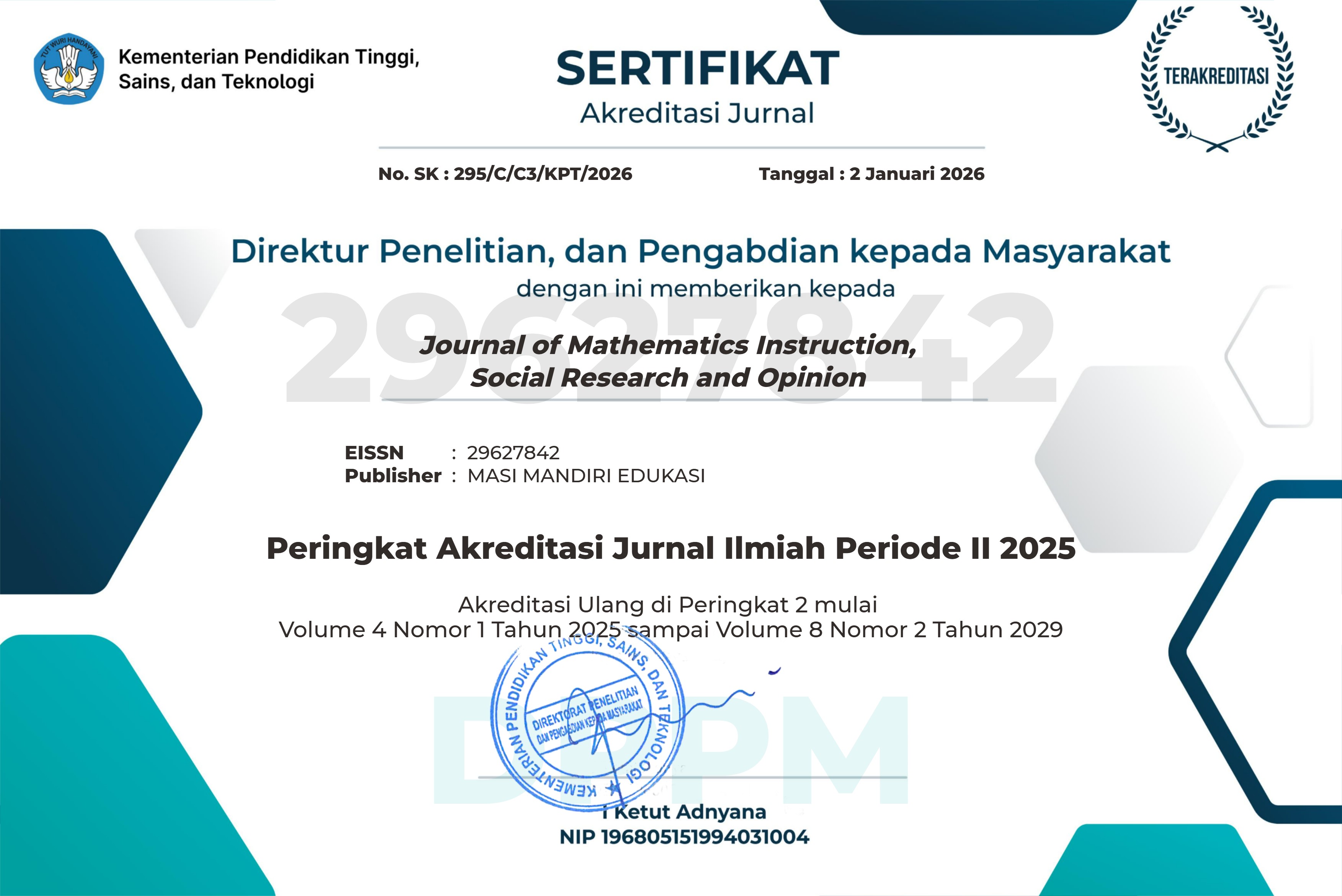
| Accreditation Certificate |
  |
| Indexing |






Contact Us

visitor
| Information |
>> For Authors
>> For Readers
>> For Librarians
| Visitor Statistics |
| Member of |


| Announcement |

| Keywords |
Mathematics Learning Difficulty Dyscalculia Teacher perceptions personality ICT Learning Computer teaching Academic Fisherfolks Economic Behavior Probit Models matrix mathematical model Concepts Guided Note Taking Golden Ratio Philosophy Integrated Learning van Hiele geometry Assessment Learning Outcomes method skills Problem Solving Experiment
| License |

MISRO is licensed under a Creative Commons Attribution-ShareAlike 4.0 International License.
| Publisher |

Address:
Jl. Gagak N0.105, Bandung,
Indonesia 40133
E-mail:
journalmisro@gmail.com
| in collaboration with |

| Recommended Tools |


| ISSN Barcode |

