
Transformational Leadership and Work Performance of Police Officers in Cambodian Provincial Police Commissariats
DOI:
https://doi.org/10.58421/misro.v4i2.417Keywords:
Effective Leadership, Transformational Leadership, Transactional Leadership, Work PerformanceAbstract
This study aimed to assess the relationship between transformational leadership and the work performance of Cambodian police officers in provincial police commissariats. Mixed approaches were used to collect the data by adapting from the multifactor leadership questionnaire (MLQ) and the individual work performance questionnaire – IWPQ. A total of 267 participants were deputy police commissariats, office chiefs, and deputy office chiefs working in the six target provinces – Kompong Cham, Kandal, Koh Kong, Svay Rieng, Banteay Meanchey, and Siem Reap province. The study found similar effects of transformational leadership (14.6%) and transactional leadership (14.5%) on work performance. Police leaders built and strengthened relationships, met needs, encouraged, motivated, and supported subordinates, and used the stick-and-carrot approach to enable the staff to perform their tasks. However, statistics explain the increase in applying transformational leadership trends and the transactional approach in the Cambodian context. This finding implies the necessity of extending transformational leadership practice among police leaders in the current context of Cambodia.
Downloads
References
M. E. Alsuwaidi and N. B. Mansor, “Knowledge Management’s Impact of Transformational Leadership on Dubai Tourism Police Performance,” International Journal of Academic Research In Business and Social Sciences.
N. B. M. Mohammed Ebrahim Alsuwaidi, “The Impact of Transformational Leadership on the Performance of Police the Mediation Role of Knowledge Management,” Mathematical Statistician and Engineering Applications, vol. 71, no. 3, pp. 349 – 362, Jun. 2022, doi: 10.17762/msea.v71i3.172.
F. Andreani and A. Petrik, “Employee performance as the impact of transformational leadership and job satisfaction in PT Anugerah Baru Denpasar,” Jurnal Manajemen dan Kewirausahaan, vol. 18, no. 1, pp. 25–32, Aug. 2016, doi: 10.9744/jmk.18.1.25-32.
A. L. J. Geyer and J. M. Steyrer, “Transformational Leadership and Objective Performance in Banks,” Applied Psychology, vol. 47, no. 3, pp. 397–420, Jul. 1998, doi: 10.1080/026999498377917.
B. M. Bass, “Two Decades of Research and Development in Transformational Leadership,” European Journal of Work and Organizational Psychology, vol. 8, no. 1, pp. 9–32, Mar. 1999, doi: 10.1080/135943299398410.
D. K. Mulli, “Ransformational Leaderships and Performance of the Kenya National Police Service in Nyeri County, Kenya,” Kenyatta University, Nairobi, 2021.
J. Russell, “A Meta-analysis: The Full Range of Leadership Model Impacting Policing Organizations,” Walden University, Minnesota, 2017.
A. Ahmad, R. Z. A. R. Ibrahim, and A. Abu Bakar, “Factors influencing job performance among police personnel: An empirical study in Selangor,” Management Science Letters, pp. 939–950, 2018, doi: 10.5267/j.msl.2018.6.014.
A. D. Miller, “Leadership Styles in Policing and Officers’ Job Satisfaction: A Correlational Study,” University of Phoenix, Phoenix, 2020.
A. A. Magaji and A. Jibiril, “Nigeria Police Leadership and Insecurity: Implication for National Development,” Usmanu Danfoidyo University, Sokoto, 2014.
E. Kimsan, “A Critical Study on The Factors Affecting the Effectiveness of Police Leadership and Practices in Cambodia,” The Academic Journal of St Clements Education Group - Veritas, vol. 13, no. 1, pp. 1–21, 2022.
GCNP, “Report on consolidated work performance results of police operations to secure and social orders year 2022 and direction 2023,” 2022.
M. o. Interior, “Annual Reports,” 2021.
F. Bushra, A. Usman, and A. Naveed, “Effect of Transformational Leadership on Employees’ Job Satisfaction and Organizational Commitment in Banking Sector of Lahore (Pakistan),” International Journal of Business and Social Science, vol. 2, Jan. 2011.
P. G. Northouse, Leadership: Theory and Practice. Michigan : Western Michigan University, 2016.
T. Meaklim and J. Sims, “Leading Powerful Partnerships — a new model of public sector leadership development,” International Journal of Leadership in Public Services, vol. 7, no. 1, pp. 21–31, Feb. 2011, doi: 10.5042/ijlps.2011.0090.
A. Uzundemir, A. Albattat, and F. Ahamed, “The Impact of Work Environment and Transactional Leadership Style on Employees’ Performance,” International Journal of Multidisciplinary Research and Studies, vol. 6, pp. 1–38, Sep. 2023, doi: 10.33826/ijmras/v06i09.6.
M. Dussault, A.-A. Deschênes, and E. Frenette, “Police Officer Transformational Leadership: Development and Validation of a Self-reported Scale,” American Journal of Applied Psychology, vol. 7, pp. 67–72, Feb. 2019, doi: 10.11648/j.ajap.20180706.11.
J. Jyoti and S. Bhau, “Transformational Leadership and Job Performance: A study of Higher Education,” Journal of Services Research, vol. 15, pp. 77–110, Oct. 2015.
Y. Musa et al., “An Impact of Transformational Leadership on Employees’ Performance: A Case Study in Nigeria,” 2018, pp. 708–719. doi: 10.1007/978-981-10-7512-4_70.
A. Javed, S. Ali, G. G. G. Goh, N. Saif, I. Shaheen, and S. U. Khan, “Unraveling the Impact of Transactional Leadership on Task Performance: The Mediating Role of Self-Efficacy among Bank Employees,” May 03, 2024. doi: 10.21203/rs.3.rs-4153576/v1.
A. Swid, “Police members perception of their leaders’ leadership style and its implications,” Policing: An International Journal of Police Strategies & Management, vol. 37, no. 3, pp. 579–595, Aug. 2014, doi: 10.1108/PIJPSM-08-2013-0085.
E. Jaqua and T. Jaqua, “Transactional leadership,” Am J Biomed Sci Res, vol. 14, no. 5, pp. 399–400, 2021.
A. B. Brahim, O. Ridic, and T. Jukic, “The Effect Of Transactional Leadership On Employees Performance - Case Study Of 5 Algerian Banking Institutions,” Economic Review: Journal of Economics and Business, vol. 13, no. 2, pp. 7–20, 2015.
Z. Ahmed Iqbal, G. Abid, M. Arshad, F. Ashfaq, M. A. Athar, and Q. Hassan, “Impact of Authoritative and Laissez-Faire Leadership on Thriving at Work: The Moderating Role of Conscientiousness,” Eur J Investig Health Psychol Educ, vol. 11, no. 3, pp. 667–685, Jul. 2021, doi: 10.3390/ejihpe11030048.
H. Tosunoglu, “Laissez-Faire leaders and organizations: how does Laissez-Faire leader erode the trust in organizations,” Pressacademia, vol. 3, no. 1, pp. 89–89, Mar. 2016, doi: 10.17261/Pressacademia.2016116538.
M. Al-Malki and W. Juan, “Impact of Laissez-Faire Leadership on Role Ambiguity and Role Conflict: Implications for Job Performance,” INTERNATIONAL JOURNAL OF INNOVATION AND ECONOMIC DEVELOPMENT, vol. 4, no. 1, pp. 29–43, 2018, doi: 10.18775/ijied.1849-7551-7020.2015.41.2003.
V. Robert and C. Vandenberghe, “Laissez-Faire Leadership and Affective Commitment: the Roles of Leader-Member Exchange and Subordinate Relational Self-concept,” J Bus Psychol, vol. 36, no. 4, pp. 533–551, Aug. 2021, doi: 10.1007/s10869-020-09700-9.
A. Bashir, A. Amir, M. Jawaad, and T. Hasan, “Work conditions and job performance: An indirect conditional effect of motivation,” Cogent Business & Management, vol. 7, no. 1, p. 1801961, Jan. 2020, doi: 10.1080/23311975.2020.1801961.
S. J. Motowildo, W. C. Borman, and M. J. Schmit, “A Theory of Individual Differences in Task and Contextual Performance,” Hum Perform, vol. 10, no. 2, pp. 71–83, Jun. 1997, doi: 10.1207/s15327043hup1002_1.
S. Sonnentag, J. Volmer, and A. Spychala, Job performance. Sage, 2008.
T. Widyastuti and R. Hidayat, “Adaptation of Individual Work Performance Questionnaire (IWPQ) into Bahasa Indonesia,” International Journal of Research Studies in Psychology, vol. 7, no. 2, Nov. 2018, doi: 10.5861/ijrsp.2018.3020.
R. Rafia and S. Achmad Sudiro, “The effect of transformational leadership on employee performance mediated by job satisfaction and employee engagement,” International Journal of Business, Economics and Law, vol. 21, no. 5, pp. 119–125, 2020.
T. Yamane, Statistics: An Introductory Analysis, 2nd ed. New York: Harper and Row, 1967.
B. M. Bass and B. J. Avolio, MLQ Multifactor Leadership Questionnaire. Redwood City: Mind Garden, 2000.
L. Koopmans, C. M. Bernaards, V. H. Hildebrandt, S. Buuren, B. van, and A.J. van der, “Improving the Individual Work Performance Questionnaire using Rasch analysis,” J Appl Meas, vol. 15, no. 2, pp. 160–175, 2014.
P. Modise, “Efficient and Effective Leadership in Law Enforcement, Characteristics and Behaviors of Effective Police Leaders that Assists Upholding A High Standard of Professionalism and Integrity,” Sep. 2023.
E. J. Chezue and E. E. Mbuti, “Effect of Training Programs on the Performance of Police Officers in Tanzania: A Case of Arusha City,” East African Journal of Management and Business Studies, vol. 3, no. 3, pp. 28–36, 2023.
F. Barth-Farkas and A. Vera, “Transformational, Transactional and Cooperative Police Leadership in Theory and Practice,” European Police Science and Research Bulletin, pp. 34–43, Jan. 2016.
C. Chikwem, “he Relationship of Job Stress to Job Performance in Police Officers,” Walden University, Minnesota, 2017.
A. Tembur, “Factors affecting job performance in national police service. A case study of Nairobi area county,” University of Africa, Lusaka, 2017.
R. C. Helfers, P. D. Reynolds, and J. Maskály, “Prior Discipline and Performance among Police Officers: Does Organizational Fairness Matter?,” Criminology, Criminal Justice, Law & Society, vol. 21, no. 3, pp. 1–16, 2020.
K. Jankingthong and S. Rurkkhum, “Factors Affecting Job Performance: A Review of Literature,” Silpakorn University Journal of Social Sciences, Humanities, and Arts, vol. 12, no. 2, pp. 115–127, 2012.
J. Shang, “Transformational Leadership Influences Employee Performance: A Review and Directions for Future Research,” Highlights in Business, Economics and Management, vol. 10, pp. 291–312, May 2023, doi: 10.54097/hbem.v10i.8113.
A. A. M. R. Zaitoun and R. M. Taib, “The Contribution of Transformational Leadership and Innovation Practices in Fostering Policemen Performance of Abu Dhabi Police,” International Journal of Business and Technology Management, vol. 6, no. 4, pp. 218–231, 2024.
M. B. Sarver and H. Miller, “Police chief leadership: styles and effectiveness,” Policing: An International Journal of Police Strategies & Management, vol. 37, no. 1, pp. 126–143, Mar. 2014, doi: 10.1108/PIJPSM-03-2013-0028.
Downloads
Published
How to Cite
Issue
Section
License
Copyright (c) 2025 Journal of Mathematics Instruction, Social Research and Opinion

This work is licensed under a Creative Commons Attribution-ShareAlike 4.0 International License.
SideBar
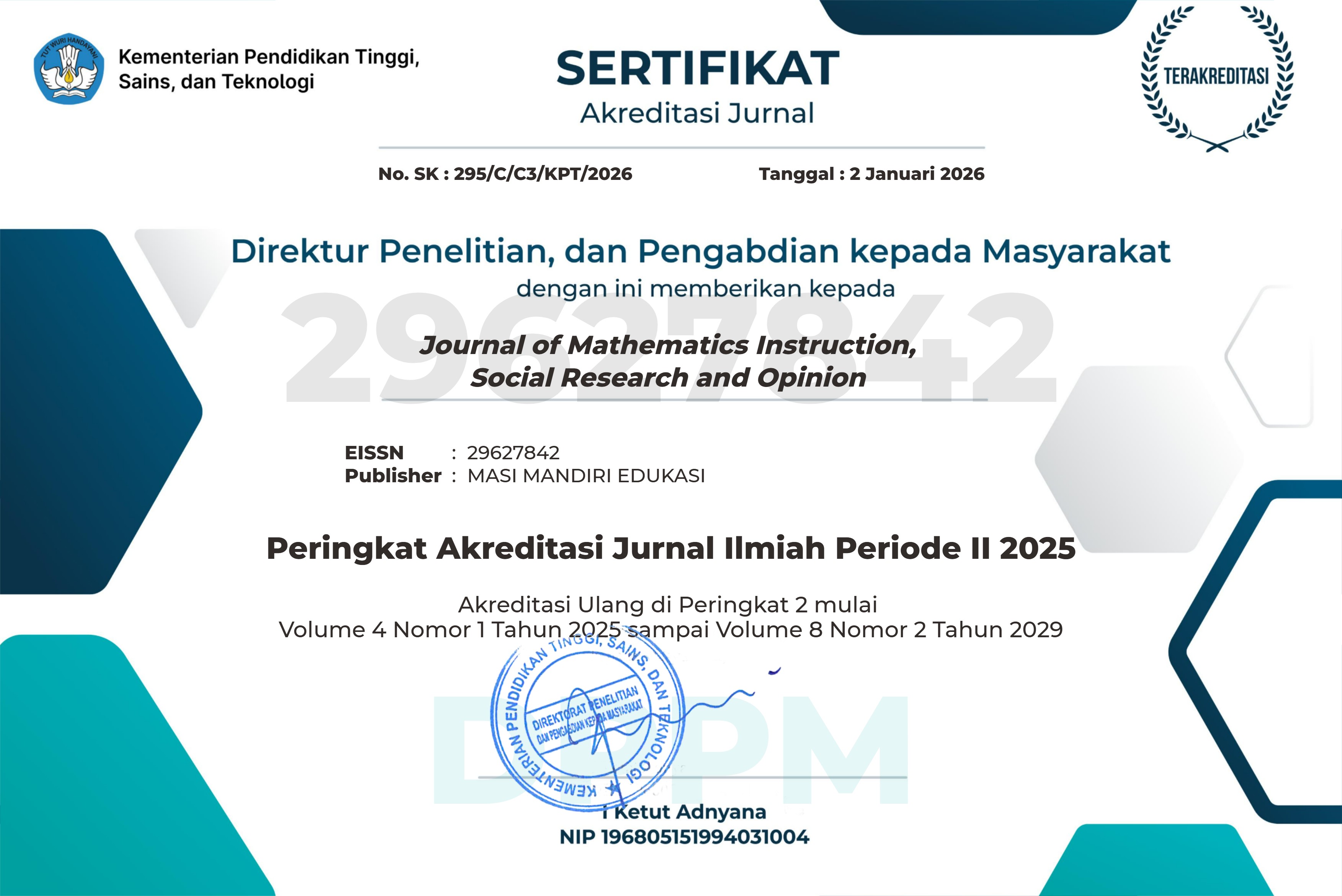
| Accreditation Certificate |
  |
| Indexing |






Contact Us

visitor
| Information |
>> For Authors
>> For Readers
>> For Librarians
| Visitor Statistics |
| Member of |


| Announcement |

| Keywords |
Mathematics Learning Difficulty Dyscalculia Teacher perceptions personality ICT Learning Computer teaching Academic Fisherfolks Economic Behavior Probit Models matrix mathematical model Concepts Guided Note Taking Golden Ratio Philosophy Integrated Learning van Hiele geometry Assessment Learning Outcomes method skills Problem Solving Experiment
| License |

MISRO is licensed under a Creative Commons Attribution-ShareAlike 4.0 International License.
| Publisher |

Address:
Jl. Gagak N0.105, Bandung,
Indonesia 40133
E-mail:
journalmisro@gmail.com
| in collaboration with |

| Recommended Tools |


| ISSN Barcode |

