
Students' Perceptions of Mathematics Teachers: Personal and Interpersonal
DOI:
https://doi.org/10.58421/misro.v1i3.39Keywords:
student perceptions, mathematics teachers, personality competenceAbstract
Based on student perceptions, this study describes mathematics teachers' personalities and social competence at MTsN 2 Cirebon. This study examines and describes mathematics teachers' personalities and social competencies based on student perceptions of MTsN 2 Cirebon. This type of research uses mixed research methods and a sequential explanatory design. The population in this study was all class VIII MTsN 2 Cirebon, and the sample in this study was 134 students. The data collection techniques are questionnaires and interviews using instruments like questionnaire results and interview guidelines. The data analysis used is descriptive statistics and descriptive qualitative. The results showed that the description of the personality competence of mathematics teachers at MTsN 2 Cirebon, according to the analysis of student perceptions in general, was categorized as good with a percentage of 72.67%, which was supported by the results of student interviews stating that the teacher always dressed neatly and according to the official schedule, starting and ending timely learning. However, there are indicators of personality competence that have not been maximized, namely the teacher being a role model for students, with a smaller percentage than the other three indicators of personality competence, namely 68.38%. Moreover, the social competence of mathematics teachers at MTsN 2 Cirebon, according to the analysis of student perceptions in general, is categorized as good. Supported the results of student interviews state that the teacher, when in class, interacts well with students and cares about students by reprimanding, advising, and repeating learning that has not been understood, but if outside the classroom, the teacher is just ordinary, not so close, just saying hello like other teachers.
Downloads
References
F. F. Patacsil, C. Lourrine, and S. Tablatin, “Exploring The Importance of Soft And Hard Skills as Perceived by It Internship Students and Industry: a Gap Analysis,” J. Technol. Sci. Educ. JOTSE, no. 3, pp. 2017–2024, doi: 10.3926/jotse.271.
V. S., “Soft skills and its application in work place,” World J. Adv. Res. Rev., vol. 3, no. 2, pp. 066–072, Sep. 2019, doi: 10.30574/WJARR.2019.3.2.0057.
M. Sholikhin, “Soft Skills Guru dalam Film Sang Pencerah Karya Hanung Bramantyo (Studi Analitik Kompetensi Kepribadian dan Kompetensi Sosial Guru),” UIN SUNAN KALIJAGA, 2017.
A. Muchyidin and N. Priatna, “Montessori method to stimulate mathematical communication skills in mild intellectual disability students,” in AIP Conference Proceedings, 2022, vol. 2577, no. 1, p. 20035.
C. Joynes, “21st Century Skills: evidence of issues in definition, demand and delivery for development contexts,” 2019.
E. van Laar, A. J. A. M. van Deursen, J. A. G. M. van Dijk, and J. de Haan, “Determinants of 21st-Century Skills and 21st-Century Digital Skills for Workers: A Systematic Literature Review,” https://doi.org/10.1177/2158244019900176, vol. 10, no. 1, Jan. 2020, doi: 10.1177/2158244019900176.
T. Wrahatnolo, “21 st centuries skill implication on educational system,” doi: 10.1088/1757-899X/296/1/012036.
G. M. Guey and L. Moore, The Inspirational Teacher, 2nd ed. New York: Routledge, 2016.
L. Halimah, Keteramiplan Mengajar Sebagai Inspirasi Untuk Menjadi Guru Yang Exellent di Abad-21. Bandung: Refika Aditama, 2017.
A. Muchyidin et al., “Mathematics curriculum for intellectual disabilities schools in Indonesia and abroad: Literature review,” AIP Conf. Proc., vol. 2633, no. September, p. 030036, 2022, doi: 10.1063/5.0102268.
A. P. Abnisa and Zubairi, “Personality Competence Educator and Student Interest in Learning,” Scaffolding J. Pendidik. Islam dan Multikulturalisme, vol. 4, no. 1, pp. 279–290, 2022.
W. Kamal, A. D. R. Tati, and M. Irfan, “Analysis of Class Teacher Social Competence ( Study of Communication with Students , Peers , and Society ) at SDI No 167 Mattoanging District of Turatea Jeneponto Regency Keywords :,” Int. J. Elem. Sch. Teach., vol. 1, no. 1, pp. 18–26, 2021, doi: 10.5937/IJESTxxx.
Pahrudin, T. Martono, and W. Murtini, “The Effect of Pedagogic Competency, Personality, Professional and Social Competency Teacher to Study Achievement of Economic Lesson in State Senior High School of East Lombok District Academic Year 2015/2016,” 2nd Int. Conf. Teach. Train. Educ. Sebel. Maret Univ., vol. 2, no. 1, pp. 332–345, 2016.
T. Taniredja and M. Abduh, “Pedagogical, Personality, Social and Professional Competence in Correlation with Teachers’ Performance (Correlational Study of Junior High School Teacher at SMPN 3 Purwokerto).”
E. Mulyasa, Standar Kompetensi dan Sertifikasi Guru. Bandung: Remaja Rosdakarya, 2013.
Nasifah, A. Muchyidin, and M. A. Misri, “Analysis of the Geometric Thinking Stage of Madrasah Tsanawiyah Students Based on Van Hiele ’ s Theory,” J. Math. Instr. Soc. Res. Opin., vol. 1, no. 2, pp. 1–10, 2022.
M. Marfuah, D. Suryadi, T. Turmudi, A. Muchyidin, and G. Satriawati, “Perceptions of pre-service and in-service mathematics teachers on the mathematical link between matrices and vectors,” AIP Conf. Proc., vol. 2633, no. September, p. 030002, 2022, doi: 10.1063/5.0102263.
Marhamah, “Kompetensi Profesional Guru Matematika,” J. Dosen Univ. PGRI Palembang, vol. 4, no. 1, pp. 1–13, 2016, [Online]. Available: https://jurnal.univpgri-palembang.ac.id/index.php/prosiding/article/download/518/400.
Sugiyono, Metode Penelitian Kuantitatif, Kualitatif, dan R&D. Bandung: Alfabeta, 2017.
Katijah, “Persepsi Siswa Tentang Kompetensi Kepribadian Guru Aqidah Ahklak di Madrasah Aliyah Hidayatul Muta’allim Mengkirau Kecamatan Merbau Kabupaten Bengkalis,” Universitas Islam Negeri Sultan Syarif Kasim Riau, 2011.
Syarifudin, “Analisis Kompetensi Kepribadian Guru Di SMPN Se-Kecamatan Binamu Kabupaten Jenepoto,” UIN Alauddin Makasar, 2017.
W. J. Lammers and J. J. Murphy, “A profile of teaching techniques used in the university classroom: A descriptive profile of a US public university,” Act. Learn. High. Educ., vol. 3, no. 1, pp. 54–67, Mar. 2002, doi: 10.1177/1468742002003001785.
Alimin, “Analisis Kompetensi Kepribadian Guru Pendidikan Agama Islam SMP di Tarakan,” J. Kebijak. dan Pengemb. Pendidik., vol. 3, no. 1, pp. 61–65, 2015, [Online]. Available: https://ejournal.umm.ac.id/index.php/jkpp/article/view/2200.
E. Mulyasa, Standar Kompetensi dan Sertifikasi Guru. Bandung: Remaja Rosdakarya, 2007.
E. Khaidir and F. M. Suud, “Islamic Education in Forming Students’ Characters At As-Shofa Islamic High School, Pekanbaru Riau,” Int. J. Islam. Educ. Psychol., vol. 1, no. 1, pp. 50–63, 2020, doi: 10.18196/ijiep.1105.
B. Norlin, “Comenius, moral and pious education, and the why, when and how of school discipline,” Hist. Educ., vol. 49, no. 3, pp. 287–312, 2020, doi: 10.1080/0046760X.2020.1739759.
Widyaningsih, “Pengaruh Kompetensi Guru Terhadap Displin Siswa Kelas V SD Se-Gugus I Sido Arum Godean Sleman Tahun Ajaran 2015/2016,” J. Pendidik., vol. 1, no. 1, pp. 1–6, 2016, [Online]. Available: http://repository.upy.ac.id/341/1/Jurnal%2520Widyaningsih.pdf.
Purnamasari, “Analisis Kompetensi Sosial Guru Berdasarkan Penilaian Kinerja Guru Matematika SMPN se-Kecamatan Binamu Kabupaten Jeneponto,” Universitas Islam Negeri Alauddin Makassar, 2017.
S. Hidayat, Pengembangan Guru Profesional. Bandung: Remaja Rosdakarya, 2017.
Downloads
Published
How to Cite
Issue
Section
License
Copyright (c) 2022 Journal of Mathematics Instruction, Social Research and Opinion

This work is licensed under a Creative Commons Attribution-ShareAlike 4.0 International License.
SideBar
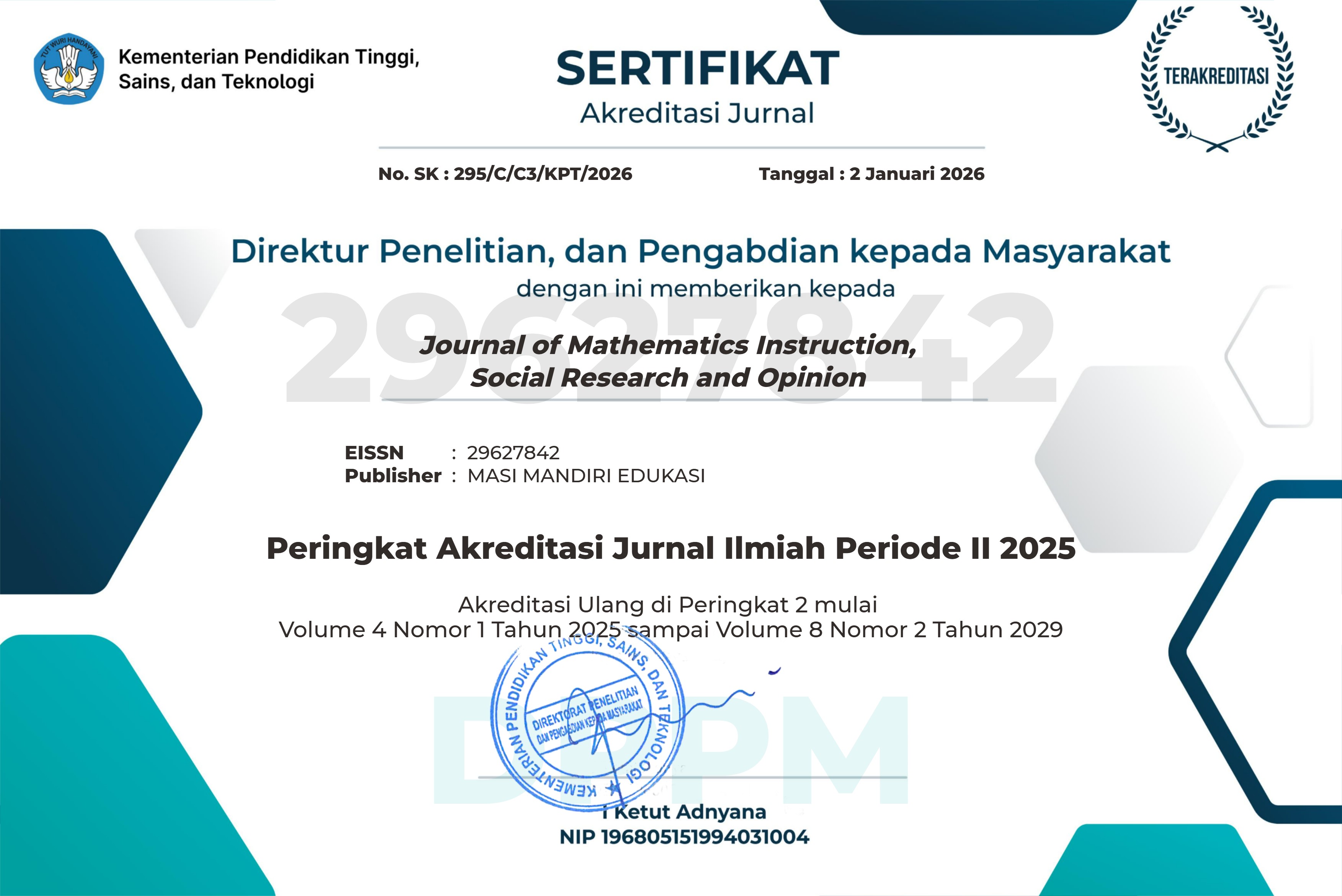
| Accreditation Certificate |
  |
| Indexing |






Contact Us

visitor
| Information |
>> For Authors
>> For Readers
>> For Librarians
| Visitor Statistics |
| Member of |

| Announcement |

| Keywords |
Mathematics Learning Difficulty Dyscalculia Teacher perceptions personality ICT Learning Computer teaching Academic Fisherfolks Economic Behavior Probit Models matrix mathematical model Concepts Guided Note Taking Golden Ratio Philosophy Integrated Learning van Hiele geometry Assessment Learning Outcomes method skills Problem Solving Experiment
| License |

MISRO is licensed under a Creative Commons Attribution-ShareAlike 4.0 International License.
| Publisher |

Address:
Jl. Gagak N0.105, Bandung,
Indonesia 40133
E-mail:
journalmisro@gmail.com
| in collaboration with |

| Recommended Tools |


| ISSN Barcode |

