
Does Computer-Assisted Instruction (CAI) Influence Academic Performance of High School Students in Social Studies? Evidence from the Philippines
DOI:
https://doi.org/10.58421/misro.v4i2.364Keywords:
Computer-assisted instruction (CAI), Academic performance, Attitudes, Araling Panlipunan, Highschool students, Philippines, Correlational studyAbstract
The study investigates the impact of computer-assisted instruction (CAI) on Grade 9 students' academic performance and attitudes towards learning Araling Panlipunan (Social Studies) at San Jose National School and Goa National School in the Philippines. Using a descriptive correlational design, it explores the relationships between the perceived effectiveness of CAI, attitudes towards its use, and academic performance. Students at both schools view CAI positively, recognising its benefits in enhancing assessment performance, critical thinking skills, and information retention. While they appreciate the supplementary materials, traditional teaching methods are slightly favoured for overall effectiveness and real-world application of knowledge. A low positive correlation exists between academic performance and perceived effectiveness at San Jose National School, implying that a better perception of CAI effectiveness may boost academic performance. Conversely, at Goa National School, a moderate positive correlation exists between academic performance and perceived effectiveness and attitude towards CAI, suggesting that a positive view and effectiveness of CAI correspond to improved academic outcomes. Enhancing students' perceptions of CAI could improve academic performance, highlighting the need for continued refinement of CAI strategies for enhanced learning experiences in Araling Panlipunan.
Downloads
References
Y. Wang, “A Comparative Study on the Effectiveness of Traditional and Modern Teaching Methods,” in Proceedings of the 2022 5th International Conference on Humanities Education and Social Sciences, 2022, pp. 270–277. doi: 10.2991/978-2-494069-89-3_32.
C. Namitha, “Modern methods of teaching,” Journal of Applied and Advanced Research, pp. S39–S41, May 2018, doi: 10.21839/jaar.2018.v3iS1.167.
R. Raja and P. C. Nagasubramani, “Impact of modern technology in education,” Journal of Applied and Advanced Research, pp. S33–S35, May 2018, doi: 10.21839/jaar.2018.v3iS1.165.
M. K. Rathore and R. Sonawat, “Integration of technology in education and its impact on learning of students,” pp. 235–246, Jan. 2015.
E. Tolbert, “The Impact of Computer-Aided Instruction on Student Achievement,” Gardner-Webb University, Boiling Springs, 2015.
C. Kaiser, “PLATO: How an educational computer system from the ’60s shaped the future - Ars Technica.” Accessed: May 26, 2025. [Online]. Available: https://arstechnica.com/gadgets/2023/03/plato-how-an-educational-computer-system-from-the-60s-shaped-the-future/
OECD, Innovating Education and Educating for Innovation. OECD, 2016. doi: 10.1787/9789264265097-en.
K. T. Seng and L. S. Choo, Information Communication Technology In Education. WORLD SCIENTIFIC, 2008. doi: 10.1142/6881.
M. Mageswari, “Malaysia’s Education Blueprint achieves success.” Accessed: May 26, 2025. [Online]. Available: https://www.thestar.com.my/news/education/2023/08/27/malaysia039s-education-blueprint-achieves-success
M. Christopher, “Transforming Education in Thailand through the Use of Technology.” Accessed: May 26, 2025. [Online]. Available: https://opengovasia.com/2018/07/27/transforming-education-in-thailand-through-the-use-of-technology/
M. B. Giray and V. F. Kim, “Spiral Progression Approach in Teaching Science in the K-12 Curriculum,” International Journal of Research Publication and Reviews, vol. 4, no. 8, pp. 1363–1378, Aug. 2023, doi: 10.55248/gengpi.4.823.50813.
D. I. Mezieobi and O. C. Onyeanusi, “Repositioning social studies education in Nigerian tertiary institutions for the attainment of Vision 20:2020 in Nigeria,” Nigerian Journal of Social Studies, vol. 15, no. 1, pp. 247–256, 2012.
M. C. O. Derraco, “Relations of Learners’ Attitude and Academic Performance in Online Distance Learning In Araling Panlipunan,” International Journal of Multidisciplinary Research and Analysis, vol. 05, no. 06, Jun. 2022, doi: 10.47191/ijmra/v5-i6-15.
R. C. Pennington, “Computer-Assisted Instruction for Teaching Academic Skills to Students With Autism Spectrum Disorders: A Review of Literature,” Focus Autism Other Dev Disabl, vol. 25, no. 4, pp. 239–248, Dec. 2010, doi: 10.1177/1088357610378291.
D. V. Rogayan Jr., M. J. Padrique, and J. Costales, “Can Computer-Assisted Instruction Improve Students’ Motivation and Academic Performance in Social Studies?,” Journal of Digital Educational Technology, vol. 1, no. 1, p. ep2105, Nov. 2021, doi: 10.21601/jdet/11334.
E. Essien, A. Akwagiobe, and J. Okogun, “Unmasking The Effectiveness of Computer Assisted Instruction In The Teaching And Learning Of Social Studies In Cross River State College Of Education Akamkpa, Cross River State, Nigeria,” vol. 6, pp. 45–52, Jul. 2018.
G. K. Ezeokeke, Foundations of Educational Technology. Owerri: House of Excellence Ventures, 2009.
D. I. Igba and O. A. Oyibe, “Utilization of information and communication technology (ICT) in teaching and learning of social studies,” Nigerian Journal of Social Studies, vol. 15, no. 2, pp. 231–240, 2012.
B. Iddrisu, “Influence Of Teachers’ Gender And Age On The Integration Of Computer Assisted Instruction In Teaching And Learning Of Social Studies Among Basic Schools In Tamale Metropolis,” Int J Humanit Soc Sci, vol. 7, pp. 52–69, Feb. 2019.
N. Bonsu, B. Bervell, E. Kpodo, V. Arkorful, and J. Edumadze, “Computer-Assisted Instruction in the Teaching and Learning of History: A Systematic Review in Africa,” vol. 14, p. 584, Nov. 2020, doi: 10.6084/m9.figshare.13308575.
R. C. Reyes, “Academic Performance and Attitude Toward Computer-Aided Instruction in Chemistry,” in Chemistry Education and Sustainability in the Global Age, Dordrecht: Springer Netherlands, 2013, pp. 257–265. doi: 10.1007/978-94-007-4860-6_22.
K. E. Owede, “Effects of Use of Computer Aided Instructions (CAI) at Secondary School on Academic Performance Undergraduates in Bayelsa State,” FUO-Journal of Educational Research, vol. 3, no. 1, Jan. 2024, [Online]. Available: https://foej.fuotuoke.edu.ng/index.php/foej/article/view/18
L. J. D. Rosali, “Effect of Computer-Assisted Instruction (CAI) on the Academic Achievement in Secondary Physics,” OAlib, vol. 07, no. 05, pp. 1–11, 2020, doi: 10.4236/oalib.1106319.
J. V. Mangahas, “Computer – Aided Instructions For Improving The Academic Performance Of The Students – Department of Education.” Accessed: May 26, 2025. [Online]. Available: https://www.depedscm.com/computer-aided-instructions-for-improving-the-academic-performance-of-the-students/
S. N. Jesse, N. V. Twoli, and J. N. Maundu, “Enhancement of Science Performance through Computer - Assisted Instruction among Selected Secondary School Learners in Kenya,” Kentucky Journal of Excellence in College Teaching and Learning, vol. 12, pp. 40–51, 2015.
A. Chevalère and D. Barlow, “The effectiveness of computer-assisted instruction: a comparative analysis,” Educ Res Rev, vol. 15, no. 1, pp. 12–19, 2021.
Downloads
Published
How to Cite
Issue
Section
License
Copyright (c) 2025 Journal of Mathematics Instruction, Social Research and Opinion

This work is licensed under a Creative Commons Attribution-ShareAlike 4.0 International License.
SideBar
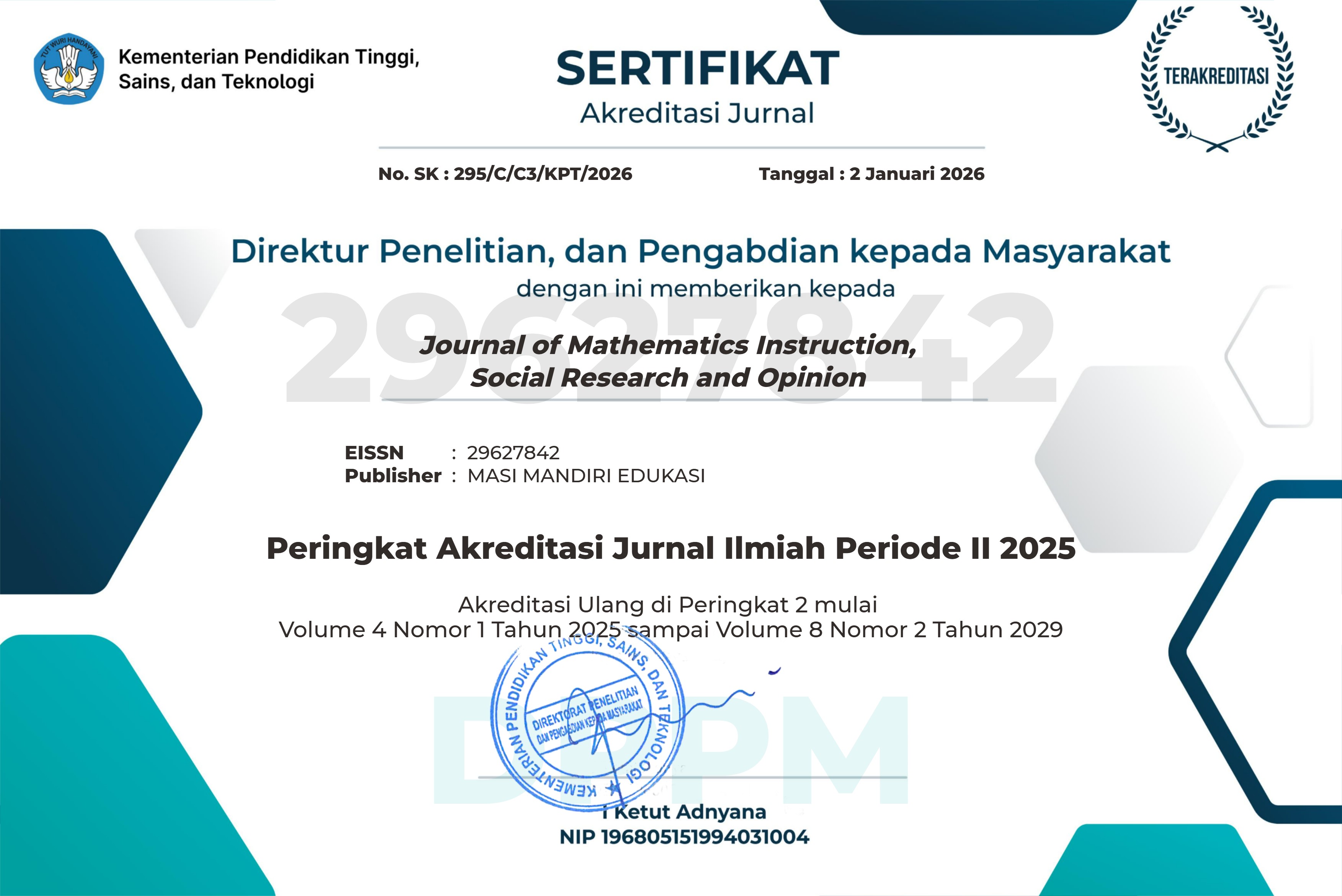
| Accreditation Certificate |
  |
| Indexing |






Contact Us

visitor
| Information |
>> For Authors
>> For Readers
>> For Librarians
| Visitor Statistics |
| Member of |


| Announcement |

| Keywords |
Mathematics Learning Difficulty Dyscalculia Teacher perceptions personality ICT Learning Computer teaching Academic Fisherfolks Economic Behavior Probit Models matrix mathematical model Concepts Guided Note Taking Golden Ratio Philosophy Integrated Learning van Hiele geometry Assessment Learning Outcomes method skills Problem Solving Experiment
| License |

MISRO is licensed under a Creative Commons Attribution-ShareAlike 4.0 International License.
| Publisher |

Address:
Jl. Gagak N0.105, Bandung,
Indonesia 40133
E-mail:
journalmisro@gmail.com
| in collaboration with |

| Recommended Tools |


| ISSN Barcode |

