
The Identification and Utilization of Maslow's Hierarchy of Needs in Ghana's Senior High Mathematics Curriculum
DOI:
https://doi.org/10.58421/misro.v3i2.235Keywords:
Aesthetic Needs, Cognitive Needs, Maslow’s Hierarchy of Needs , Mathematics Curriculum, TranscendenceAbstract
This study identifies all observable action verbs in the Senior High School core mathematics curriculum and links them to Maslow’s Hierarchy of Needs. All the 217 identified action verbs were further grouped in a matrix form in the order of Maslow’s hierarchy of needs against the major headings as stated above in the syllabus. The study collated the frequencies and percentages of the action verbs in a matrix form using Microsoft Office Excel 2019. The study revealed that each of the verbs represents the key profile component of each objective. The study revealed that teachers should evaluate students appropriately in their knowledge and understanding, invention and creativity, analysis, and application, as these represent the growing needs in Maslow’s Hierarchy of Needs. It also revealed how the curriculum designers intended for students to fulfill the majority of their needs in the teaching and learning column of Maslow's hierarchy matrix through these activities. To accomplish the predetermined goal, the study advises teachers to employ these action verbs as they arise in the curriculum's objective for the subject being studied. Future studies should look into whether the mathematics curriculum's application of 21st-century skills aligns with the needs hierarchy's stages.
Downloads
References
E. Adodey and J. A. Ansah, “Differentiated Curriculum: The Perspectives of the Special Educationist,” Research on Humanities and Social Sciences, vol. 7, no. 23, pp. 26–33, 2017.
I. Buabeng, D. F. Ntow, and D. C. Otami, “Teacher Education in Ghana: Policies and Practices,” Journal of Curriculum and Teaching, vol. 9, no. 1, pp. 86–95, 2020, doi: 10.5430/jct.v9n1p86.
K. Acheampong, “Teacher Educators’ Practice and Vision of Good Teaching in Teacher Education Reform Context in Ghana,” Educational Researcher, vol. 46, no. 4, pp. 194–203, 2017, doi: 10.3102/0013189X17711907.
S. A. McLeod, “Maslow’s Hierarchy of Needs, Retrieved from http://www.simplypsychology.org/maslow.html on 15/05/2022,” Simple Psychology.
A. Neher, “Maslow’s Theory of Motivation: ACritique.,” Journal of Humanistic Biology, vol. 31, no. 3, pp. 89–112, 1991.
G. Howson and B. Wilson, School Mathematics in the 1990s, 1st ed. in ICMI Study Series. Cambridge: Cambridge University Press, 1986. Accessed: May 18, 2022. [Online]. Available: https://www.researchgate.net/publication/350989918_Sixty_years_of_teacher_education_in_Ghana_Successes_challenges_and_the_way_forward/link/6087e42d2fb9097c0c0fd9f6/download
J. Adu-Agyem and P. Osei-Poku, “Quality Education In Ghana: The Way Forward,” International Journal of Innovative Research and Development, vol. 1, no. 9, pp. 164–177, 2012.
H. O. A. Mcwilliam and Kwamena-Po, The Development of Education in Ghana. Hong kong: Longman, 1978.
D. K. Mereku, “Five Decades of School Mathematics in Ghana,” The Mathematical Association of Ghana, vol. 9, pp. 73–88, 2010.
D. K. Mereku, “School Mathematics in Ghana: 1960 - 2000,” Denu, Ghana: Mathematical Association of Ghana, 1999, p. 7.
G. A. A. Williams, “The development of a modern mathematics curriculum in Africa. The Arithmetic Teacher,” vol. 23, no. 4, pp. 254–261, 1976.
H. Gbagolo, “Examination Malpractices in Nigeria: A Review of Literature,” Continental J. Education Research, vol. 4, no. 3, pp. 34–43, 2011, doi: 10.1.1.367.7889.
R. Pinto, “The Effect of Western Formal Education on the Ghanaian Educational System and Cultural Identity,” Journal of Negro Education, vol. 88, no. 1, pp. 5–16, 2019.
AMTE, “Position of the Association of Mathematics Teacher Educators on Technology,” Press Release: AMTE Statement on Technology | AMTE. Accessed: May 15, 2023. [Online]. Available: https://amte.net/news/2022/06/press-release-amte-statement-technology
I. V. S. Mullis and M. O. Martin, TIMSS 2019 Assessment frameworks. Commonwealth Avenue, Chestnut Hill, MA: TIMSS & PIRLS, 2017. [Online]. Available: timssandpirls.bc.edu/timss2019/frameworks/
OECD, PISA 2015 Results (Volume I): Excellence and Equity in Education, vol. 1. Paris: Organisation for Economic Co-operation and Development, 2015. Accessed: Oct. 03, 2022. [Online]. Available: https://doi.org/10.1787/9789264266490-en
M. Alagaraja and N. Arthur-Mensah, “Exploring technical vocational education and training systems in emerging markets: A case study on Ghana,” European Journal of Training and Development, vol. 37, no. 9, pp. 835–850, Jan. 2013, doi: 10.1108/EJTD-04-2013-0037.
E. A. Quainoo, F. Quansah, F. Adams, and E. Opoku, “Comparative Review of Educational Reforms, Policies, and Systems: A case of China and Ghana,” (JCSIE), vol. 2, no. 1, Dec. 2020, Accessed: Mar. 20, 2022. [Online]. Available: https://www.jcsie.com/ojs/dir/index.php/JCSIE/article/view/20
D. D. Agyei and J. Voogt, “ICT use in the teaching of mathematics: Implications for professional development of pre-service teachers in Ghana,” Educ Inf Technol, vol. 16, no. 4, pp. 423–439, Dec. 2011, doi: 10.1007/s10639-010-9141-9.
E. Oppong-Gyebi, E. Bonyah, and L. J. Clark, “Constructive instructional teaching and learning approaches and their mathematical classroom teaching practices: A junior high school perspective,” CONT MATH SCI ED, vol. 4, no. 1, p. ep23002, Jan. 2023, doi: 10.30935/conmaths/12541.
Ministry of Education, “Teaching Syllabus for Core mathematics (Senior High School).” Curriculum Research and Development Division, MOE, Ghana, 2010.
E. Ampadu, “Implementing a new mathematics curriculum: Mathematics teachers’ beliefs and practices,” IJRSE, vol. 3, no. 1, Oct. 2013, doi: 10.5861/ijrse.2013.562.
G. P. Atta and Manu J., “Ghana School Feeding Program: A Retrospective Review,” International Journal of Innovative Research and Development, vol. 4, no. 8, pp. 402–410, 2015, doi: 10.1.1.1004.5802.
T. Chanimbe and O. K. Dankwa, “The ‘New’ Free Senior High School Policy in Ghana: Emergent Issues and Challenges of Implementation in Schools,” Interchange, vol. 52, pp. 599–630, 2021, doi: doi.org/10.1007/s10780-021-09440-6.
E. Tamanja and E. Pajibo, “Ghana’s Free Senior High School Policy: Evidence and Insight from Data,” presented at the 11th International Conference on Education and New Learning Technologies, Palma, Spain, Jul. 2019, pp. 7837–7846. doi: 10.21125/edulearn.2019.1906.
G. E. S. GES, Professional Learning Community Handbook 1. Working to the National Teachers’ Standards, 1st ed. Accra, Ghana: Ministry of Education, Ghana, 2022. [Online]. Available: https://t-tel.org/download/professional-learning-community-handbook-1-_coordinator/?wpdmdl=7650&refresh=64b2308fcdc7c1689399439
Ghana Education Service, Professional Learning Community (PLC) Handbook. Introduction to the Senior High School (SHS), Senior High Technical School (SHTS) and Science, Technology, Engineering and Mathematics (STEM) Curriculum., Teacher Version. Accra, Ghana: Ministry of Education, Ghana, 2023.
M. Akkus, “The Common Core State Standards for Mathematics,” IJRES, vol. 2, no. 1, p. 49, Oct. 2015, doi: 10.21890/ijres.61754.
E. O. Aruma and M. E. Hanachor, “Abraham Maslow’s Hierarchy of Needs and Assessment of Needs in Community Development,” International Journal of Development and Economic Sustainability, vol. 5, no. 7, pp. 15–27, 2017.
R. H. M. Fallatah and J. Syed, “A Critical Review of Maslow’s Hierarchy of Needs. In Employee Motivation in Saudi Arabia,” Palgrave Macmillan, pp. 19–59, 2018, doi: doi.org/10.1007/978-3-319-67741-5_2.
H. T. Uysal, S. Aydemir, and E. Genc, “Maslow’s Hierarchy of Needs In 21st Century: The Examination of Vocational Differences,” Researches on Science and Art in 21st Century Turkey, pp. 211–227, 2017.
A. H. Maslow, “A Theory of Human Motivation,” Psychological Review, vol. 50, pp. 370–396, 1943, doi: 10.1037/h0054346.
L. Deckers, “Motivation: Biological, Psychological, and Environmental,” Routledge Press, 2018. Accessed: May 17, 2022. [Online]. Available: https://www.verywellmind.com/what-is-maslows-hierarchy-of-needs-4136760
T. Bridgman, S. Cummings, and J. Ballard, “Who Built Maslow’s Pyramid? A History of the Creation of Management Studies’ Most Famous Symbol and Its Implications for Management Education,” Academy of Management Learning & Education, vol. 18, no. 1, 2019, doi: https://doi.org/10.5465/amle.2017.0351.
S. E. Eaton, “Maslow’s Hierarchy of Needs: Is the pyramid a hoax?,” Learning, Teaching and Leadership. Accessed: May 17, 2022. [Online]. Available: https://drsaraheaton.wordpress.com/2012/08/04/maslows-hierarchy-of-needs/
J. M. Kiel, “Reshaping Maslow’s Hierarchy of Needs to Reflect Today’s Educational and Managerial Philosophies,” Journal of Instructional Psychology, vol. 26, no. 3, p. 167, 1999.
B. F. Steere, Becoming an effective classroom manager: A resource for teachers. Albany, NY: Suuny Press, 1988.
J. Ansorger, “An Analysis of Education Reforms and Assessment in the Core Subjects Using an Adapted Maslow’s Hierarchy: Pre and Post COVID-19,” Education Sciences, vol. 11, no. 376, 2021, doi: doi.org/10.3390/ educsci11080376.
S. Tulika and B. M. Prakash, “Application of the Maslow’s Hierarchy of Need Theory: Impacts and Implications on Employee’s Career Stages,” Indian Journals, vol. 7, no. 2, pp. 43–52, 2016, doi: 10.5958/2231-069X.2016.00007.X.
A. Noltemeyer, K. Bush, J. Patton, and D. Bergen, “The relationship among deficiency needs and growth needs: An empirical investigation of Maslow’s theory,” Children and Youth Services Review, vol. 34, no. 9, pp. 1862–1867, 2012, doi: 10.1016/j.childyouth.2012.05.021.
M. H. Fisher and D. Royster, “Mathematics teachers’ support and retention: using Maslow’s hierarchy to understand teachers’ needs,” International Journal of Mathematical Education in Science and Technology, vol. 47, no. 7, pp. 993–1008, Oct. 2016, doi: 10.1080/0020739X.2016.1162333.
W. E. Mathes, “Maslow’s Hierarchy of Needs as a Guide for Living,” Journal of Humanistic Psychology, vol. 21, no. 4, pp. 69–72, 1981, doi: 10.1177/002216788102100406.
M. H. Fisher and B. Crawford, “From School of Crisis to Distinguished: Using Maslow’s Hierarchy in a rural underperforming school,” The Rural Educator, vol. 40, no. 1, pp. 8–19, 2020, doi: doi.org/10.35608/ruraled.v41i1.83.
Z. Zheng et al., “Safety Needs Mediate Stressful Events Induced Mental Disorders,” Neural Plasticity, vol. 2016, p. 8058093, Sep. 2016, doi: 10.1155/2016/8058093.
L. M. Karen, “Toward a Better Experience: Examining Student Needs in the Online Classroom through Maslow’s Hierarchy of Needs Model,” MERLOT Journal of Online Learning and Teaching, vol. 8, no. 2, pp. 159–171, 2012.
A. H. Maslow, Motivation and Personality, 1st ed. New York: Harper and Brothers, 1954.
E. P. Yildiz, “Academist Perceptions on the Use of Web 2.0 Tools Through Maslow’s Needs Hierarchy: A Case Study,” Asian Institute of Research Education Quarterly Reviews, vol. 4, no. 1, pp. 173–188, 2021, doi: 10.31014/aior.1993.04.01.185.
W. Mittelman, “Maslow’s study of self-actualization: A reinterpretation,” Journal of Humanistic Psychology, vol. 31, no. 1, pp. 114–135, 1991, doi: 10.1177/0022167891311010.
A. H. Maslow, Motivation and Personality, 2nd ed. New York: Harper and Brothers, 1970.
L. D. Weller, “Principals, meet Maslow: A Prescription for Teacher Retention,” NASSAP Bulletin, vol. 66, no. 456, pp. 32–36, 1982, doi: 10.1177/019263658206645605.
S. Ventegodt, J. Merrick, and J. N. Andersen, “Quality of Life Theory III. Maslow Revisited,” The Scientific World Journal, vol. 3, p. 8, 2003, doi: 10.1100/tsw.2003.84.
D. Ward and M. Lasen, “An Overview of Needs Theories behind Consumerism,” Journal of Applied Economic Sciences, vol. 4, no. 1, 2009, Accessed: Jun. 15, 2024. [Online]. Available: https://www.researchgate.net/publication/23961616_An_Overview_of_Needs_Theories_behind_Consumerism?_tp=eyJjb250ZXh0Ijp7ImZpcnN0UGFnZSI6Il9kaXJlY3QiLCJwYWdlIjoiX2RpcmVjdCJ9fQ
S. King-Hill, “Critical analysis of Maslow’s Hierarchy of Needs,” The Student Teacher Perspectives Journal (STeP), vol. 2, no. 4, pp. 54–57, 2015.
L. Tay and E. Diener, “Needs and subjective well-being around the world.,” Journal of Personality and Social Psychology, vol. 101, no. 2, pp. 354–365, 2011, doi: 10.1037/a00.
M. A. Wahba and L. G. Bridwell, “Maslow reconsidered: A review of research on the need hierarchy theory,” Organizational Behavior and Human Performance, vol. 15, no. 2, pp. 212–240, 1976, doi: 10.1016/0030-5073(76)90038-6.
R. Kolstad, L. D. Briggs, and K. Whalen, “Incorporating language arts into the mathematics curriculum: a literature survey,” Education, vol. 116, no. 3, pp. 423–432, Mar. 1996.
B. Sargent, C. Gautreau, and K. Stang, “Multicultural Considerations for Curriculum Developers of Online Courses,” International Journal of Online Pedagogy and Course Design (IJOPCD), vol. 4, no. 4, pp. 31–43, 2014, doi: 10.4018/ijopcd.2014100103.
M.-L. Hassi, A. Hannula, and S. I. N. Laia, “Basic Mathematical Skills and Empowerment: Challenges and Opportunities in Finnish Adult Education 2010-Jun,” Adults Learning Mathematics, vol. 5, no. 1, pp. 6–22, 2010.
J. E. Cooper, G. Ponder, S. Merrit, and C. Matthews, “High-performing High Schools: Patterns of Success,” National Association of Secondary School Principals (NASSP) Bulletin, vol. 89, no. 645, pp. 2–23, 2005, doi: 10.1177/019263650508964502.
J. M. Lee and S. D. Hanna, “Savings Goals and Saving Behavior from a Perspective of Maslow’s Hierarchy of Needs,” Journal of Financial Counseling and Planning, vol. 26, no. 2, pp. 129–147, 2015, doi: 10.1891/1052-3073.26.2.129.
M. Martin, E. Fergus, and P. Noguera, “Responding to the needs of the whole child: A case study of a high-performing elementary school for immigrant children,” Reading & Writing Quarterly, vol. 26, no. 3, pp. 195–222, 2010, doi: 10.1080/10573561003769582.
J. McLesky, N. L. Waldron, and L. Redd, “A Case Study of a Highly Effective, Inclusive Elementary School,” The Journal of Special Education, vol. 48, no. 1, pp. 59–70, 2012, doi: 10.1177/0022466912440455.
M. Priestly, “Schools, teachers, and curriculum change: A balancing act?,” Journal of Educational Change, vol. 12, no. 1, pp. 1–23, 2011, doi: 10.1007/s10833-010-9140-z.
P. Woolner, U. Thomas, and L. Tiplady, “Structural change from physical foundations: The role of the environment in enacting school change,” Journal of Educational Change, vol. 19, no. 2, pp. 223–242, 2018, doi: 10.1007/s10833-018- 9317-4.
T. Tambyehik and T. S. M. Meerah, “Students’ difficulties in mathematics problem-solving: What do they say?,” Procedia-Social and Behavioral Science, vol. 8, pp. 142–151, 2010.
J. E. Morin and D. J. Franks, “Why Do Some Children Have Difficulty Learning Mathematics? Looking at Language for Answers,” Preventing School Failure: Alternative Education for Children and Youth, vol. 54, no. 2, pp. 111–118, Oct. 2009, doi: 10.1080/10459880903217861.
Downloads
Published
How to Cite
Issue
Section
License
Copyright (c) 2024 Journal of Mathematics Instruction, Social Research and Opinion

This work is licensed under a Creative Commons Attribution-ShareAlike 4.0 International License.
SideBar
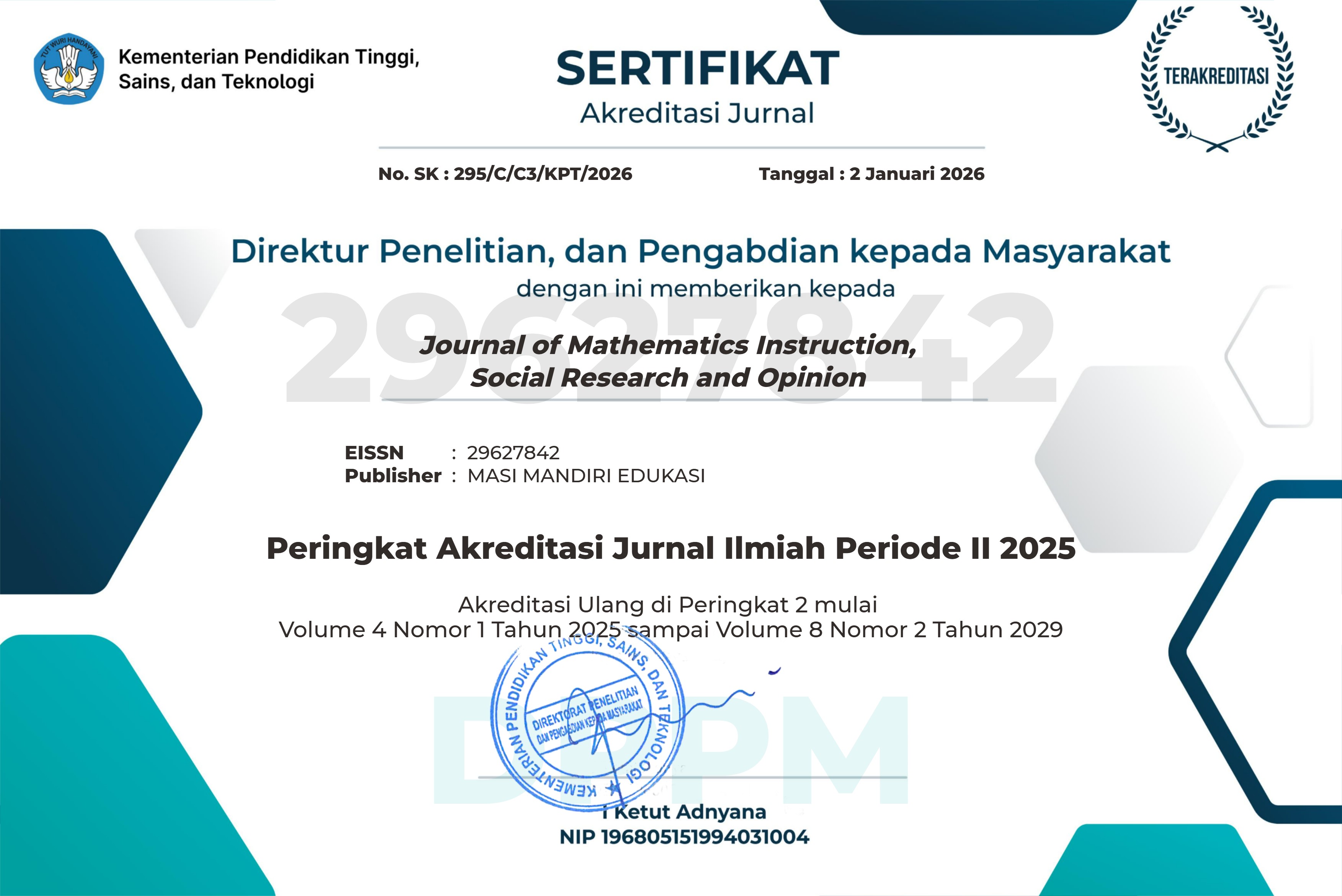
| Accreditation Certificate |
  |
| Indexing |






Contact Us

visitor
| Information |
>> For Authors
>> For Readers
>> For Librarians
| Visitor Statistics |
| Member of |


| Announcement |

| Keywords |
Mathematics Learning Difficulty Dyscalculia Teacher perceptions personality ICT Learning Computer teaching Academic Fisherfolks Economic Behavior Probit Models matrix mathematical model Concepts Guided Note Taking Golden Ratio Philosophy Integrated Learning van Hiele geometry Assessment Learning Outcomes method skills Problem Solving Experiment
| License |

MISRO is licensed under a Creative Commons Attribution-ShareAlike 4.0 International License.
| Publisher |

Address:
Jl. Gagak N0.105, Bandung,
Indonesia 40133
E-mail:
journalmisro@gmail.com
| in collaboration with |

| Recommended Tools |


| ISSN Barcode |

