
The Effect of the Discovery Learning Model Assisted by the Photomath Application on Students’ Critical Thinking Skills in the Topic of Systems of Linear Equations in Two Variables (SPLDV)
DOI:
https://doi.org/10.58421/misro.v5i4.2145Keywords:
Discovery Learning; Photomath; critical thinking skills; SPLDV.Abstract
This study was motivated by students’ low critical thinking skills in solving mathematical problems, particularly in Systems of Linear Equations in Two Variables (SPLDV). This study aimed to determine the effect of the Discovery Learning model assisted by the Photomath application on students’ critical thinking skills. The study used a quantitative approach with a quasi-experimental Nonequivalent Pretest-Posttest Control Group Design. The research was conducted at SMP Negeri 3 Hutaraja Tinggi and involved 38 eighth-grade students: 19 in the experimental class and 19 in the control class, selected through purposive sampling. Data were collected using essay tests based on Facione’s five indicators of critical thinking and analyzed using the N-Gain test and statistical tests. The results showed that the experimental class had an average N-Gain score of 0.8004 (high category), while the control class had 0.3213 (medium category). The hypothesis testing results showed that the t-value (12.375) was greater than the t-table value (2.028), with a significance value of 0.000 < 0.05. Therefore, was rejected and was accepted. It can be concluded that the Discovery Learning model assisted by the Photomath application affects students’ critical thinking skills in the topic of Systems of Linear Equations in Two Variables (SPLDV).
Downloads
References
D. S. Setiana and R. Y. Purwoko, “Analisis Kemampuan Berpikir Kritis Siswa Ditinjau Dari Gaya Belajar,” Edukasi, vol. 7, no. 2, pp. 163–177, 2020.
R. H. Ennis, “Critical Thinking: Reflection and Perspective Part II,” Inq. Crit. Think. across Discip., vol. 26, no. 2, pp. 5–19, 2011.
Facione, “Critical thinking: what it is and why it counts,” Insight Assess., vol. 5, no. 1, pp. 1–23, 2013.
Yani at el., “Pengaruh Model Pembelajaran Problem Based Learning Terhadap Kemampuan Berpikir Kritis dan Pemecahan Masalah,” RELEVAN: JURNAL PENDIDIKAN MATEMATIKA, vol. 4, no. 6, 2024.
Clasrissa, F. L. Rahma, F. Nur, K. Hasibuan, N. Khodijah, and S. Maysarah, “ Analisis Kemampuan Berpikir Kritis Mahasiswa Pendidikan Matematika Dalam Memecahkan Masalah Struktur Aljabar,” Jurnal Matematika dan Pendidikan Matematika, pp. 52–60, 2021, DOI: https://doi.org/10.47662/farabi.v4i1.93.
M. B. Siregar and S. D. Narpila, “Influence of Problem- Based Learning Model on Students ’ Critical Thinking Ability and Learning Motivation in Mathematics Learning,” Jurnal Matematika dan Pendidikan Matematika, vol. 7, pp. 263–274, 2023, DOI: https://doi.org/10.25217/numerical.v7i2.3884.
J. Subiono and W. Wasitohadi, “Efektivitas Model Discovery Learning Dan Inquiry Terhadap Keterampilan Berpikir Kritis Pada Mata Pelajaran Matematika Siswa Kelas 5 Sd,” Jurnal Karya Pendidikan Matematika, vol. 7, no. 1, p. 69, 2020, DOI: https://doi.org/10.26714/jkpm.7.1.2020.69-75.
L. Maydawati, “Sistem Persamaan Linear Dua Variabel dengan Metode Subsitusi dan Eliminasi,” vol. 02, no. 01, pp. 46–50, 2024.
L. Hutagalung and M. Meiliasari, “Kemampuan Berpikir Kritis Siswa Smp Dalam Menyelesaikan Soal Hots Matematika,” JP2M (Jurnal Pendidik. dan Pembelajaran Mat., vol. 11, no. 2, pp. 1157–1169, 2025.
Organisation for Economic Co-operation and Development (OECD), PISA 2025 Results (Volume I): Indonesia. Paris, France: OECD Publishing, 2025.
S. Edi and R. Rosnawati, “Kemampuan Berpikir Kritis Siswa dalam Pembelajaran Matematika Model Discovery Learning,” JNPM (Jurnal Nasional Pendidikan Matematika, vol. 5, no. 2, p. 234, 2021, DOI: http://dx.doi.org/10.33603/jnpm.v5i2.3604.
Kemendikbud, Model-model Pembelajaran. 2017.
Khasinah, "Discovery learning: Definisi, sintaksis, keunggulan dan kelemahan," Jurnal Mudarrisuna: Media Kajian Pendidikan Agama Islam, vol. 11, no. 3, pp. 402–413, 2021.
J. Bruner, The act of discovery. 1961.
F. S. Batubara, F. Rakhmawati, and E. Andhany, “Perbedaan Model Pembelajaran Discovery Learning dan Problem Based Learning terhadap Kemampuan Berpikir Kritis,” RELEVAN: Jurnal Pendidikan Matematika, vol. 4, no. 4, 2024.
Y. Kartika and F. Rakhmawati, “Peningkatan Kemampuan Berpikir Kritis Matematis Siswa Menggunakan Model Inquiry Learning,” vol. 06, no. 03, pp. 2515–2525, 2022, DOI: https://doi.org/10.31004/cendekia.v6i3.1627
R. L. P. Rika Septi Savitri, Ade Mirza, “PEMANFAATAN PHOTOMATH SEBAGAI MEDIA PEMBELAJARAN UNTUK MENINGKATKAN KEMAMPUAN MENYELESAIKAN SOAL SISTEM PERSAMAAN LINEAR TIGA VARIABEL,” Journal Mathematic Eduaction Sigma (JMES), vol. 7, no. 1, pp. 1–10, 2026.
R. D. Oktaviani, T. Ilmiah, N. Sholihah, R. Apriliyani, and I. Fauzi, “Pemanfaatan Aplikasi Photomath Sebagai Media Pemecahan Masalah Matematis,” RANGE Jurnal Pendidikan. Matematika., vol. 4, no. 1, pp. 40–54, 2022, DOI: https://doi.org/10.32938/jpm.v4i1.2539.
F. Thalib, R. A. Jaya, and A. Sudiman, “Pengaruh Penggunaan Aplikasi Photomath Untuk Meningkatkan Pemahaman Siswa Dalam Pembelajaran Sistem Persamaan Linear Dua Variabel,” Jurnal Ilmiah Matematika, vol. 5, no. 2, pp. 192–203, 2024, DOI: https://doi.org/10.63976/jimat.v5i2.623.
L. D. A. cahyan syari, “Pengaruh Penggunaan Aplikasi Photomath Terhadap Kemampuan Pemecahan Masalah Matematis Siswa,” Jurnal Pendidikan Matematika, vol. 32, no. 3, pp. 167–186, 2025, DOI: https://doi.org/10.31539/judika.v8i1.13765.
D. Z. Rotinsulu and T. Listiani, “Peran Guru dalam Meminimalisir Penggunaan Aplikasi Instan PhotoMath di Kelas Matematika,” Edukatif Jurnal Ilmu Pendidikan, vol. 5, no. 5, pp. 1864–1876, 2023, DOI: https://doi.org/10.31004/edukatif.v5i5.4864.
G. L. S. Fatmah, N. A. Nurcahyono, and A. Setiana, “Pengaruh PhotoMath Terhadap Kemampuan Berpikir Kritis Siswa SMP Negeri 3 Sukabumi,” Indiktika Jurnal Inovasi Pendidikan Matematika, vol. 7, no. 2, pp. 477–488, 2025, DOI: 10.31851/indiktika.v7i2.16423.
M. Rifa’i and Yahfizham, “Penggunaan Aplikasi Photomath pada Pembelajaran Matematika: Systematic Literature Review,” LANCAH Jurnal Inovasi dan Tren, vol. 2, no. 2, pp. 587–590, 2024, DOI: https://doi.org/10.35870/ljit.v2i2.2798.
N. Rokan, I. Maharani, and U. A. Lubis, “Pengaruh Model Pembelajaran Discovery Berbantuan Aplikasi Photomath Terhadap Self Efficacy Matematis Siswa MA,” Jurnal Matematika dan Pendidikan Matematika, vol. 8, pp. 45–53, 2024, DOI: https://doi.org/10.47662/farabi.v8i1.867.
R. Fatmawati and T. J. Siregar, “Pengaruh Model Game-based Learning terhadap Kemampuan Berpikir Kritis Matematis Siswa pada Materi Bangun Ruang Sisi Datar,” Jurnal Pendidikan Matematika dan Sains, vol. 14, no. 1, pp. 131–140, 2026, DOI: https://doi.org/10.21831/jpms.v14i1.93601.
J. W. Creswell, Research Design: Qualitative, Quantitative, and Mixed Methods Approaches. 2018.
Arikunto, prosedur penelitian: Suatu pendekatan praktik. 2018.
Asrul, H. saragih, A, and Mukhtar, Evaluasi Pembelajaran. Perdana Publishing, 2022.
Sugiyono, metode Penelitian Pendidikan: Pendekatan Kuantitatif, Kualitatif, dan R&D. 2020.
N. P. Siregar and E. Andhany, "Pengaruh model pembelajaran Numbered Head Together dan Realistic Mathematic Education terhadap kemampuan berpikir kritis dan kemampuan pemecahan masalah matematis siswa di SMA Negeri 11 Medan," AXIOM: Jurnal Pendidikan dan Matematika, vol. 9, no. 1, pp. 99–106, 2020, DOI: http://dx.doi.org/10.30821/axiom.v9i1.7253.
Downloads
Additional Files
Published
How to Cite
Issue
Section
License
Copyright (c) 2026 Journal of Mathematics Instruction, Social Research and Opinion

This work is licensed under a Creative Commons Attribution-ShareAlike 4.0 International License.
SideBar
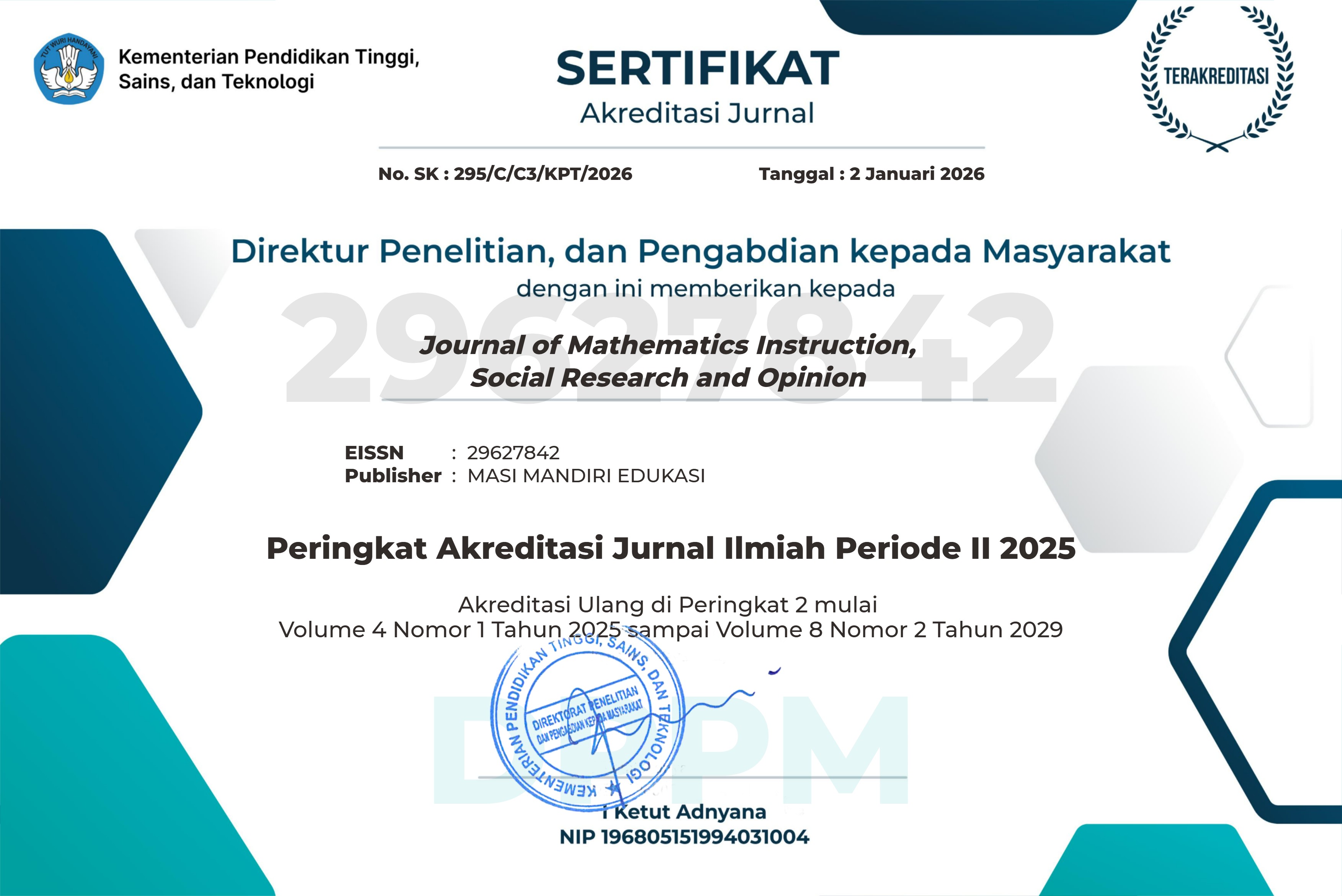
| Accreditation Certificate |
  |
| Indexing |






Contact Us

visitor
| Information |
>> For Authors
>> For Readers
>> For Librarians
| Visitor Statistics |
| Member of |

| Announcement |

| Keywords |
Mathematics Learning Difficulty Dyscalculia Teacher perceptions personality ICT Learning Computer teaching Academic Fisherfolks Economic Behavior Probit Models matrix mathematical model Concepts Guided Note Taking Golden Ratio Philosophy Integrated Learning van Hiele geometry Assessment Learning Outcomes method skills Problem Solving Experiment
| License |

MISRO is licensed under a Creative Commons Attribution-ShareAlike 4.0 International License.
| Publisher |

Address:
Jl. Gagak N0.105, Bandung,
Indonesia 40133
E-mail:
journalmisro@gmail.com
| in collaboration with |

| Recommended Tools |


| ISSN Barcode |

