
The Influence of Self-efficacy on Self-Anxiety Based on Students' Mathematics Learning
DOI:
https://doi.org/10.58421/misro.v2i3.193Keywords:
Self-Anxiety, Self-Efficacy, Mathematic LearningAbstract
Anxiety towards a particular subject is experienced by most students in various schools, especially in mathematics. This research aims to determine the influence of self-efficacy and self-anxiety on mathematics in one of the schools in Cirebon City. The sample was selected using a purposive sampling technique, with a sample size of 40 students, each representing a higher grade. This study employs a quantitative approach. The data analysis techniques used are regression analysis and ANOVA test. The results of the research conclude that self-efficacy does not have a significant influence on self-anxiety in mathematics. Based on the R-Square analysis, a coefficient of determination of 0.238 is obtained, indicating that self-efficacy accounts for 28.5% of the influence on self-anxiety, while other variables influence the remaining 71.5%. Meanwhile, the ANOVA analysis shows a value of ÿ1 of 0.232. This means that each unit increase in the coefficient of self-efficacy will influence 0.232 on self-anxiety. Additionally, ÿ is equals 45.146, which means that if self-efficacy (d) is equal to 0, self-anxiety will be equal to 15.382. Therefore, it can be concluded that self-efficacy does not have a significant influence on self-anxiety in students, particularly in the subject of mathematics.
Downloads
References
M. Mariatun, A. Munir, and C. Metia, “Hubungan Self Efficacy dan Dukungan Keluarga dengan Kecemasan Siswa pada Pelajaran Matematika Sekolah Menegah Atas Negeri 2 Sinabang,” Tabularasa J. Ilm. Magister Psikol., vol. 2, no. 1, pp. 1–7, Jan. 2020, doi: 10.31289/tabularasa.v2i1.281.
Y. Passiatore, S. Pirchio, C. Oliva, A. Panno, and G. Carrus, “Self-efficacy and Anxiety in Learning English as a Foreign Language: Singing in Class Helps Speaking Performance,” ECPS - Educ. Cult. Psychol. Stud., no. 20, Dec. 2019, doi: 10.7358/ecps-2019-020-passi.
K. Chityadewi, “Meningkatkan Hasil Belajar Matematika Pada Materi Operasi Hitung Penjumlahan Pecahan Dengan Pendekatan CTL (Contextual Teaching and Learning),” J. Educ. Technol., vol. 3, no. 3, p. 196, Nov. 2019, doi: 10.23887/jet.v3i3.21746.
A. Fitri, D. Darwan, and A. Muchyidin, “Appliying The Influence of Problem Based Learning (PBL) Applications Using Lectora Inspire Media on Student Problem Solving Ability,” Educ. INSIGHTS, vol. 1, no. 1, pp. 21–29, 2023.
G. Bassi, E. Mancinelli, D. Di Riso, and S. Salcuni, “Parental Stress, Anxiety and Depression Symptoms Associated with Self-Efficacy in Paediatric Type 1 Diabetes: A Literature Review,” Int. J. Environ. Res. Public Health, vol. 18, no. 1, p. 152, Dec. 2020, doi: 10.3390/ijerph18010152.
L. A. Mamolo, “Online Learning and Students’ Mathematics Motivation, Self-Efficacy, and Anxiety in the ‘New Normal,’” Educ. Res. Int., vol. 2022, pp. 1–10, Jan. 2022, doi: 10.1155/2022/9439634.
C. C. Nicolas, A. F. Jorm, M. C. Cardamone‐Breen, K. A. Lawrence, and M. B. H. Yap, “Parental Self‐Efficacy for Reducing the Risk of Adolescent Depression and Anxiety: Scale Development and Validation,” J. Res. Adolesc., vol. 30, no. 1, pp. 249–265, Mar. 2020, doi: 10.1111/jora.12521.
I. L. Kampmann, P. M. G. Emmelkamp, and N. Morina, “Cognitive predictors of treatment outcome for exposure therapy: do changes in self-efficacy, self-focused attention, and estimated social costs predict symptom improvement in social anxiety disorder?,” BMC Psychiatry, vol. 19, no. 1, p. 80, Dec. 2019, doi: 10.1186/s12888-019-2054-2.
Z. Azizi, A. Rezai, E. Namaziandost, and S. Ahmad Tilwani, “The Role of Computer Self-Efficacy in High School Students’ E-Learning Anxiety: A Mixed-Methods Study,” Contemp. Educ. Technol., vol. 14, no. 2, p. ep356, Jan. 2022, doi: 10.30935/cedtech/11570.
P. M. Mayorga Lascano, Á. Jaramillo, and R. Moreta-Herrera, “Ansiedad competitiva y autoeficacia en tenistas de alto rendimiento antes y después de una competencia,” Rev. Guillermo Ockham, vol. 18, no. 1, pp. 45–54, Oct. 2021, doi: 10.21500/22563202.4526.
F. Pajares and D. H. Schunk, “Self-beliefs and school success: Self-efficacy, self-concept, and school achievement,” Perception, vol. 11, no. 2, pp. 239–266, 2001.
C. Moreno, D. Pham, and L. Ye, “Chemistry self-efficacy in lower-division chemistry courses: changes after a semester of instruction and gaps still remain between student groups,” Chem. Educ. Res. Pract., vol. 22, no. 3, pp. 772–785, 2021, doi: 10.1039/D0RP00345J.
N. Naibert, K. D. Duck, M. M. Phillips, and J. Barbera, “Multi-institutional Study of Self-Efficacy within Flipped Chemistry Courses,” J. Chem. Educ., vol. 98, no. 5, pp. 1489–1502, May 2021, doi: 10.1021/acs.jchemed.0c01361.
A. Bandura, N. E. Adams, A. B. Hardy, and G. N. Howells, “Tests of the generality of self-efficacy theory,” Cognit. Ther. Res., vol. 4, no. 1, pp. 39–66, Mar. 1980, doi: 10.1007/BF01173354.
A. Hayat, H. Choupani, and H. Dehsorkhi, “The mediating role of students’ academic resilience in the relationship between self-efficacy and test anxiety,” J. Educ. Health Promot., vol. 10, no. 1, p. 297, 2021, doi: 10.4103/jehp.jehp_35_21.
C. Gençoğlu, E. Şahin, and N. Topkaya, “General Self-Efficacy and Forgiveness of Self, Others, and Situations as Predictors of Depression, Anxiety, and Stress in University Students,” Educ. Sci. Theory Pract., vol. 18, no. 3, pp. 605–626, 2018, doi: 10.12738/estp.2018.3.0128.
J. Choi, M. Gu, S. Oh, and S. Sok, “Relationship between End-of-Life Care Stress, Death Anxiety, and Self-Efficacy of Clinical Nurses in South Korea,” Int. J. Environ. Res. Public Health, vol. 19, no. 3, p. 1082, Jan. 2022, doi: 10.3390/ijerph19031082.
B. Senler, “Pre-service science teachers’ self-efficacy: The role of attitude, anxiety and locus of control,” Aust. J. Educ., vol. 60, no. 1, pp. 26–41, Apr. 2016, doi: 10.1177/0004944116629807.
C. Lemée, G. Fleury-Bahi, and O. Navarro, “Impact of Place Identity, Self-Efficacy and Anxiety State on the Relationship Between Coastal Flooding Risk Perception and the Willingness to Cope,” Front. Psychol., vol. 10, Mar. 2019, doi: 10.3389/fpsyg.2019.00499.
F. Kasapoğlu, “The Relationship Among Spirituality, Self-Efficacy, COVID-19 Anxiety, and Hopelessness During the COVID-19 Process in Turkey: A Path Analysis,” J. Relig. Health, vol. 61, no. 1, pp. 767–785, Feb. 2022, doi: 10.1007/s10943-021-01472-7.
S. Hood et al., “‘I Like and Prefer to Work Alone’: Social Anxiety, Academic Self-Efficacy, and Students’ Perceptions of Active Learning,” CBE—Life Sci. Educ., vol. 20, no. 1, p. ar12, Mar. 2021, doi: 10.1187/cbe.19-12-0271.
T. Aune, E. M. L. Juul, D. C. Beidel, H. M. Nordahl, and R. D. Dvorak, “Mitigating adolescent social anxiety symptoms: the effects of social support and social self-efficacy in findings from the Young-HUNT 3 study,” Eur. Child Adolesc. Psychiatry, vol. 30, no. 3, pp. 441–449, Mar. 2021, doi: 10.1007/s00787-020-01529-0.
J. J. Palestro and M. M. Jameson, “Math self-efficacy, not emotional self-efficacy, mediates the math anxiety-performance relationship in undergraduate students,” Cogn. Brain, Behav. An Interdiscip. J., vol. 24, no. 4, pp. 379–394, Dec. 2020, doi: 10.24193/cbb.2020.24.20.
D. Rozgonjuk, T. Kraav, K. Mikkor, K. Orav-Puurand, and K. Täht, “Mathematics anxiety among STEM and social sciences students: the roles of mathematics self-efficacy, and deep and surface approach to learning,” Int. J. STEM Educ., vol. 7, no. 1, p. 46, Dec. 2020, doi: 10.1186/s40594-020-00246-z.
H. A. Trisnawati, R. Winarni, and S. Yamtinah, “Self-Efficacy in Scientific Literacy Student Ability Based on Gender,” 2020, doi: 10.2991/assehr.k.200129.091.
L. W. Morris, M. A. Davis, and C. H. Hutchings, “Cognitive and emotional components of anxiety: Literature review and a revised worry–emotionality scale.,” J. Educ. Psychol., vol. 73, no. 4, pp. 541–555, 1981, doi: 10.1037/0022-0663.73.4.541.
A. C. P. Harahap et al., “Penggunaan Sosiometri Dalam Layanan Bimbingan Konseling,” El-Mujtama J. Pengabdi. Masy., vol. 3, no. 2, pp. 364–369, Jan. 2023, doi: 10.47467/elmujtama.v3i2.2513.
H. E. Putro, “PKU bagi guru bk smk kota magelang untuk meningkatkan layanan dan kinerja bk melalui analisis sosiometri-sosiogram,” 2018.
P. A. N. C. N. S. Rosidah, “Pemanfaatan Sosiometri Dalam Layanan Bimbingan Dan Konseling Di SMPN 1 Sukajaya,” Prophet. Guid. Couns. J., no. Vol 2, No 2 (2021), pp. 41–46, 2021, [Online]. Available: http://ejournal.uika-bogor.ac.id/index.php/prophetic/article/view/6876/3955.
K. Khoirunnisa and S. Gumiandari, “Menurunkan Stres Akademik Siswa SMA NU Lemahabang dengan Menggunakan Teknik Self Intruction dan Self Efficacy,” JIIP - J. Ilm. Ilmu Pendidik., vol. 6, no. 2, pp. 887–895, Feb. 2023, doi: 10.54371/jiip.v6i2.1590.
R. A. H. Cahyadi, “Pengembangan Bahan Ajar Berbasis Addie Model,” Halaqa Islam. Educ. J., vol. 3, no. 1, pp. 35–42, Jun. 2019, doi: 10.21070/halaqa.v3i1.2124.
S. Umaroh, Y. Yuhana, and A. Hendrayana, “Pengaruh self-efficacy dan kecemasan matematika terhadap kemampuan penalaran matematis siswa SMP,” J. Inov. Dan Ris. Pendidik. Mat, vol. 1, no. 1, pp. 1–15, 2020.
Resti Rahmawati, “Menurunkan gejala kecemasan pada gangguan kecemasan umum dengan cognitive therapy,” Procedia Stud. Kasus dan Interv. Psikol., vol. 10, no. 4, pp. 103–107, Dec. 2022, doi: 10.22219/procedia.v10i4.19184.
S. Imro’ah, W. Winarso, and E. P. Baskoro, “Analisis Gender Terhadap Kecemasan Matematika dan Self Efficacy Siswa,” KALAMATIKA J. Pendidik. Mat., vol. 4, no. 1, pp. 23–36, Apr. 2019, doi: 10.22236/KALAMATIKA.vol4no1.2019pp23-36.
A. Putra and Y. Yulanda, “Kecemasan Matematika Siswa dan Pengaruhnya: Systematic Literature Review,” Didakt. J. Kependidikan; Vol 15, No 1, 2022, doi: 10.30863/didaktika.v15i1.1148.
S. Safiyah and Widyastuti, “The Relationship Between Academic Self-Efficacy and Mathematics Anxiety in Upper Elementary School Students,” Acad. Open, vol. 7, Dec. 2022, doi: 10.21070/acopen.7.2022.5459.
M. TÜRKMENOĞLU and F. YURTAL, “An Investigation of Elementary School Students’ Anxiety Levels Toward Mathematics and Their Perceptions of Self-Efficacy TT - İlkokul Öğrencilerinin Matematiğe Karşı Kaygı Düzeyleri ve Öz-yeterlik Algılarının İncelenmesi,” Cukurova Univ. Fac. Educ. J., vol. 49, no. 2, pp. 628–650, 2020, doi: 10.14812/cuefd.733968.
Y. Mao, R. Yang, M. Bonaiuto, J. Ma, and L. Harmat, “Can Flow Alleviate Anxiety? The Roles of Academic Self-Efficacy and Self-Esteem in Building Psychological Sustainability and Resilience,” Sustainability, vol. 12, no. 7, p. 2987, Apr. 2020, doi: 10.3390/su12072987.
J. T. Ducay and A. D. Alave, “Self Efficacy, anxiety, and academic performance in mathematics of Junior High School students,” Glob. J. Progress. Educ., vol. 11, no. 1, 2021.
S. Sevgi and K. Arslan, “Exploring middle school students mathematics self-efficacy and mathematics anxiety,” Eur. J. Educ. Stud, vol. 7, no. 2, pp. 41–61, 2020.
“Investigating Math Self-Efficacy and Math Anxiety Regarding Gender, A-Level Math Entry Grade and Mathematics Achievement,” J. Educ. Pract., Sep. 2020, doi: 10.7176/JEP/11-26-05.
M. H. Delshad, F. Pourhaji, F. Pourhaji, and H. Azhdari Zarmehri, “The Relationship between Self-Efficacy, Self-Care Behavior, and Generalized Anxiety Disorder in COVID-19: A Path Analysis Model,” Nurse Media J. Nurs., vol. 12, no. 1, pp. 111–121, Apr. 2022, doi: 10.14710/nmjn.v12i1.32938.
N. Razak, “How Self-Efficacy Drives Job Performance: The Role of Job Anxiety and Intrinsic Motivation,” J. Manaj., vol. 25, no. 2, p. 190, Jun. 2021, doi: 10.24912/jm.v25i2.735.
J. Yusof et al., “Self-Efficacy and Anxiety among Undergraduate University Students,” J. Soc. Transform. Reg. Dev., vol. 2, no. 2 SE-Articles, pp. 37–41, Dec. 2020, [Online]. Available: https://publisher.uthm.edu.my/ojs/index.php/jstard/article/view/6166.
E. S. Apriani, I. Somantri, and T. Pahria, “Pengalaman Belajar Mahasiswa Keperawatan dalam Mengikuti Proses Pembelajaran Praktikum di Laboratorium,” J. Nurs. Care, vol. 3, no. 2, Jun. 2020, doi: 10.24198/jnc.v3i2.20583.
W. Anggraini, B. Hudiono, and Hamdan, “Pemberian Umpan Balik (Feedback) Terhadap Hasil Belajar dan Self-Efficacy Matematis Siswa Kelas VII SMP,” J. Pendidik. dan Pembelajaran Khatulistiwa, vol. 4, no. 9, pp. 1–13, 2015.
Downloads
Published
How to Cite
Issue
Section
License
Copyright (c) 2023 Journal of Mathematics Instruction, Social Research and Opinion

This work is licensed under a Creative Commons Attribution-ShareAlike 4.0 International License.
SideBar
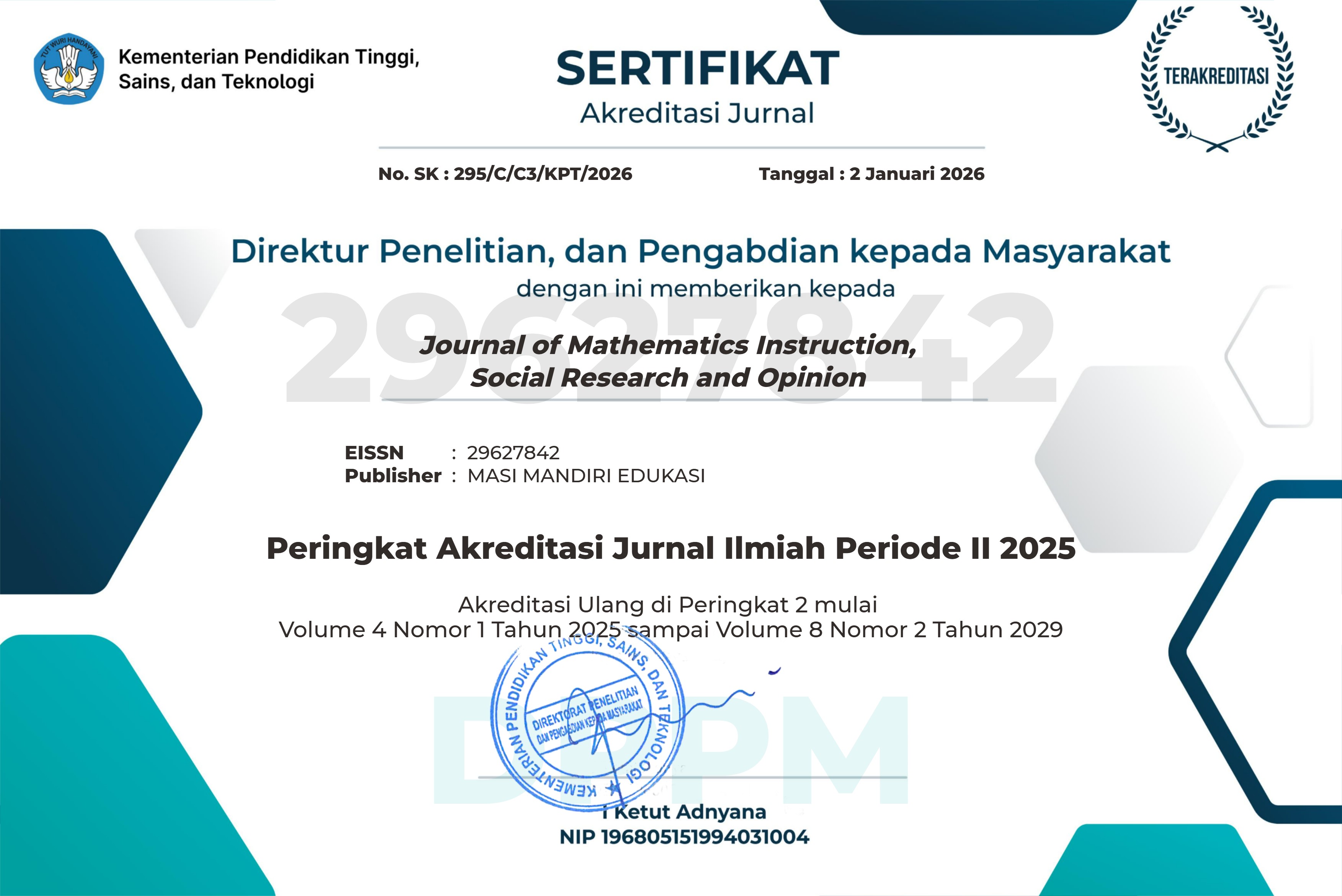
| Accreditation Certificate |
  |
| Indexing |






Contact Us

visitor
| Information |
>> For Authors
>> For Readers
>> For Librarians
| Visitor Statistics |
| Member of |

| Announcement |

| Keywords |
Mathematics Learning Difficulty Dyscalculia Teacher perceptions personality ICT Learning Computer teaching Academic Fisherfolks Economic Behavior Probit Models matrix mathematical model Concepts Guided Note Taking Golden Ratio Philosophy Integrated Learning van Hiele geometry Assessment Learning Outcomes method skills Problem Solving Experiment
| License |

MISRO is licensed under a Creative Commons Attribution-ShareAlike 4.0 International License.
| Publisher |

Address:
Jl. Gagak N0.105, Bandung,
Indonesia 40133
E-mail:
journalmisro@gmail.com
| in collaboration with |

| Recommended Tools |


| ISSN Barcode |

