
Senior High School Mathematics Teachers’ Perception of the Teaching and Learning of Logarithm in the Kwahu East District
DOI:
https://doi.org/10.58421/misro.v3i1.185Keywords:
Logarithm, Mathematics Teachers’ , Motivation, Teacher quality, PerceptionAbstract
The motive of the study was to find factors that influence the teaching and learning of logarithms at the senior High schools in the Kwahu East Municipality. The study employed a descriptive survey where a questionnaire was administered to Eighty-Six (86) teachers. The sample was selected using the Census method. After the SPSS software was used to analyse the data, the descriptive analysis revealed that most teachers positively perceive logarithms. Factors influencing Senior High School mathematics teachers' teaching of logarithm were identified. Teachers believe that suitable teaching methods can influence students' perceptions. Strategies to encourage positive perceptions should be promoted among teachers, and recommendations include developing innovative methods for teaching logarithms in Senior High School mathematics.
Downloads
References
R. Satriawan, N. Endriana, F. A. Irianto, and S. Ahyan, “The Card Logic Logarithm as an Interactive Media in Teaching Logarithm: a Development Study,” J. Phys. Conf. Ser., vol. 1539, no. 1, p. 012080, May 2020, doi: 10.1088/1742-6596/1539/1/012080.
M. Khalid, S. Saad, S. R. Abdul Hamid, M. Ridhuan Abdullah, H. Ibrahim, and M. Shahrill, “Enhancing Creativity and Problem Solving Skills Through Creative Problem Solving in Teaching Mathematics,” Creat. Stud., vol. 13, no. 2, pp. 270–291, May 2020, doi: 10.3846/cs.2020.11027.
I. Ansah, “Improving understanding of logarithms by using the approach of repeated division,” University of Agder, 2016.
J. F. C. Wardle and S. E. Aaron, “How fast are the large-scale jets in quasars? Constraints on both Doppler beaming and intrinsic asymmetries,” Mon. Not. R. Astron. Soc., vol. 286, no. 2, pp. 425–435, Apr. 1997, doi: 10.1093/mnras/286.2.425.
W.-H. Zhu, B. Tryggvason, and J.-C. Piedboeuf, “On active acceleration control of vibration isolation systems,” Control Eng. Pract., vol. 14, no. 8, pp. 863–873, Aug. 2006, doi: 10.1016/j.conengprac.2005.04.016.
E. Cajueiro, R. Kalid, and L. Schnitman, “Using NARX model with wavelet network to inferring the polished rod position,” Int. J. Math. Comput. Simul., vol. 1, no. 6, pp. 66–73, 2012.
Ministry of Education, Teaching Syllabus for Core Mathematics (Senior High School). Accra: Curriculum Research and Development Division (CRDD), 2010.
S. Amoako Atta and W. A. Brantuo, “Digitalising the Teaching and Learning of Mathematics at the Senior High Schools in Ghana; the Case of Flipped Classroom Approach,” Am. J. Educ. Pract., vol. 5, no. 3, pp. 29–37, Dec. 2021, doi: 10.47672/ajep.869.
S. O. BADA, “Fostering Creativity among Children in the 21st Century Classroom: The Emerging Perspectives,” Acad. Res. Int., vol. 6, no. 6, pp. 136–145, 2015.
R. Duit, “The constructivist view in science education - what it has to offer and what should not be expected,” Investig. em Ensino Ciências, vol. 7, no. 1, pp. 40–75, 1996.
S. A. Atta and E. Bonyah, “Designing a flipped classroom instruction to improve plane geometry learning among pre-service teachers in Ghana,” Contemp. Math. Sci. Educ., vol. 4, no. 1, p. ep23004, Jan. 2023, doi: 10.30935/conmaths/12674.
M. N. Kholid, A. Imawati, A. Swastika, S. Maharani, and L. N. Pradana, “How are Students’ Conceptual Understanding for Solving Mathematical Problem?,” J. Phys. Conf. Ser., vol. 1776, no. 1, p. 012018, Feb. 2021, doi: 10.1088/1742-6596/1776/1/012018.
Z. Xu and Y. Shi, “Application of Constructivist Theory in Flipped Classroom — Take College English Teaching as a Case Study,” Theory Pract. Lang. Stud., vol. 8, no. 7, p. 880, Jul. 2018, doi: 10.17507/tpls.0807.21.
D. A. Pierce and L. D. Haugh, “Causality in temporal systems,” J. Econom., vol. 5, no. 3, pp. 265–293, May 1977, doi: 10.1016/0304-4076(77)90039-2.
P. C. van Oorschot and M. J. Wiener, “Parallel collision search with application to hash functions and discrete logarithms,” in Proceedings of the 2nd ACM Conference on Computer and communications security - CCS ’94, 1994, pp. 210–218, doi: 10.1145/191177.191231.
C. B. Liang and E. Wood, “Working with Logarithms: Students’ Misconceptions and Errors,” Math. Educ., vol. 8, no. 2, pp. 53–70, 2005.
R. Kenney and S. Kastberg, “Links in learning logarithms,” Aust. Sr. Math. J., vol. 27, no. 1, pp. 12–20, 2013.
C. Weber, “Making Logarithms Accessible – Operational and Structural Basic Models for Logarithms,” J. für Math., vol. 37, no. S1, pp. 69–98, Jul. 2016, doi: 10.1007/s13138-016-0104-6.
X. A. Newton, H. Jang, N. Nunes, and E. Stone, “Recruiting, Preparing, and Retaining High Quality Secondary Mathematics and Science Teachers for Urban Schools: The Cal Teach Experimental Program,” Issues Teach. Educ., vol. 9, no. 1, pp. 21–40, 2010.
M. du Preez, “The factors influencing Mathematics students to choose teaching as a career,” South African J. Educ., vol. 38, no. 2, May 2018, doi: 10.15700/saje.v38n2a1465.
S. Abramovich, A. Z. Grinshpan, and D. L. Milligan, “Teaching Mathematics through Concept Motivation and Action Learning,” Educ. Res. Int., vol. 2019, pp. 1–13, Apr. 2019, doi: 10.1155/2019/3745406.
I. D. Akpan and M. E. Umobong, “Analysis of Achievement Motivation and Academic Engagement of Students in the Nigerian Classroom,” Acad. J. Interdiscip. Stud., Nov. 2013, doi: 10.5901/ajis.2013.v2n3p385.
B.-M. Kim, A. E.-S. Jeong, and Y.-J. An, “Pedagogical Effect of Learning-Teaching Module of Unit for the Logarithm According to Historico-Genetic Principle,” Sch. Math, vol. 11, no. 3, pp. 431–462, 2009.
Y. D. Arthur, S. Asiedu–Addo, and C. Assuah, “Connecting Mathematics to real life problem using instructor quality and availability, Mathematics facility and teacher motivation for prediction,” Int. J. Sci. Res. Educ., vol. 10, no. 3, pp. 311–324, 2017.
Y. D. Arthur, S. K. Boadu, and B. Asare, “Effects of Peer Tutoring, Teaching Quality and Motivation on Mathematics Achievement in Senior High Schools,” Int. J. Educ. Sci, vol. 37, no. 3, pp. 35–43, 2022.
D. C. Geary, “Cognitive predictors of achievement growth in mathematics: A 5-year longitudinal study.,” Dev. Psychol., vol. 47, no. 6, pp. 1539–1552, 2011, doi: 10.1037/a0025510.
D. Tall, “Using the computer as an environment for building and testing mathematical concepts: A Tribute to Richard Skemp,” 1986, [Online]. Available: https://api.semanticscholar.org/CorpusID:140998286.
S. E. Kastberg, “Understanding mathematical concept: The case of the logarithmic function,” University of Georgia, 2002.
R. R. Skemp, “Relational Understanding and Instrumental Understanding,” Math. Teach., vol. 77, pp. 20–26, 1976.
S. Recber, M. Isiksal, and Y. Koc, “Investigating Self-Efficacy, Anxiety, Attitudes and Mathematics Achievement Regarding Gender and School Type,” An. Psicol., vol. 34, no. 1, p. 41, Dec. 2017, doi: 10.6018/analesps.34.1.229571.
P. A. Amankwah, “Factors Influencing Low Academic Performance in English, Maths and Science in The 2018 WASSCE Examination: A Case Study of Shama Senior High School,” Kwame Nkrumah University of Science and Technology, 2020.
S. Amoako Atta and E. Bonyah, “Teaching Mathematics for Social Justice: The Challenges and the Prospects in The Ghanaian Senior High Schools,” Golden Ratio Soc. Sci. Educ., vol. 3, no. 1, pp. 50–60, May 2023, doi: 10.52970/grsse.v3i1.231.
M. Ohipeni-Ablode, “Validation of The Mathematics Anxiety Rating Scale by Zakariya With Evidence From Senior High School Students in the Asuogyaman District of Ghana,” Kwame Nkrumah University of Science and Technology, 2020.
J. K. Annan, “Preparing Globally Competent Teachers: A Paradigm Shift for Teacher Education in Ghana,” Educ. Res. Int., vol. 2020, pp. 1–9, Sep. 2020, doi: 10.1155/2020/8841653.
A. Knapp, R. Landers, and S. Liang, “How Does Parental Attitude Toward Mathematics Prompt Student,” 2016.
P. J. Esperanza, C. Himang, M. Bongo, E. Selerio Jr., and L. Ocampo, “The utility of a flipped classroom in secondary Mathematics education,” Int. J. Math. Educ. Sci. Technol., vol. 54, no. 3, pp. 382–415, Mar. 2023, doi: 10.1080/0020739X.2021.1957166.
S. A. Silviani, M. Mashuri, and K. Wijayanti, “Algebraic thinking ability of VIIth grade students in mathematics using SAVI learning model,” Unnes J. Math. Educ., vol. 9, no. 2, pp. 154–159, 2020.
Downloads
Published
How to Cite
Issue
Section
License
Copyright (c) 2023 Journal of Mathematics Instruction, Social Research and Opinion

This work is licensed under a Creative Commons Attribution-ShareAlike 4.0 International License.
SideBar
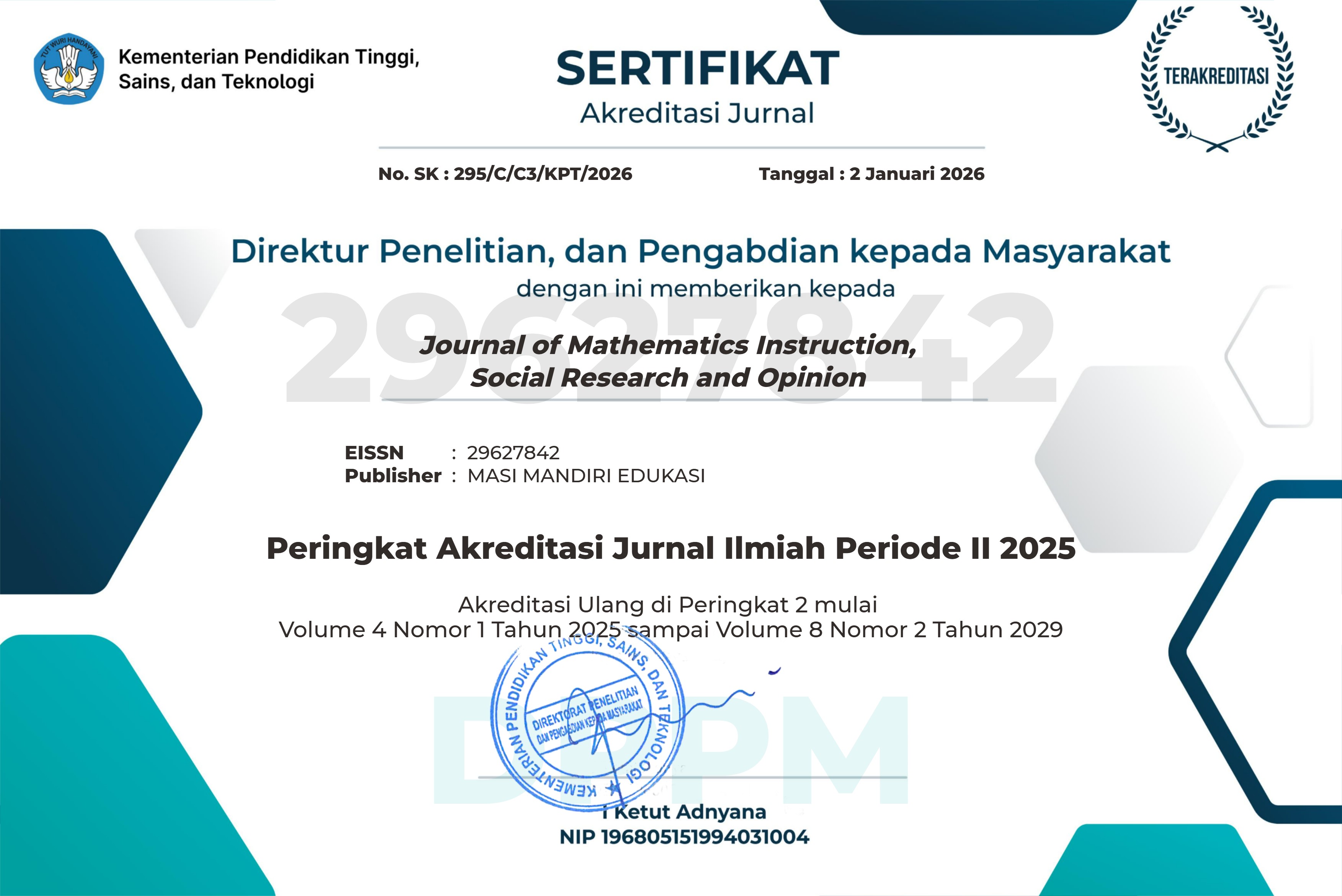
| Accreditation Certificate |
  |
| Indexing |






Contact Us

visitor
| Information |
>> For Authors
>> For Readers
>> For Librarians
| Visitor Statistics |
| Member of |


| Announcement |

| Keywords |
Mathematics Learning Difficulty Dyscalculia Teacher perceptions personality ICT Learning Computer teaching Academic Fisherfolks Economic Behavior Probit Models matrix mathematical model Concepts Guided Note Taking Golden Ratio Philosophy Integrated Learning van Hiele geometry Assessment Learning Outcomes method skills Problem Solving Experiment
| License |

MISRO is licensed under a Creative Commons Attribution-ShareAlike 4.0 International License.
| Publisher |

Address:
Jl. Gagak N0.105, Bandung,
Indonesia 40133
E-mail:
journalmisro@gmail.com
| in collaboration with |

| Recommended Tools |


| ISSN Barcode |

