
Diversity in Elementary Students’ Mathematical Problem-Solving Based on Polya’s Theory
DOI:
https://doi.org/10.58421/misro.v5i2.1661Keywords:
Mathematical problem solving, Polya's theory, Elementary school students, Lots and hots, Mathematics educationAbstract
This study aimed to describe elementary school students’ mathematical problem-solving abilities based on Polya’s problem-solving stages across different problem types (LOTS and HOTS) and school contexts. A descriptive quantitative design was employed involving 95 fourth-grade students from six elementary schools. Data were collected through a mathematical problem-solving test consisting of five essay questions developed according to Polya’s four stages: understanding the problem, devising a plan, carrying out the plan, and looking back. The results showed that students achieved the highest performance in the plan stage (63.68%), followed by understanding the problem (60.05%), while lower achievement was observed in devising a plan (40.11%) and looking back (37.63%). The overall average problem-solving achievement was 50.37%. A comparison between LOTS and HOTS problems revealed that students consistently performed better on LOTS tasks across all Polya stages, whereas HOTS tasks presented substantial difficulties, particularly in planning solution strategies and evaluating answers. These findings indicate that procedural skills still dominate students’ mathematical problem-solving abilities, while strategic reasoning and reflective thinking remain underdeveloped. The study highlights the importance of instructional practices that explicitly support all stages of Polya’s framework through problem-based learning, mathematical justification, guided reflection, and differentiated instruction, thereby strengthening students’ problem-solving abilities.
Downloads
References
E. Yayuk, A. R. As’ari, et al., “Primary School Students’ Creative Thinking Skills in Mathematics Problem Solving,” European Journal of Educational Research, vol. 9, no. 3, pp. 1281–1295, 2020.
N. Ozrecberoglu, S. Aydin, and O. Aydin, “Students’ Skills in Solving Non-Routine Mathematical Problems,” Education Quarterly Reviews, vol. 5, no. 2, 2022.
N. A. Lestari, A. Trisiana, and E. Rizkasari, “Analisis Kemampuan Pemecahan Masalah dalam Menyelesaikan Soal Matematika Materi KPK dan FPB Berbasis HOTS Peserta Didik Kelas IV SD Negeri Ngandul 1 Tahun Pelajaran 2024/2025,” Pendas: Jurnal Ilmiah Pendidikan Dasar, vol. 10, no. 3, pp. 632–642, 2025.
I. Supriatna, W. Wahyudin, T. Turmudi, and H. Yasing, “The Effect of Motivation and Interaction Effects on Improving Mathematical Comprehension Skills Through Problem and Inquiry-Based Learning,” Journal of Integrated Elementary Education, vol. 4, no. 1, pp. 42–53, 2024.
M. Masjaya and W. Wardono, “Pentingnya Kemampuan Literasi Matematika untuk Menumbuhkan Kemampuan Koneksi Matematika dalam Meningkatkan SDM,” in PRISMA, Prosiding Seminar Nasional Matematika, vol. 1, pp. 568–574, 2018.
S. Shanta and J. G. Wells, “T/E Design Based Learning: Assessing Student Critical Thinking and Problem Solving Abilities,” International Journal of Technology and Design Education, vol. 32, no. 1, pp. 267–285, 2022.
A. F. Madzkiyah, S. Arifin, et al., “Students’ Problem-Solving Skills Based on Polya’s Stages,” Indonesian Journal of Mathematics Education, vol. 7, no. 2, pp. 92–100, 2024.
J. Graydon, “New Frontiers: A Systematic Review of Positive Psychology Interventions for College and University Student Mental Health and Well-Being,” 2024.
E. Stiadi, “Analisis Kemampuan Pemecahan Masalah Siswa Kelas V dalam Menyelesaikan Soal HOTS Matematika,” KULIDAWA, vol. 4, no. 1, pp. 1–9, 2023.
I. K. Sari, B. Isdaryanti, and Ellianawati, “Development of Local Wisdom-Based Blended Learning Programs to Improve Students’ Learning Outcomes and Communication Skills,” Jurnal Pendidikan Progresif, vol. 12, no. 1, pp. 336–347, 2022.
É. Fülöp, “Developing Problem-Solving Abilities by Learning Problem-Solving Strategies: An Exploration of Teaching Intervention in Authentic Mathematics Classes,” Scandinavian Journal of Educational Research, vol. 65, no. 7, pp. 1309–1326, 2021.
N. Kania and N. Ratnawulan, “Kompetensi Matematika: Kemampuan Pemecahan Masalah Matematis Siswa Menurut Polya,” Journal of Research in Science and Mathematics Education, vol. 1, no. 1, pp. 17–26, 2022.
D. Thomas and P. Zubkov, “Quantitative Research Designs,” in Quantitative Research for Practical Theology, pp. 103–114, 2023.
A. H. Schoenfeld, “Pólya, Problem Solving, and Education,” Mathematics Magazine, vol. 60, no. 5, pp. 283–291, 1987.
S. A. Shirali, “George Pólya & Problem Solving... An Appreciation,” Resonance, vol. 19, no. 4, pp. 310–322, 2014.
Y. A. Ansya, A. Alfianita, H. P. Syahkira, et al., “Optimizing Mathematics Learning in Fifth Grades: The Critical Role of Evaluation in Improving Student Achievement and Character,” Progres Pendidikan, vol. 5, no. 3, pp. 302–311, 2024.
T. Siregar, “Analysis of Mathematical Literacy Skills Through the Think-Talk-Write (TTW) Model Assisted by GeoGebra in Terms of Students’ Self-Efficacy,” 2025.
F. Ukobizaba, G. Nizeyimana, and A. Mukuka, “Assessment Strategies for Enhancing Students’ Mathematical Problem-Solving Skills: A Review of Literature,” Eurasia Journal of Mathematics, Science and Technology Education, vol. 17, no. 3, 2021.
B. Rittle-Johnson and R. S. Siegler, “The Relation Between Conceptual and Procedural Knowledge in Learning Mathematics: A Review,” in The Development of Mathematical Skills, pp. 75–110, 2022.
A. Schulz, “Assessing Student Teachers’ Procedural Fluency and Strategic Competence in Operating and Mathematizing with Natural and Rational Numbers,” Journal of Mathematics Teacher Education, vol. 27, no. 6, pp. 981–1008, 2024.
G. Polya, How to Solve It. Princeton, NJ, USA: Princeton University Press, 1957.
U. N. Hanifa, S. Prabawanto, and S. Fatimah, “Identification of the Difficulties of Middle School Students in Understanding the Mixed Operations of Integer,” KnE Social Sciences, pp. 534–541, 2024.
F. R. Putri, S. Marmoah, and S. Supianto, “Analyzing Students Mathematical Problem Solving Skills Through HOTS-Based Questions at the Elementary School Level,” Social, Humanities, and Educational Studies (SHES): Conference Series, vol. 7, no. 1, pp. 85–95, 2024.
K. A. Wibawa, I. P. A. A. Payadnya, I. M. Wena, and S. Saelee, “Metacognitive Strategies in Solving Mathematical Realistic Word Problems: A Case of Indonesian Junior High School Learners,” Asian Education and Development Studies, vol. 14, no. 5, pp. 1068–1079, 2025.
S. A. Tachie and J. M. Ramathe, “Metacognition Application: The Use of Chess as a Strategy to Improve the Teaching and Learning of Mathematics,” Education Research International, vol. 2022, no. 1, Art. no. 6257414, 2022.
N. M. I. Yani, I. N. Jampel, and I. W. Widiana, “Strategi Pembelajaran Metakognitif Berbantuan Video Animasi Meningkatkan Kemampuan Berpikir Reflektif Matematika Siswa Sekolah Dasar,” Jurnal Media dan Teknologi Pendidikan, vol. 4, no. 3, pp. 391–401, 2024.
T. Chandran, N. Kamarudin, S. S. Mustakim, L. Silvarajan, and Z. Zaremohzzabieh, “Factors Influencing Teaching Higher-Order Thinking Skills Among Mathematics Teachers in Malaysian Primary Schools,” Pertanika Journal of Social Sciences & Humanities, vol. 31, no. 4, 2023.
K. Koh, O. Chapman, B. Gierus, and K. Stacey, “Assessment of Higher-Level Mathematical Thinking Skills: A Scoping Review,” ZDM–Mathematics Education, vol. 57, no. 4, pp. 665–678, 2025.
D. Li, S. Osman, and N. S. A. Alhassora, “Unlocking Spatial Wisdom: A Polya-Inspired Approach to Strengthening Year 5 Students’ Higher-Order Thinking Skills,” International Journal of Instruction, vol. 18, no. 2, pp. 593–614, 2025.
Y. Melawati, R. Rochmiyati, and N. Nurhanurawati, “A Needs Analysis of HOTS-Based Assessment Instruments for Elementary School Mathematics Learning,” 2022.
S. Gao and J. Wang, “Do Variations of Science Teaching Approaches Make Difference in Shaping Student Content and Problem Solving Achievement Across Different Racial/Ethnic Groups?,” International Journal of Environmental and Science Education, vol. 11, no. 12, pp. 5404–5428, 2016.
D. Panchal, M. Champaneria, A. Agarwal, and M. Shah, “Unlocking the Power of Machine Learning in Education: A Comprehensive Overview of Opportunities and Challenges,” in The Intersection of 6G, AI/Machine Learning, and Embedded Systems, pp.
Downloads
Additional Files
Published
How to Cite
Issue
Section
License
Copyright (c) 2026 Journal of Mathematics Instruction, Social Research and Opinion

This work is licensed under a Creative Commons Attribution-ShareAlike 4.0 International License.
SideBar
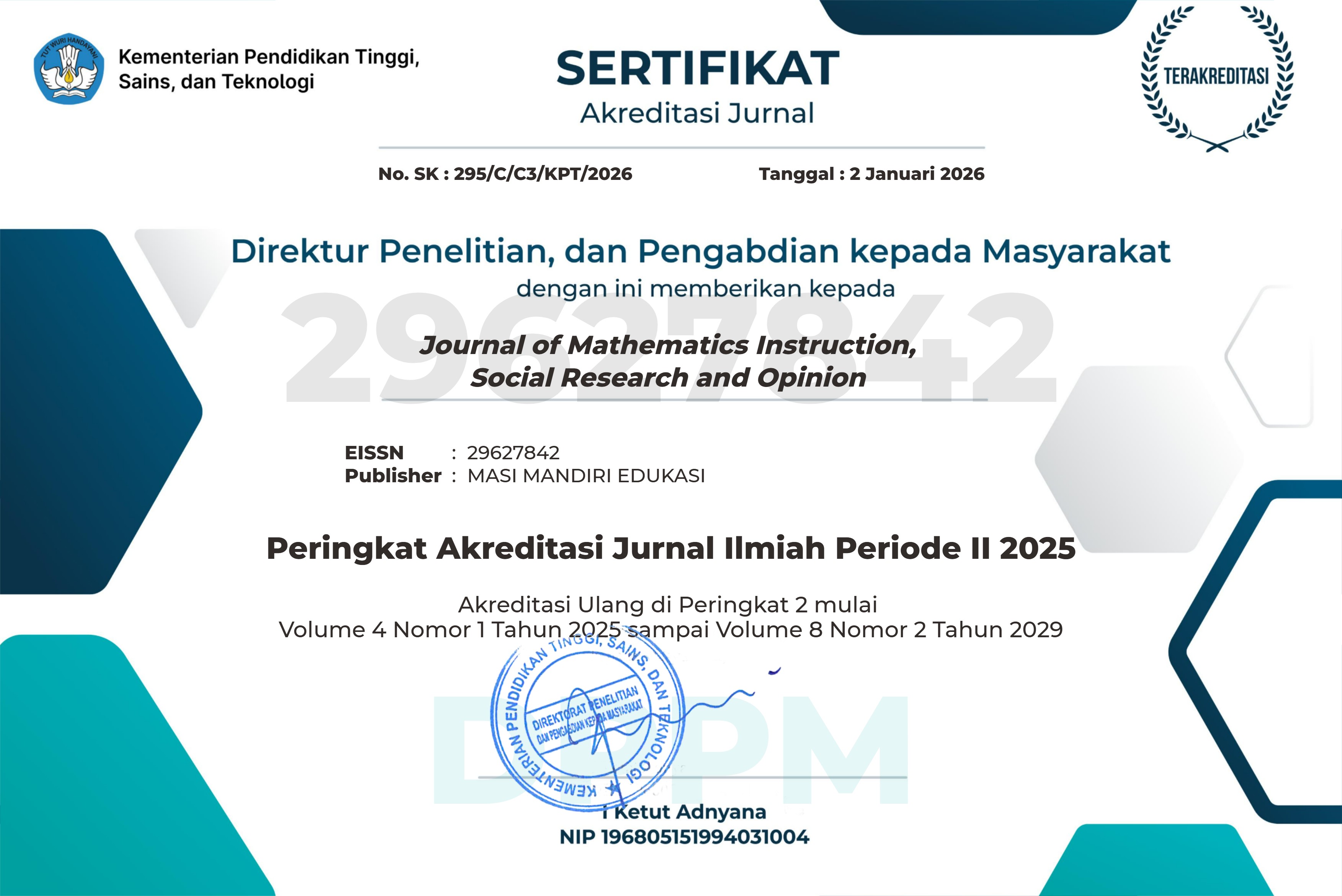
| Accreditation Certificate |
  |
| Indexing |






Contact Us

visitor
| Information |
>> For Authors
>> For Readers
>> For Librarians
| Visitor Statistics |
| Member of |

| Announcement |

| Keywords |
Mathematics Learning Difficulty Dyscalculia Teacher perceptions personality ICT Learning Computer teaching Academic Fisherfolks Economic Behavior Probit Models matrix mathematical model Concepts Guided Note Taking Golden Ratio Philosophy Integrated Learning van Hiele geometry Assessment Learning Outcomes method skills Problem Solving Experiment
| License |

MISRO is licensed under a Creative Commons Attribution-ShareAlike 4.0 International License.
| Publisher |

Address:
Jl. Gagak N0.105, Bandung,
Indonesia 40133
E-mail:
journalmisro@gmail.com
| in collaboration with |
| Recommended Tools |


| ISSN Barcode |

