
The Effect of Mind Mapping Learning Model on Students’ Mathematical Conceptual Understanding of Algebraic Function Derivatives: A Quasi-Experimental Study
DOI:
https://doi.org/10.58421/misro.v5i2.1660Keywords:
Algebraic function derivatives, Conceptual understanding, Mind mappingAbstract
Mathematical conceptual understanding is a fundamental competency in secondary mathematics learning, particularly challenging for topics such as algebraic function derivatives. Limited studies have specifically examined mind mapping as a standalone intervention for this topic at the senior high school level in the Indonesian context. This study examines the effect of the mind mapping learning model on students’ mathematical conceptual understanding of algebraic function derivatives. Quasi-experimental pre-test post-test non-equivalent control group; 42 students (23 experimental, 19 control); five-item essay instrument; Cronbach’s α = 0.78; eight instructional meetings; SPSS 29. The findings indicate = 3.478, p = 0.001, Cohen’s d = 1.07; post-test mean experimental (78.43) vs control (69.05). Mind mapping significantly and practically improved conceptual understanding. Mind mapping is a viable alternative strategy for teachers to deepen conceptual mastery of derivative rules.
Downloads
References
W. A. Hazaymeh, “The effectiveness of visual mind mapping strategy for improving English language learners’ critical thinking skills and reading ability,” Eur. J. Educ. Res., vol. 11, no. 1, pp. 141–153, 2022, doi: 10.12973/eu-jer.11.1.141.
L. Badriah, T. Herman, D. Dasari, and E. Nurlaelah, “Collaborative mind mapping-assisted RICOSRE to promote students’ problem-solving skills,” Particip. Educ. Res., vol. 10, no. 4, pp. 166–180, 2023, doi: 10.17275/per.23.84.10.4.
M. Maamin, S. M. Maat, and Z. H. Iksan, “The influence of student engagement on mathematical achievement among secondary school students,” Mathematics, vol. 10, no. 1, p. 41, 2022, doi: 10.3390/math10010041.
E. A. Padmore, I. M. Gunu, and C. A. Ali, “Availability and use of learning resources for basic school mathematics instruction in Ghana,” J. Math. Instr. Soc. Res. Opin. (MISRO), vol. 4, no. 2, pp. 243–256, 2025, doi: 10.58421/misro.v4i2.376.
M. Sun, M. Wang, R. Wegerif, and J. Peng, “How do students generate ideas together in scientific creativity tasks through computer-based mind mapping?” Comput. Educ., vol. 176, p. 104359, 2022, doi: 10.1016/j.compedu.2021.104359.
S. Ruiz Loza, L. M. Medina Herrera, J. M. Molina Espinosa, and G. Huesca Juárez, “Facilitating mathematical competencies development for undergraduate students during the pandemic through ad-hoc technological learning environments,” Front. Educ., vol. 7, p. 830167, 2022, doi: 10.3389/feduc.2022.830167.
S. M. Hidayani, A. Muchyidin, and A. A. Haqq, “Development of an augmented reality-integrated student worksheet (LKPD) to enhance mathematics learning outcomes,” J. Math. Instr. Soc. Res. Opin. (MISRO), vol. 4, no. 2, pp. 291–304, 2025, doi: 10.58421/misro.v4i2.395.
Y. Zeng, “Effects of mind mapping-based instruction on student cognitive learning outcomes: A meta-analysis,” Asia Pacific Educ. Rev., vol. 24, no. 3, pp. 303–317, Sep. 2022, doi: 10.1007/s12564-022-09746-9.
O. Polat, E. Aksin Yavuz, and A. B. Ozkarabak Tunc, “The effect of using mind maps on the development of maths and science skills,” Cypriot J. Educ. Sci., vol. 12, no. 1, pp. 32–45, 2021, doi: 10.18844/cjes.v12i1.1201.
D. H. Tong and B. P. Uyen, “The efficacy of a four-stage learning model incorporating ACODESA method and mind map in fostering students’ mathematical communication skills,” Front. Educ., vol. 7, p. 1074096, 2022, doi: 10.3389/feduc.2022.1074096.
B. Menouer, L. Faouzi, F. Ou Zennou, M. Sbaa, and B. Nachit, “Effects of employing mind mapping techniques in geometry instruction on logical thinking abilities,” Int. J. Tech. Phys. Probl. Eng. (IJTPE), iss. 60, vol. 16, no. 3, pp. 220–226, Sep. 2024. [Online]. Available: http://www.iotpe.com/IJTPE/IJTPE-2024/IJTPE-Issue60-Vol16-No3-Sep2024/26-IJTPE-Issue60-Vol16-No3-Sep2024-pp220-226.pdf
D. Pujiani and K. N. S. Effendi, “Designing probability learning with volleyball context through a problem-based learning approach in vocational schools,” J. Math. Instr. Soc. Res. Opin. (MISRO), vol. 4, no. 3, pp. 699–712, 2025, doi: 10.58421/misro.v4i3.590.
H. Semilarski, R. Soobard, J. Holbrook, and M. Rannikmae, “Expanding disciplinary and interdisciplinary core idea maps by students to promote perceived self-efficacy in learning science,” Int. J. Sci. Math. Educ., vol. 21, no. 6, pp. 1829–1847, 2023, doi: 10.1007/s10763-022-10305-4.
T. G. K. Bryce and E. J. Blown, “Ausubel’s meaningful learning re-visited,” Curr. Psychol., vol. 43, pp. 7723–7745, 2024, doi: 10.1007/s12144-023-04440-4.
T. Seufert, “The interplay between self-regulation and cognitive load — a research agenda,” Z. Angew. Psychol., vol. 228, no. 1, pp. 10–23, 2020, doi: 10.1027/2151-2604/a000408.
M. Ahmad and S. Wilkins, “Purposive sampling in qualitative research: A framework for the entire journey,” Qual. Quant., vol. 59, pp. 1015–1033, 2025, doi: 10.1007/s11135-024-02022-5.
Y. F. Zakariya, “Cronbach’s alpha in mathematics education research: Its appropriateness, overuse, and alternatives in estimating scale reliability,” Front. Psychol., vol. 13, p. 1074430, 2022, doi: 10.3389/fpsyg.2022.1074430.
D. K. Evans and F. Yuan, “How big are effect sizes in international education studies?” Am. Educ. Res. J., vol. 59, no. 3, pp. 447–468, 2022, doi: 10.3102/01623737221079646.
M. A. Kraft, “Interpreting effect sizes of education interventions,” Educ. Res., vol. 49, no. 4, pp. 241–253, 2020, doi: 10.3102/0013189X20912798.
R. Herheim, “On the origin, characteristics, and usefulness of instrumental and relational understanding,” Educ. Stud. Math., vol. 113, pp. 389–404, 2023, doi: 10.1007/s10649-023-10225-0.
M. Elhilal, “Digital conceptual mapping for enhancing mathematical concept formation and creative mathematical problem-solving through cognitive flexibility skills: A mixed methods study,” Cogent Educ., vol. 12, no. 1, Art. no. 2494945, Apr. 2025, doi: 10.1080/2331186X.2025.2494945.
C. Kefalis, C. Skordoulis, and A. Drigas, “A systematic review of mind maps, STEM education, algorithmic and procedural learning,” Computers (MDPI), vol. 14, no. 6, p. 204, 2025, doi: 10.3390/computers14060204.
D. Fung and T. Liang, “The effectiveness of collaborative mind mapping in Hong Kong primary science classrooms,” Int. J. Sci. Math. Educ., vol. 21, no. 3, pp. 899–922, 2023, doi: 10.1007/s10763-022-10279-1.
Z. Yang, X. Yang, K. Wang, Y. Zhang, G. Pei, and B. Xu, “The emergence of mathematical understanding: Connecting to the closest superordinate and convertible concepts,” Front. Psychol., vol. 12, p. 525493, 2021, doi: 10.3389/fpsyg.2021.525493.
J. Sweller, “The development of cognitive load theory: Replication crises and incorporation into application,” Educ. Psychol. Rev., vol. 36, no. 1, p. 10, 2024, doi: 10.1007/s10648-023-09851-8.
L. M. Medina Herrera, S. Ruiz Loza, J. M. Molina Espinosa, and M. J. Santos Delgado, “Enhancing mathematical education with spatial visualization tools,” Front. Educ., vol. 9, p. 1229126, 2024, doi: 10.3389/feduc.2024.1229126.
Z. C. K. Hawes, K. A. Gilligan-Lee, and K. S. Mix, “Effects of spatial training on mathematics performance: A meta-analysis,” Dev. Psychol., vol. 58, no. 1, pp. 112–137, 2022, doi: 10.1037/dev0001281.
H.-S. Siller and W. Ahmad, “Analyzing the impact of collaborative learning approach on grade six students’ mathematics achievement and attitude towards mathematics,” Eurasia J. Math. Sci. Technol. Educ., vol. 20, no. 3, p. em2421, 2024, doi: 10.29333/ejmste/14153.
M. A. Almulla and M. M. Alamri, “Using conceptual mapping for learning to affect students’ motivation and academic achievement,” Sustainability, vol. 13, no. 7, p. 4029, 2021, doi: 10.3390/su13074029.
Z. Zheng, T. E. Johnson, and C. Zhou, “A pilot study examining the impact of collaborative mind mapping strategy in a flipped classroom: Learning achievement, self-efficacy, motivation, and students’ acceptance,” Educ. Technol. Res. Dev., vol. 68, no. 6, pp. 3527–3545, 2020, doi: 10.1007/s11423-020-09777-7.
Downloads
Additional Files
Published
How to Cite
Issue
Section
License
Copyright (c) 2026 Journal of Mathematics Instruction, Social Research and Opinion

This work is licensed under a Creative Commons Attribution-ShareAlike 4.0 International License.
SideBar
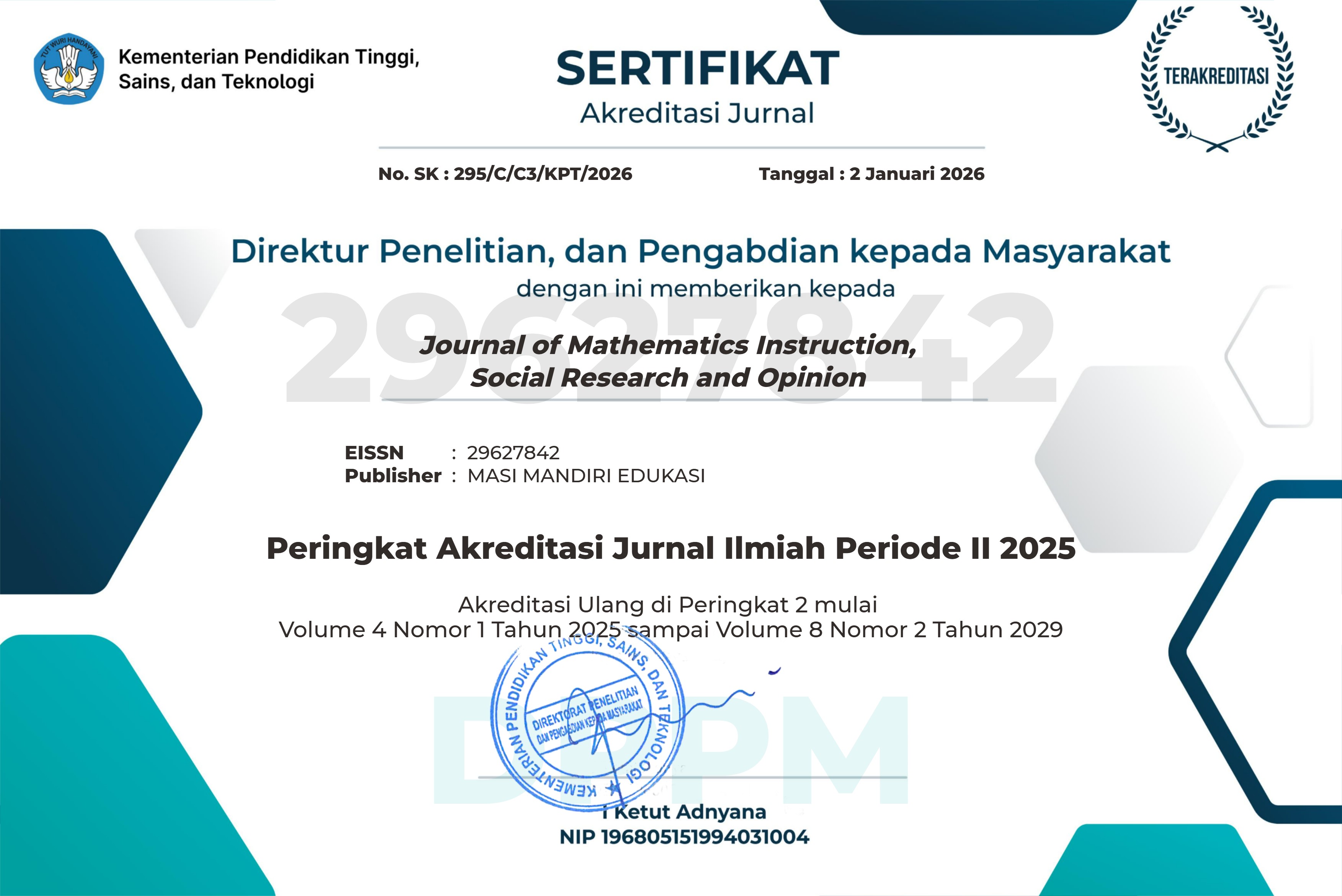
| Accreditation Certificate |
  |
| Indexing |






Contact Us

visitor
| Information |
>> For Authors
>> For Readers
>> For Librarians
| Visitor Statistics |
| Member of |


| Announcement |

| Keywords |
Mathematics Learning Difficulty Dyscalculia Teacher perceptions personality ICT Learning Computer teaching Academic Fisherfolks Economic Behavior Probit Models matrix mathematical model Concepts Guided Note Taking Golden Ratio Philosophy Integrated Learning van Hiele geometry Assessment Learning Outcomes method skills Problem Solving Experiment
| License |

MISRO is licensed under a Creative Commons Attribution-ShareAlike 4.0 International License.
| Publisher |

Address:
Jl. Gagak N0.105, Bandung,
Indonesia 40133
E-mail:
journalmisro@gmail.com
| in collaboration with |

| Recommended Tools |


| ISSN Barcode |

