
Mathematical Aptitude Analysis of Prospective Teachers at the Indian Institute of Teacher Education
DOI:
https://doi.org/10.58421/misro.v3i1.160Keywords:
Mathematics, Aptitude, Mathematical aptitude, EducationAbstract
In this study, the researcher wants to find the mathematical aptitude of future teachers. The sample taken for the study is the teacher trainees of different colleges under the Indian Institute of Teacher Education, and the technique used is a random sampling technique. An investigation that covers the entire population is challenging to carry out. The population's representative subjects must, therefore, be chosen. An examined and observed sample is a subset of a larger population. DIET Gandhinagar, DIET Ahmedabad, Centre for Education, M. N. Shukla College, A.G. teacher's college. The sample is drawn from the 168 prospective teachers (teacher trainees) enrolled; 84 are from the District Institute of Education and Training, and the remaining 84 are from other colleges. The data is collected through a questionnaire as the research tool. Collected data were analyzed by t-test. The findings denoted that there are some differences between mathematical aptitude concerning gender and based on colleges.
Downloads
References
A. Al-Shuaibi, “Education and Its Impact on Economic Growth: A Theoretical and Empirical Review,” J. Soc. Sci., vol. 10, no. 3, pp. 139–146, 2014.
S. K. Mangal, Foundations of Education, Prakash Br. New Delhi, 1990.
F. Cajori, A History of Mathematics. London: The Macmillan Company, 1893.
C. B. Boyer, A History of Mathematics. New York: John Wiley & Sons, 1991.
V. J. Katz, A History of Mathematics: An Introduction. Boston: Addison Wesley, 2009.
M. Kline, Mathematical Thought from Ancient to Modern Times. Oxford: Oxford University Press, 1972.
S. Cornelius, ““Why is Mathematics Regarded by Most People as a Difficult and Dull Subject?,” Educ. Stud. Math., vol. 13, no. 2, pp. 167–173, 1982.
S. Paramananda, The Science of Logical Thinking. Hollywood: Vedanta Press, 2005.
B. Natalie and L. Nebraska, “Logical Intelligence,” in Encyclopedia of Intelligence, Berlin: Springer, 2006, pp. 302–306.
H. C. Warren, Dictionary of Psychology. London: Routledge, 2018.
W. V. Bingham, “Aptitude: A construct or a group of factors,” Psychol. Bull., vol. 34, no. 6, pp. 431–467, 1937.
J. L. Mursell, “Aptitudes and Aptitude Testing,” Am. J. Psychol., vol. 62, no. 4, pp. 542–548, 1949.
D. F. Lohman, “Aptitude Testing,” in Handbook of Child Psychology, New York: John Wiley & Sons, 2006.
H. A. M. Carlton and T. Sydell, “Differential item functioning on 6 types of the scholarship aptitude test in Mathematics for male and female students,” J. Educ. Meas., vol. 30, no. 2, pp. 133–148, 1993.
D. Bhugra and K. Lin, “The construct and criterion validity of the differential aptitude test for assessing minority group students,” Int. J. Soc. Psychiatry, vol. 44, no. 3, pp. 218–224, 1998.
J. T. Nijenhuis, A. Evers, and J. P. Mur, “The Dutch differential aptitude test for assessing minority group students in secondary education,” Eur. J. Psychol. Assess., vol. 16, no. 3, pp. 184–192, 2000.
T. S. Shivakumar and M. Suvarna, “Influence of reasoning ability on mathematical ability of secondary school students in Shimoga district, Karnataka,” Int. J. Sci. Res. Publ., vol. 4, no. 2, pp. 1–6, 2014.
J. Mankar and D. Chavan, “A Study of Differential Aptitude of College Students,” Int. J. Soc. Sci. Interdiscip. Res., vol. 2, no. 9, pp. 51–62, 2013.
G. C. Mahakud, “Relationship between aptitude and intelligence quotient for better career guidance,” Int. J. Soc. Sci. Interdiscip. Res., vol. 2, no. 2, pp. 57–64, 2013.
S. T. Carlton and A. M. Harris, “Characteristics Associated with Differential Item Functioning on the Scholastic Aptitude Test: Gender and Majority/Minority Group Comparisons,” Princeton, 1992.
J. Te Nijenhuis, A. Evers, and J. P. Mur, “Validity of the Differential Aptitude Test for the Assessment of Immigrant Children,” Educ. Psychol., vol. 20, no. 1, pp. 99–115, Mar. 2000, doi: 10.1080/014434100110416.
S. T.S. and M. Suvarna, “A Study On Influence Of Reasoning Ability On Mathematical Ability Of Secondary School Students,” Indian Streams Res. J., vol. 4, 2014.
J. Mankar and D. Chavan, “Differential Aptitude Testing of Youth,” Int. J. Sci. Res. Publ., vol. 3, no. 7, 2013.
G. C. Mahakud, Dyslexia: An Introduction to Reading Disorders. New York: McGraw - Hill, 2013.
K. P. Soman, “Mathematical aptitude and mathematical achievement,” J. Educ. Psychol., vol. 69, no. 3, pp. 238–242, 1977.
J. W. Best and J. V.Kahn, Research in Education. London: Pearson Education, 2017.
J. C. Agarwal, Essentials of research methodology and dissertation writing. New Delhi: Atlantic Publishers & Distributors, 2011.
Downloads
Published
How to Cite
Issue
Section
License
Copyright (c) 2023 Journal of Mathematics Instruction, Social Research and Opinion

This work is licensed under a Creative Commons Attribution-ShareAlike 4.0 International License.
SideBar
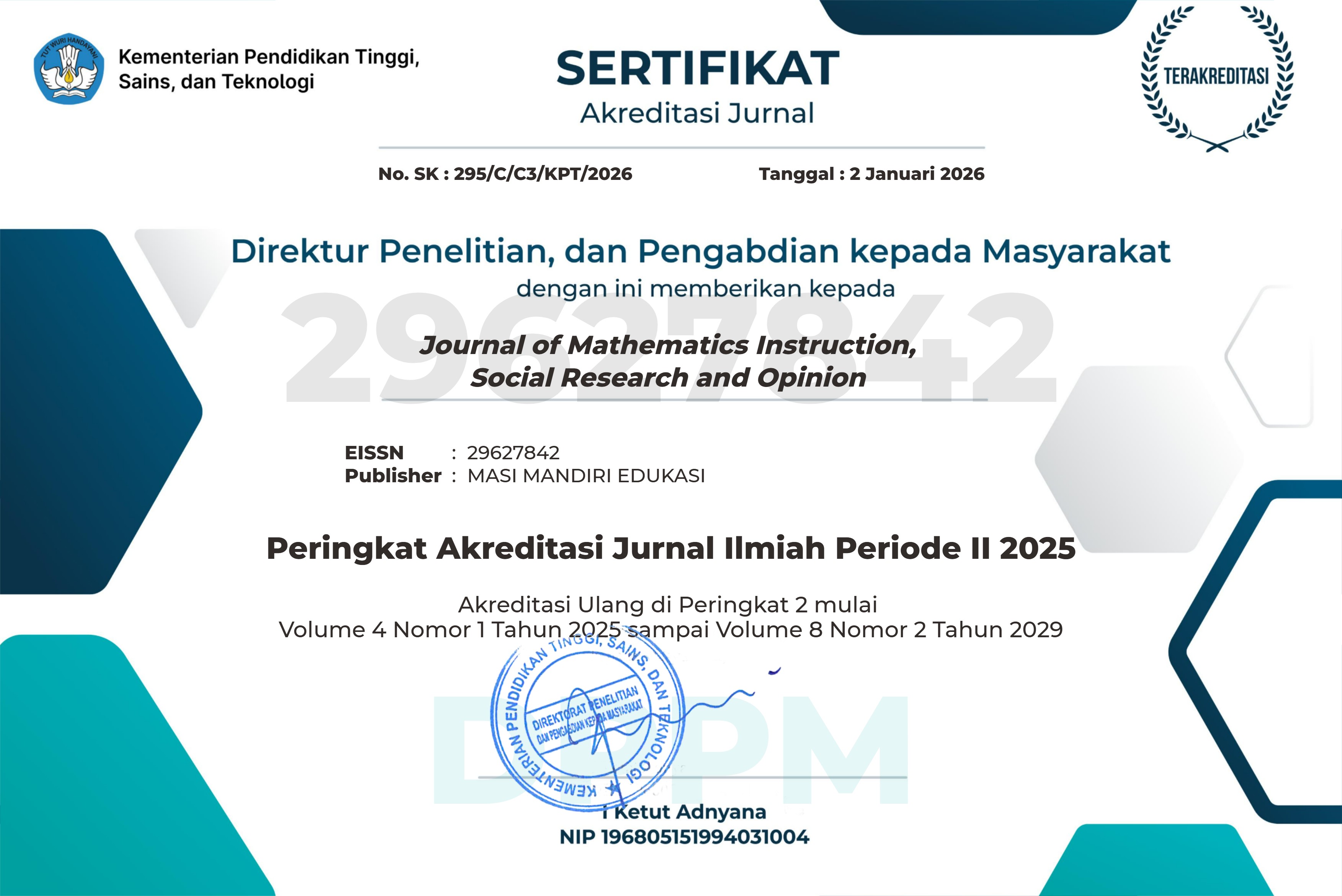
| Accreditation Certificate |
  |
| Indexing |






Contact Us

visitor
| Information |
>> For Authors
>> For Readers
>> For Librarians
| Visitor Statistics |
| Member of |


| Announcement |

| Keywords |
Mathematics Learning Difficulty Dyscalculia Teacher perceptions personality ICT Learning Computer teaching Academic Fisherfolks Economic Behavior Probit Models matrix mathematical model Concepts Guided Note Taking Golden Ratio Philosophy Integrated Learning van Hiele geometry Assessment Learning Outcomes method skills Problem Solving Experiment
| License |

MISRO is licensed under a Creative Commons Attribution-ShareAlike 4.0 International License.
| Publisher |

Address:
Jl. Gagak N0.105, Bandung,
Indonesia 40133
E-mail:
journalmisro@gmail.com
| in collaboration with |

| Recommended Tools |


| ISSN Barcode |

