
Selective Law Enforcement and Tax Revenue Recovery: A Systematic Literature Review and Bibliometric Analysis
DOI:
https://doi.org/10.58421/misro.v5i2.1599Keywords:
Tax law enforcement, Selective law enforcement, Tax compliance, Risk-based audit, Evidence-based policyAbstract
Driven by Indonesia’s low tax ratio and limited enforcement resources, this study integrates fragmented academic research to address the need for evidence-based selective law enforcement policies. Unlike conventional enforcement, selective strategies are critical because they efficiently prioritize cases that maximize state revenue and compliance deterrents. The research aims to map thematic clusters and research gaps while conceptually synthesizing the effectiveness of enforcement in optimizing state revenue. Utilizing a Systematic Literature Review (SLR) guided by the PRISMA approach and bibliometric analysis of 2010–2025 publications, this study offers a novel integration of bibliometrics with evidence-based policy evaluation. Findings show a significant increase in research over the last decade, primarily focused on tax compliance, risk-based audits, and international tax avoidance. However, bibliometric mapping highlights a critical scarcity of empirical studies on selective law enforcement, Preliminary Evidence Investigations, and voluntary disclosure behavior. The synthesis demonstrates that enforcement effectiveness relies heavily on procedural design, legal certainty, taxpayers’ economic capacity, and risk-based strategies. Consequently, this study recommends developing risk-based, selective-enforcement models and expanding empirical research on taxpayer behavioral compliance in Indonesia.
Downloads
References
Stiglitz, J. E., & Rosengard, J. K. (2015). Public Finance and Public Policy (4th ed.). New York, NY: W.W. Norton & Company.
Organisation for Economic Co-operation and Development (OECD). (2023). Revenue Statistics 2023: The OECD Tax Database. Paris: OECD Publishing
Heller, P. S. (2005). Understanding fiscal space. IMF Policy Discussion Paper, PDP/05/4, 1–19.
Organisation for Economic Co-operation and Development (OECD). (2025). Revenue Statistics 2023: The OECD Tax Database. Paris: OECD Publishing
Kaplan, A. (1963). The conduct of inquiry: Methodology for behavioral science. San Francisco, CA: Chandler Publishing
Anderson, J. E. (1994). Public policymaking: An introduction (2nd ed.). Boston, MA: Houghton Mifflin
Dunn, W. N. (2011). Public policy analysis: An introduction (5th ed.). Boston, MA: Pearson.
Dye, T. R. (2013). Understanding public policy (14th ed.). Boston, MA: Pearson.
Buchanan, J. M. (1967). Public finance in democratic process: Fiscal institutions and individual choice. Chapel Hill, NC: University of North Carolina Press
Gruber, J. (2013). Public finance and public policy (4th ed.). New York, NY: Worth Publishers.
Meter, D. S. V., & Van Horn, C. E. (1975). The policy implementation process: A conceptual framework. Administration & Society, 6(4), 445–488.
Parsons, W. (2001). Public policy: An introduction to the theory and practice of policy analysis. Cheltenham: Edward Elgar Publishing
Becker, G. S. (1968). Crime and punishment: An economic approach. Journal of Political Economy, 76(2), 169–217.
Posner, R. A. (2014). Economic analysis of law (9th ed.). New York, NY: Wolters Kluwer.
Davies, H. T. O., Nutley, S. M., & Smith, P. C. (2000). What works? Evidence-based policy and practice in public services. Bristol: Policy Press
Nutley, S. M., Walter, I., & Davies, H. T. O. (2007). Using evidence: How research can inform public services. Bristol: Policy Press.
Head, B. W. (2016). Toward more “evidence-informed” policy making? Public Administration Review, 76(3), 472–484
Howlett, M., Ramesh, M., & Perl, A. (2020). Studying public policy: Principles and processes (4th ed.). Oxford: Oxford University Press
Pawson, R. (2006). Evidence-based policy: A realist perspective. London: Sage Publications.
Allingham, M. G., & Sandmo, A. (1972). Income tax evasion: A theoretical analysis. Journal of Public Economics, 1(3–4), 323–338.
Kahneman, D., & Tversky, A. (1979). Prospect theory: An analysis of decision under risk. Econometrica, 47(2), 263–291.
Ajzen, I. (1991). The theory of planned behavior. Organizational Behavior and Human Decision Processes, 50(2), 179–211
Musgrave, R. A. (1959). The theory of public finance: A study in public economy. New York, NY: McGraw-Hill.
Todaro, M. P., & Smith, S. C. (2015). Economic development (12th ed.). Boston, MA: Pearson
Mankiw, N. G. (2011). Principles of economics (6th ed.). Mason, OH: South-Western Cengage Learning
Page, M. J., McKenzie, J. E., Bossuyt, P. M., Boutron, I., Hoffmann, T. C., Mulrow, C. D., … Moher, D. (2021). The PRISMA 2020 statement: An updated guideline for reporting systematic reviews. BMJ, 372, n71.
Snyder, H. (2019). Literature review as a research methodology: An overview and guidelines. Journal of Business Research, 104, 333–339.
Allingham, M. G., & Sandmo, A. (1972). Income tax evasion: A theoretical analysis. Journal of Public Economics, 1(3–4), 323–338
Slemrod, J. (2019). Tax compliance and enforcement. Journal of Economic Literature, 57(4), 904–954.
Tranfield, D., Denyer, D., & Smart, P. (2003). Towards a methodology for developing evidence-informed management knowledge. British Journal of Management.
Creswell, J. W. (2014). Research design: Qualitative, quantitative, and mixed methods approaches.
Creswell, J. W., & Plano Clark, V. L. (2018). Designing and conducting mixed methods research
Aria, M., & Cuccurullo, C. (2017). Bibliometrix: An R-tool for comprehensive science mapping analysis. Journal of Informetrics, 11(4), 959–975.
Donthu, N., Kumar, S., Mukherjee, D., Pandey, N., & Lim, W. M. (2021). How to conduct a bibliometric analysis: An overview and guidelines. Journal of Business Research, 133, 285–296.
Kitchenham, B., Brereton, P., Budgen, D., Turner, M., Bailey, J., & Linkman, S. (2009). Systematic literature reviews in software engineering – A systematic literature review. Information and Software Technology, 51(1), 7–15.
Cobo, M. J., López-Herrera, A. G., Herrera-Viedma, E., & Herrera, F. (2011). Science mapping software tools: Review, analysis, and cooperative study among tools. Journal of the American Society for Information Science and Technology, 62(7), 1382–1402.
Rudyanto, A., & Pirzada, K. (2021). The role of sustainability reporting in shareholder perception of tax avoidance. Social Responsibility Journal, 17(5), 669–685. https://doi.org/10.1108/SRJ-01-2020.
Tandean, V. A., & Winnie, W. (2016). The effect of good corporate governance on tax avoidance: An empirical study on manufacturing companies listed in IDX period 2010-2013. Asian Journal of Accounting Research, 1(1), 28–38. https://doi.org/10.1108/AJAR-2016-01-01-B004
Kalbuana, N., Taqi, M., Uzliawati, L., & Ramdhani, D. (2023). CEO narcissism, corporate governance, financial distress, and company size on corporate tax avoidance. Cogent Business & Management, 10(1), 2167550. https://doi.org/10.1080/23311975.2023.
Downloads
Additional Files
Published
How to Cite
Issue
Section
License
Copyright (c) 2026 Journal of Mathematics Instruction, Social Research and Opinion

This work is licensed under a Creative Commons Attribution-ShareAlike 4.0 International License.
SideBar
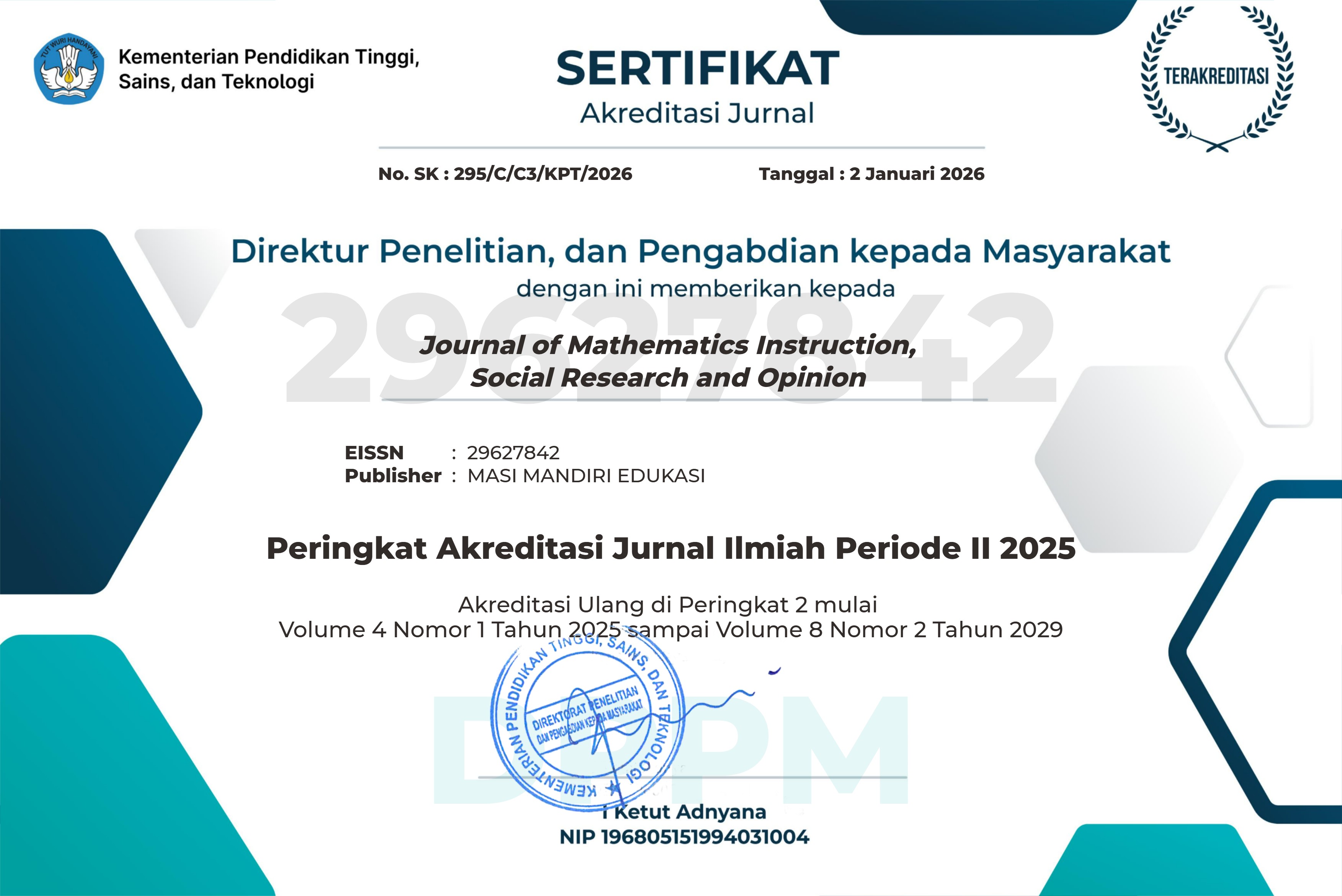
| Accreditation Certificate |
  |
| Indexing |






Contact Us

visitor
| Information |
>> For Authors
>> For Readers
>> For Librarians
| Visitor Statistics |
| Member of |


| Announcement |

| Keywords |
Mathematics Learning Difficulty Dyscalculia Teacher perceptions personality ICT Learning Computer teaching Academic Fisherfolks Economic Behavior Probit Models matrix mathematical model Concepts Guided Note Taking Golden Ratio Philosophy Integrated Learning van Hiele geometry Assessment Learning Outcomes method skills Problem Solving Experiment
| License |

MISRO is licensed under a Creative Commons Attribution-ShareAlike 4.0 International License.
| Publisher |

Address:
Jl. Gagak N0.105, Bandung,
Indonesia 40133
E-mail:
journalmisro@gmail.com
| in collaboration with |

| Recommended Tools |


| ISSN Barcode |

