
Integration of Design Thinking and Quizalize Gamification in Problem Based Learning Numerical Literacy
DOI:
https://doi.org/10.58421/misro.v5i2.1592Keywords:
Problem Based Learning (PBL), Design Thinking, Quizalize, Gamifikasi, Numerical LiteracyAbstract
This study aims to develop and explore a Problem-Based Learning (PBL) instructional design integrated with the Design Thinking framework and the gamification platform Quizalize to support students’ numerical problem-solving skills. The study employed a qualitative exploratory design through the five stages of Design Thinking: empathize, define, ideate, prototype, and test. Data were collected through questionnaires distributed via Google Forms, classroom observations, and interviews involving teachers and students from Al Anfal High School, Al Kamal Sarang Islamic High School, and Al Yaqin Sluke High School. During the empathize stage, the researcher identified students’ learning difficulties, classroom needs, and barriers in numerical problem-solving to formulate a more adaptive instructional design. The novelty of this study lies in integrating Problem-Based Learning, Design Thinking, and Quizalize within a human-centered instructional framework that combines contextual problem-solving, interactive gamification, and instant feedback in mathematics learning. The findings indicate that integrating PBL with Design Thinking encourages more student-centered, collaborative learning, while Quizalize provides immediate feedback and strengthens students’ conceptual understanding during problem-solving activities. Overall, the proposed instructional design shows potential for creating more interactive, adaptive, and meaningful numerical literacy learning experiences.
Downloads
References
M. Muhtarom and N. Nizaruddin, “Analisis kemampuan mahasiswa dalam pengajuan masalah numerasi,” AKSIOMA: Jurnal Program Studi Pendidikan Matematika, vol. 11, no. 4, pp. 3757–3767, 2022, doi: 10.24127/ajpm.v11i4.6036.
M. Muhtarom and N. Nizaruddin, “Analisis Kemampuan Mahasiswa Dalam Pengajuan Masalah Numerasi,” AKSIOMA: Jurnal Program Studi Pendidikan Matematika, vol. 11, no. 4, pp. 3757–3767, 2022, doi: 10.24127/ajpm.v11i4.6036.
D. S. Nahdi, M. G. Jatisunda, U. Cahyaningsih, and V. Suciawati, “Pre-service teacher’s ability in solving mathematics problem viewed from numeracy literacy skills,” Ilkogretim Online, vol. 19, no. 4, 2020, doi: 10.17051/ilkonline.2020.762541.
K. T. Pudjastuti, G. N. S. Agustika, and I. K. N. Wiyasa, “Improving the Numeracy Skills Elementary School Students by Problem Based Learning Model,” MIMBAR PGSD Undiksha, vol. 12, no. 1, pp. 57–63, 2024, doi: 10.23887/jjpgsd.v12i1.69233.
A. D. Pratiwi, A. A. Nugroho, R. D. Setyawati, and S. Raharjo, “Analisis Kemampuan Literasi Numerasi Pada Siswa Kelas IV Di SD Negeri Tlogosari 01 Semarang,” Janacitta, vol. 6, no. 1, pp. 38–47, 2023, doi: 10.35473/jnctt.v6i1.2263.
“PISA 2022: Mathematics Framework.” Accessed: Apr. 11, 2025. [Online]. Available: https://pisa2022-maths.oecd.org/ca/index.html
I. F. Rahmah, A. Irianto, and R. Rachmadtullah, “Problem based learning models to numeracy literacy skills: a study in elementary school,” Journal of Education and Teacher Training Innovation, vol. 1, no. 1, pp. 1–10, 2023, doi: 10.61227/jetti.v1i1.4.
N. Abbas and N. Bito, “Students’ Numeracy Literacy Ability through the Implementation of Problem-Based Learning and STEM Approach,” Technium Social Sciences Journal, vol. 59, no. 1, pp. 40–54, 2024, doi: 10.47577/tssj.v59i1.11098.
L. Masliah, S. D. Nirmala, and S. Sugilar, “Keefektifan model pembelajaran problem based learning (pbl) terhadap kemampuan literasi dan numerasi peserta didik di sekolah dasar,” Jurnal Basicedu, vol. 7, no. 1, pp. 1–10, 2023, doi: 10.31004/basicedu.v7i1.4106.
F. T. Ramadhanti and D. Juandi, “Problem-based learning assisted by GeoGebra and Cabri 3D for understanding of geometrical concepts: A systematic review and meta-analysis,” presented at the AIP Conference Proceedings, AIP Publishing LLC, 2022, p. 070034. doi: 10.1063/5.0102475.
A. K. Fatoni and N. Ainiyah, “Pemanfaatan Media Pembelajaran Berbasis Platform Quizalize Dalam Pembelajaran Bahasa Arab Siswa Kelas VII MTs N 2 Bolaang Mongondow,” Jurnal Al-Mashadir: Journal of Arabic Education and Literature, vol. 4, no. 1, pp. 33–47, 2024, doi: 10.30984/almashadir.v4i1.803.
M. Mahdian et al., “Training Science Teacher Understanding in Creating Science Learning Assessments Using the Quizalize Application,” Bubungan Tinggi: Jurnal Pengabdian Masyarakat, vol. 6, no. 2, pp. 293–299, 2024, doi: 10.20527/btjpm.v6i2.10174.
H. Muizzatissalmi, D. Setiadi, L. Japa, and S. Handayani, “Pengaruh Model Problem Based Learning (PBL) Terintegrasi Design Thinking Terhadap Kemampuan Literasi Biologi Peserta Didik,” Journal of Classroom Action Research, vol. 5, no. 3, pp. 247–251, 2023.
H. Utomo, M. Muhtarom, and I. Dwijayanti, “Eksplorasi Media Interaktif Googles Site Dengan Alur Merdeka Berbasis Design Thinking,” Jurnal Riset dan Inovasi Pembelajaran, vol. 4, no. 1, pp. 42–58, 2024, doi: 10.51574/jrip.v4i1.1262.
T. Lindberg, C. Noweski, and C. Meinel, “Evolving discourses on design thinking: how design cognition inspires meta-disciplinary creative collaboration,” Technoetic Arts, vol. 8, no. 1, pp. 31–37, 2010.
D. Dunne and R. Martin, “Design thinking and how it will change management education: An interview and discussion,” Academy of Management Learning & Education, vol. 5, no. 4, pp. 512–523, 2006, doi: 10.5465/amle.2006.23473212.
M. Muhtarom, S. Sugiyanti, M. S. Zuhri, N. L. D. Mutiara, H. Adrillian, and M. Baldemor, “Development of educational games based on design thinking to improve mathematical thinking skills,” Qalamuna: Jurnal Pendidikan, Sosial, dan Agama, vol. 17, no. 1, pp. 337–350, 2025, doi: 10.37680/qalamuna.v17i1.6203.
A. T. L. Anto, I. Dwijayanti, and A. A. Nugroho, “Exploring learning innovation through design thinking to improve geometry problem-solving skills,” Alifmatika: Jurnal Pendidikan dan Pembelajaran Matematika, vol. 7, no. 2, pp. 275–294, 2025, doi: 10.35316/alifmatika.2025.v7i2.275-294.
I. Hartina, N. Nurmalasari, and T. Hidayat, “Penerapan metode design thinking pada model perancangan UI/UX pada fitur report helpdesk ticketing sistem,” INTI Nusa Mandiri, vol. 17, no. 1, pp. 24–31, 2022, doi: 10.33480/inti.v17i1.3451.
A. Mu’awinah, M. Muhtarom, and I. Purnamasari, “Pengembangan Modul Pembelajaran Matematika Berbasis Kearifan Lokal Untuk Meningkatkan Literasi Numerasi Peserta Didik Sekolah Dasar,” Consilium: Education And Counseling Journal, 2021, [Online]. Available: https://unars.ac.id/ojs/index.php/consilium/article/view/5375
S. A. Nugroho, L. Rohmawati, T. Rahayu, T. F. W. Wicaksono, A. P. Y. Utomo, and D. Prasandha, “Penerapan model ASSURE dengan media QuizAlize dalam pembelajaran mengidentifikasi struktur dan ciri kebahasaan teks berita kelas VII,” Jurnal Kajian Penelitian Pendidikan Dan Kebudayaan, vol. 1, no. 2, pp. 56–67, 2023, doi: 10.59031/jkppk.v1i2.113.
N. Nurjannah, N. Nurfadhilah, N. Nurfiana, and D. Danial, “Pelatihan pemanfaatan aplikasi quizalize dalam pembelajaran siswa di man 2 sinjai,” Catimore: Jurnal Pengabdian Kepada Masyarakat, vol. 2, no. 1, pp. 48–54, 2023, doi: 10.56921/cpkm.v2i1.62.
B. L. Wulandari and M. Hartono, “The effectiveness of using Quizizz and Quizalize media on mathematics learning outcomes of grade IV students,” presented at the 2021 7th International Conference on Education and Technology (ICET), IEEE, 2021, pp. 320–325. doi: 10.1109/ICET53279.2021.9575113.
D. Haryuda, M. Asfi, and R. Fahrudin, “Perancangan UI/UX menggunakan metode design thinking berbasis web pada Laportea Company,” Jurnal Ilmiah Teknologi Infomasi Terapan, vol. 8, no. 1, pp. 111–117, 2021, doi: 10.33197/jitter.vol8.iss1.2021.730.
R. F. Dam and T. Yu. Siang, “Stage 2 in the Design Thinking Process: Define the Problem and Interpret the Results,” 2020.
A. R. A. Sidharta, R. I. Rokhmawati, and D. Priharsari, “Perancangan Learning Management System menggunakan Metode Design Thinking (Studi Kasus: SMK Prajnaparamita Malang),” Jurnal Pengembangan Teknologi Informasi Dan Ilmu Komputer, vol. 6, no. 2, pp. 838–847, 2022.
G. Khairani, R. H. Maulidiah, and I. Isnaini, “Peningkatan Minat Belajar Siswa Melalui Penggunaan Media Digital Quizalize Berbasis Game Pada Pelajaran Bahasa Indonesia Kelas VII-1 SMPN 3 KISARAN,” Bahastra: Jurnal Pendidikan Bahasa dan Sastra Indonesia, vol. 8, no. 2, pp. 149–153, 2024, doi: 10.30743/bahastra.v8i2.8954.
D. Febriansari, S. Sarwanto, and S. Yamtinah, “Konstruksi model pembelajaran STEAM (Science, Technology, Engineering, Arts, and Mathematics) dengan pendekatan design thinking pada materi energi terbarukan,” JINoP (Jurnal Inovasi Pembelajaran), vol. 8, no. 2, pp. 186–200, 2022, doi: 10.22219/jinop.v8i2.22456.
A. K. Fatoni and N. Ainiyah, “Pemanfaatan Media Pembelajaran Berbasis Platform Quizalize Dalam Pembelajaran Bahasa Arab Siswa Kelas VII MTs N 2 Bolaang Mongondow,” Jurnal Al-Mashadir: Journal of Arabic Education and Literature, vol. 4, no. 1, pp. 33–47, 2024, doi: 10.30984/almashadir.v4i1.803.
L. Lutfiyana, F. D. Purwosetiyono, and M. Muhtarom, “Development of digital book STEM with design thinking assisted by augmented reality in improving mathematical literacy abilities,” Mathline: Jurnal Matematika dan Pendidikan Matematika, vol. 10, no. 2, pp. 505–519, 2025, doi: 10.31943/mathline.v10i2.950.
D. Oktaviana and R. Haryadi, “Pengaruh model pembelajaran problem based learning (PBL) terhadap kemampuan pemecahan masalah mahasiswa,” AKSIOMA: Jurnal Program Studi Pendidikan Matematika, vol. 9, no. 4, p. 1076, 2020, doi: 10.31004/basicedu.v7i1.4106.
L. Indriyani, “Pemanfaatan media pembelajaran dalam proses belajar untuk meningkatkan kemampuan berpikir kognitif siswa,” presented at the Prosiding Seminar Nasional Pendidikan FKIP, May 2019, pp. 17–26. [Online]. Available: https://jurnal.untirta.ac.id/index.php/psnp/article/view/5682
R. Jiang et al., “How mathematics anxiety affects students’ inflexible perseverance in mathematics problem-solving: Examining the mediating role of cognitive reflection,” British Journal of Educational Psychology, vol. 91, no. 1, 2021, doi: 10.1111/bjep.12364.
Downloads
Additional Files
Published
How to Cite
Issue
Section
License
Copyright (c) 2026 Journal of Mathematics Instruction, Social Research and Opinion

This work is licensed under a Creative Commons Attribution-ShareAlike 4.0 International License.
SideBar
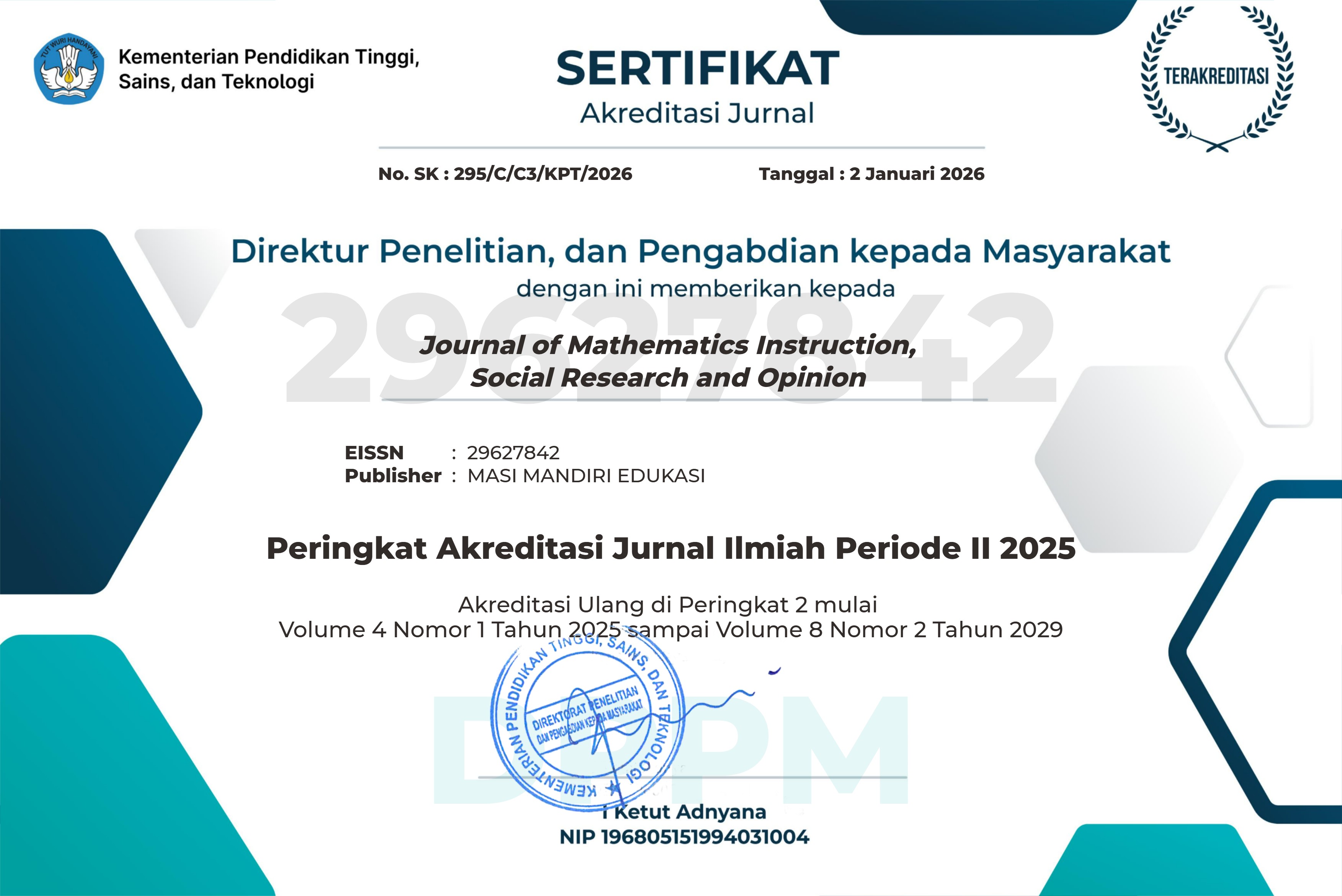
| Accreditation Certificate |
  |
| Indexing |






Contact Us

visitor
| Information |
>> For Authors
>> For Readers
>> For Librarians
| Visitor Statistics |
| Member of |


| Announcement |

| Keywords |
Mathematics Learning Difficulty Dyscalculia Teacher perceptions personality ICT Learning Computer teaching Academic Fisherfolks Economic Behavior Probit Models matrix mathematical model Concepts Guided Note Taking Golden Ratio Philosophy Integrated Learning van Hiele geometry Assessment Learning Outcomes method skills Problem Solving Experiment
| License |

MISRO is licensed under a Creative Commons Attribution-ShareAlike 4.0 International License.
| Publisher |

Address:
Jl. Gagak N0.105, Bandung,
Indonesia 40133
E-mail:
journalmisro@gmail.com
| in collaboration with |

| Recommended Tools |


| ISSN Barcode |

