
Reconstructing Corporate Environmental Sanctions through Ecological Justice in Indonesia
DOI:
https://doi.org/10.58421/misro.v5i2.1582Keywords:
Corporate environmental crime, Corporate liability, Ecological justice, Environmental sanctions, Environmental restoration, IndonesiaAbstract
Corporate environmental crime in Indonesia raises a difficult socio-legal problem: sanctions may punish polluting corporations while damaged ecosystems remain unrestored. This article examines how sanctions against corporate polluters are constructed under Indonesian law and how they should be reconstructed in light of ecological justice. The study uses normative legal research with socio-legal sensitivity, applying statutory, conceptual, and prescriptive approaches to legislation, corporate liability doctrine, environmental sanction provisions, and the ecological justice literature. The findings show that Indonesian law recognises corporate criminal liability and additional sanctions, including restoration, profit confiscation, closure of business activities, fulfilment of neglected obligations, and corporate supervision. However, the framework is weakened by discretionary restoration orders, evidentiary difficulty, institutional fragmentation, and an anthropocentric legal culture. The article contributes a restoration-oriented reconstruction model that places ecological recovery, unlawful gain removal, corporate compliance reform, and executable institutional mechanisms at the centre of environmental punishment. It argues that sanctions should be assessed not merely by their punitive severity, but by their capacity to repair ecological harm and prevent recurrence.
Downloads
References
Intergovernmental Panel on Climate Change, Climate Change 2023: Synthesis Report. Geneva, Switzerland: IPCC, 2023, doi: 10.59327/IPCC/AR6-9789291691647.
World Health Organization, “Ambient air pollution,” World Health Organization, 2024.
World Bank and Asian Development Bank, Climate Risk Country Profile: Indonesia. Washington, DC, USA: World Bank Group and Asian Development Bank, 2021.
United Nations Environment Programme, Environmental Rule of Law: First Global Report. Nairobi, Kenya: UNEP, 2019.
United Nations General Assembly, “The human right to a clean, healthy and sustainable environment,” A/RES/76/300, 2022.
D. R. Boyd, The Environmental Rights Revolution: A Global Study of Constitutions, Human Rights, and the Environment. Vancouver, Canada: UBC Press, 2012.
Republic of Indonesia, The 1945 Constitution of the Republic of Indonesia, 1945.
Republic of Indonesia, Law No. 39 of 1999 concerning Human Rights, 1999.
Republic of Indonesia, Law No. 32 of 2009 concerning Environmental Protection and Management, 2009.
S. S. Simpson, Corporate Crime, Law, and Social Control. Cambridge, UK: Cambridge University Press, 2002.
M. Halsey and R. White, “Crime, ecophilosophy and environmental harm,” Theor. Criminol., vol. 2, no. 3, pp. 345–371, 1998, doi: 10.1177/1362480698002003003.
N. South, “Green criminology: Reflections, connections, horizons,” Int. J. Crime Justice Soc. Democr., vol. 3, no. 2, pp. 5–20, 2014, doi: 10.5204/ijcjsd.v3i2.172.
A. Brisman and N. South, “Green criminology and environmental crimes and harms,” Sociol. Compass, vol. 13, no. 1, Art. no. e12650, 2019, doi: 10.1111/soc4.12650.
R. White, Environmental Harm: An Eco-Justice Perspective. Bristol, UK: Policy Press, 2013, doi: 10.1332/policypress/9781447300403.001.0001.
R. A. Kagan, N. Gunningham, and D. Thornton, “Explaining corporate environmental performance: How does regulation matter?,” Law Soc. Rev., vol. 37, no. 1, pp. 51–90, 2003, doi: 10.1111/1540-5893.3701002.
N. Gunningham, R. A. Kagan, and D. Thornton, “Social license and environmental protection: Why businesses go beyond compliance,” Law Soc. Inq., vol. 29, no. 2, pp. 307–341, 2004.
D. Thornton, N. Gunningham, and R. A. Kagan, “General deterrence and corporate environmental behavior,” Law Policy, vol. 27, no. 2, pp. 262–288, 2005, doi: 10.1111/j.1467-9930.2005.00200.x.
C. Almer and T. Goeschl, “Environmental crime and punishment: Empirical evidence from the German Penal Code,” Land Econ., vol. 86, no. 4, pp. 707–726, 2010, doi: 10.3368/le.86.4.707.
W. B. Gray and J. P. Shimshack, “The effectiveness of environmental monitoring and enforcement: A review of the empirical evidence,” Rev. Environ. Econ. Policy, vol. 5, no. 1, pp. 3–24, 2011, doi: 10.1093/reep/req017.
M. G. Faure and K. Svatikova, “Criminal or administrative law to protect the environment? Evidence from Western Europe,” J. Environ. Law, vol. 24, no. 2, pp. 253–286, 2012, doi: 10.1093/jel/eqs005.
Republic of Indonesia, Supreme Court Regulation No. 13 of 2016 concerning Procedures for Handling Criminal Cases Committed by Corporations, 2016.
Republic of Indonesia, Law No. 1 of 2023 concerning the Criminal Code, 2023.
Republic of Indonesia, Law No. 6 of 2023 concerning the Enactment of Government Regulation in Lieu of Law No. 2 of 2022 concerning Job Creation into Law, 2023.
A. G. Wibisana, M. G. Faure, and R. Majory, “Error in personam: Confusion in Indonesia’s environmental corporate criminal liability,” Crim. Law Forum, vol. 32, no. 2, pp. 247–284, 2021, doi: 10.1007/s10609-021-09412-6.
A. Ogus and C. Abbot, “Sanctions for pollution: Do we have the right regime?,” J. Environ. Law, vol. 14, no. 3, pp. 283–298, 2002, doi: 10.1093/jel/14.3.283.
M. G. Faure and M. Visser, “Law and economics of environmental crime: A survey,” Ger. Work. Pap. Law Econ., vol. 2003, no. 2, Art. no. 2, 2003.
B. J. Preston, “The use of restorative justice for environmental crime,” in EPA Victoria Seminar on Restorative Environmental Justice, 2011.
R. Saputra, A. Usada, and M. S. Islam, “Ecological justice in environmental criminal sanctions for corporations in Indonesia: Problems and solution,” J. Law Environ. Justice, vol. 2, no. 1, pp. 1–17, 2024, doi: 10.62264/jlej.v2i1.19.
D. Schlosberg, “Reconceiving environmental justice: Global movements and political theories,” Environ. Polit., vol. 13, no. 3, pp. 517–540, 2004, doi: 10.1080/0964401042000229025.
C. D. Stone, “Should trees have standing? Toward legal rights for natural objects,” South. Calif. Law Rev., vol. 45, pp. 450–501, 1972.
H. Purnaweni, J. Saputra, A. Roziqin, K. Kismartini, T. Djumiarti, and T. Seitz, “Oil spill governance: Evidence from Bintan Island, Indonesia,” Sustainability, vol. 14, no. 3, Art. no. 1603, 2022, doi: 10.3390/su14031603.
H. Tegnan, A. Suryani, and A. Wibowo, “Mining corruption and environmental degradation in Indonesia: Critical legal issues,” Bestuur, vol. 9, no. 2, pp. 90–100, 2021, doi: 10.20961/bestuur.v9i2.55219.
A. G. Wibisana, “The many faces of strict liability in Indonesia’s wildfire litigation,” Rev. Eur. Comp. Int. Environ. Law, vol. 28, no. 2, pp. 185–196, 2019, doi: 10.1111/reel.12284.
N. Gunningham, “Enforcing environmental regulation,” J. Environ. Law, vol. 23, no. 2, pp. 169–201, 2011, doi: 10.1093/jel/eqr006.
Downloads
Additional Files
Published
How to Cite
Issue
Section
License
Copyright (c) 2026 Journal of Mathematics Instruction, Social Research and Opinion

This work is licensed under a Creative Commons Attribution-ShareAlike 4.0 International License.
SideBar
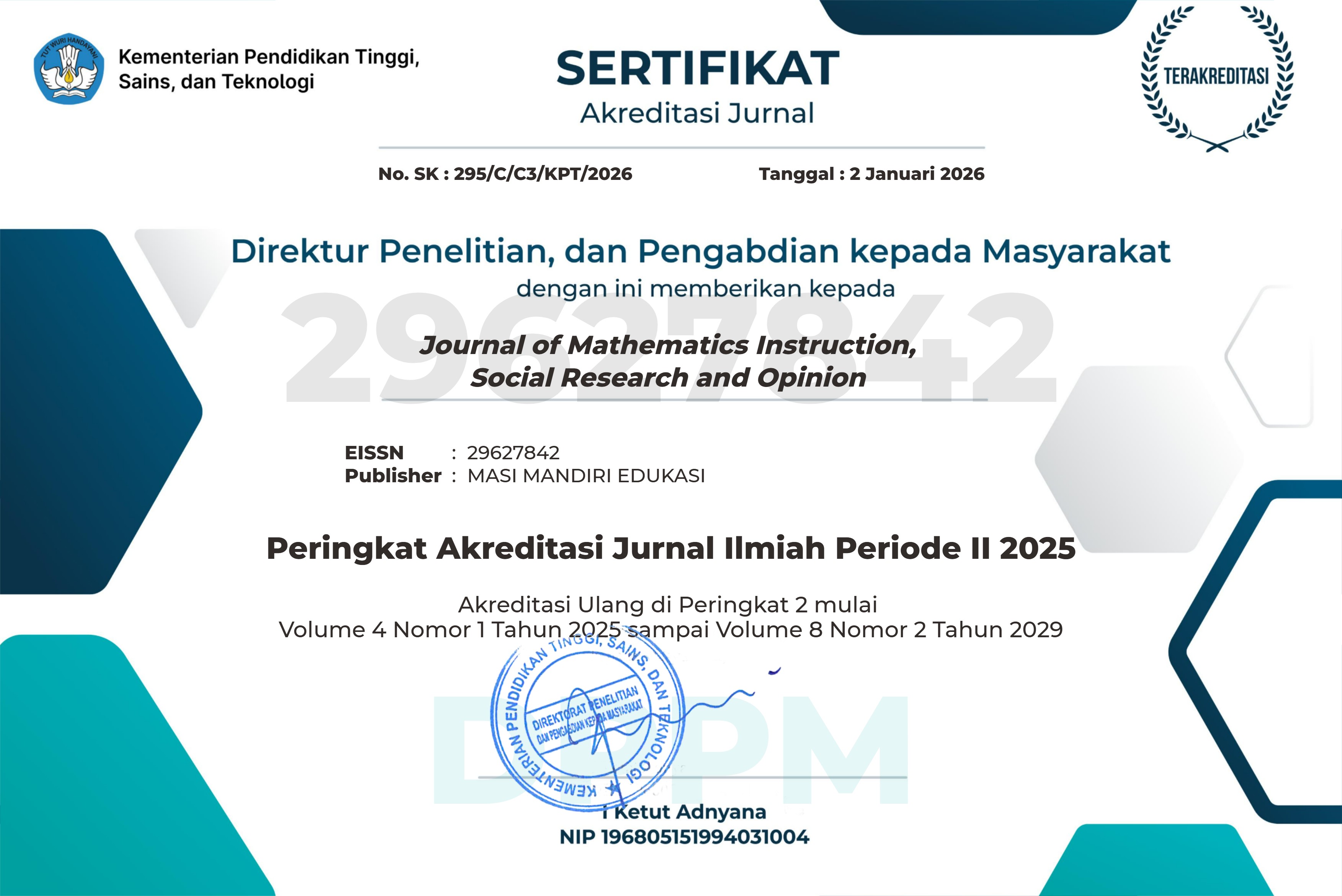
| Accreditation Certificate |
  |
| Indexing |






Contact Us

visitor
| Information |
>> For Authors
>> For Readers
>> For Librarians
| Visitor Statistics |
| Member of |


| Announcement |

| Keywords |
Mathematics Learning Difficulty Dyscalculia Teacher perceptions personality ICT Learning Computer teaching Academic Fisherfolks Economic Behavior Probit Models matrix mathematical model Concepts Guided Note Taking Golden Ratio Philosophy Integrated Learning van Hiele geometry Assessment Learning Outcomes method skills Problem Solving Experiment
| License |

MISRO is licensed under a Creative Commons Attribution-ShareAlike 4.0 International License.
| Publisher |

Address:
Jl. Gagak N0.105, Bandung,
Indonesia 40133
E-mail:
journalmisro@gmail.com
| in collaboration with |

| Recommended Tools |


| ISSN Barcode |

