
An Analysis of Corruption Prevention in Jepara: The Integration of E-Government, Legislative Functions, Legal Integrity, and Local Wisdom
DOI:
https://doi.org/10.58421/misro.v5i2.1550Keywords:
Corruption Prevention, Integration of E-Government, Legislative Functions, Legal Integrity, Local WisdomAbstract
This study investigates a corruption prevention paradox in Jepara Regency, Indonesia, where massive financial crimes persist despite high Monitoring Center for Prevention (MCP) scores and robust Electronic-Government (E-Government) adoption. The research aims to deconstruct the failure of purely technocratic anti-corruption approaches by emphasizing the sociological context of human operators. Utilizing quantitative Path Analysis, this study examines the influence of Legislative Function, Legal Integrity, Local Wisdom, and E-Government Integration on Corruption Prevention. Data was acquired through structured Likert-scale questionnaires distributed to 226 respondents, comprising local government officials, legislative representatives (DPRD), governance experts, and cultural preservation figures. Findings reveal that while E-Government and legislation provide essential regulatory frameworks, Legal Integrity acts as a critical mediator. Furthermore, Local Wisdom, as measured through indicators of Ratu Kalinyamat's meritocratic leadership philosophy and the socio-cultural ethos of Jepara woodcarving, functions as a significant socio-cultural moderator that bridges the gap between theoretical regulation and actual bureaucratic behavior. The novelty of this research lies in its mathematical demonstration that integrating traditional cultural ethics fundamentally enhances the efficacy of modern anti-corruption systems. Ultimately, sustainable local corruption eradication requires a holistic synthesis of digital transparency, legislative accountability, and deep-rooted cultural ethics. These findings urge Indonesian regional governance policymakers to incorporate localized moral frameworks alongside technocratic oversight to achieve genuine bureaucratic reform.
Downloads
References
D. Kaufmann and P. C. Vicente, “Legal corruption,” Econ. Polit., vol. 23, no. 2, pp. 195–219, 2011.
A. Shah and M. Schacter, “Combating Corruption: Look Before You Leap: A lack of progress in eradicating corruption could be due to misguided strategies,” Finance Dev., vol. 41, no. 004, 2004.
J. Hafidz, “Corruption Eradication in the Government’s Goods and/or Service Procurement,” in International Conference on Business Law and Local Wisdom in Tourism (ICBLT 2018), 2018, pp. 104–109.
D. Dinanti and D. D. Y. Tarina, “The Punishment of Perpetrators of Corruption with the Approach of the Local Wisdom (Businesses Looking For an Alternative Model of Criminal in Indonesia),” Int. J. Multicult. Multireligious Underst., vol. 6, no. 7, pp. 32–44, 2019.
E. Hulitt and R. B. Vaughn, “Information system security compliance to FISMA standard: A quantitative measure,” Telecommun. Syst., vol. 45, no. 2–3, pp. 139–152, 2010, doi: 10.1007/s11235-009-9248-8.
L. Chen and A. K. Aklikokou, “Relating e-government development to government effectiveness and control of corruption: a cluster analysis,” J. Chinese Gov., vol. 6, no. 1, pp. 155–173, 2021.
S. Ikhsan, N. N. Afiah, and I. Yudianto, “Analysis of Factors Affecting the Level Of E-Government Implementation in West Java,” JASa (Jurnal Akuntansi, Audit dan Sist. Inf. Akuntansi), vol. 5, no. 1, pp. 123–134, 2021.
D. K. Basyal, N. Poudyal, and J.-W. Seo, “Does E-government reduce corruption? Evidence from a heterogeneous panel data model,” Transform. Gov. People, Process Policy, 2018.
I. K. Mensah and J. Mi, “Computer self-efficacy and e-government service adoption: the moderating role of age as a demographic factor,” Int. J. Public Adm., vol. 42, no. 2, pp. 158–167, 2019.
R. E. Indrajit, A. Zainudin, and D. Rudianto, “Electronic government in action,” Yogyakarta Andi Yogyakarta, 2005.
C. H. Park and K. Kim, “E-government as an anti-corruption tool: Panel data analysis across countries,” Int. Rev. Adm. Sci., vol. 86, no. 4, pp. 691–707, 2020.
A. Wicaksono, “Exploring the roots and solutions of maladministration, power abuse, or corruption in contemporary Indonesian villages,” Pertanika J. Soc. Sci. Humanit., 2024.
E. Asorwoe, “Can e-Government mitigate administrative corruption? An empirical study into the potential role of e-Government in eradicating administrative corruption in sub-Saharan Africa,” Glob. J. Interdisplinary Soc. Sci., vol. 3, no. 4, pp. 41–47, 2014.
K. Anwar, T. Djumiarti, and R. Rihandoyo, “Analisis Faktor-faktor Keberhasilan Elektronik Government Pada Pemerintah Kabupaten Jepara,” J. Public Policy Manag. Rev., vol. 2, no. 4, pp. 87–96, 2013.
M. Muhaimin, S. N. C. Attalina, N. Rofiqoh, F. A. Yasin, and K. Sa’diyah, “Digitalisasi Pendidikan: Pemanfaatan Teknologi AI Dalam Pembelajaran Berdiferensiasi Di SDN 1 Rajekwesi Jepara,” J. Pengabdi. Masy. Bhinneka, vol. 3, no. 4, pp. 826–833, 2025, doi: 10.58266/jpmb.v3i4.270.
A. P. Nasution and I. Malikhah, “Identifikasi Strategi Keberhasilan Layanan E-Goverment Di Kota Medan,” J. Akunt. Bisnis dan Publik, vol. 11, no. 2, pp. 38–45, 2021.
X. Zhao and H. D. Xu, “E-government and corruption: A longitudinal analysis of countries,” Int. J. Public Adm., vol. 38, no. 6, pp. 410–421, 2015.
B. Irfan, “Tantangan Infrastruktur dan Literasi Digital dalam Implementasi E-Government di Wilayah Rural,” J. Digit. Nas., 2024.
A. Jameel, M. Asif, A. Hussain, J. Hwang, N. Sahito, and M. H. Bukhari, “Assessing the moderating effect of corruption on the e-government and trust relationship: An evidence of an emerging economy,” Sustainability, vol. 11, no. 23, p. 6540, 2019.
T. N. Pham, “The role of e-government in fighting against the corruption: A case study of Vietnam,” Quant. Econ. Manag. Stud., vol. 1, no. 5, pp. 335–345, 2020.
J. Caldow, “ON THE MOVE: Mobile e-Gov: No Turning Back to the Swamp,” in World Of E-Government, The, Routledge, 2013, pp. 159–170.
K. D. A. Sari and W. A. Winarno, “Implementasi E-Government System Dalam Upaya Peningkatan Clean And Good Governancedi Indonesia,” J. Ekon. Akunt. dan Manaj., vol. 11, no. 1, 2012.
A. Jalil, “Socializing local wisdom values to the people of Southeast Sulawesi as an effort to prevent corruption,” Asia Pacific Fraud J., vol. 3, no. 1, pp. 51–57, 2018.
N. N. S. P. Verawati and A. Ramdani, “Research trend of local wisdom issues based on scopus journal database: A bibliometric study,” Int. J. Context. Sci. Educ., vol. 1, no. 1, pp. 11–21, 2023.
M. Ishom, K. M. Raharjo, D. Avrilianda, and M. K. Fatihin, “The role of facilitators in community empowerment based on learning community to improve vocational skills,” in International Conference on Information Technology and Education (ICITE 2021), 2021, pp. 156–159.
D. Avrilianda, “Sumbangsih Pendidikan Non Formal Melalui e-Branding Pariwisata Untuk Keberdayaan Masyarakat Banyuwangi,” J. Pendidik. Nonform., vol. 20, no. 1, pp. 1–12, 2025.
S. Zuhri, “Bibliometric Analysis of Human Development and Local Wisdom: Global Trends and Insights,” J. Inf. Syst. Res. Pract., vol. 2, no. 3, pp. 2–15, 2024.
M. S. Ahmad and N. B. Abu Talib, “Analysis of Community Empowerment on Projects Sustainability: Moderating Role of Sense of Community,” Soc. Indic. Res., vol. 129, no. 3, pp. 1039–1056, 2016, doi: 10.1007/s11205-014-0781-9.
E. Widianto, K. M. Raharjo, and D. Avrilianda, “Indigenous Learning Pantun and Gurindam Traditions in the Malay Community Penyengat Island Tanjung Pinang, Kepulauan Riau, Indonesia,” in 1st International Conference on Continuing Education and Technology (ICCOET 2021), 2021, pp. 212–216.
F. K. Stage, H. C. Carter, and A. Nora, “Path analysis: An introduction and analysis of a decade of research,” J. Educ. Res., vol. 98, no. 1, pp. 5–13, 2004.
G. D. Garson, Path analysis. Statistical Associates Publishing Asheboro, NC, 2013.
Downloads
Additional Files
Published
How to Cite
Issue
Section
License
Copyright (c) 2026 Journal of Mathematics Instruction, Social Research and Opinion

This work is licensed under a Creative Commons Attribution-ShareAlike 4.0 International License.
SideBar
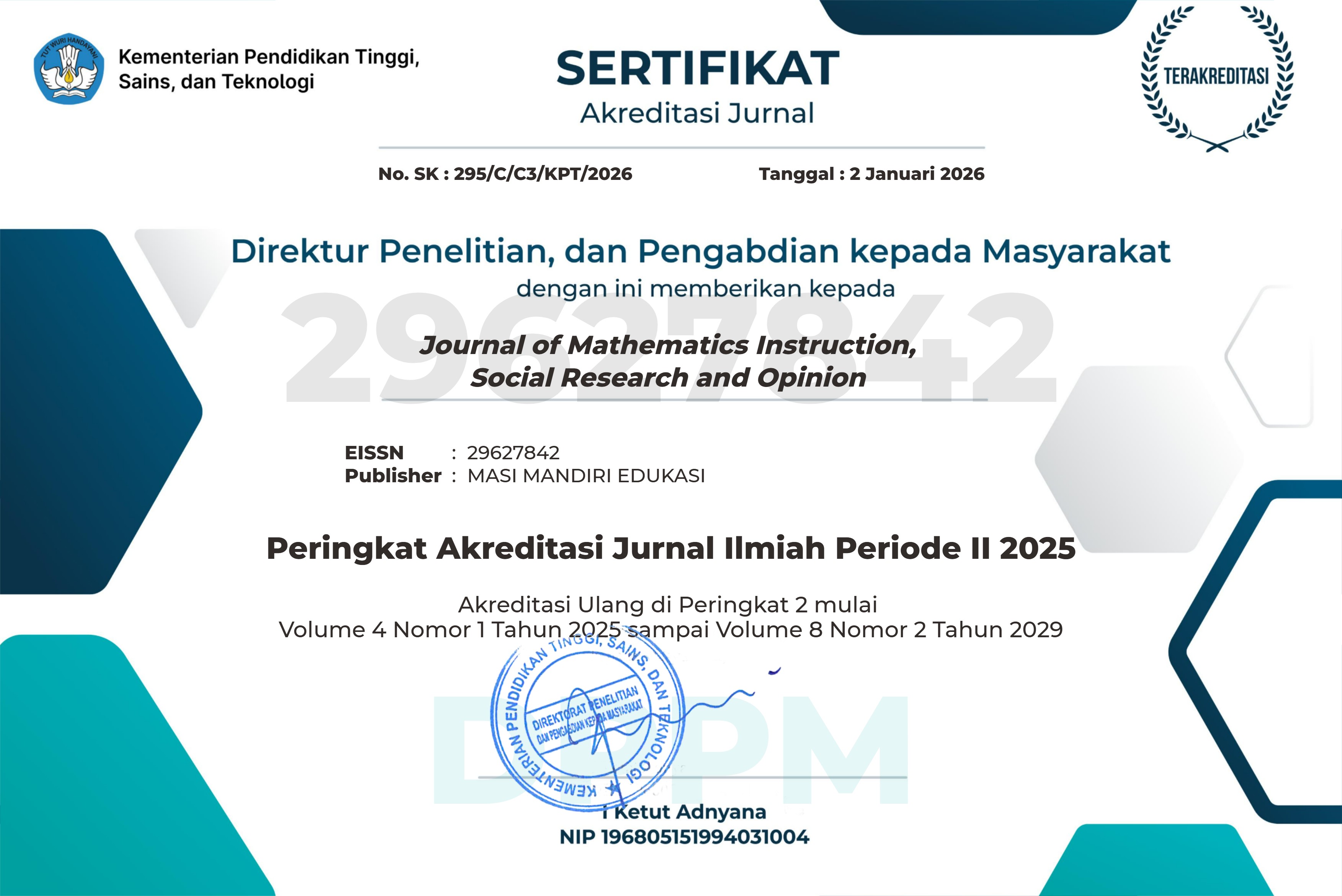
| Accreditation Certificate |
  |
| Indexing |






Contact Us

visitor
| Information |
>> For Authors
>> For Readers
>> For Librarians
| Visitor Statistics |
| Member of |

| Announcement |

| Keywords |
Mathematics Learning Difficulty Dyscalculia Teacher perceptions personality ICT Learning Computer teaching Academic Fisherfolks Economic Behavior Probit Models matrix mathematical model Concepts Guided Note Taking Golden Ratio Philosophy Integrated Learning van Hiele geometry Assessment Learning Outcomes method skills Problem Solving Experiment
| License |

MISRO is licensed under a Creative Commons Attribution-ShareAlike 4.0 International License.
| Publisher |

Address:
Jl. Gagak N0.105, Bandung,
Indonesia 40133
E-mail:
journalmisro@gmail.com
| in collaboration with |

| Recommended Tools |


| ISSN Barcode |

