
Profiling Pseudo-True and Pseudo-False Thinking in Solving One-Variable Linear Equations Among Junior High Students
DOI:
https://doi.org/10.58421/misro.v5i4.1458Keywords:
LEOV, Pseudo Thinking, Qualitative StudyAbstract
Linear equations in one variable (LEOV) are among the first algebra topics taught in junior high school. A correct written answer on this topic does not guarantee that a student understands it, and a wrong answer does not prove that the student does not. Research on pseudo thinking has mostly examined other topics and has rarely compared students' written work with their oral reasoning on LEOV word problems. This study aimed to profile the pseudo-true and pseudo-false thinking of eighth-grade students when solving contextual LEOV problems. A qualitative descriptive design was used with 34 eighth-grade students at SMP Negeri 6 Jambi City. Data were collected through a written test of two contextual LEOV problems, semi-structured interviews, and documentation. Three students were selected purposively for in-depth analysis, and the data were analyzed through data reduction, data display, and conclusion drawing, with triangulation between test and interview data. Two of the three subjects showed pseudo-false thinking: their written solutions were wrong or inconsistent, but in the interviews they could explain how the information in the problems was related and which steps should have been taken. The third subject showed pseudo-true thinking, writing correct solutions without being able to justify the steps. Judging students only by their final answers would have misread all three. The study offers an indicator-based profile of pseudo thinking for LEOV word problems and suggests that teachers combine written tasks with explanation prompts or short reasoning interviews when assessing students.
Downloads
References
Nizaruddin, “International Journal Of Educational Methodology Transforming Students ’ Pseudo -Thinking Into Real Thinking In Mathematical Problem Solving,” Vol. 9, No. 3, Pp. 477–491, 2023.
S. Qetrani, S. Ouailal, And N. Achtaich, “Enhancing Students ’ Conceptual And Procedural Knowledge Using A New Teaching Approach Of Linear Equations Based On The Equivalence Concept,” Vol. 17, No. 7, 2021.
M. W. Winanda, “Analisis Faktor-Faktor Yang Mempengaruhi Kesulitan Belajar,” P. 5, 2016.
& S. P. Yusuf Adhitya, Wahyudin, “Students’ Pseudo-Thinking In Solving The Area Of Obtuse Triangles: A Mindset- Based Perspective,” Vol. 15, No. 2, Pp. 161–176, 2025.
A. Maqruf And T. Herman, “The Characteristics Of Real And Pseudo-True Thinking In Stem Students ’ Analytical Thinking Process In Solving Set Problems,” Vol. 14, No. 1, Pp. 28–41, 2025.
T. Nusantara, “Thinking Process Of Pseudo Construction In Mathematics Concepts,” Vol. 9, No. 2, Pp. 17–31, 2016, Doi: 10.5539/Ies.V9n2p17.
L. M. And Abdussakir, “Restructuring Of Students ’ Thinking In Junior High School Through Defragmentation For Solving,” Vol. 10, No. 2, 2021.
T. Wibowo, R. Y. Purwoko, And T. Swaraswati, “Analisis Berpikir Pseudo Siswa Iq Normal Dalam,” Vol. 4, Pp. 115–127, 2019.
M. Tohir And M. Maswar, “Pseudo Thinking Process In Understanding The Concept Of Exponential Equations Pseudo Thinking Process In Understanding The Concept Of Exponential Equations”, Doi: 10.1088/1742-6596/1808/1/012043.
And A. S. Hilwatut Tilawah, Nurcholif Diah Sri Lestari, Didik Sugeng Pambudi, Susanto, “Pseudo-Construction Errors In Solving Number Pattern Problems Based On Apos Theory,” Vol. 15, No. 1, Pp. 34–52, 2024.
D. N. Hilawati, D. Kurniati, N. S. Lestari, And D. S. Pambudi, “International Journal Of Current Science Research And Review Pseudo Students ’ Thinking Process In Solving Function Composition Inverse Problems Based On Piaget ’ S Theory Corresponding Author : Dinda Nurma Hilawati Corresponding Author : Dinda Nurma Hilawati,” Vol. 09, No. 01, Pp. 436–446, 2026, Doi: 10.47191/Ijcsrr/V9-I1-57.
C. Hurst And D. Hurrell, “Multiplicative Thinking : ‘ Pseudo-Procedures ’ Are Enemies Of Conceptual Understanding,” Vol. 15, No. 3, 2020.
M. Q. Zuhriawan And S. Faizah, “Characterization Of Primary School Students ’ Perceptions In Understanding Negative Integer,” Vol. 16, No. 2, Pp. 171–184, 2024.
A. Syahraini And N. Priatna, “Students ’ Pseudo-Thinking Process In Solving Spldv Problems Based On Polya ’ S Stages,” Vol. 9, No. 1, Pp. 12–21, 2023, Doi: 10.15575/Ja.V9i1.26543.
T. K. Safira And K. Anwar, “Analysis Of Pseudo Thinking Process Skills In Elementary School Students Through,” Vol. 9, No. 2, Pp. 223–233, 2024.
S. Rahmat Septria, Kamid, “Analisis Berpikir Pseudo Pada Anak Autis Dalam Memecahkan Soal,” Vol. 05, No. 02, Pp. 1090–1103, 2021.
Z. A. Rifqy Et Al., “Pseudo-Thinking In Solving Mathematical Problems Based On Field Independent Cognitive Style,” Vol. 5, No. 2, Pp. 898–908, 2026.
A. I. Nurmaela, “Students’ Pseudo-Thinking Process In Solving Mathematics Problems In Terms Of Learning Style,” Vol. 25, No. September, Pp. 601–619, 2024.
I. S. Hr, “International Journal Of Educational Methodology Cognitive Conflict Based On Thinking Errors In Constructing Mathematical Concept,” Vol. 9, No. 4, Pp. 631–643, 2023.
J. F. Efendi, “Defragmenting Proses Berpikir Pseudo Siswa Dalam Menyelesaikan Masalah Matematika,” Vol. 9, No. 3, Pp. 651–661, 2020.
D. A. Et Al, “Construction Of The Mathematical Concept Of Pseudo Thinking Students”.
K. A. Wibawa And Program, “Karakteristik Berpikir Pseudo Dalam Pembelajaran Matematika Kadek,” Pp. 1–16, 2012.
R. L. Adawiyah, “Pengaruh Miskonsepsi Terhadap Kemampuan Berfikir Logis Siswa Dalam Menyelesaikan Soal Cerita Materi Persamaan Linear Satu Variabel Kelas Vii Smpn 4 Alala,” 2023.
G. M. Cordia, “Analisis Kemampuan Siswa Dalam Menyelesaikan Persamaan Linear,” Vol. 5, No. 1, Pp. 1–6, 2023.
Downloads
Additional Files
Published
How to Cite
Issue
Section
License
Copyright (c) 2026 Journal of Mathematics Instruction, Social Research and Opinion

This work is licensed under a Creative Commons Attribution-ShareAlike 4.0 International License.
SideBar
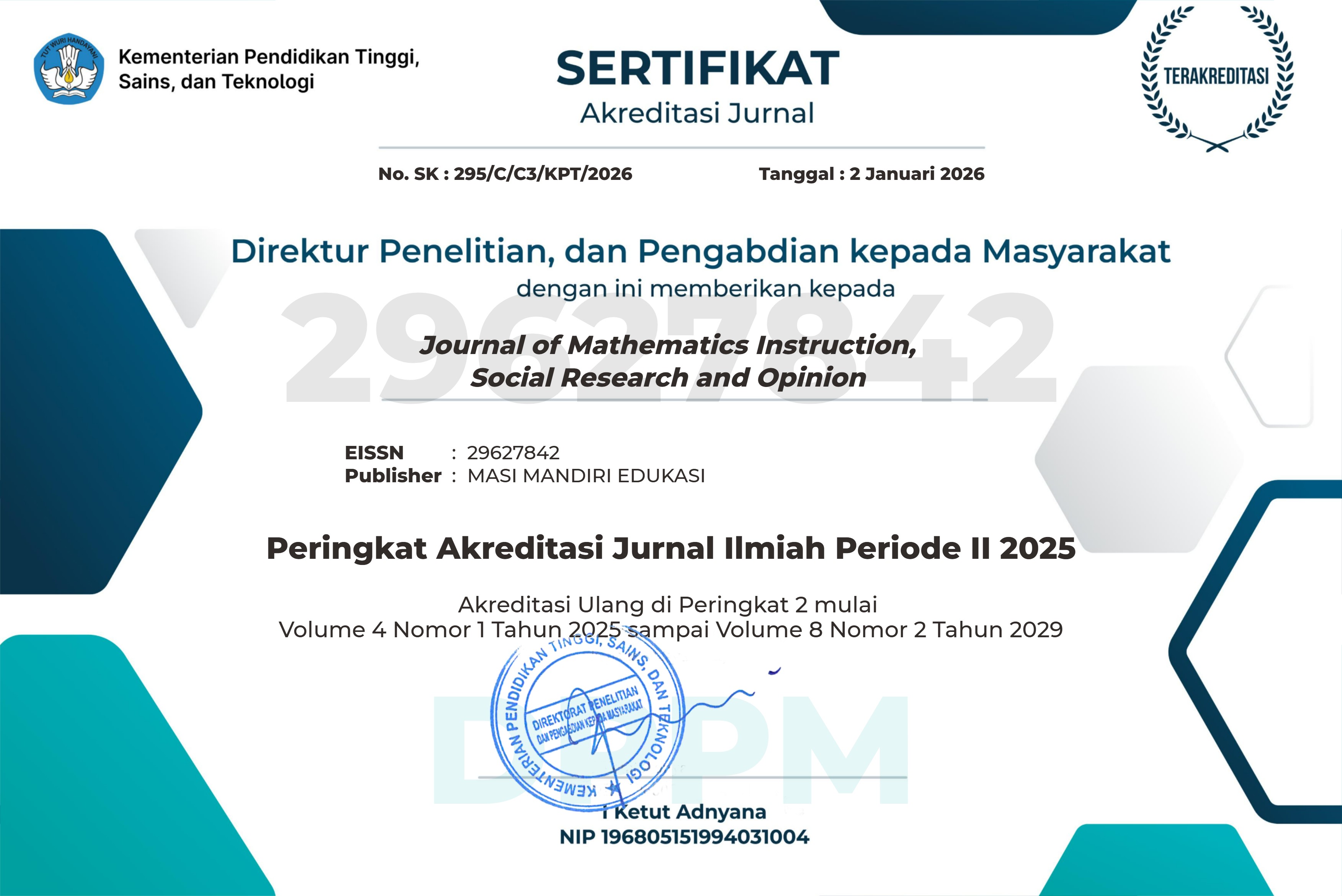
| Accreditation Certificate |
  |
| Indexing |






Contact Us

visitor
| Information |
>> For Authors
>> For Readers
>> For Librarians
| Visitor Statistics |
| Member of |


| Announcement |

| Keywords |
Mathematics Learning Difficulty Dyscalculia Teacher perceptions personality ICT Learning Computer teaching Academic Fisherfolks Economic Behavior Probit Models matrix mathematical model Concepts Guided Note Taking Golden Ratio Philosophy Integrated Learning van Hiele geometry Assessment Learning Outcomes method skills Problem Solving Experiment
| License |

MISRO is licensed under a Creative Commons Attribution-ShareAlike 4.0 International License.
| Publisher |

Address:
Jl. Gagak N0.105, Bandung,
Indonesia 40133
E-mail:
journalmisro@gmail.com
| in collaboration with |

| Recommended Tools |


| ISSN Barcode |

