
A Praxeological Analysis of Textbook: Systems of Linear Inequalities in Two Variables
DOI:
https://doi.org/10.58421/misro.v5i2.1410Keywords:
mathematics textbooks, praxeology, system of linear inequalities in two variablesAbstract
This study aims to analyse the presentation of systems of linear inequalities in two variables in Grade X senior high school/vocational high school mathematics textbooks under the Merdeka Curriculum using a praxeological framework. This research employed a qualitative method through document analysis of the student textbook and teacher guidebook published in the 2023 revised edition. The data were analysed based on the four components of praxeology: task, technique, technology, and theory. The findings show that the textbook presents contextual and exploratory tasks that encourage students to construct mathematical models from real-life situations. However, the continuity between exploratory tasks and procedural exercises is not consistently developed. In terms of technique, students are mostly directed to use graphical methods, while alternative strategies such as numerical testing or algebraic approaches are not sufficiently explored. The technology component, which refers to the justification of techniques, is not explicitly emphasised. Similarly, the theory component is not clearly presented in the student textbook, leaving formal mathematical concepts implicit. These findings indicate that the textbook has not fully supported students’ conceptual understanding of systems of linear inequalities in two variables. Therefore, teachers play an important role in complementing, contextualising, and deepening the material presented in the textbook.
Downloads
References
M. Sun and H. Cao, “Study of the Application of Inequalities in Mathematics,” Academic Journal of Science and Technology, vol. 6, no. 2, pp. 164–166, 2023. https://doi.org/10.54097/ajst.v6i2.9878
S. Page, J. Berry, and H. Hampson, “Equations and Inequalities,” in Mathematics, 2002. https://doi.org/10.1533/9780857099600.121
E. L. W. Palupi, S. N. Sumarto, and M. Purbaningrum, “Senior high school students’ understanding of mathematical inequality,” Jurnal Elemen, vol. 8, no. 1, pp. 201–215, 2022. https://doi.org/10.29408/jel.v8i1.4537
M. M. Rizqi, D. Wijayanti, and M. A. Basir, “Analisis Buku Teks Matematika Materi Himpunan Menggunakan Model Prakseologi,” vol. 9, no. 1, pp. 57–76, 2021.
A. Kajander and M. Lovric, “Mathematics textbooks and their potential role in supporting misconceptions,” International Journal of Mathematical Education in Science and Technology, vol. 40, no. 2, pp. 173–181, 2009. https://doi.org/10.1080/00207390701691558
B. Tanujaya, R. C. I. Prahmana, and J. Mumu, “Mathematics instruction, problems, challenges and opportunities: a case study in Manokwari Regency, Indonesia,” World Transactions on Engineering and Technology Education, vol. 15, no. 3, pp. 287–291, 2017.
E. Suharyono and R. Rosnawati, “Analisis Buku Teks Pelajaran Matematika SMP ditinjau dari Literasi Matematika,” Mosharafa: Jurnal Pendidikan Matematika, vol. 9, no. 3, pp. 451–462, 2020. https://doi.org/10.31980/mosharafa.v9i3.819
Rinawati and T. H. Utami, “Analisis Kesesuaian Soal-Soal Latihan pada Buku Teks Matematika SMA Kelas X dengan Kompetensi Dasar Berdasarkan Ranah Kognitif Taksonomi Bloom,” Himpunan Matematika Indonesia, pp. 423–430, 2013.
T. N. H. Yunianta, D. Suryadi, D. Dasari, and T. Herman, “Textbook praxeological-didactical analysis: Lessons learned from the Indonesian mathematics textbook,” Journal on Mathematics Education, vol. 14, no. 3, pp. 503–524, 2023. https://doi.org/10.22342/jme.v14i3.pp503-524
N. R. Ummah, S. Sugeng, and S. Safrudiannur, “Kajian Kontekstual Soal Latihan pada Buku Teks Matematika Indonesia, Malaysia, dan Singapura,” Jurnal Cendekia: Jurnal Pendidikan Matematika, vol. 8, no. 2, pp. 1200–1210, 2024. https://doi.org/10.31004/cendekia.v8i2.2241
R. N. N. M. Sofa and S. Prabawanto, “Kesalahan Dalam Menyelesaikan Soal Koneksi Matematis Materi Sistem Pertidaksamaan Linear Dua Variabel,” Jurnal Pembelajaran Matematika Inovatif, vol. 6, no. 6, pp. 2183–2194, 2023. https://doi.org/10.22460/jpmi.v6i6.20072
S. Lestari, E. Hidayat, and E. Nurhayati, “Analisis miskonsepsi peserta didik pada materi pertidaksamaan linear satu variabel melalui two-tier test,” Jurnal Kongruen, vol. 1, no. 4, pp. 367–371, 2022.
Nurhayati and M. Bernard, “Analisis Kesulitan Siswa dalam Pemecahan Masalah Matematik,” Journal on Education, vol. 1, no. 2, pp. 497–502, 2019.
L. Sulastri and E. A. R. Arhasy, “Kajian learning obstacle materi persamaan dan pertidaksamaan linear satu variabel,” Jurnal Penelitian Pendidikan dan Pengajaran Matematika, vol. 3, no. 2, pp. 151–159, 2017.
Z. Tastbita, E. N. L, and A. Nugraha, “Analisis Hambatan Pembelajaran (Learning Obstacle) Siswa pada Materi Luas Daerah Persegi Panjang,” Pedadidaktika, vol. 7, no. 2, pp. 138–147, 2020. https://doi.org/10.17509/pedadidaktika.v7i2.25323
A. Anifarka and R. Rosnawati, “Analisis Buku Teks Matematika SMP Berdasarkan Tingkat Kognitif pada Taksonomi Bloom Revisi dan Numerasi pada AKM,” Jurnal Cendekia, vol. 7, no. 3, pp. 2151–2166, 2023. https://doi.org/10.31004/cendekia.v7i3.1701
I. Rizkianto and R. H. Santosa, “Analisis Buku Matematika Siswa SMP Kurikulum 2013,” Mosharafa: Jurnal Pendidikan Matematika, vol. 6, no. 2, pp. 229–236, 2018. https://doi.org/10.31980/mosharafa.v6i2.310
N. S. Utami, S. Prabawanto, and D. Suryadi, “How do Indonesian students learn function concepts? A praxeological analysis of textbook,” Journal on Mathematics Education, vol. 15, no. 2, pp. 451–472, 2024. https://doi.org/10.22342/jme.v15i2.pp451-472
Y. Chevallard and M. Bosch, “Anthropological Theory of the Didactic (ATD),” in Encyclopedia of Mathematics Education, 2019, pp. 1–8. https://doi.org/10.1007/978-3-319-77487-9_100034-1
B. Grugeon-Allys and J. Pilet, “The algebraic learning of middle school students’ evolution during a school year,” Educational Studies in Mathematics, vol. 117, no. 3, 2024. https://doi.org/10.1007/s10649-024-10347-z
D. Agustito et al., “Praxeological analysis of linear algebra content presentation: A case study of Indonesian mathematics textbooks,” Eurasia Journal of Mathematics, Science and Technology Education, vol. 21, no. 6, 2025. https://doi.org/10.29333/ejmste/16508
N. S. Utami, S. Prabawanto, and N. Priatna, “A didactical design for introducing algebraic forms using the theory of praxeology,” Beta: Jurnal Tadris Matematika, vol. 15, no. 1, pp. 53–71, 2022. https://doi.org/10.20414/betajtm.v15i1.508
D. Wijayanti and C. Winslow, “Mathematical practice in textbooks analysis: Praxeological reference models,” Journal of Research in Mathematics Education, vol. 6, no. 3, pp. 307–330, 2017. https://doi.org/10.17583/redimat.2017.2078
D. Susanto et al., Matematika Edisi Revisi SMA/MA/SMK/MAK Kelas X. 2023.
D. Susanto et al., Panduan Guru Matematika untuk SMA/MA/SMK/MAK Kelas X (Edisi Revisi). 2023.
R. S. Siegler and C. O. Oppenzato, “Missing input: How imbalanced distributions of textbook problems affect mathematics learning,” Child Development Perspectives, vol. 15, no. 2, pp. 76–82, 2021. https://doi.org/10.1111/cdep.12402
Z. H. Putra, “Didactic transposition of rational numbers: A case from a textbook analysis and prospective elementary teachers’ mathematical and didactic knowledge,” Journal of Elementary Education, vol. 13, no. 4, pp. 365–394, 2020. https://doi.org/10.18690/rei.13.4.365-394.2020
Y. Chevallard, Steps Towards a New Epistemology in Mathematics Education, 2006.
M. Bosch and J. Gascón, “Introduction to the Anthropological Theory of the Didactic (ATD),” pp. 249–265, 2014. https://doi.org/10.1007/978-3-319-05389-9
C. Kieran, “Algebra Teaching and Learning,” in Encyclopedia of Mathematics Education, pp. 36–44, 2020. https://doi.org/10.1007/978-3-030-15789-0_57
Y. Chevallard, “Introducing the Anthropological Theory of the Didactic: an Attempt at a Principled Approach,” Hiroshima Journal of Mathematics Education, vol. 12, pp. 71–114, 2019.
S. Ivie, “Ausubel’s Learning Theory: An Approach to Teaching Higher Useful,” The High School Journal, vol. 82, no. 1, pp. 35–42, 2013.
A. S. González-Martín, V. Giraldo, and A. M. Souto, “The introduction of real numbers in secondary education: An institutional analysis of textbooks,” Research in Mathematics Education, vol. 15, no. 3, pp. 230–248, 2013. https://doi.org/10.1080/14794802.2013.803778
A. Hendriyanto, D. Suryadi, J. A. Dahlan, and D. Juandi, “Praxeology review: Comparing Singaporean and Indonesian textbooks in introducing the concept of sets,” Eurasia Journal of Mathematics, Science and Technology Education, vol. 19, no. 2, pp. 1–13, 2023. https://doi.org/10.29333/ejmste/12953
Downloads
Additional Files
Published
How to Cite
Issue
Section
License
Copyright (c) 2026 Journal of Mathematics Instruction, Social Research and Opinion

This work is licensed under a Creative Commons Attribution-ShareAlike 4.0 International License.
SideBar
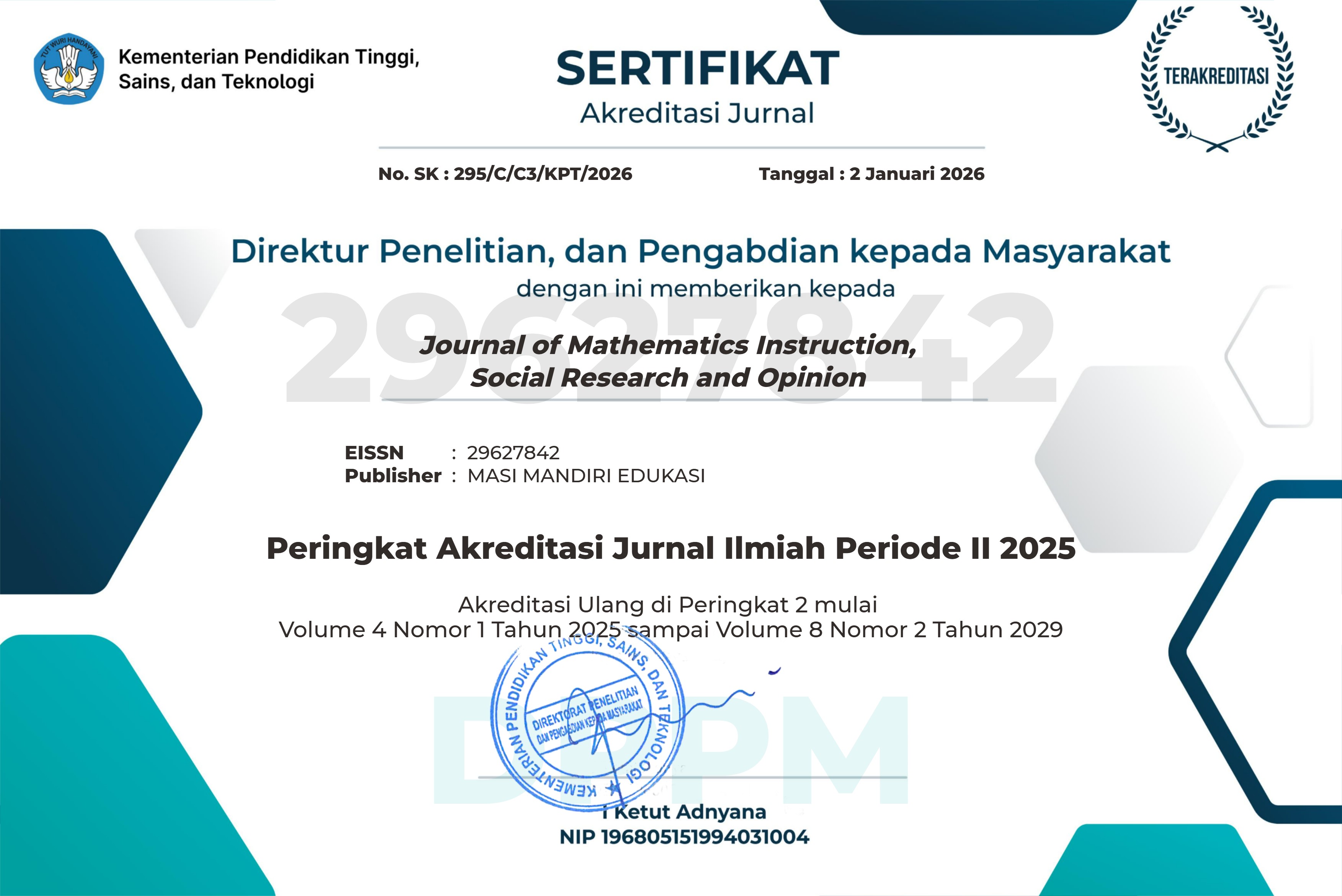
| Accreditation Certificate |
  |
| Indexing |






Contact Us

visitor
| Information |
>> For Authors
>> For Readers
>> For Librarians
| Visitor Statistics |
| Member of |


| Announcement |

| Keywords |
Mathematics Learning Difficulty Dyscalculia Teacher perceptions personality ICT Learning Computer teaching Academic Fisherfolks Economic Behavior Probit Models matrix mathematical model Concepts Guided Note Taking Golden Ratio Philosophy Integrated Learning van Hiele geometry Assessment Learning Outcomes method skills Problem Solving Experiment
| License |

MISRO is licensed under a Creative Commons Attribution-ShareAlike 4.0 International License.
| Publisher |

Address:
Jl. Gagak N0.105, Bandung,
Indonesia 40133
E-mail:
journalmisro@gmail.com
| in collaboration with |

| Recommended Tools |


| ISSN Barcode |

