
Students' Creative Thinking Indicators in Solving Open-Ended Problems Across Different Levels of Mathematical Ability
DOI:
https://doi.org/10.58421/misro.v5i2.1364Keywords:
Creative thinking, open-ended problem, Mathematical AbilityAbstract
Previous studies have examined mathematical creative thinking in open-ended problem solving; however, qualitative investigations that explicitly trace the emergence of each creative thinking indicator — fluency, flexibility, originality, and reasoning depth — across different mathematical ability levels remain limited. Departing from the traditional elaboration indicator, this study adopts reasoning depth to more accurately capture students' process-oriented mathematical reasoning, representing a conceptual novelty in the assessment framework applied. This study aims to describe how students' mathematical creative thinking indicators emerge in solving open-ended problems based on mathematical ability. A descriptive qualitative approach was employed with six students from SMA Negeri 14 Kota Jambi, Indonesia, representing high, medium, and low mathematical ability levels. Data were collected through written tests and semi-structured interviews and analyzed through data reduction, data display, and conclusion drawing. The findings indicate that mathematical ability shapes students' creative thinking profiles but does not guarantee the development of all indicators. Fluency and reasoning depth emerged more consistently among high-ability students, while originality remained the most constrained indicator across all groups, regardless of ability level. Medium-ability students showed inconsistent indicator emergence, whereas low-ability students exhibited limited development across all four indicators. These findings imply the need for instructional designs that integrate open-ended tasks with strategies explicitly promoting divergent thinking, strategic flexibility, and reflective reasoning across all ability levels.
Downloads
References
Ikromi SL. Meningkatkan kemampuan berpikir kreatif matematis siswa SMA melalui pembelajaran open-ended pada materi SPLTV. J Mat Stat Dan Komputasi 2018;15:104. https://doi.org/10.20956/jmsk.v15i2.5719.
Ulinnuha R, Budi Waluya S, Rochmad R, NoKm P, Kedu K. Creative thinking ability with open-ended problems based on self-efficacy in gnomio blended learning. Unnes J Math Educ Res 2021;10:20–5.
World Economic Forum. The future of jobs report 2023. Geneva: 2023. https://doi.org/10.1142/11458.
OECD. Mathematics performance (PISA) - OECD Data 2021. https://data.oecd.org/pisa/mathematics-performance-pisa.htm (accessed September 24, 2021).
Prasetyo A, Tuanaya R, Sangkala NS. Assessing the potential of open-ended problem to improve students' creative thinking skills in mathematics learning. Mat Dan Pembelajaran 2023;11:122–37. https://doi.org/10.33477/mp.v11i2.5518.
Torrance EP. Torrance tests of creative thinking. Educ Psychol Meas 1966.
Silver EA. Fostering creativity through instruction rich in mathematical problem solving and problem posing. ZDM 1997;29:75–80. https://doi.org/10.1007/s11858-997-0003-x.
Anggareni P, Hidayat AF. Identifikasi tahapan proses berpikir kreatif siswa SMP dalam aktivitas pengajuan masalah matematika. Kreano, J Mat Kreat 2019;10:132–40. https://doi.org/10.15294/kreano.v10i2.18818.
Nurjannah N. Proses berpikir kreatif siswa smp berdasarkan tahapan wallas dalam memecahkan masalah matematika ditinjau dari adversity quotient (aq). JTMT J Tadris Mat 2020;1:7–13. https://doi.org/10.47435/jtm.v1i1.391.
Suherman S, Vidákovich T. Assessment of mathematical creative thinking: a systematic review. Think Ski Creat 2022;44. https://doi.org/10.1016/j.tsc.2022.101019.
Meier MA, Burgstaller JA, Benedek M, Vogel SE, Grabner RH. Mathematical creativity in adults: its measurement and its relation to intelligence, mathematical competence and general creativity. J Intell 2021;9:1–27. https://doi.org/10.3390/jintelligence9010010.
Ibrahim, Khalil IA, Indra Prahmana RC. Mathematics learning orientation: mathematical creative thinking ability or creative disposition? J Math Educ 2024;15:253–76. https://doi.org/10.22342/jme.v15i1.pp253-276.
Saraswati MA. identifikasi tingkat kemampuan berpikir kreatif siswa dalam memecahkan masalah tipe multiple solution task (MST). MATHEdunesa J Ilm Pendidik Mat 2018;3. https://doi.org/10.26740/mathedunesa.v7n2.p429-434.
Becker JP, Shimada S. The open-ended approach: a new proposal for teaching mathematics. National Council of Teachers of Mathematics; 1997.
Suastika K. Mathematics learning model of open problem solving to develop students' creativity. Int Electron J Math Educ 2021;12:569–77. https://doi.org/10.29333/iejme/633.
Sukendra IK, Surat I. Penerapan model pembelajaran open ended untuk meningkatkan hasil belajar aljabar linier mahasiswa pendidikan matematika dengan pembelajaran daring. Widyadari 2021;22:439–48. https://doi.org/10.5281/zenodo.5550348.
Kurniawan H, Zabeta M, Prasetyo KB. Student difficulties in solving open-ended model mathematics problems. Inomatika 2023;5:47–57. https://doi.org/10.35438/inomatika.v5i1.350.
Siswono TYE. Leveling students' creative thinking in solving and posing mathematical problem. Indones Math Soc J Math Educ 2010;1:17–40.
Leikin R. Exploring mathematical creativity using multiple solution tasks. Creat Math Educ Gift sSudents 2009;9:129–45. https://doi.org/10.1163/9789087909352_010.
Krulik S, Rudnick JA. The new sourcebook for teaching reasoning and problem solving in elementary school. Allyn and Bacon; 1995.
Schoenfeld AH. Mathematical problem solving. Elsevier; 2014.
Hanurrani CA, Susanah. Kemampuan berpikir kreatif siswa dalam menyelesaikan masalah matematika open-ended ditinjau dari kemampuan matematika. MATHEdunesa J Ilm Pendidik Mat 2019;8. https://doi.org/10.26740/mathedunesa.v8n2.p90-97.
Rohati R, Kusumah YS, Kusnandi K. Exploring Students' Mathematical Reasoning Behavior in Junior High Schools: A Grounded Theory. Educ Sci 2023;13. https://doi.org/10.3390/educsci13030252.
Rahmawati. Tingkat berpikir kreatif siswa dalam pemecahan masalah matematika melalui tipe soal open ended di SMP. J At-Tarbiyah 2018;4:76–88. https://doi.org/10.54621/jiat.v4i1.199.
Arista EDW, Mahmudi A. Kemampuan berpikir kreatif matematis dalam penyelesaian soal open-ended jenis PISA berdasarkan level sekolah. PYTHAGORAS J Mat Dan Pendidik Mat 2020;15:87–99. https://doi.org/10.21831/pg.v15i1.34606.
Downloads
Additional Files
Published
How to Cite
Issue
Section
License
Copyright (c) 2026 Journal of Mathematics Instruction, Social Research and Opinion

This work is licensed under a Creative Commons Attribution-ShareAlike 4.0 International License.
SideBar
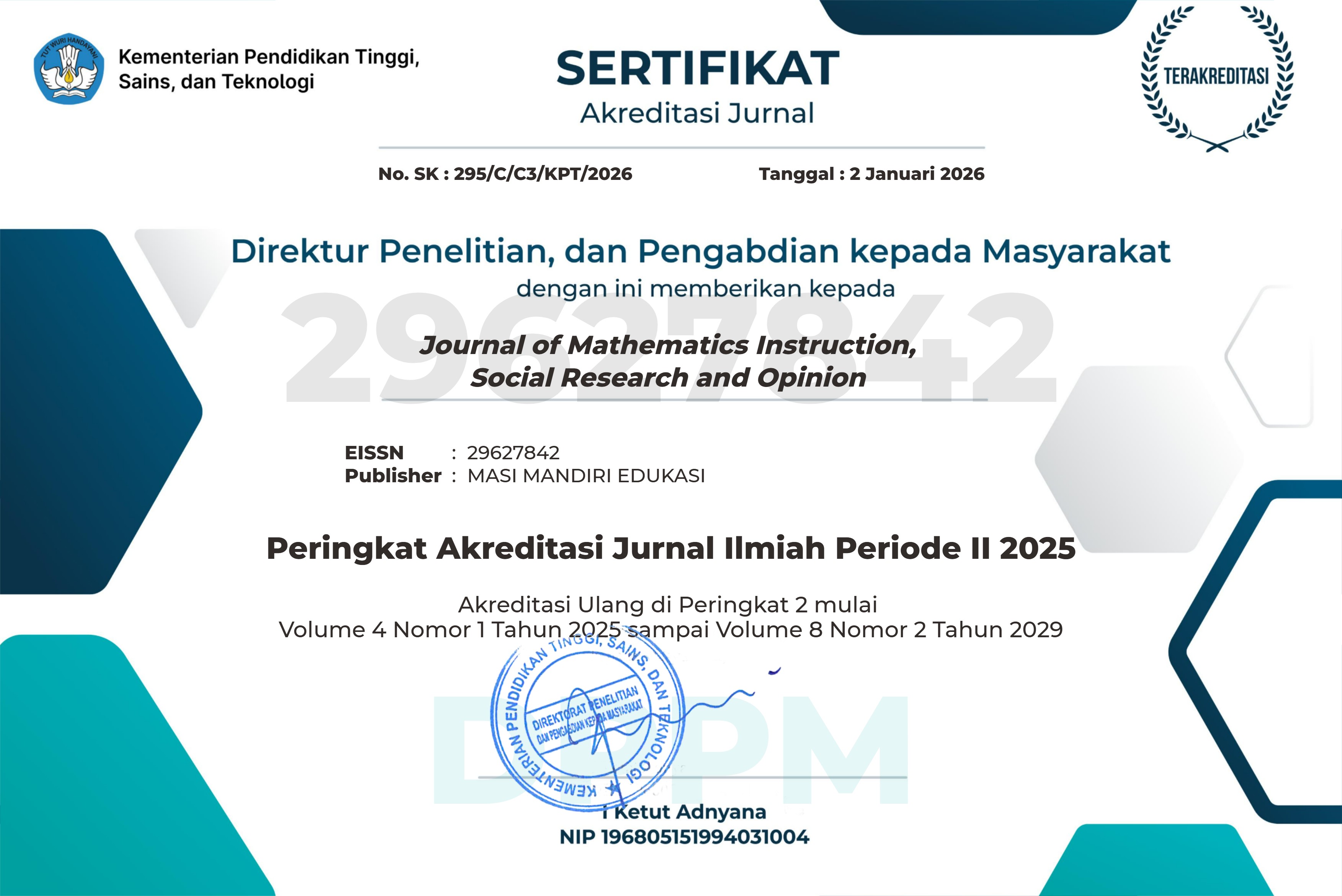
| Accreditation Certificate |
  |
| Indexing |






Contact Us

visitor
| Information |
>> For Authors
>> For Readers
>> For Librarians
| Visitor Statistics |
| Member of |


| Announcement |

| Keywords |
Mathematics Learning Difficulty Dyscalculia Teacher perceptions personality ICT Learning Computer teaching Academic Fisherfolks Economic Behavior Probit Models matrix mathematical model Concepts Guided Note Taking Golden Ratio Philosophy Integrated Learning van Hiele geometry Assessment Learning Outcomes method skills Problem Solving Experiment
| License |

MISRO is licensed under a Creative Commons Attribution-ShareAlike 4.0 International License.
| Publisher |

Address:
Jl. Gagak N0.105, Bandung,
Indonesia 40133
E-mail:
journalmisro@gmail.com
| in collaboration with |

| Recommended Tools |


| ISSN Barcode |

