
Enhancing Mathematical Representation and Reasoning Through Metacognitive Problem-Based Learning
DOI:
https://doi.org/10.58421/misro.v5i2.1251Keywords:
Mathematical Reasoning, Mathematical Representation, Metacognitive Problem-Based Learning, Secondary Education, Self-EfficacyAbstract
Mathematical representation and reasoning are critical competencies that students often struggle to master. This study aims to evaluate the effectiveness of the Metacognitive Problem-Based Learning (MPBL) model in enhancing these abilities, while also examining the predictive roles of self-efficacy and metacognitive awareness. Using a quasi-experimental pretest-posttest non-equivalent control group design, a sample of 350 secondary students in Indonesia was selected via cluster random sampling. The experimental group (n=200) received MPBL, while the control group (n=150) followed conventional instruction. Results indicated that the MPBL group achieved significantly higher N-gains in mathematical representation (0.72, "High") and reasoning (0.68, "Medium") than the control group. Statistical analysis confirmed that the improvements were significant (p < 0.05). Furthermore, multiple regression analysis revealed that metacognition and self-efficacy jointly predicted 58% of the variance in problem-solving performance (p < 0.05). These findings suggest that integrating metacognitive scaffolding within problem-based frameworks is a potent strategy for fostering higher-order thinking in mathematics education.
Downloads
References
M. F. Amal and A. Mahmudi, “Enhancing students’ self-efficacy through metacognitive strategies in learning mathematics,” J. Phys. Conf. Ser., vol. 1613, 2020, doi: 10.1088/1742-6596/1613/1/012061.
E. Pedroza-Niño et al., “Contribución de la enseñanza en los procesos metacognitivos y la resolución de problemas matemáticos,” Espacios, vol. 41, no. 20, pp. 1–15, 2020.
U. Özkubat and E. Özmen, “Investigation of Effects of Cognitive Strategies and Metacognitive Functions on Mathematical Problem- Solving Performance of Students with or Without Learning Disabilities,” Int. Electron. J. Elem. Educ., 2021, doi: 10.26822/IEJEE.2021.203.
W. M. Daher et al., “Developing Pre-service Mathematics Teachers’ Metacognitive Thinking for Learning and Teaching with Mobile Technology,” Int. J. Mob. Blended Learn., vol. 10, no. 2, pp. 1–19, 2018, doi: 10.4018/IJMBL.2018040101.
L. K. Arviani and S. S. Dewanti, “The Effect of Self-Awareness and Self-Regulated Learning on Student Mathematics Learning Outcomes,” Kontinu: J. Penelit. Didakt. Mat., 2023, doi: 10.30659/kontinu.7.1.19-37.
J. Lemay, “The Effects of Using Selected Metacognitive Strategies on ACT Mathematics Sub-Test Scores,” Dissertation, Walden University, Minneapolis, MN, 2016.
R. Cera, M. Mancini, and A. Antonietti, “Relationships between Metacognition, Self-efficacy and Self-regulation in Learning,” J. Educ. Cult. Psychol. Stud., vol. 4, pp. 115-141, 2013, doi: 10.7358/ECPS-2013-007-CERA.
B. Setiawan and O. J. Dores, “Peran Keterampilan Metakognisi Terhadap Peningkatan Kemampuan Literasi Mahasiswa,” 2019.
E. M. Rohmah and N. Ubaidah, “Examination of student’s mathematical literacy in solving PISA questions on space and shape content in terms of metacognitive awareness,” Union: J. Ilm. Pendidik. Mat., 2025, doi: 10.30738/union.v13i1.19123.
A. Azzam and M. H. Talafha, “The Level of Metacognitive Thinking and its Relationship with Perceived Self-Efficacy for a Sample of Junior High School Students in Light of some Variables,” J. Educ. Psychol. Sci., vol. 14, no. 4, pp. 577-612, 2013, doi: 10.12785/JEPS/140418.
C. Rosenzweig, J. Krawec, and M. Montague, “Metacognitive Strategy Use of Eighth-Grade Students With and Without Learning Disabilities During Mathematical Problem Solving,” J. Learn. Disabil., vol. 44, no. 6, pp. 508-520, 2011, doi: 10.1177/0022219410378445.
K. Bozgün and S. Pekdogan, “The Self-Efficacy as Predictors of the Metacognition Awareness in Children,” J. Theory Pract. Educ., vol. 14, no. 1, pp. 71–85, 2018, doi: 10.17244/eku.339613.
M. B. Susilo and H. Retnawati, “An Analysis of Metacognition and Mathematical Self-Efficacy Toward Mathematical Problem Solving Ability,” J. Phys. Conf. Ser., vol. 1097, 2018, doi: 10.1088/1742-6596/1097/1/012140.
B. B. Kathayat, “Metacognitive Skills in Mathematics Learning: A Systematic Review of Literature,” J. Musikot Campus, 2024, doi: 10.3126/jmc.v2i1.70785.
A. Y. T et al., “Penerapan model reciprocal teaching dengan pendekatan metakognitif untuk meningkatkan kemampuan literasi matematis mahasiswa,” J. Pendidik. Inform. Sains, 2024, doi: 10.31571/saintek.v13i2.7865.
J. Krawec et al., “The Effects of Cognitive Strategy Instruction on Knowledge of Math Problem-Solving Processes of Middle School Students With Learning Disabilities,” Learn. Disabil. Q., vol. 36, no. 2, pp. 80-92, 2013, doi: 10.1177/0731948712463368.
A. Karabulut and E. R. Özmen, “Effect of 'Understand and Solve' Strategy Instruction on Mathematical Problem Solving of Students with Mild Intellectual Disabilities,” Int. Electron. J. Elem. Educ., 2019, doi: 10.26822/IEJEE.2018245314.
N. Zhu, “Cognitive Strategy Instruction for Mathematical Word Problem-solving of Students with Mathematics Disabilities in China,” Int. J. Disabil. Dev. Educ., vol. 62, no. 6, pp. 608-627, 2015, doi: 10.1080/1034912X.2015.1077935.
U. Özkubat, A. Karabulut, and E. R. Özmen, “Mathematical Problem-Solving Processes of Students with Special Needs: A Cognitive Strategy Instruction Model Solve It,” Int. Electron. J. Elem. Educ., vol. 12, no. 5, pp. 405-416, 2020, doi: 10.26822/iejee.2020562131.
U. Özkubat and E. Özmen, “Matematik Problemi Çözmede Üstbilişsel Deneyim Ölçeğinin Türkçe’ye Uyarlanması,” 2020, doi: 10.26466/opus.736793.
J. DeVecchis, “The effects of cognitive strategy instruction on math problem solving of high school students with learning disabilities,” 2015.
C. Sweeney, “The metacognitive functioning of middle school students with and without learning disabilities during mathematical problem solving,” 2010.
M. Montague, “The Solve It! Instructional Approach Yields Evidence-Based Results for Math Students,” 2013.
U. Özkubat, A. Karabulut, and A. S. Uçar, “Investigating the Effectiveness of STAR Strategy in Math Problem Solving,” Int. J. Prog. Educ., 2021, doi: 10.29329/IJPE.2021.332.6.
S. Arifin et al., “Contextual-STEM-Based E-Module Development in Enhancing Junior High School Students’ Mathematical Reasoning Abilities,” J. Pendidik. MIPA, vol. 26, no. 3, pp. 1932-1957, 2025, doi: 10.23960/jpmipa.v26i3.pp1932-1957.
M. R. Rasyid, “Integrating STEM Approaches in Algebra Instruction to Improve Students’ Mathematical Representation Skills,” Aksioma Educ. J., 2024, doi: 10.62872/tp357t12.
E. Lovisia and Y. Febrianti, “Development of Business and Energy Module Based on Problem Based Learning,” J. Penelit. Pendidik. IPA, vol. 11, no. 7, 2025, doi: 10.29303/jppipa.v11i7.11247.
M. Ozdogru, T. Tulubas, T. Karakose, S. Kanadli, A. Kardas, and S. Papadakis, “How does teacher self-efficacy mediate the relationship between student outcomes and principal leadership for learning? Results from meta-analytic structural equation modelling,” Acta Psychologica, vol. 258, Article 105144, 2025, doi: 10.1016/j.actpsy.2025.105144.
S. Papadakis and T. Karakose, “Gamification and student achievement: Potential benefits, limitations, and effective use in educational environments,” Educational Process: International Journal, vol. 19, Article e2025529, 2025, doi: 10.22521/edupij.2025.19.529.
Downloads
Additional Files
Published
How to Cite
Issue
Section
License
Copyright (c) 2026 Journal of Mathematics Instruction, Social Research and Opinion

This work is licensed under a Creative Commons Attribution-ShareAlike 4.0 International License.
SideBar
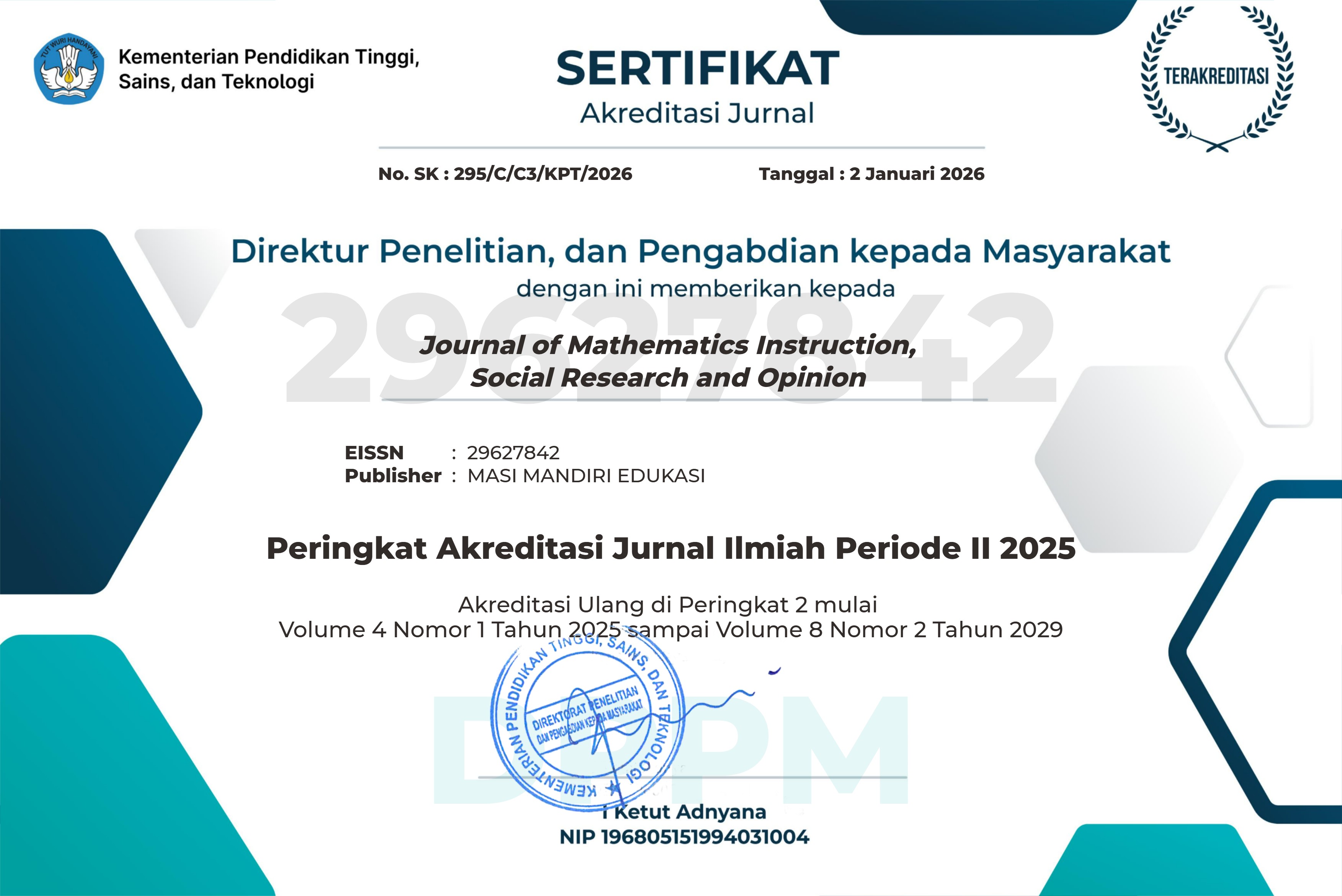
| Accreditation Certificate |
  |
| Indexing |






Contact Us

visitor
| Information |
>> For Authors
>> For Readers
>> For Librarians
| Visitor Statistics |
| Member of |


| Announcement |

| Keywords |
Mathematics Learning Difficulty Dyscalculia Teacher perceptions personality ICT Learning Computer teaching Academic Fisherfolks Economic Behavior Probit Models matrix mathematical model Concepts Guided Note Taking Golden Ratio Philosophy Integrated Learning van Hiele geometry Assessment Learning Outcomes method skills Problem Solving Experiment
| License |

MISRO is licensed under a Creative Commons Attribution-ShareAlike 4.0 International License.
| Publisher |

Address:
Jl. Gagak N0.105, Bandung,
Indonesia 40133
E-mail:
journalmisro@gmail.com
| in collaboration with |

| Recommended Tools |


| ISSN Barcode |

