
Augmented Reality Game-Based Learning, Spatial Ability, and Learning Style: An Explanatory Mixed Methods
DOI:
https://doi.org/10.58421/misro.v5i2.1210Keywords:
Augmented reality, Game-based, Geometry, Mix-method, Spatial AbilityAbstract
This study investigates the effectiveness of Augmented Reality Game-Based Learning (AR-GBL) in enhancing seventh-grade students’ spatial ability in geometry, using an explanatory mixed-methods design. The quantitative phase employed a quasi-experimental post-test-only control-group design involving 52 students from a public junior high school in Cirebon City, Indonesia. The experimental group received geometry instruction on flat-faced three-dimensional solids through AR-GBL, while the control group was taught conventionally. Data were collected using a spatial ability test and analysed through independent-samples t-tests, mastery analysis, and simple linear regression. The results indicate a statistically significant difference in spatial ability between groups (p < 0.05), with AR-GBL contributing 32.9% of the variance in students’ spatial performance and enabling both classical and individual mastery. The qualitative phase consisted of semi-structured student interviews and classroom observations to explain the quantitative results. Qualitative findings reveal that AR-GBL supported spatial understanding by strengthening three-dimensional visualization, facilitating mental rotation, increasing engagement, and enabling teacher-mediated reflection during learning activities. At the same time, initial technological adaptation and attentional regulation emerged as constraints that influenced individual learning trajectories. Integration of quantitative and qualitative findings shows that AR-GBL operates as a mediated learning environment rather than an autonomous instructional solution. These findings underscore the importance of pedagogical scaffolding to maximize the benefits of AR-based game-based learning for spatial ability development in geometry classrooms.
Downloads
References
T. Lowrie, T. Logan, and M. Hegarty, “The influence of spatial visualization training on students’ spatial reasoning and mathematics performance,” J. Cogn. Dev., vol. 20, no. 5, pp. 729–751, 2019. https://doi.org/10.1080/15248372.2019.1653298
A. A. Supli and X. Yan, “Exploring the effectiveness of augmented reality in enhancing spatial reasoning skills: A study on mental rotation, spatial orientation, and spatial visualization in primary school students,” Educ. Inf. Technol., vol. 29, no. 1, pp. 351–374, 2024. Doi: 10.1007/s10639-023-12255-w
S. Z. Sholihah and E. A. Afriansyah, “Analisis kesulitan siswa dalam proses pemecahan masalah geometri berdasarkan tahapan berpikir Van Hiele,” Mosharafa, vol. 6, no. 2, pp. 287–298, 2017. https://doi.org/10.31980/mosharafa.v6i2.317
S. Desai, S. Bush, and F. Safi, “Mathematical representations in the teaching and learning of geometry: A review of the literature from the United States,” Electron. J. Res. Sci. Math. Educ., vol. 25, no. 4, pp. 6–22, 2021. https://doi/10.3991/ijim.v18i16.47079
F. Del Cerro Velázquez and G. M. Méndez, “Application in augmented reality for learning mathematical functions: A study for the development of spatial intelligence in secondary education students,” Mathematics, vol. 9, no. 4, pp. 1–19, 2021, doi: 10.3390/math9040369.
D. Phon, M. H. Abdul Rahman, N. Utama, M. Bilal Ali, N. Abd halim, and S. Kasim, “The Effect of Augmented Reality on Spatial Visualization Ability of Elementary School Student,” Int. J. Adv. Sci. Eng. Inf. Technol., vol. 9, p. 624, Mar. 2019, doi: 10.18517/ijaseit.9.2.4971.
S. Fleck and J. Bastien, “Marker-based augmented reality: Instructional-design to improve children interactions with astronomical concepts,” ACM SIGCHI Interact. Des. Child. IDC’15, Jun. 2015, doi: 10.1145/2771839.2771842.
M. B. Nadzeri, M. Musa, and I. M. Ismail, “The Effects of Augmented Reality Geometry Learning Applications on Spatial Visualization Ability for Lower Primary School Pupils.,” Int. J. Interact. Mob. Technol., vol. 18, no. 16, 2024. https://doi.org/10.3991/ijim.v18i16.47079
L. Wang, Q. Zhang, and D. Sun, “Exploring the impact of an augmented reality-integrated mathematics curriculum on students’ spatial skills in elementary school,” Int. J. Sci. Math. Educ., vol. 23, no. 2, pp. 387–414, 2025. https://doi/10.3991/ijim.v18i16.47079
A. Lai, C. Chen, and G. Lee, “An augmented reality‐based learning approach to enhancing students’ science reading performances from the perspective of the cognitive load theory,” Br. J. Educ. Technol., vol. 50, no. 1, pp. 232–247, 2019. https://doi.org/10.1111/bjet.12716
N. A. M. Mokmin, S. Hanjun, C. Jing, and S. Qi, “Impact of an AR-based learning approach on the learning achievement, motivation, and cognitive load of students on a design course,” J. Comput. Educ., vol. 11, no. 2, pp. 557–574, 2024. https://doi/10.3991/ijim.v18i16.47079
A. Ozerem and B. Akkoyunlu, “Learning environments designed according to learning styles and its effects on mathematics achievement,” Eurasian J. Educ. Res., no. 61, 2015. https://izlik.org/JA37WX29YY
L. Laswadi, N. Supriadi, C. Khaidir, and B. S. Anggoro, “Investigating the effectiveness of using various mathematics learning media among students with various learning styles,” Al-Jabar J. Pendidik. Mat., vol. 13, no. 1, pp. 189–198, 2022. https://doi.org/10.24042/ajpm.v13i1.12485
U. Umrana, E. Cahyono, and M. Sudia, “Analisis kemampuan pemecahan masalah matematis ditinjau dari gaya belajar siswa,” J. Pembelajaran Berpikir Mat., vol. 4, no. 1, pp. 67–76, 2019.
Z. A. M. Silmi Juman, M. Mathavan, A. S. Ambegedara, and I. G. K. Udagedara, “Difficulties in Learning Geometry Component in Mathematics and Active-Based Learning Methods to Overcome the Difficulties,” Shanlax Int. J. Educ., vol. 10, no. 2, pp. 41–58, 2022, doi: 10.34293/education.v10i2.4299.
J. Lahdenperä, J. Rämö, and L. Postareff, “Student-centred learning environments supporting undergraduate mathematics students to apply regulated learning: A mixed-methods approach,” J. Math. Behav., vol. 66, p. 100949, 2022. https://doi.org/10.1016/j.jmathb.2022.100949
J. Lahdenperä, J. Rämö, and L. Postareff, “Contrasting undergraduate mathematics students’ approaches to learning and their interactions within two student-centred learning environments,” Int. J. Math. Educ. Sci. Technol., vol. 54, no. 5, pp. 687–705, 2023. https://doi.org/10.1080/0020739X.2021.1962998
J. W. Creswell and V. L. Plano Clark, “Revisiting mixed methods research designs twenty years later,” Handb. Mix. methods Res. Des., vol. 1, no. 1, pp. 21–36, 2023. https://doi.org/10.4135/9781529614572
D. Ary, L. C. Jacobs, C. Sorensen, and A. Razavieh, “Introduction to research in education 8th edition,” Canada Wadsworth Cengage Learn., vol. 8, no. 8, pp. 1–320, 2010.
J. Buckley, N. Seery, and D. Canty, “A heuristic framework of spatial ability: A review and synthesis of spatial factor literature to support its translation into STEM education,” Educ. Psychol. Rev., vol. 30, no. 3, pp. 947–972, 2018. https://doi/10.1007/s10648-018-9432-z
P. S. Nam, “Augmented Reality as a Tool to Enhance the Learning Experience and Outcomes of Spatial Geometry,” in Integrating Cultural and Educational Needs Into Foreign Educational Systems, IGI Global Scientific Publishing, 2025, pp. 39–62.
M. J. Parandreni, “Development of an Augmented Reality–Based Geometry Module to Enhance Students’ Understanding of Three-Dimensional Concepts,” Aksioma Educ. J., vol. 1, no. 2, pp. 44–54, 2024. https://doi.org/10.62872/chh9qw39
S. Martin, “Measuring cognitive load and cognition: metrics for technology-enhanced learning,” in Technology-enhanced and collaborative learning, Routledge, 2018, pp. 77–106. Doi: 10.4324/9781315270111-5
O. Chen and G. Woolcott, “Technology-enhanced mathematics learning: A perspective from Cognitive Load Theory,” in Journal of Physics: Conference Series, IOP Publishing, 2019, p. 12064. https://doi/10.1088/1742-6596/1320/1/012064
Downloads
Additional Files
Published
How to Cite
Issue
Section
License
Copyright (c) 2026 Journal of Mathematics Instruction, Social Research and Opinion

This work is licensed under a Creative Commons Attribution-ShareAlike 4.0 International License.
SideBar
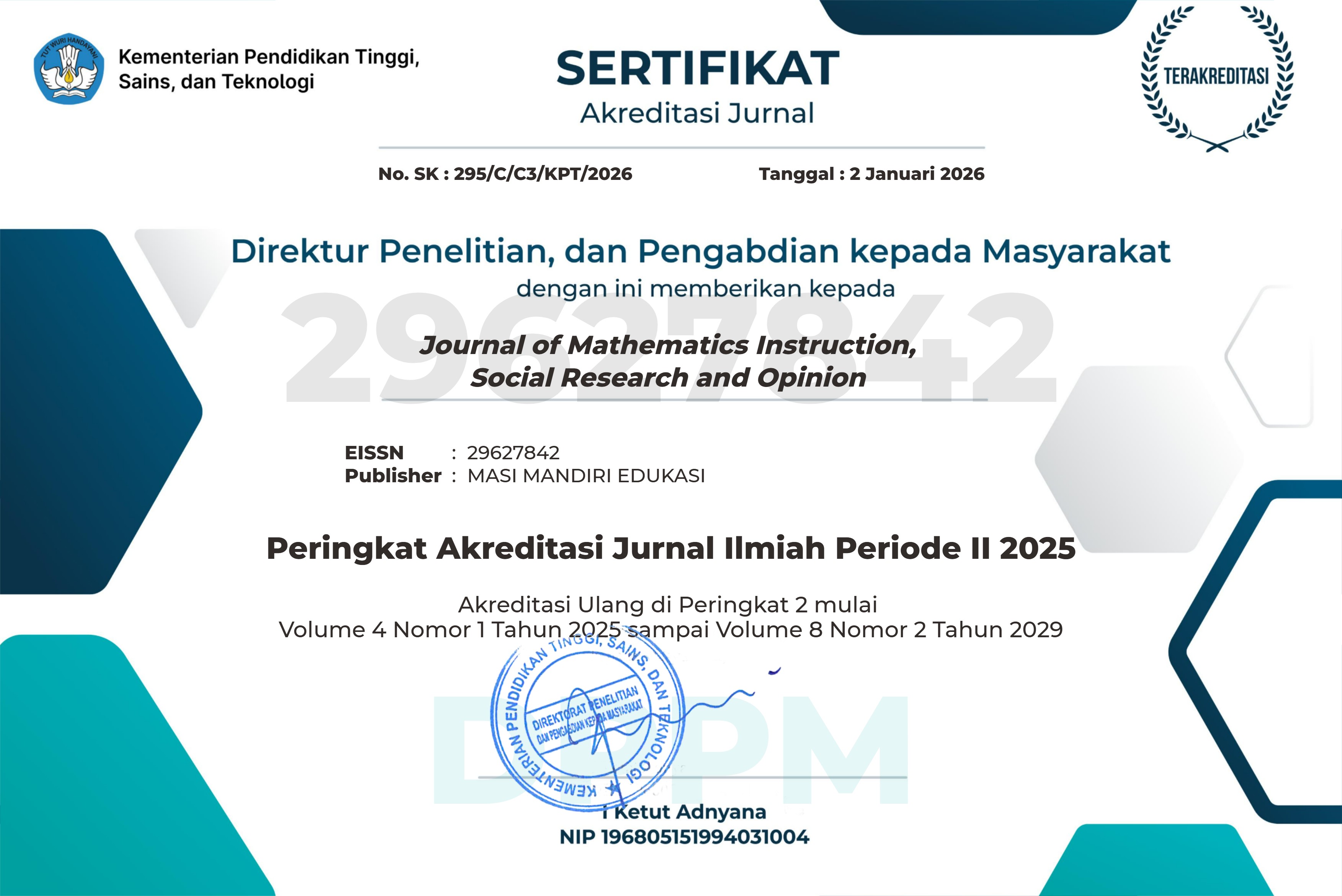
| Accreditation Certificate |
  |
| Indexing |






Contact Us

visitor
| Information |
>> For Authors
>> For Readers
>> For Librarians
| Visitor Statistics |
| Member of |


| Announcement |

| Keywords |
Mathematics Learning Difficulty Dyscalculia Teacher perceptions personality ICT Learning Computer teaching Academic Fisherfolks Economic Behavior Probit Models matrix mathematical model Concepts Guided Note Taking Golden Ratio Philosophy Integrated Learning van Hiele geometry Assessment Learning Outcomes method skills Problem Solving Experiment
| License |

MISRO is licensed under a Creative Commons Attribution-ShareAlike 4.0 International License.
| Publisher |

Address:
Jl. Gagak N0.105, Bandung,
Indonesia 40133
E-mail:
journalmisro@gmail.com
| in collaboration with |

| Recommended Tools |


| ISSN Barcode |

