
Digital Transformation and Human Resource Competence As Drivers of Operational Effectiveness: The Mediating Role of Organizational Innovation in Port Operations
DOI:
https://doi.org/10.58421/misro.v5i2.1100Keywords:
Digital Transformation, Human Resource Competence, Organizational Innovation, Operational EffectivenessAbstract
Organizations operating in operational-intensive environments, such as port services, face increasing pressure to enhance operational effectiveness amid rapid digital disruption. Although digital transformation initiatives have been widely implemented, many organizations struggle to translate technological adoption into tangible operational improvements. This study aims to examine the effects of digital transformation and human resource (HR) competence on operational effectiveness, with organizational innovation positioned as a mediating variable. This research applies a quantitative explanatory design using a causal approach. Data were collected through structured questionnaires distributed to 200 respondents, consisting of 100 internal employees and 100 external port service users at PT Pelindo (Persero) Regional 2, Sunda Kelapa Branch. The data were analyzed using Partial Least Squares–Structural Equation Modeling (PLS-SEM) with SmartPLS software to evaluate the measurement and structural models and test the proposed hypotheses. The findings reveal that digital transformation has a positive and significant effect on organizational innovation, and that HR competence also significantly influences it. Furthermore, organizational innovation has a strong positive effect on operational effectiveness and partially mediates the relationship between digital transformation and HR competence. These results indicate that technological initiatives and human resource capabilities contribute more effectively to operational performance when supported by strong organizational innovation mechanisms.
Downloads
References
Navi Muda Priyatna, “Transformasi Digital: Efisiensi dan Inovasi dalam Manajemen Operasional,” Economic Reviews Journal, vol. 3, no. 3, Sep. 2024, doi: 10.56709/mrj.v3i3.525.
E. Ahyani and E. M. Dhuhani, “Transformasi Digital dalam Manajemen Perkantoran Pendidikan: Sebuah Kajian Literatur,” Jurnal Visionary : Penelitian dan Pengembangan dibidang Administrasi Pendidikan, vol. 12, no. 1, p. 205, Apr. 2024, doi: 10.33394/vis.v12i1.10785.
P. C. Verhoef et al., “Digital transformation: A multidisciplinary reflection and research agenda,” J. Bus. Res., vol. 122, pp. 889–901, Jan. 2021, doi: 10.1016/j.jbusres.2019.09.022.
M. Sarstedt, J. F. Hair, and C. M. Ringle, “‘PLS-SEM: indeed a silver bullet’ – retrospective observations and recent advances,” Journal of Marketing Theory and Practice, vol. 31, no. 3, pp. 261–275, Jul. 2023, doi: 10.1080/10696679.2022.2056488.
A. Mutaqin, Y. O. Armi Djemat, R. Budianto, P. Strategi Operasi Darat Pasisi Dikreg LXIV, S. Staf dan Komando Tentara Nasional Indonesia Angkatan Darat, and K. Kunci, “Pengembangan Sistem Informasi Geospasial Militer Oleh Direktorat Topografi Angkatan Darat Dalam Rangka Mendukung Tugas Operasi Militer,” vol. 13, no. 1, pp. 89–93, 2025, doi: 10.37081/ed.v13i1.6474.
H. M. S. Turnip, “Peran Strategis Teknologi Informasi Dan Komunikasi Dalam Operasi Militer TNI AD,” Jurnal Mahatvavirya, vol. 12, no. 2, pp. 120–131, Sep. 2025, doi: 10.63824/jmp.v12i2.342.
S. Raisch and S. Krakowski, “Artificial Intelligence and Management: The Automation–Augmentation Paradox,” Academy of Management Review, vol. 46, no. 1, pp. 192–210, Jan. 2021, doi: 10.5465/amr.2018.0072.
D. Giarimpampa, R. Meier, T. F. Bissyande, V. Lenders, and J. Klein, “Exploring the Role of Artificial Intelligence in Enhancing Security Operations: A Systematic Review,” ACM Comput. Surv., vol. 58, no. 3, pp. 1–38, Feb. 2026, doi: 10.1145/3747587.
D. Singh, A. Muneeb, S. Singh, K. Choksi, A. B. Mirza, and F. Luo, “Powering the Sea: Challenges and Trends in Tidal Energy Integration, Power Converter Technology, and the Path Forward,” IEEE Access, vol. 13, pp. 187155–187186, 2025, doi: 10.1109/ACCESS.2025.3625578.
B. Alshammari and M. Mahinderjit Singh, “A Systematic Literature Review on Tackling Cyber Threats for Cyber Logistic Chain and Conceptual Frameworks for Robust Detection Mechanisms,” IEEE Access, vol. 13, pp. 67661–67692, 2025, doi: 10.1109/ACCESS.2025.3552689.
C. Jiakui, J. Abbas, H. Najam, J. Liu, and J. Abbas, “Green technological innovation, green finance, and financial development and their role in green total factor productivity: Empirical insights from China,” J. Clean. Prod., vol. 382, p. 135131, Jan. 2023, doi: 10.1016/j.jclepro.2022.135131.
Saw. Mu. S. Haque, “The Impact Of Remote Work On Hr Practices: Navigating Challenges, Embracing Opportunities,” European Journal of Human Resource Management Studies, vol. 7, no. 1, Aug. 2023, doi: 10.46827/ejhrms.v7i1.1549.
D. Jaiswal and A. Tyagi, “Effect of high performance work practices on service innovative behavior,” Tourism Review, vol. 75, no. 2, pp. 382–401, Sep. 2019, doi: 10.1108/TR-07-2018-0101.
A. Abbood Abdulhameed and S. A.-D. Al-Kubaisy, “The Effect of Knowledge Upgrading on Business Continuity:A Field Research in Private Colleges and Universities in Baghdad,” Journal of Economics and Administrative Sciences, vol. 29, no. 136, pp. 1–15, Jun. 2023, doi: 10.33095/jeas.v29i136.2601.
A. Nuryana, Setya Yuwana, Rachmawati Novaria, and V. R. Handoko, “LAMDIK Policy and Its Impact on Education Quality,” Jurnal Administrasi Publik Public Administration Journal, vol. 15, no. 1, pp. 99–113, Jun. 2025, doi: 10.31289/jap.v15i1.14306.
Sugiyono, “Metode Penelitian Kuantitatif Kualitatif Dan RD,” 2022.
T. Nefianto, “Strategi Transformasi Digital Untuk Penguatan Manajemen Organisasi,” Jurnal Sosial Teknologi, vol. 5, no. 10, pp. 4026–4031, Oct. 2025, doi: 10.59188/jurnalsostech.v5i10.32469.
A. Syaputra, M. D. Ananda, M. J. R. Tovarel, Y. Apriyanto, and V. F. Sanjaya, “Strategi Inovasi Dalam Meningkatkan Competitive Advantage Di Era Digital,” JURNAL MANAJEMEN DAN BISNIS, vol. 3, no. 2, pp. 121–132, Dec. 2024, doi: 10.36490/jmdb.v3i2.1489.
Dicky Artanto, Hasan Ibadin, and Suwadi, “Penerapan Evaluasi CIPP (Context, Input, Process,Product) Dalam Program Rintisan Madrasah Unggul Di MTsN 1 Yogyakarta,” Al-fahim : Jurnal Manajemen Pendidikan Islam, vol. 5, no. 1, pp. 68–82, Feb. 2023, doi: 10.54396/alfahim.v5i1.543.
W. Belabas, “Moving Toward More Inclusive Government Communication in an Era of Superdiversity,” Adm. Soc., vol. 55, no. 10, pp. 1952–1973, Nov. 2023, doi: 10.1177/00953997231190570.
J. F. Hair, J. J. Risher, M. Sarstedt, and C. M. Ringle, “When to use and how to report the results of PLS-SEM,” European Business Review, vol. 31, no. 1, pp. 2–24, Jan. 2019, doi: 10.1108/EBR-11-2018-0203.
J. F. Hair, G. T. M. Hult, C. M. Ringle, M. Sarstedt, N. P. Danks, and S. Ray, “An Introduction to Structural Equation Modeling,” 2021, pp. 1–29. doi: 10.1007/978-3-030-80519-7_1.
M. Matthews, “PLS-SEM: The Holy Grail for Advanced Analysis,” 2018.
Shahid Mahmood and Raja Irfan Sabir, “From Digital Service Excellence to Enduring Customer Relationships: Analyzing the Mediating Effect of Customer Satisfaction Between E-Banking Services Quality and Customer Loyalty,” International Journal of Management Research and Emerging Sciences, vol. 15, no. 3, Sep. 2025, doi: 10.56536/ijmres.v15i3.803.
D. Ivanov, A. Tsipoulanidis, and J. Schönberger, “Basics of Supply Chain and Operations Management,” 2021, pp. 3–19. doi: 10.1007/978-3-030-72331-6_1.
Afridah and Muhlisah Lubis, “The Role of Communication and Employee Engagement in Promoting Inclusion in the Workplace: A Case Study in the Creative Industry,” Feedback International Journal of Communication, vol. 1, no. 1, pp. 1–15, Mar. 2024, doi: 10.62569/fijc.v1i1.8.
Downloads
Additional Files
Published
How to Cite
Issue
Section
License
Copyright (c) 2026 Journal of Mathematics Instruction, Social Research and Opinion

This work is licensed under a Creative Commons Attribution-ShareAlike 4.0 International License.
SideBar
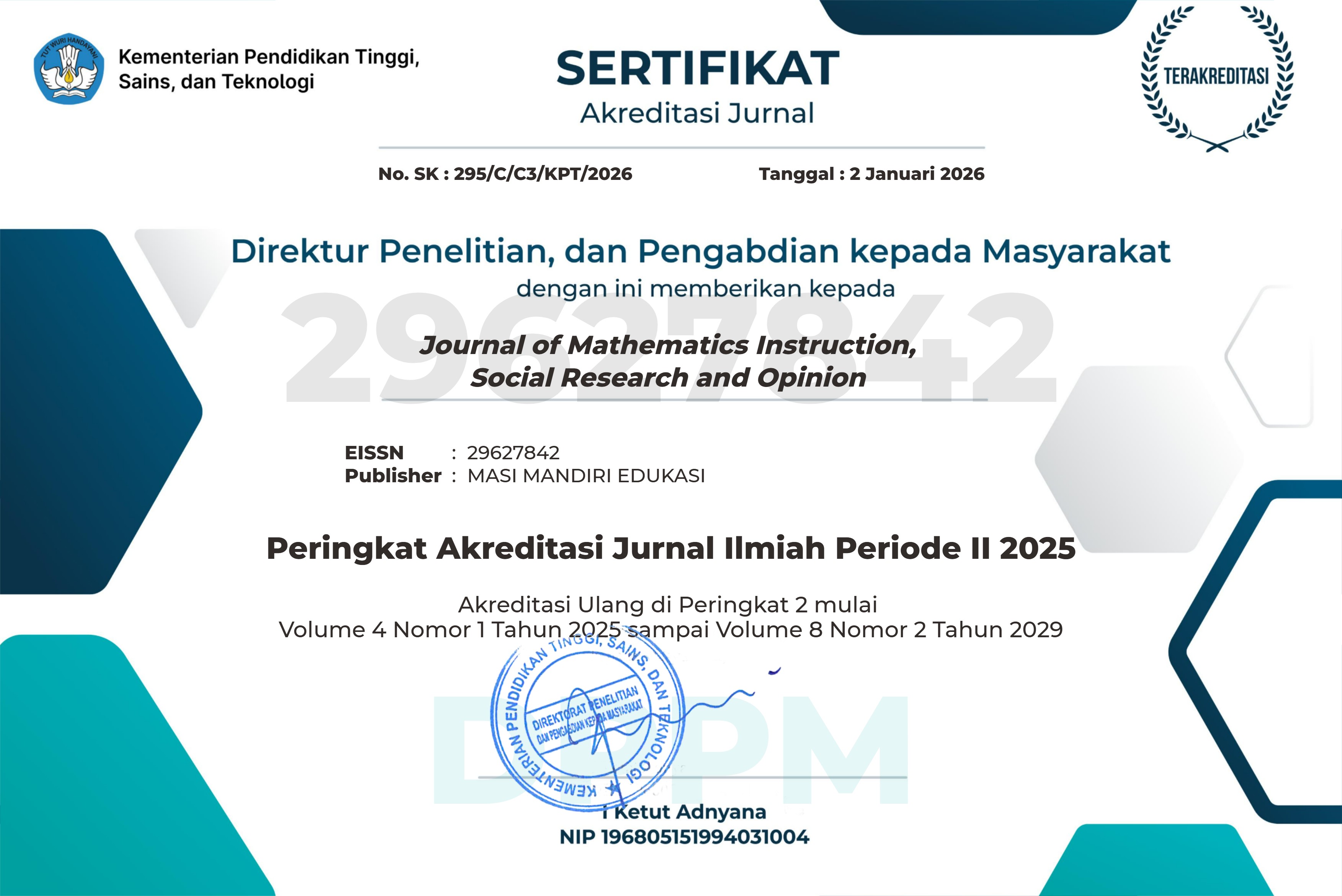
| Accreditation Certificate |
  |
| Indexing |






Contact Us

visitor
| Information |
>> For Authors
>> For Readers
>> For Librarians
| Visitor Statistics |
| Member of |


| Announcement |

| Keywords |
Mathematics Learning Difficulty Dyscalculia Teacher perceptions personality ICT Learning Computer teaching Academic Fisherfolks Economic Behavior Probit Models matrix mathematical model Concepts Guided Note Taking Golden Ratio Philosophy Integrated Learning van Hiele geometry Assessment Learning Outcomes method skills Problem Solving Experiment
| License |

MISRO is licensed under a Creative Commons Attribution-ShareAlike 4.0 International License.
| Publisher |

Address:
Jl. Gagak N0.105, Bandung,
Indonesia 40133
E-mail:
journalmisro@gmail.com
| in collaboration with |

| Recommended Tools |


| ISSN Barcode |

