
Representation of Muhammadiyah's Hisab Method in TVMU's Da'wah Media: Systematic Literature Review
DOI:
https://doi.org/10.58421/misro.v5i1.999Keywords:
Muhammadiyah Hisab, Rukyat, Hijri Calendar, Media, PRISMAAbstract
Determining the beginning of the hijri month, which marks the beginning of religious observances such as the Ramadan fast and the Hajj, should ideally be carried out simultaneously in Indonesia. Differences in methods among Islamic organizations, such as Muhammadiyah and Nahdlatul Ulama, often lead to differences in timing. This study aims to examine the development of literature on Muhammadiyah's hisab method and the contribution of Islamic media to shaping public understanding of the determination of the Hijri month's beginning. The study used the Systematic Literature Review (SLR) method, following PRISMA guidelines, to include articles published between 2010 and 2025. The results show that Muhammadiyah's hisab method has evolved from a theological approach to a scientific paradigm grounded in modern astronomy, based on the principle of hisab benarki wujudul hilal (accurate crescent moon sighting). Studies of Islamic media, particularly television, show limited research specifically discussing the representation of the hisab method in religious broadcasts. The media has great potential to disseminate science-based religious literacy and strengthen public understanding of the rationality of hisab as a method for determining the Islamic calendar. This study emphasizes the importance of integrating science, religion, and Islamic media in strengthening religious awareness in the modern era.
Downloads
References
A. Wasil, Toleransi Beragama Perspektif K.H. M. Sholeh Bahruddin, Pemikiran dan Praktik di Pondok Pesantren Ngalah Pasuruan. Malang: PT. Literasi Nusantara Abadi Group, 2023.
Abdul Manap, ‘Mengenal Rukyatul Hilal Metode NU dalam Penentuan Awal Bulan Hijriyah’, jabar.nu.or.id. Accessed: July 13, 2024. [Online]. Available: https://jabar.nu.or.id/ubudiyah/mengenal-rukyatul-hilal-metode-nu-dalam-penentuan-awal-bulan-hijriyah-PlBad
T. Djamaludin, Hisab Rukyat di Indonesia Serta Permasalahannya. Jakarta: Badan Meteorologi Klimatologi dan Geofisika, 2010.
N. A. Rohmah, ‘Perspektif Nahdlatul Ulama dan Muhammadiyah dalam Penetapan Awal Bulan Hijriyah’, Kompasiana.com. Accessed: September 12, 2024. [Online]. Available: https://www.kompasiana.com/nadzifauliaaa/668fff5134777c4b240ccb94/perspektif-nahdlatul-ulama-dan-muhammadiyah-dalam-penetapan-awal-bulan-hijriyah
A. Shampton, ‘Dengan Kriteria Baru, Awal Ramadan Kemungkinan Beda’, kemenag.malangkota.go.id. Accessed: August 08, 2024. [Online]. Available: https://kemenag.malangkota.go.id/showNews?head=dengan-kriteria-baru,-awal-ramadan-kemungkinan-beda#
H. Rohmat, ‘Penentuan Awal Bulan Qamariyah Menurut Muhammadiyah’, Ijtimaiyyah, vol. Vol. 7, No, no. Februari, pp. 1–19, 2014.
I. Ibrahim, ‘Perkembangan Kriteria Awal Bulan Kamariah di Muhammadiyah’, smamuh3jogja.sch.id. Accessed: August 25, 2024. [Online]. Available: https://smamuh3jogja.sch.id/berita/read/Perkembangan-Kriteria-Awal-Bulan-Kamariah-di-Muhammadiyah
A. Imron, ‘Muhammadiyah DiTengah Pusaran Kontroversi Hisab-Rukyat (Studi Kritis atas Pemaknaan Hadis-Hadis Hisab-Rukyat Muhammadiyah)’, Sekretariat Diskusi Ilmiah Dosen Tetap UIN Sunan Kalijaga Yogyakarta, Yogyakarta.
M. Ulum, ‘Fatwa Ulama NU (Nahdlatul Ulama) dan Muhammadiyah Jawa Timur Tentang Hisab Rukyat’, J. Keislam., vol. 1, no. 2, pp. 244–272, 2018.
Ridwan, Kontestasi Mazhab Hisab dan Rukyat di Indonesia. Yogyakarta: Pustaka Ilmu, 2022.
M. T. dan T. P. P. Muhammadiyah, Himpunan Putusan Tarjih 3. Yogyakarta: Suara Muhammadiyah, 2018.
S. Muslifah, ‘Upaya Menyikapi Perbedaan Penentuan Awal Bulan Qamariyah di Indonesia’, Azimuthh J. Islam. Astron., vol. 1, no. 1, pp. 74–100, 2020.
Baidhowi, ‘Hisab dan Ru’yatul Hilal Saat Kini dan Yang Akan Datang Dalam Menetapkan 1 (satu) Syawal Sebuah Problema Yang Tak Kunjung Selesai Di Indonesia’, Mahkamag Agung Republik Indonesia Mahkamah Syariah Aceh. Accessed: Nov. 23, 2024. [Online]. Available: https://ms-aceh.go.id/berita-artikel-galeri/artikel/174-hisab-dan-rukyatul-hilal-oleh-drs-baidhowihbsh--3110.html
Jayusman, Ilmu Falak Fiqh Hisab Rukyah Penentuan Awal Bulan Kamariah, no. July. Banten: Media Edu Pustaka, 2021.
M. F. Nasar, ‘Sejarah Sidang Isbat Awal Ramadan/Idul Fitri di Kementerian Agama’, Kementrian Agama Republik Indonesia. Accessed: December 16, 2024. [Online]. Available: https://kemenag.go.id/opini/sejarah-sidang-isbat-awal-ramadanidul-fitri-di-kementerian-agamanbsp-w4zue7
H. Brin, ‘Indonesia Terapkan Kriteria Baru Penetapan Bulan Hijriah’, BRIN: Badan Riset dan Inovasi Sosial. Accessed: November 12, 2024. [Online]. Available: https://www.brin.go.id/news/117816/indonesia-terapkan-kriteria-baru-penetapan-bulan-hijriah
D. A. R.I, Badan Hisab dan Rukyat, Almanak Hisab Rukyat. Jakarta: Proyek Pembinaan Badan Peradilan Agama Islam, 1981.
M. Khoeron, ‘Kenapa Perlu Sidang Isbat Awal Ramadan, Syawal, dan Zulhijjah? Ini Penjelasan Kemenag’, Kemenag RI. Accessed: October 07, 2024. [Online]. Available: https://kemenag.go.id/nasional/kenapa-perlu-sidang-isbat-awal-ramadan-syawal-dan-zulhijjah-ini-penjelasan-kemenag-7x8Mb
D. P. P. Agama, Selayang Pandang Hisab Rukyat. Jakarta: Direktoral Jenderal Bimbingan Masyarakat Islam dan Penyelenggaraan Haji, 2004.
M. S. NF, ‘Ketika NU dan Pemerintah Berbeda dalam Penentuan Awal Hijriah’, NU Online. Accessed: November 19, 2024. [Online]. Available: https://www.nu.or.id/fragmen/ketika-nu-dan-pemerintah-berbeda-dalam-penentuan-awal-hijriah-7seId
N. Nashrullah, ‘Pernahkah NU dan Pemerintah Berbeda Hari Raya Idul Fitri atau Adha?’, Republika. Accessed: October 18, 2024. [Online]. Available: https://khazanah.republika.co.id/berita/rteuyz320/pernahkah-nu-dan-pemerintah-berbeda-hari-raya-idul-fitri-atau-adha
P. Oemar, ‘Beda Lebaran Tergantung Menteri Agamanya Siapa?’, oohya.republika. Accessed: October 27, 2024. [Online]. Available: https://oohya.republika.co.id/sekapur-sirih/1742937249/beda-lebaran-tergantung-menteri-agamanya-siapa
N. Laoli, ‘Melihat Jejak Sejarah Tentang Perbedaan Penetapan Idul Fitri di Indonesia’, Kontan.co.id. Accessed: November 25, 2024. [Online]. Available: https://nasional.kontan.co.id/news/melihat-jejak-sejarah-tentang-perbedaan-penetapan-idul-fitri-di-indonesia
A. Keren, ‘Sejak 1990-an, Sudah 3 Kali Beda Idul Fitri’, NU Online. Accessed: October 19, 2024. [Online]. Available: https://www.nu.or.id/warta/sejak-1990-an-sudah-3-kali-beda-idul-fitri-G8VFy
M. Zaid. Wahyudi, ‘Sains Saja Tak Cukup untuk Tuntaskan Perbedaan Awal Kalender Hijriah’, Kompas.id. Accessed: October 07, 2024. [Online]. Available: https://www.kompas.id/baca/ilmiah-populer/2022/04/27/sains-saja-tak-cukup-untuk-menyelesaikan-perbedaan-awal-bulan-kalender-hijriah?utm_source=whatsapp&utm_medium=shared&utm_campaign=tpd_-_website_traffic%3Fstatus%3Dsukses_login&login=1739584002888&open_f
A. P. Saptohutomo, ‘Jejak Perbedaan Idul Fitri 1 Syawal di Indonesia’, Kompas.com. Accessed: November 28, 2024. [Online]. Available: https://nasional.kompas.com/read/2023/04/21/03450041/jejak-perbedaan-idul-fitri-1-syawal-di-indonesia
M. R. Muzakkir, ‘Diskusi Mengenai Argumentasi Ulama Pra-Modern Dalam Menolak Hisab’, Al-Marshad J. Astron. Islam Dan Ilmu-Ilmu Berkaitannya, vol. X, no. 2, pp. 17–33, 2015.
A. Revianur, ‘Mulai Tahun Ini, Muhammadiyah Tidak Ikut Sidang Isbat’, Kompas.com. Accessed: October 07, 2024. [Online]. Available: https://nasional.kompas.com/read/2012/06/27/19425141/~Nasional
M. Maskufa, ‘Hisab Wujud al-Hilal sebagai Politik Identitas Muhammadiyah dalam Diskursus Hisab Ruyat di Indonesia’, J. Indo-Islam., vol. 6, no. 2, pp. 183–202, 2016, doi: 10.15408/idi.v6i2.14802.
F. Y. Yacob and F. A. Syah, ‘Metode Penentuan Awal Ramadhan dan Hari Raya Menurut Ulama Daya Aceh’, J. Ilm. Islam Futura, vol. 16, no. 1, pp. 9–31, 2016.
Machzumy and M. R. Syarif, ‘Gender dan Legitimasi Penentuan Awal Bulan Kamariah’, Elfalaky J. Ilmu Falak, vol. 4, no. 1, pp. 107–123, 2020, doi: 10.24252/ifk.v4i1.14555.
Sakirman, ‘Respon Fikih terhadap Perkembangan Teknologi Rukyat’, Al-Manahij J. Kaji. Huk. Islam, vol. 14, no. 1, pp. 69–86, 2020, doi: 10.24090/mnh.v14i1.3190.
S. Azhari, ‘Gagasan Menyatukan Umat Islam Indonesia Melalui Kalender Islam’, AHKAM J. Ilmu Syariah, vol. 15, no. 2, pp. 249–258, 2015, doi: 10.15408/ajis.v15i2.2869.
M. J. Page et al., ‘The PRISMA 2020 statement: an updated guideline for reporting systematic reviews’, Syst. Rev., vol. 10, no. 1, pp. 1–11, 2021, doi: 10.1186/s13643-021-01626-4.
M. S. Faid, M. S. A. Mohd Nawawi, M. H. Mohd Saadon, K. Wahid, and P. Norman, ‘Methods in Determining New Hijri Month: a Thematic Review From Islamic Jurisprudence Perspective’, Malays. J. Syariah Law, vol. 13, no. 1, pp. 75–99, 2025, doi: 10.33102/mjsl.vol13no1.687.
Y. Lairgi, ‘When Astronomy Meets AI: Manazel For Crescent Visibility Prediction in Morocco’, ArXiv Prepr., pp. 1–6, 2025.
A. Humairah, T. Setiawati, and A. Pamungkas, ‘Organizational Communication Strategy in Reporting Ramadan Coverage (Jelang Berbuka) and Breaking News of the Sidang Isbat For 1 Syawal 1446 H’, Syiar J. Komun. Dan Penyiaran Islam, vol. 5, no. 1, pp. 63–76, 2025, doi: 10.54150/syiar.v5i1.605.
Marwadi, M. Labib, and M. F. Zain, ‘Reforming the Islamic Calendar and Religious Authority: Dynamics of Hijri Calendar Calculation in Indonesia within Persatuan Islam’s Thought’, Al-Manāhij J. Kaji. Huk. Islam, vol. 19, no. 1, pp. 1–18, 2025.
Y. Faisal, ‘Analysis of determining the beginning of the lunar month in indonesia: a comparative study of the rukyah and hisab methods’, Al-Wadh’iyyah J. Sharia Law Leg. Stud., vol. 1, no. 2, pp. 60–68, 2025.
F. F. Hikam, A. A. Rofiuddin, M. Zulfaiz, and A. Rahman, ‘An Examination of The Practical Implementation of The Neo Mabims Criteria in the Determination of the New Islamic Month in Indonesia’, JSEAIS J. Southeast Asian Islam Soc., vol. 4, no. 1, pp. 1–21, 2025.
Ahmad Adib Rofiuddin, Mahsun Mahsun, and Arifana Nur Kholiq, ‘State Authority and Religious Contestation: Resistance to Governmental Decisions on Islamic Calendar Determination in Indonesia’, Fikri J. Kaji. Agama Sos. Dan Budaya, vol. 10, no. 1, pp. 250–263, 2025, doi: 10.25217/jf.v10i1.5159.
M. S. A. Mohd Nawawi, M. S. Faid, M. H. M. Saadon, R. A. Wahab, and N. Ahmad, ‘Hijri Month Determination in Southeast Asia: An Illustration Between Religion, Science, and Cultural Background’, Heliyon, vol. 10, no. 20, p. e38668, 2024, doi: 10.1016/j.heliyon.2024.e38668.
S. Herlambang, A. L. Rizqina, Ridwansyah, M. Muslih, and A. K. Naffati, ‘Ḥusn al-Jawāb ‘an Ithbāt al-Ahillah bi al-Ḥisāb: Basyūnī ‘Imrān’s Method for Standardising the Determination of the Qamariyah Month in the Sultanate of Sambas (1913-1976)’, J. Islam. Law, vol. 5, no. 2, pp. 222–241, 2024, doi: 10.24260/jil.v5i2.2775.
M. Al-Rajab, S. Loucif, and Y. Al Risheh, ‘Predicting new crescent moon visibility applying machine learning algorithms’, Sci. Rep., vol. 13, no. 1, pp. 1–15, 2023, doi: 10.1038/s41598-023-32807-x.
Marwadi, R. Heriyanti, and F. N. Izza, ‘The Fiqh of Hisab-Ru’ya in the Twentieth Century Indonesia: Study on the Thoughts of Hamka, Hasbi Ash-Shiddieqy, and Moenawar Chalil about the Unification of Hijri Calendar’, Al-Manahij J. Kaji. Huk. Islam, vol. 17, no. 1, pp. 13–26, 2023, doi: 10.24090/mnh.v17i1.7902.
Alimuddin, Mukarramah, and Alamsyah, ‘Hijriyah Months and The Construction of Religious Moderation in The Sombaopu Community of Gowa, South Sulawesi’, Al-Adalah, vol. 20, no. 1, pp. 137–156, 2023, doi: 10.24042/adalah.v20i1.16818.
F. Fatmawati, A. M. Akmal, A. M. Akhyar, A. Azwar, and A. Nasyori, ‘Determination of Islamic Month Start by Moonsighting Australia (Case Study: 1 Dzulhijah 1441)’, J. Islam. Thought Civiliz., vol. 12, no. 2, pp. 225–241, 2022, doi: 10.32350/jitc.122.16.
Z. T. Allawi, ‘A Pattern-Recognizer Artificial Neural Network for the Prediction of New Crescent Visibility in Iraq’, Computation, vol. 10, no. 10, 2022, doi: 10.3390/computation10100186.
W. Parwanto, ‘Visualization and Legalization of K.H. Ahmad Dahlan’s Hisab Method in Tafsir al-Azhar by Hamka’, Al-Qisthu J. Kaji. Ilmu-Ilmu Huk., vol. 19, no. 2, pp. 153–164, 2021, doi: 10.32694/qst.v19i2.1124.
Y. A. Hafez et al., ‘A radio determination of the time of the New Moon’, Mon. Not. R. Astron. Soc., vol. 439, no. 3, pp. 1–11, 2021, doi: 10.1093/mnras/stt2476.
I. Zein and A. El-Wakil, ‘On the origins of the hijri calendar: A multi-faceted perspective based on the covenants of the prophet and specific date verification’, Religions, vol. 12, no. 1, pp. 1–21, 2021, doi: 10.3390/rel12010042.
M. Arif Royyani, A. Mufid, M. I. Ni’am, A. Q. Azizi, and A. A. Abidin, ‘Shahadah ’Ilmy; Integrating Fiqh and Astronomy Paradigm in Determining The Arrival of Lunar Months in Indonesia’, Al-Ihkam J. Huk. Dan Pranata Sos., vol. 16, no. 2, pp. 503–524, 2021, doi: 10.19105/AL-LHKAM.V16I2.5320.
A. Mufid, A. Zaiyadi, H. Nabawiyah, and M. I. Fasa, ‘Unification of global hijri calendar in Indonesia: An effort to preserve the maqasid sunnah of the prophet (saw)’, J. Islam. Thought Civiliz., vol. 10, no. 2, pp. 18–36, 2020, doi: 10.32350/jitc.102.02.
H. N. Afida, S. Marhamah, and A. Budiwati, ‘Global Islamic Calendar Digital Information Mapping’, Al-Marshad J. Astron. Islam Dan Ilmu-Ilmu Berkaitan, vol. 5, no. 1, pp. 57–73, 2019, doi: 10.30596/jam.v5i1.3023.
A. Wahidi, N. Yasin, and A. Kadarisman, ‘THE BEGINNING OF ISLAMIC MONTHS DETERMINATION IN INDONESIA AND MALAYSIA: Procedure and Social Condition’, Ulul Albab, vol. 20, no. 2, pp. 322–345, 2019.
M. Raharto, N. Sopwan, M. I. Hakim, and Y. Sugianto, ‘New approach on study of new young crescent (Hilal) visibility and new month of Hijri calendar’, J. Phys. Conf. Ser., vol. 1170, no. 1, 2019, doi: 10.1088/1742-6596/1170/1/012080.
T. Alrefay et al., ‘Analysis of observations of earliest visibility of the lunar crescent’, Observatory, vol. 138, no. 1267, pp. 267–291, 2018.
F. A. H. M. Asni, ‘Al-Syatibi Methodology Analysis In The Unification Of Usul Al-Fiqh Methods’, Int. J. Acad. Res. Bus. Soc. Sci., vol. 7, no. 7, pp. 260–269, 2017, doi: 10.6007/ijarbss/v7-i7/3093.
M. G. Rashed and M. G. Moklof, ‘Suggestion of a conventional Islamic calendar’, NRIAG J. Astron. Geophys., vol. 6, no. 2, pp. 275–277, 2017, doi: 10.1016/j.nrjag.2017.06.004.
S. Anwar, ‘UNIFIED ISLAMIC CALENDAR IN THE PERSPECTIVE OF ISLAMIC LEGAL PHILOSOPHY’, Al-Jāmi‘ah J. Islam. Stud., vol. 54, no. 1, pp. 1–45, 2016, doi: 10.14421/ajis.2016.541.203-247.
S. Anwar, K. M. Omar, and M. S. C. Awang, ‘The relevance of using the moon’s age as an alternative in imkanur rukyah criteria’, Int. Arch. Photogramm. Remote Sens. Spat. Inf. Sci. - ISPRS Arch., vol. 42, no. 4W1, pp. 209–215, 2016, doi: 10.5194/isprs-archives-XLII-4-W1-209-2016.
Dr. M. S. Hanapi and Dr. S. A. Hassan, ‘Basis for Using the Rukyah Method for Determining the Arrival of Ramadan and Syawal in Brunei Darussalam’, J. Islam. Stud. Cult., vol. 3, no. 2, pp. 12–22, 2015, doi: 10.15640/jisc.v3n2a2.
A. Halim, A. Aziz, and A. K. Ahmed, ‘A Unified Islamic Calendar Proposal for the World’, Middle-East J. Sci. Res., vol. 22, no. 1, pp. 115–120, 2014, doi: 10.5829/idosi.mejsr.2014.22.01.21831.
J.A.R. Caldwell, ‘Moonset Lag With Arc of Light Predicts Crescent Visibility’, MNASSA Mon. Notes Astron. Soc. South Afr., vol. 70, no. 11, pp. 1–16, 2012.
M. Gharaybeh, ‘Jurisprudential Reliance on Astronomical Calculations in Determining the Beginnings of the Hijri month’, Springer Proc. Phys. 420, no. November, pp. 160–177, 2025.
F. Fatmawati, A. M. Akmal, A. M. Akhyar, A. Azwar, and A. Nasyori, ‘Determination of Islamic Month Start by Moonsighting Australia (Case Study: 1 Dzulhijah 1441)’, J. Islam. Thought Civiliz., vol. 12, no. 2, pp. 225–241, 2022, doi: 10.32350/jitc.122.16.
N. Ahmad, M. S. A. Mohd Nawawi, M. Z. Zainuddin, Z. M. Nasir, R. M. Yunus, and I. Mohamed, ‘A New Crescent Moon Visibility Criteria using Circular Regression Model: A Case Study of Teluk Kemang, Malaysia’, Sains Malays., vol. 49, no. 4, pp. 859–870, 2020, doi: 10.17576/jsm-2020-4904-15.
W. Marpaung and Nurhayati, ‘Determination the Beginning of Qamariyah Month According To Government’, J. Ilm. Islam Futura, vol. 19, no. 2, pp. 278–293, 2019, doi: 10.22373/jiif.v19i2.4867.
Suhardiman, ‘Fikih Hisab - Rukyat: Peran Badan Hisab Rukyat terhadap Dinamika dalam Penentuan Awal Bulan Kamariyah di Indonesia’, -Turats J. Pemikir. Pendidik. Islam, vol. 12, no. 1, pp. 63–98, 2018.
S. Putra, ‘Embracing Harmonizing Time: A Tafsir Perspective on Islamic Calendar Unification’, J. Iman Dan Spirit., vol. 5, no. 2, pp. 183–190, 2025, doi: 10.15575/jis.v5i2.44397.
S. T. Qulub and A. Munif, ‘Urgensi Fatwa dan Sidang Isbat dalam Penentuan Awal Bulan Kamariah di Indonesia’, J. Bimas Islam, vol. 16, no. 2, 2023, doi: 10.37302/jbi.v16i2.929.
A. M. Sofyan, H. D. Mapuna, and Abd. S. A. Bakar, ‘Peran Pengadilan Agama Dalam Penentuan Awal Bulan Kamariah di Indonesia’, vol. 5, pp. 138–161, 2024.
K. Nufus, ‘Sidang Isbat Penentuan Awal Bulan Kamariah Prespektif Hukum Islam’, Inklusif, vol. 3, no. 1, pp. 1–20, 2018.
Y. Wahyuningsih, ‘IMPLEMENTASI KRITERIA NEO-MABIMS DALAM PENENTUAN 1 SYAWAL 1443 H DI INDONESIA’, Azimuth J. Islam. Astron., vol. 5, no. 1, pp. 1–18, 2024.
N. J. Long, ‘On the Islamic Authority of the Indonesian State: Responsibility, Suspicion, and Acts of Compliance’, J. R. Anthropol. Inst. NS, vol. 23, pp. 709–726, 2017, doi: 10.1111/1467-9655.12698.
Machzumy, ‘Parameter Pos Observasi Hilal (POB) di Pondok Assalam Surakarta’, AL-MARSHAD J. Astron. Islam Dan Ilmu-Ilmu Berkaitan, vol. 6, no. 1, pp. 1–10, 2020, doi: 10.30596/jam.v.
A. Hanip, ‘Penentuan Awal Dan Akhir Bulan Ramadan Dengan Metode Hisab “Urf Khomasi” Di Pesantren Mahfiludduror Jember’, Sakinah J. Huk. Kelauarga Islam, vol. 5, no. 1, pp. 14–30, 2023, doi: 10.58293/asa.v5i1.65.
Rizalludin, ‘Penolakan Pengurus Besar Nahdlatul Ulama (PBNU) Terhadap Kesaksian Hasil Rukyat Di Bawah Kriteria Imkan Al-Rukyah Dari Tahun 1998 – 2017’, J. Alwatzikhoebillah Kaji. Islam Pendidik. Ekon. Hum., vol. 6, no. 2, pp. 35–53, 2020, doi: 10.37567/alwatzikhoebillah.v6i2.274.
Nursodik, ‘Kajian Kriteria Hisab Global Turki dan Usulan Kriteria Baru MABIMS dengan Menggunakan Algoritma Jean Meeus’, Al-Ahkam, vol. 29, no. 1, pp. 119–140, 2018.
Holis, A. Musadad, and T. Pujiati, ‘The Role of Public Law in Determining the Islamic Calendar in Indonesia’, Al-Hilal J. Islam. Astron., vol. 7, no. 1, pp. 1–18, 2025.
Maskufa, ‘IMPLIKASI FIKIH PENGGUNAAN METODE HISAB WUJÛD AL-HILÂL PADA KALENDER MUHAMMADIYAH’, Istinbáth J. Islam. LawJurnal Huk. Islam, vol. 16, no. 2, pp. 1–22, 2017.
F. Suleman and D. Usup, ‘The Role of Modern Observation in Understanding the Beginning of the Hijri Month’, J. Ilm. Al-Syirah, vol. 19, no. 1, pp. 106–121, 2021, doi: 10.30984/jis.v19i1.1128.
A. Muttaqin, ‘Determination Of The Beginning Of Ramadhan And Syawal In Indonesia (an Overview of Political and Historical Perspectives)’, J. Islam. Stud. Humanit., vol. 7, no. 2, pp. 131–147, 2022.
S. Anwar, ‘Tinjauan Maqasid Syariah Terhadap Kalender Islam Global’, Al-Marshad J. Astron. Islam Dan Ilmu-Ilmu Berkaitan, vol. 5, no. 2, pp. 205–220, 2019, doi: 10.30596/jam.v5i2.3801.
A. Wahidi, N. Yasin, A. Kadir, Abd. Rouf, and S. Haq, ‘Implementation of the Mabims Criteria in Determining the Beginning of Islamic Month in Indonesia and Brunei Darussalam’, Proc. Int. Conf. Eng. Technol. Soc. Sci. ICONETOS 2020, vol. 529, no. Iconetos 2020, pp. 96–108, 2021, doi: 10.2991/assehr.k.210421.016.
V. Fitriyanti, A. Haries, and A. Syakur, ‘The Triple Helix Theory as a Solution for the Unification of the Hijri Calendar in Indonesia’, J. Al-Fikr., vol. 13, no. 2, pp. 202–224, 2024, doi: 10.54621/jiaf.v13i2.871.
M. Nurkhanif, A. Muttaqin, A. Imron, and M. R. Ahmad, ‘The Integration Between Syar’i and Astronomy to Determine the Beginning of Hijri Calendar: An Applied Study of Moon Elongation to Prove the Hilal Testimony’, Ulul Albab J. Studi Islam, vol. 23, no. 2, pp. 183–207, 2022.
Muhammad Abdul Aziz, Ahmad Izzuddin, Muhyar Fanani, and Ahmad Adib Rofiudin, ‘Differentiation of Methods for Determining the Beginning of the Month of Muharram 1446 H in the Perspective of Islamic Law’, AL - AFAQ J. Ilmu Falak Dan Astron., vol. 6, no. 2, pp. 239–252, 2024, doi: 10.20414/afaq.v6i2.11457.
A. H. Husna, S. Ardini, and S. T. Qulub, ‘Penyatuan Kalender Hijriah Nasional dalam Perspektif Ormas Muhammadiyah dan Nahdatul Ulama (NU)’, AL - AFAQ J. Ilmu Falak Dan Astron., vol. 3, no. 2, pp. 171–188, 2022, doi: 10.20414/afaq.v3i2.4772.
S. Amajida, ‘The Systematic Implications of the Hijri Calendar in the Caliph Umar bin Khattab’s Period for the Present’, AL - AFAQ J. Ilmu Falak Dan Astron., vol. 7, no. 1, pp. 57–66, 2025, doi: 10.20414/afaq.v7i1.11449.
A. Helim, ‘Hamka’s Legal Methodology on Hisab–Ru’yah in His Book “Saya Kembali ke Ru’yah”’, Juris J. Ilm. Syariah, vol. 23, no. 2, pp. 215–226, 2024, doi: 10.31958/juris.v23i2.11952.
R. Jordan, ‘Din: Muhammadiyah Selalu Ikut Sidang Isbat, Kecuali Saat Menag SDA’, detiknews.com. Accessed: November 28, 2024. [Online]. Available: https://news.detik.com/berita/d-2944081/din-muhammadiyah-selalu-ikut-sidang-isbat-kecuali-saat-menag-sda
F. Thohari, ‘Fatwa Mui Tentang Penentuan Awal Ramadhan, Syawal, dan Dzu Al-Hijjah (Upaya Rekonstruksi Metodologis)’, Al-‘Adalah, vol. X, no. 2, pp. 179–184, 2011.
Ridwan, Kontestasi Mazhab Hisab dan Rukyat di Indonesia, vol. 11, no. 1. Yogyakarta: CV. Pustaka Ilmu Group, 2022.
Downloads
Additional Files
Published
How to Cite
Issue
Section
License
Copyright (c) 2026 Journal of Mathematics Instruction, Social Research and Opinion

This work is licensed under a Creative Commons Attribution-ShareAlike 4.0 International License.
SideBar
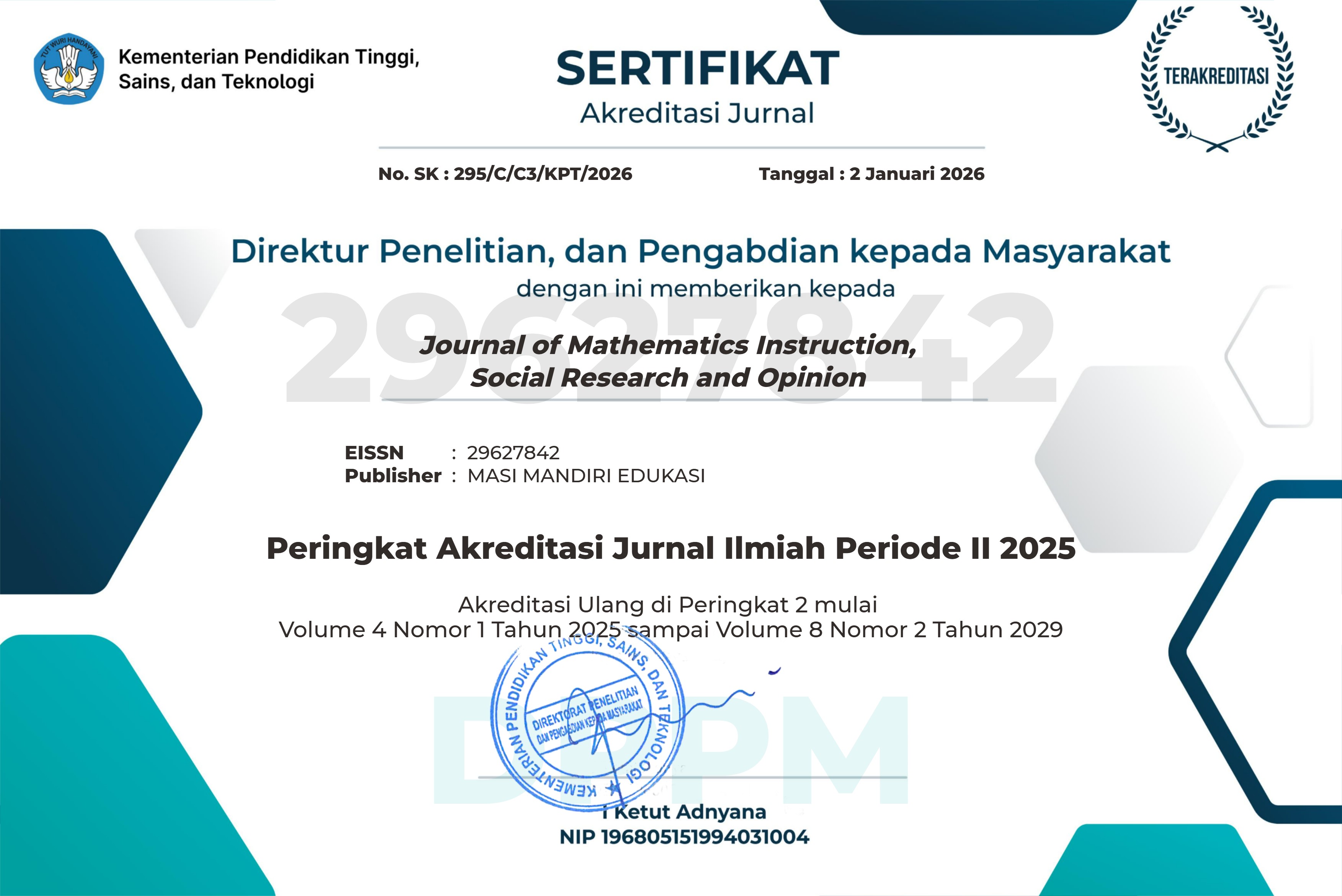
| Accreditation Certificate |
  |
| Indexing |






Contact Us

visitor
| Information |
>> For Authors
>> For Readers
>> For Librarians
| Visitor Statistics |
| Member of |


| Announcement |

| Keywords |
Mathematics Learning Difficulty Dyscalculia Teacher perceptions personality ICT Learning Computer teaching Academic Fisherfolks Economic Behavior Probit Models matrix mathematical model Concepts Guided Note Taking Golden Ratio Philosophy Integrated Learning van Hiele geometry Assessment Learning Outcomes method skills Problem Solving Experiment
| License |

MISRO is licensed under a Creative Commons Attribution-ShareAlike 4.0 International License.
| Publisher |

Address:
Jl. Gagak N0.105, Bandung,
Indonesia 40133
E-mail:
journalmisro@gmail.com
| in collaboration with |

| Recommended Tools |


| ISSN Barcode |

