
The Effect of Competency and Employee Engagement on Employee Performance in Public Sector Institutions
DOI:
https://doi.org/10.58421/misro.v5i1.993Keywords:
Competence, Employee Engagement, Human Resource Management, Performance, Public Sector OrganizationsAbstract
This study examines the influence of competency and employee engagement on employee performance in public sector institutions in Indonesia. The research is motivated by persistent performance disparities within public sector organizations, which are frequently linked to misalignment between employee competency and job demands, as well as insufficient levels of employee engagement. The study aims to analyze the direct effects of competency and employee engagement on employee performance and to investigate the mediating role of employee engagement in the competency–performance relationship. A quantitative explanatory approach was employed, involving 105 employees from a public-sector institution selected via simple random sampling. Data were collected using a structured questionnaire with a five-point Likert scale measuring competency, employee engagement, and employee performance. Path analysis was used to test the hypothesized relationships among variables. The results reveal that competency has a positive and significant effect on employee performance, employee engagement has a positive and significant effect on employee performance, and employee engagement significantly mediates the relationship between competency and employee performance. These findings underscore the importance of integrating competency development and employee engagement strategies to enhance performance and organizational effectiveness in public sector institutions.
Downloads
References
F. Alfawaire and T. Atan, “The effect of strategic human resource and knowledge management on sustainable competitive advantages at Jordanian universities: The mediating role of organizational innovation,” Sustainability (Switzerland), vol. 13, no. 15, 2021, doi: 10.3390/su13158445.
F. A. Mansor, S. N. Z. Omar, Y. H. Mat Jusoh, M. Z. Hashim, and N. Muhammad, “Employee Engagement and Organizational Performance,” International Journal of Accounting, Finance, and Business (IJAFB), vol. 8, no. 50, pp. 69–80, 2023, doi: 10.32861/bmer.73.93.100.
J. A. Colquitt, J. A. LePine, and M. J. Wesson, Organizational behavior: Improving performance and commitment in the workplace, 7th ed., vol., no. New York: McGraw Hill Education, 2021.
A. Aman-Ullah, W. Mehmood, S. Amin, and Y. A. Abbas, “Human capital and organizational performance: A moderation study through innovative leadership,” Journal of Innovation and Knowledge, vol. 7, no. 4, 2022, doi: 10.1016/j.jik.2022.100261.
D. Kriswanto, Noermijati, Rofiaty, and A. Rofiq, “The Effect Of Market Orientation, Hr Competence, Knowledge Management On Competitive Advantage, Mediated By Company Performance,” Revista de Gestao Social e Ambiental, vol. 17, no. 8, 2023, doi: 10.24857/rgsa.v17n8-021.
S. M. Spencer, L. M., & Spencer, Competence at Work: Models for Superior Performance. Wiley., vol. 9. 2019.
V. Nila Sari, H. Hady, and E. Elfiswandi, “The Influence of Organizational Culture and HR Competency on Employee Commitment and Their Impact on Organizational Performance,” International Journal of Social Science and Business, vol. 7, no. 2, 2023, doi: 10.23887/ijssb.v7i2.51921.
M. D. D. Laksana, A. Tjaija, and M. Nawawi, “The Influence Of Competence On The Performance Of Civil Servants At The Regional Civil Servant, Education, And Training Agency Of Pasangkayu Regency,” International Journal of Progressive Sciences and Technologies (IJPSAT), vol. 36, no. 1, pp. 256–263, 2022.
D. Pangaribuan and Pardomuan Robinson Sihombing, “The Effect of Competence on Employee Performance Mediated on Job Satisfaction (Case Study; Ministry of Finance PPSDM Employee),” Economit Journal: Scientific Journal of Accountancy, Management and Finance, vol. 1, no. 4, 2022, doi: 10.33258/economit.v1i4.586.
T. W. Puspitasari, M. A. Akbar, and R. Lina, “Leadership Style and Work Discipline on employee performance,” Advances in Human Resource Management Research, vol. 3, no. 1, pp. 15–29, 2025, doi: 10.60079/ahrmr.v3i1.321.
A. B. Bakker and E. Demerouti, “Job demands-resources theory: Taking stock and looking forward,” J Occup Health Psychol, vol. 22, no. 3, 2017, doi: 10.1037/ocp0000056.
I. W. Bagia, W. Cipta, F. Yudiaatmaja, and K. K. Heryanda, “The Influence of Competency and Work-Job Fit on the Work-Engagement and Its Impact on The Employee’s Performance of District Government,” in Proceedings of the 6th International Conference on Tourism, Economics, Accounting, Management, and Social Science (TEAMS 2021), 2021. doi: 10.2991/aebmr.k.211124.030.
S. D. Astuti and N. K. Suryani, “The role of proactive attitude and employee engagement in mediating the effect of perceived organizational Support and workplace spirituality on public servant performance in Indonesia,” Cogent Business and Management, vol. 12, no. 1, p., 2025, doi: 10.1080/23311975.2025.2547960.
S. N. Sari, A. Safitri, M. Mahrizal, A. R. Wulandari, V. L. Sinaga, and N. Mulyani, “Analisis Pengaruh Lingkungan Kerja, Work Engagement dan Work Life Balance terhadap Motivasi Kerja Tenaga Pengajar,” Edu Cendikia: Jurnal Ilmiah Kependidikan, vol. 4, no. 03, 2025, doi: 10.47709/educendikia.v4i03.5220.
S. Sugiyono, “The evaluation of facilities and infrastructure standards achievement of vocational high school in the Special Region of Yogyakarta,” Jurnal Penelitian dan Evaluasi Pendidikan, vol. 25, no. 2, 2021, doi: 10.21831/pep.v25i2.46002.
W. B. Schaufeli, A. B. Bakker, and M. Salanova, “Schaufeli et al. 2006 Short UWES,” Educ Psychol Meas, 2006.
Badan Kepegawaian Negara, “Laporan Kinerja Badan Kepegawaian 2022,” Badan Kepegawaian Negara, 2022.
Wibowo, “Manajemen Kinerja,” 2016, Raja Grafindo Persada, Jakarta.
R. Roviana, E. Bahiroh, A. I. Zarkasyi, and A. Amiruddin, “Effect of Employee Competency on Employee Performance Moderated by Organizational Community,” Journal of Business Management and Economic Development, vol. 3, no. 02, 2025, doi: 10.59653/jbmed.v3i02.1610.
S. J. Alainati, “Towards an Effective Competency-based Education and Training Model,” OSR Journal of Business and Management (IOSR-JBM), vol. 23, no. 11, 2021.
I. Mulyasari, “Pengaruh Kecerdasan Emosional Dan Kompetensi Terhadap Kinerja Pegawai,” Journal of Management Review, vol. 2, no. 2, 2019, doi: 10.25157/jmr.v2i2.1786.
A. Asniwati, “Pengaruh Kompensasi Dan Kompetensi Terhadap Kinerja Pegawai,” jesya, vol. 5, no. 2, 2022, doi: 10.36778/jesya.v5i2.716.
H. Mulang, “Pengaruh Kompetensi dan Motivasi Terhadap Kinerja Pegawai,” Jesya, vol. 6, no. 1, 2023, doi: 10.36778/jesya.v6i1.894.
R. F. Fancha, D. Hadiwijaya, and M. I. Muttaqijn, “The effect of quality of worklife, work motivation and employee engagement on employee performance,” Indonesian Journal of Multidisciplinary Science, vol. 3, no. 4, 2024, doi: 10.55324/ijoms.v3i4.809.
W. H. Macey, B. Schneider, K. M. Barbera, and S. A. Young, Employee Engagement: Tools for Analysis, Practice, and Competitive Advantage. 2009. doi: 10.1002/9781444306538.indsub.
E. M. Mone and M. London, Employee Engagement Through Effective Performance Management: A Practical Guide for Managers: Second Edition. 2018. doi: 10.4324/9781315626529.
K. Sendawula, S. Nakyejwe Kimuli, J. Bananuka, and G. Najjemba Muganga, “Training, employee engagement and employee performance: Evidence from Uganda’s health sector,” Cogent Business and Management, vol. 5, no. 1, 2018, doi: 10.1080/23311975.2018.1470891.
A. A. Rumman, L. Al-Abbadi, and R. Alshawabkeh, “The impact of human resource development practices on employee engagement and performance in Jordanian family restaurants,” Problems and Perspectives in Management, vol. 18, no. 1, 2020, doi: 10.21511/ppm.18(1).2020.12.
N. I. Kurniawati and E. Raharja, “The Influence of Employee Engagement on Organizational Performance: A Systematic Review,” WSEAS Transactions on Business and Economics, vol. 20, 2023, doi: 10.37394/23207.2023.20.20.
T. Maryati and R. J. Astuti, “The Influence of Spiritual Leadership and Employee Engagement toward Employee Performance: The Role of Organizational Commitment,” Quality - Access to Success, vol. 23, no. 189, 2022, doi: 10.47750/QAS/23.189.37.
N. Salsabila and S. J. Lo, “The Influences of Competency and Compensation on Employee Performance at PT Balai Pustaka (Persero) as Mediated by Work Engagement,” European Journal of Business and Management Research, vol. 8, no. 2, 2023, doi: 10.24018/ejbmr.2023.8.2.1848.
D. Fetriah and A. Hermingsih, “The Effect of Perceived Organizational Support, Work Motivation, and Competence on Employee Performance Mediated by Employee Engagement,” Dinasti International Journal of Management Science, vol. 5, no. 1, 2023, doi: 10.31933/dijms.v5i1.2023.
N. E. Artati and S. Suyati, “The Effect of Competence and Engagement on Employee Performance: The Mediation Role of Organizational Citizenship Behavior,” Untag Business and Accounting Review, vol. 3, no. 2, 2024, doi: 10.56444/ubar.v3i2.5517.
Downloads
Additional Files
Published
How to Cite
Issue
Section
License
Copyright (c) 2026 Journal of Mathematics Instruction, Social Research and Opinion

This work is licensed under a Creative Commons Attribution-ShareAlike 4.0 International License.
SideBar
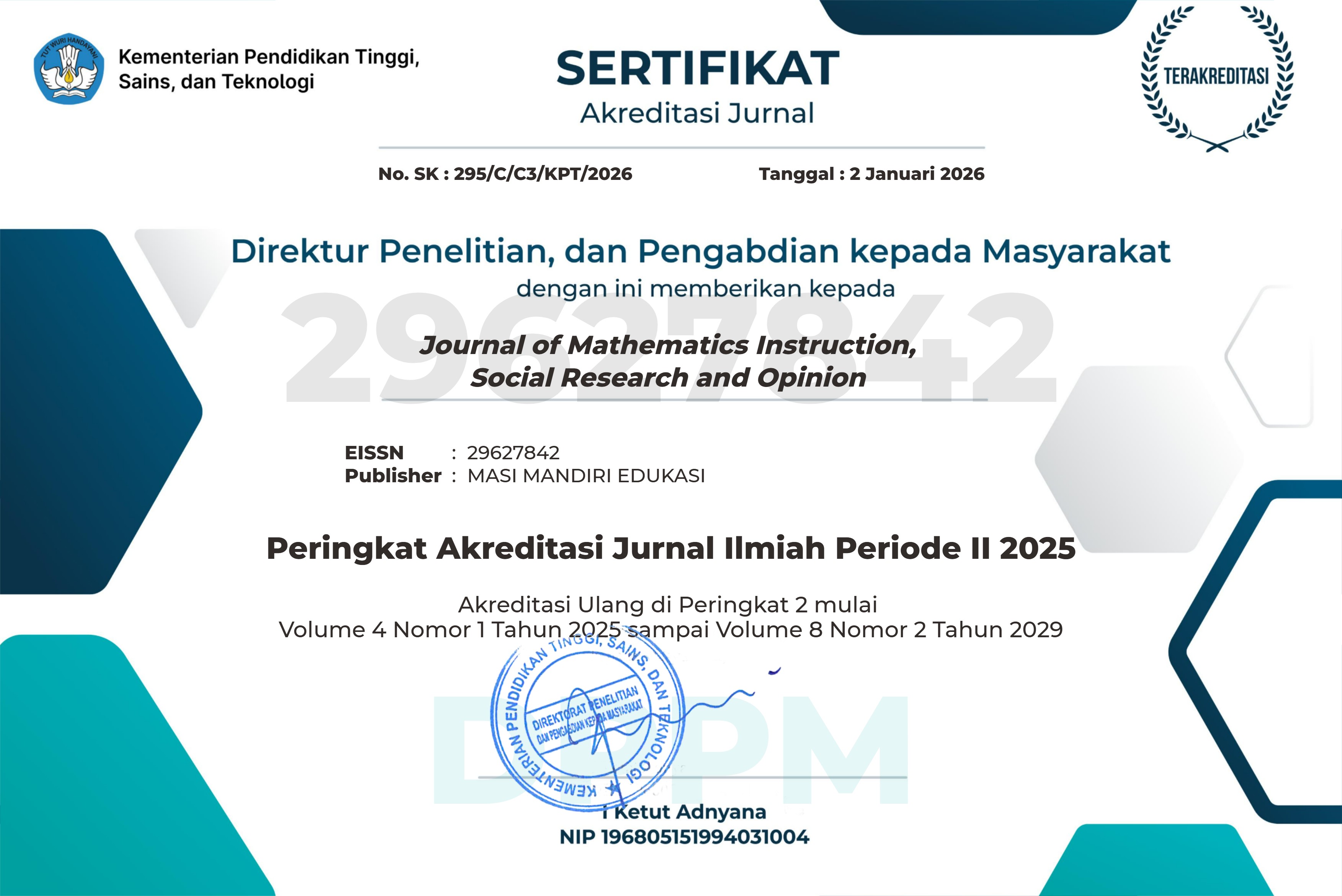
| Accreditation Certificate |
  |
| Indexing |






Contact Us

visitor
| Information |
>> For Authors
>> For Readers
>> For Librarians
| Visitor Statistics |
| Member of |


| Announcement |

| Keywords |
Mathematics Learning Difficulty Dyscalculia Teacher perceptions personality ICT Learning Computer teaching Academic Fisherfolks Economic Behavior Probit Models matrix mathematical model Concepts Guided Note Taking Golden Ratio Philosophy Integrated Learning van Hiele geometry Assessment Learning Outcomes method skills Problem Solving Experiment
| License |

MISRO is licensed under a Creative Commons Attribution-ShareAlike 4.0 International License.
| Publisher |

Address:
Jl. Gagak N0.105, Bandung,
Indonesia 40133
E-mail:
journalmisro@gmail.com
| in collaboration with |

| Recommended Tools |


| ISSN Barcode |

