
Application of Problem-based Learning Based Set Mobile Game Oriented to Motivation, Interest, and Logical-Mathematical Thinking
DOI:
https://doi.org/10.58421/misro.v4i4.980Keywords:
Mobile game, Set, Problem-based learning, Motivation, Interest, Logical-mathematical thinkingAbstract
The purpose of this study is to describe (1) the effectiveness of problem-based learning using Mobile Games; (2) the effectiveness of conventional learning using Mobile Games; and (3) the comparative effectiveness between problem-based learning using Mobile Games and conventional learning using Mobile Games in terms of students' motivation, interest, and logical-mathematical thinking ability. This research is a quasi-experimental study with a population of all seventh-grade students at SMP Negeri 1 Minggir, and the sample comprises classes VIIF and VIIG, each with 31 students. Data were obtained using non-test and test instruments. The effectiveness of mobile game treatment in each class was analyzed using t-tests and MANOVA (Hotteling T2). The results of this study show: (1) problem-based learning using Mobile Games is effective in terms of students' motivation, interest, and logical-mathematical thinking ability based on questionnaire and post-test; (2) conventional learning using Mobile Games is effective in terms of students' motivation, interest, and logical-mathematical thinking ability based on questionnaire and post-test; and (3) the results of the comparative effectiveness analysis show that problem-based learning using Mobile Games is more effective compared to conventional learning using Mobile Games in terms of students' motivation, interest, and logical-mathematical thinking.
Downloads
References
M. H. D. Seli Helena, Motivation and Learning Strategies for College Success A Focus on Self-Regulated Learning, 4th ed. New York, 2016.
O. N. Adamma, O. P. Ekwutosim, and E. C. Unamba, “Influence of Extrinsic and Intrinsic Motivation on Pupils Academic Performance in Mathematics,” SJME (Supremum J. Math. Educ., vol. 2, no. 2, pp. 52–59, 2018, doi: 10.35706/sjme.v2i2.1322.
R. M. Ryan and E. L. Deci, “Intrinsic and extrinsic motivation from a self-determination theory perspective: Definitions, theory, practices, and future directions,” Contemp. Educ. Psychol., vol. 61, no. xxxx, p. 101860, 2020, doi: 10.1016/j.cedpsych.2020.101860.
K. D. P. Meke, J. Jailani, D. U. Wutsqa, and H. D. Alfi, “Problem based learning using manipulative materials to improve student interest of mathematics learning,” J. Phys. Conf. Ser., vol. 1157, no. 3, 2019, doi: 10.1088/1742-6596/1157/3/032099.
M. E. Kılıç, M. Y. Kılıç, and D. Akan, “Motivation in the classroom,” Particip. Educ. Res., vol. 8, no. 2, pp. 31–56, 2021, doi: http://dx.doi.org/10.17275/per.21.28.8.2.
T. B. Tin, “Stimulating Student Interest in Language Learning,” in Stimulating Student Interest in Language Learning, 2016.
D. Ainley, M., Hidi, S., Berndorff, “Interest, learning, and the psychological processes that mediate their relationship,” J. Educ. Psychol., vol. 94, no. 3, pp. 545–561, 2002, doi: doi:10.1037/0022-0663.94.3.545.
W. D. P. Putra and W. Setyaningrum, “The effect of edutainment toward students’ interest in learning mathematics,” J. Phys. Conf. Ser., vol. 1097, no. 1, 2018, doi: 10.1088/1742-6596/1097/1/012120.
S. Hashim, A. Masek, B. N. S. M. Mahthir, A. H. A. Rashid, and D. Nincarean, “Association of interest, attitude and learning habit in mathematics learning towards enhancing students’ achievement,” Indones. J. Sci. Technol., vol. 6, no. 1, pp. 113–122, 2021, doi: 10.17509/ijost.v6i1.31526.
J. Xu, “Individual and class-level factors for middle school students’ interest in math homework,” Learn. Motiv., vol. 72, no. June, p. 101673, 2020, doi: 10.1016/j.lmot.2020.101673.
H. Tambunan, B. Sinaga, and W. Widada, “Analysis of teacher performance to build student interest and motivation towards mathematics achievement,” Int. J. Eval. Res. Educ., vol. 10, no. 1, pp. 42–47, 2021, doi: 10.11591/ijere.v10i1.20711.
C. Y. C. Yeh, H. N. H. Cheng, Z. H. Chen, C. C. Y. Liao, and T. W. Chan, “Enhancing achievement and interest in mathematics learning through Math-Island,” Res. Pract. Technol. Enhanc. Learn., vol. 14, no. 1, 2019, doi: 10.1186/s41039-019-0100-9.
D. P. Arum, T. A. Kusmayadi, and I. Pramudya, “Students’ logical-mathematical intelligence profile,” in Journal of Physics: Conference Series, 2018, vol. 1008, no. 1, doi: 10.1088/1742-6596/1008/1/012071.
T. State, Pisa 2022, vol. I. 2023.
C. E. Summaries, “What Students Know and Can Do,” PISA 2009 a Glance, vol. I, 2019, doi: 10.1787/g222d18af-en.
OECD, “PISA 2015 Results in Focus,” 2018.
A. W. Khurniawan and G. Erda, “Evaluasi Pisa 2018: Indonesia Perlu Segera Berbenah,” Vocat. Educ. Policy, White Pap., vol. 1, no. 21, pp. 1–13, 2019.
V. A. Nurlaily, H. Soegiyanto, B. Usodo, Darhim, S. Prabawanto, and B. E. Susilo, “Elementary school teacher’s obstacles in the implementation of problem-based learning model in mathematics learning,” Int. J. Instr., vol. 13, no. 2, pp. 229–238, 2020, doi: 10.22342/jme.10.2.5386.229-238.
W.-H. Chao, C.-Y. Yang, S.-M. Hsien, and R.-C. Chang, “Using Mobile Apps to Support Effective Game-Based Learning in the Mathematics Classroom,” Int. J. Inf. Educ. Technol., vol. 8, no. 5, pp. 354–357, 2018, doi: 10.18178/ijiet.2018.8.5.1062.
Permendikbud, “Permendikbud RI Nomor 37 tahun 2018,” JDIH Kemendikbud, vol. 2025, pp. 1–527, 2018.
Permendikbud, “Permendikbud RI Nomor 7 tahun 2022,” JDIH Kemendikbud, pp. 6–8, 2022.
H. Gardner, Frames of mind: The theory of multiple intelligences. New York, 1983.
O.-S. Tan, Problem-Based Learning Innovation: Using Problems to Power Learning in the 21st Century. Seng Lee Press, 2003.
H. Gardner, “Frames of Minds: The Theory of Multiple Intelligences,” in NY: Basic Books, New York, 2011, p. 529.
D. A. Putri and D. B. Widjajanti, “Improving Students’ Mathematical Literacy Skills Through Multiple Intelligences Approach in Problem Based Learning,” J. Phys. Conf. Ser., vol. 1397, no. 1, pp. 0–7, 2019, doi: 10.1088/1742-6596/1397/1/012094.
A. F. Muzaky, W. Sunarno, and Harjana, “Evaluating students logical thinking ability: TPACK model as a physics learning strategy to improve students logical thinking ability,” J. Phys. Conf. Ser., vol. 1511, no. 1, 2020, doi: 10.1088/1742-6596/1511/1/012027.
S. Andriani, E. Nurlaelah, and K. Yulianti, “The effect of process oriented guided inquiry learning (POGIL) model toward students’ logical thinking ability in mathematics,” J. Phys. Conf. Ser., vol. 1157, no. 4, 2019, doi: 10.1088/1742-6596/1157/4/042108.
A. H. Schoenfeld, “Learning to think mathematically: Problem solving, metacognition, and sense making in mathematics,” Handb. Res. Math. Teach. Learn., pp. 334–370, 1992.
A. Miswanto, E. Susanti, H. Hapizah, M. Meryansumayeka, and A. Nurzalena, “Analysis of mathematical thinking types reasoning students in completing the problem-solving question,” J. Phys. Conf. Ser., vol. 1318, no. 1, 2019, doi: 10.1088/1742-6596/1318/1/012101.
A. Nurzalena, E. Susanti, H. Hapizah, M. Meryansumayeka, and A. Miswanto, “Design of problem-solving questions for measuring mathematical thinking type mathematization,” J. Phys. Conf. Ser., vol. 1318, no. 1, 2019, doi: 10.1088/1742-6596/1318/1/012106.
S. Suwarno, F. B. Nisa, and M. Mukhlis, “Does students’ logical-mathematical intelligence correlate to mathematics communication skills on a linear system with three variables problems?,” J. Phys. Conf. Ser., vol. 1663, no. 1, 2020, doi: 10.1088/1742-6596/1663/1/012029.
S. Fatimah, R. Johar, and C. M. Zubainur, “Students’ logical mathematical intelligence in completing mathematical problems with natural disaster context,” J. Phys. Conf. Ser., vol. 1470, no. 1, 2020, doi: 10.1088/1742-6596/1470/1/012022.
K. Fahuzan and R. H. Santosa, “Gender Differences in Motivation to Learn Math Using Role Play Game in Smartphone,” in Journal of Physics: Conference Series, 2018, vol. 1097, no. 1, p. 8, doi: 10.1088/1742-6596/1097/1/012130.
R. I. Arends, Learning to Teach, 10th ed. McGraw-Hill Education, 2015.
Ardeniyansah and R. Rosnawati, “Implementation of Problem-Based Learning in terms of Student Mathematical Creative Thinking,” in Journal of Physics: Conference Series, 2018, vol. 1097, no. 1, doi: 10.1088/1742-6596/1097/1/012111.
Y. Selvy, M. Ikhsan, R. Johar, and Saminan, “Improving students’ mathematical creative thinking and motivation through GeoGebra assisted problem based learning,” J. Phys. Conf. Ser., vol. 1460, no. 1, 2020, doi: 10.1088/1742-6596/1460/1/012004.
Hidayati, Z. Abidin, and B. I. Ansari, “Improving students’ mathematical communication skills and learning interest through problem based learning model,” in Journal of Physics: Conference Series, 2020, vol. 1460, no. 1, doi: 10.1088/1742-6596/1460/1/012047.
H. Hendriana, T. Johanto, and U. Sumarmo, “The role of problem-based learning to improve students’ mathematical problem-solving ability and self confidence,” J. Math. Educ., vol. 9, no. 2, pp. 291–299, 2018, doi: 10.22342/jme.9.2.5394.291-300.
J. Moust, P. Bouhuijs, and H. Schmidt, Introduction to Problem-based Learning : A guide for students, 4th ed. 2021.
S. Damrongpanit, “From modern teaching to mathematics achievement: The mediating role of mathematics attitude, achievement motivation, and self-efficacy,” Eur. J. Educ. Res., vol. 8, no. 3, pp. 713–727, 2019, doi: 10.12973/eu-jer.8.3.713.
Rasmitadila et al., “The perceptions of primary school teachers of online learning during the covid-19 pandemic period: A case study in Indonesia,” J. Ethn. Cult. Stud., vol. 7, no. 2, pp. 90–109, 2020, doi: 10.29333/ejecs/388.
J. Traxler, “Defining mobile learning,” Proceedings, IADIS Int. Conf. Mob. Learn., pp. 261–266, 2005.
Y. and D. C. Zhang, Handbook of Mobile Teaching and Learning, 2rd ed. Springer, 2019.
Digital 2024, “Data Reportal,” 2024, 2024. .
A. Bahauddin and W. Setyaningrum, “Teacher’s and prospective-teacher’s perceptions of mobile math game ‘proadventure’ implementation in mathematics learning,” in Journal of Physics: Conference Series, 2019, vol. 1320, no. 1, p. 9, doi: 10.1088/1742-6596/1320/1/012080.
E. A. Bilgin, “A Mobile Educational Game Design for Eliminating Math Anxiety of Middle School Students,” Educ. Q. Rev., vol. 4, no. 2, pp. 354–361, 2021, doi: 10.31014/aior.1993.04.02.251.
L. D. Pratama and W. Setyaningrum, “GBL in math problem solving: Is it effective?,” Int. J. Interact. Mob. Technol., vol. 12, no. 6, pp. 101–111, 2018, doi: 10.3991/ijim.v12i6.8658.
J. Russo, L. A. Bragg, and T. Russo, “How primary teachers use games to support their teaching of mathematics,” Int. Electron. J. Elem. Educ., vol. 13, no. 4, pp. 407–419, 2020, doi: 10.26822/iejee.2021.200.
J. Xie, M. Wang, and D. Hooshyar, “Student, parent, and teacher perceptions towards digital educational games: How they differ and influence each other,” Knowledge Management and E-Learning, vol. 13, no. 2. pp. 142–160, 2021, doi: 10.34105/j.kmel.2021.13.008.
S. Laato et al., “Evaluation of the Pedagogical Quality of Mobile Math Games in App Marketplaces,” in Proceedings - 2020 IEEE International Conference on Engineering, Technology and Innovation, ICE/ITMC 2020, 2020, no. September, doi: 10.1109/ICE/ITMC49519.2020.9198621.
W. J. Creswell, Educational research : planning, conducting, and evaluating quantitative and qualitative research, 4th ed. Boston: Pearson Education, Inc, 2012.
F. S. T. Ting, W. H. Lam, and R. H. Shroff, “Active learning via problem-based collaborative games in a large mathematics university course in Hong Kong,” Educ. Sci., vol. 9, no. 3, 2019, doi: 10.3390/educsci9030172.
Munawaroh, N. S. Setyani, L. Susilowati, and Rukminingsih, “The Effect of E-Problem Based Learning on Students’ Interest, Motivation and Achievement,” Int. J. Instr., vol. 15, no. 3, pp. 503–518, 2022, doi: 10.29333/iji.2022.15328a.
H. C. Çelik, “The effect of modelling, collaborative and game-based learning on the geometry success of third-grade students,” Educ. Inf. Technol., vol. 25, no. 1, pp. 449–469, 2020, doi: 10.1007/s10639-019-09983-3.
P. Yaniawati, S. M. Maat, I. I. Supianti, and D. Fisher, “Mathematics mobile blended learning development: Student-oriented high order thinking skill learning,” Eur. J. Educ. Res., vol. 11, no. 1, pp. 69–81, 2022, doi: 10.12973/EU-JER.11.1.69.
M. Gök and M. İnan, “Sixth-grade students’ experiences of a digital game-based learning environment: A didactic analysis,” JRAMathEdu (Journal Res. Adv. Math. Educ., vol. 6, no. 2, pp. 142–157, 2021, doi: 10.23917/jramathedu.v6i2.13687.
L. Sun, H. Ruokamo, P. Siklander, B. Li, and K. Devlin, “Primary school students’ perceptions of scaffolding in digital game-based learning in mathematics,” Learn. Cult. Soc. Interact., vol. 28, no. August 2020, p. 100457, 2021, doi: 10.1016/j.lcsi.2020.100457.
N. Pellas, P. Fotaris, I. Kazanidis, and D. Wells, “Augmenting the learning experience in primary and secondary school education: a systematic review of recent trends in augmented reality game-based learning,” Virtual Real., vol. 23, no. 4, pp. 329–346, 2019, doi: 10.1007/s10055-018-0347-2.
G. Albano, F. Arzarello, and U. Dello Iacono, “Digital Inquiry Through Games,” Technol. Knowl. Learn., vol. 26, no. 3, pp. 577–595, 2021, doi: 10.1007/s10758-020-09459-1.
F. Ke, K. M. Clark, and S. Uysal, “Architecture Game-Based Mathematical Learning by Making,” Int. J. Sci. Math. Educ., vol. 17, pp. 167–184, 2019, doi: 10.1007/s10763-019-09996-x.
Drijvers P, The 12th International Congress On Mathematical Education. New York, 2015.
M. Bakker, M. van den Heuvel-Panhuizen, and A. Robitzsch, “Effects of mathematics computer games on special education students’ multiplicative reasoning ability,” Br. J. Educ. Technol., vol. 47, no. 4, pp. 633–648, 2016, doi: https://doi.org/10.1111/bjet.12249.
C. H. Chen and V. Law, “Scaffolding individual and collaborative game-based learning in learning performance and intrinsic motivation,” Comput. Human Behav., vol. 55, pp. 1201–1212, 2016, doi: 10.1016/j.chb.2015.03.010.
Y. M. Huang, S. H. Huang, and T. T. Wu, “Embedding diagnostic mechanisms in a digital game for learning mathematics,” Educ. Technol. Res. Dev., vol. 62, no. 2, pp. 187–207, 2014, doi: 10.1007/s11423-013-9315-4.
A. Bell and M. Gresalfi, “Teaching with Videogames: How Experience Impacts Classroom Integration,” Technol. Knowl. Learn., vol. 22, no. 3, pp. 513–526, 2017, doi: 10.1007/s10758-017-9306-3.
Downloads
Additional Files
Published
How to Cite
Issue
Section
License
Copyright (c) 2025 Journal of Mathematics Instruction, Social Research and Opinion

This work is licensed under a Creative Commons Attribution-ShareAlike 4.0 International License.
SideBar
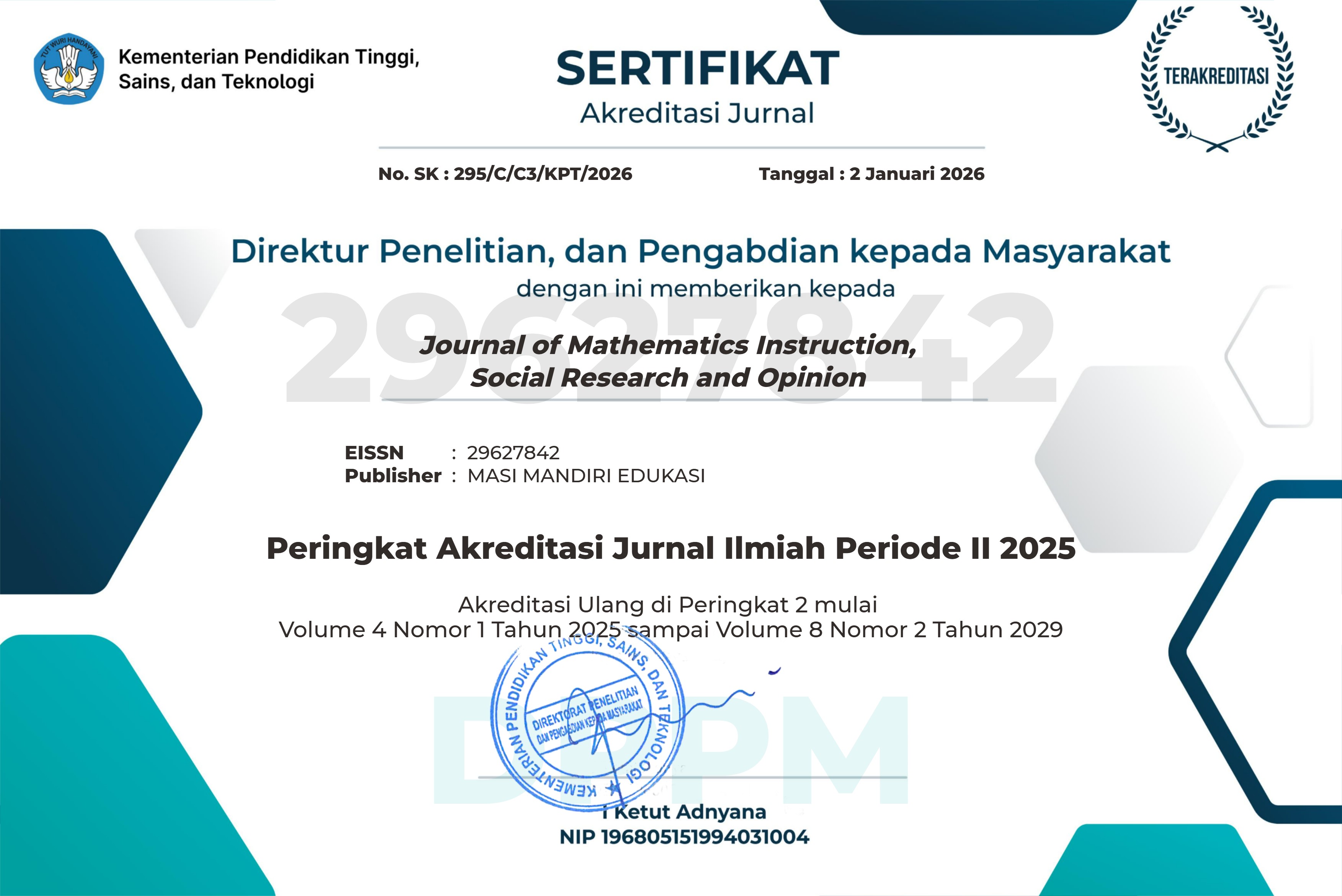
| Accreditation Certificate |
  |
| Indexing |






Contact Us

visitor
| Information |
>> For Authors
>> For Readers
>> For Librarians
| Visitor Statistics |
| Member of |


| Announcement |

| Keywords |
Mathematics Learning Difficulty Dyscalculia Teacher perceptions personality ICT Learning Computer teaching Academic Fisherfolks Economic Behavior Probit Models matrix mathematical model Concepts Guided Note Taking Golden Ratio Philosophy Integrated Learning van Hiele geometry Assessment Learning Outcomes method skills Problem Solving Experiment
| License |

MISRO is licensed under a Creative Commons Attribution-ShareAlike 4.0 International License.
| Publisher |

Address:
Jl. Gagak N0.105, Bandung,
Indonesia 40133
E-mail:
journalmisro@gmail.com
| in collaboration with |

| Recommended Tools |


| ISSN Barcode |

