
Institutional Transformation and Digital Adaptation of Radio Republik Indonesia (RRI) Medan as a Public Broadcasting Institution (1998-2014)
DOI:
https://doi.org/10.58421/misro.v4i4.962Keywords:
Radio Republik Indonesia, RRI Medan, History of Broadcasting, Media Reform, Radio DigitizationAbstract
This study analyzes the institutional transformation of Radio Republik Indonesia (RRI) Medan, a public broadcasting institution, during the post-Reformasi period, focusing on how the organization responded to declining relevance and competitiveness amid media liberalization and accelerating digitalization. The main objective of this research is to examine the processes of institutional repositioning, changes in broadcasting practices, and strategic adaptations undertaken by RRI Medan in response to increasing competition from private radio and digital media between 1998 and 2014. Employing an institutional history approach, this study uses historical methods encompassing heuristic exploration, source criticism, interpretation, and historiography, supported by archival records, broadcasting policy documents, academic literature, and selected oral sources from RRI practitioners. The findings demonstrate that RRI Medan faced significant external pressures following its transition from a state-controlled radio to a public broadcasting institution. These pressures stimulated institutional restructuring, redefinition of public service functions, adjustments in broadcast content and listener segmentation, and the initial adoption of digital strategies through streaming and online platforms. However, these adaptive efforts were constrained by bureaucratic inertia, limited technological infrastructure, and human resource capacity. This study argues that the period 1998–2014 constitutes a critical transitional phase that laid the institutional foundation for RRI Medan’s shift toward a multi-channel public broadcasting model in the digital era. Scientifically, this research contributes to the historiography of Indonesian media by providing an empirical analysis of the transformation of public broadcasting at the local level, highlighting the interaction among institutional change, media policy, and digital disruption in post-authoritarian Indonesia.
Downloads
References
P. Heuristik, M. Pro, and M. Alih, “A Comparative Heuristic Assessment Of Muslim Pro And Sajda : Evaluating User- Centered Islamic Mobile Applications,” vol. 10, no. 2, pp. 181–195, 2025.
D. M. S. Dr. Harliantara and A. Rustam, Radio Is Sound Only: Pengantar Dan Prinsip Penyiaran Radio Di Era Digital. Broadcastmagz Publisher, 2021. [Online]. Available: https://books.google.co.id/books?id=ojRPEAAAQBAJ
I. O. Ajisafe, “Radio as a Tool for National Development,” Asian J. Educ. Soc. Stud., vol. 14, no. 3, pp. 1–9, 2021, doi: 10.9734/ajess/2021/v14i330354.
A. Indonesian, C. Study, A. A. Yani, and S. Ahmad, “Public Service Performance and Public Trust in Government,” vol. 43, no. Icas, pp. 86–89, 2017.
Winda Kustiawan, Alphy Shahri Maulana, Arif Indra Hasan Harahap, Mahadir Muhammad, and Zulhafiz Zulhafiz, “Evolusi Radio Republik Indonesia (Rri) Sebagai Situs Media Informasi Tertua Dan Eksistensinya Di Masa Modern,” J. Ilm. Tek. Inform. dan Komun., vol. 2, no. 3, pp. 65–71, 2022, doi: 10.55606/juitik.v2i3.347.
C. Nasution and E. Madya, “Communication Management of Republic of Indonesia Radio Broadcasters (Rri) Medan in Maintaining Its Existence in the Digitalization Era,” J. Pamator J. Ilm. Univ. Trunojoyo, vol. 16, pp. 247–258, May 2023, doi: 10.21107/pamator.v16i2.19785.
T. Piñeiro-Otero and L. Pedrero Esteban, “Audio communication in the face of the renaissance of digital audio,” El Prof. la Inf., vol. 31, Sep. 2022, doi: 10.3145/epi.2022.sep.07.
D. Hill, The Press in New Order Indonesia. 1994.
Sofwan, “Partisipasi Publik Dalam Pembentukan Peraturan Daerah,” Lex Adm., vol. 1, no. 2, pp. 114–123, 2013.
I. Sakina and D. Hendrik, “The development of Indonesian mass media: An analysis of political power and its influence on democracy,” J. Polit. Indones. (Indonesian J. Polit., vol. 11, no. 1, pp. 96–106, 2025, doi: 10.20473/jpi.v11i1.66957.
J. Poti and M. K. Ahmad, “Mass Media Reform and Democratization in the Indonesian Context,” Soc. Sci., vol. 10, p. 28, 2021, [Online]. Available: https://api.semanticscholar.org/CorpusID:233251148
N. Kholis, G. A. Savitri, and N. Husna, “The Use of Social Media (Instagram) for the Radio Industry (Content and Marketing Strategies to Increase Audience Loyalty),” E3S Web Conf., 2023, [Online]. Available: https://api.semanticscholar.org/CorpusID:261989782
A. C. Prasatya, “The Role of Social Media in Indonesia’s 2014 Presidential Election Campaign,” J. Ilm. Univ. Bakrie, vol. 3, no. 03, 2015.
I. Abbas, “Memahami Metodologi Sejarah antara Teori dan Praktek *),” vol. 1, no. 1, 2014.
H. Sjamsuddin and P. Ombak, Metodologi sejarah. Penerbit Ombak, 2020. [Online]. Available: https://books.google.co.id/books?id=ZLYSywAACAAJ
Y. Yulius and H. P. Widodo, “Strategi Komunikasi Pemasaran RRI Malang dalam Upaya Pencapaian PNBP dan Meningkatkan Jumlah Pengiklan,” J. Komun. Nusant., vol. 1, no. 2, pp. 64–75, 2019, doi: 10.33366/jkn.v1i2.19.
R. Surbakti, “Меманамі Ilmu Politik,” p. 37, 2007.
I. Buying, I. In, and M. City, “Simangunsong : Journal Of Business Administration , Management , Economic And Accounting,” vol. 01, no. 01, pp. 17–29, 2023.
S. Afria et al., “Marketing Communication Strategy in Increasing the Number of Advertisements : A Case Study of RRI Medan,” vol. 9, no. 2, pp. 1050–1063, 2024.
B. Budisatrio, N. Rakhmawati, and K. Sitorus, “Analyzing Ethical Challenges of Deepfake Technology in Media and Communication Using Bibliometric Research and VOSviewer Visualization.” 2025. doi: 10.13140/RG.2.2.27235.46881.
C. Sinaga and R. Rizky, The Role of Commercial Advertising on Social Media to Develop Small Business in the Muslimah Entrepreneur Community. 2022. doi: 10.2991/978-2-494069-07-7_36.
T. Laor, “Radio on demand: New habits of consuming radio content,” Glob. Media Commun., vol. 18, no. 1, pp. 25–48, 2022, doi: 10.1177/17427665211073868.
A. A. Parkha and T. Walisyah, “Tantangan Komunikasi Penyiar Radio Republik Indonesia ( RRI ) Medan Dalam Adaptasi Teknologi Siaran Digital,” vol. 10, no. 2, 2025.
Y. Saragih and A. S. Manurung, “The Role of Media Journalism in Influencing Public Perceptions of Religious Issues in the Digital Age,” vol. 19, no. 1, pp. 137–158.
D. Sacco, Film Regulation in A Cultural Context. Edinburgh University Press, 2023. [Online]. Available: http://www.jstor.org/stable/10.3366/jj.5864730
G. Ferri, M. Ambrosetti, A. Beretta, G. Groppi, and E. Tronconi, “Experimental investigation and 2D mathematical modelling of copper foams packed with Rh-Al2O3 catalysts for the intensification of methane steam reforming,” Catal. Today, vol. 426, p. 114386, 2024, doi: https://doi.org/10.1016/j.cattod.2023.114386.
A. D. Andriani, S. A. Fitri, and K. Muchtar, “Model Komunikasi Literasi Digital Dalam Mengatasi Ujaran Kebencian Di Media Sosial,” Interak. J. Ilmu Komun., vol. 13, no. 2, pp. 439–464, 2024, doi: 10.14710/interaksi.13.2.439-464.
C. Wittrock, E. Forsberg, A. Pols, P. Macnaghten, and D. Ludwig, “Introduction to RRI and the Organisational Study,” 2021, pp. 7–22. doi: 10.1007/978-3-030-54286-3_2.
Downloads
Additional Files
Published
How to Cite
Issue
Section
License
Copyright (c) 2025 Journal of Mathematics Instruction, Social Research and Opinion

This work is licensed under a Creative Commons Attribution-ShareAlike 4.0 International License.
SideBar
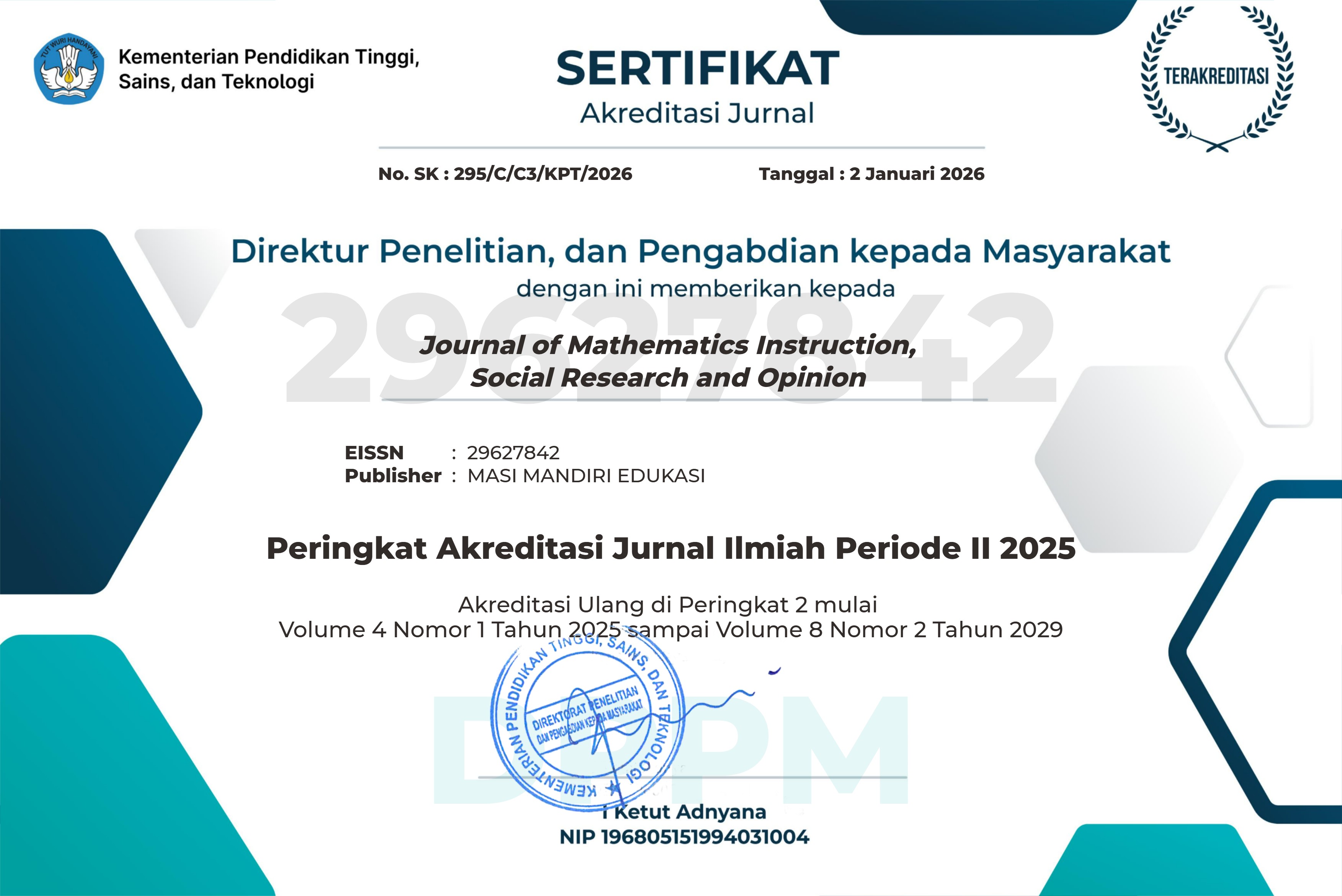
| Accreditation Certificate |
  |
| Indexing |






Contact Us

visitor
| Information |
>> For Authors
>> For Readers
>> For Librarians
| Visitor Statistics |
| Member of |

| Announcement |

| Keywords |
Mathematics Learning Difficulty Dyscalculia Teacher perceptions personality ICT Learning Computer teaching Academic Fisherfolks Economic Behavior Probit Models matrix mathematical model Concepts Guided Note Taking Golden Ratio Philosophy Integrated Learning van Hiele geometry Assessment Learning Outcomes method skills Problem Solving Experiment
| License |

MISRO is licensed under a Creative Commons Attribution-ShareAlike 4.0 International License.
| Publisher |

Address:
Jl. Gagak N0.105, Bandung,
Indonesia 40133
E-mail:
journalmisro@gmail.com
| in collaboration with |

| Recommended Tools |


| ISSN Barcode |

