
Development of Group Investigation-Based Mathematics E-Comic to Improve Mathematical Representation Skills of Junior High School Students
DOI:
https://doi.org/10.58421/misro.v5i1.954Keywords:
E-Comic, Group Investigation, Representation Mathematical, Junior High School , Mathematics LearningAbstract
Mathematics plays a fundamental role in developing logical, analytical, and systematic thinking; therefore, mathematics learning should emphasize not only procedural mastery but also meaningful conceptual understanding. One essential process standard in mathematics learning is mathematical representation, as it enables students to organize ideas, communicate reasoning, and transform abstract concepts into visual, verbal, and symbolic forms. In plane geometry, particularly quadrilaterals, many students experience difficulties in drawing accurate figures, linking geometric properties to formulas, and translating contextual problems into mathematical models. In addition to cognitive challenges, affective factors such as low perseverance and the tendency to give up easily indicate the need to strengthen students’ mathematical resilience. This study aimed to develop a group investigation–based mathematics e-comic for quadrilateral topics at the junior high school level and to examine its feasibility and effectiveness. The research employed a Research and Development (R&D) approach using the ADDIE model, consisting of analysis, design, development, implementation, and evaluation stages. The product was validated by subject-matter experts and media experts and implemented with 32 seventh-grade students at SMP NU Darul Ma’arif. Data were collected through validation sheets, teacher and student response questionnaires, and learning evaluations. The results indicate that the developed e-comic meets high feasibility criteria and receives positive responses from teachers and students. The integration of narrative visuals with group investigation activities enhances engagement, supports students’ understanding of quadrilateral concepts, and encourages active participation and discussion. Therefore, the proposed e-comic is suitable as an alternative learning medium for junior high school mathematics instruction.
Downloads
References
B. Rott, B. Specht, and C. Knipping, “A descriptive phase model of the problem-solving process,” ZDM–Mathematics Education, vol. 53, pp. 737–752, 2021, doi.org/10.1007/s11858-021-01244-3
S. Rezat, Y.H. Chiu, M. Hattermann, et al., “Mathematics textbooks and curriculum resources as an interface between intended and implemented curricula,” ZDM–Mathematics Education, vol. 53, pp. 1189–1206, 2021, doi.org/10.1007/s11858-021-01309-3
B. Roesken-Winter, R. Stahnke, S. Prediger, et al., “Towards a research basis for implementation strategies aimed at mathematics teachers and facilitators,” ZDM–Mathematics Education, vol. 53, pp. 1007–1019, 2021, doi.org/10.1007/s11858-021-01220-x
J.M. Diego-Mantecon, T. Prodromou, Z. Lavicza, et al., “An attempt to evaluate STEAM project-based teaching from a school mathematics perspective,” ZDM–Mathematics Education, vol. 53, pp. 1137–1148, 2021, doi.org/10.1007/s11858-021-01303-9
J.F.A. Salminen-Saari, E. Garcia Moreno-Esteva, E. Haataja, et al., “Phases of collaborative mathematics problem solving and joint attention: a case study leveraging mobile eye gaze tracking,” ZDM–Mathematics Education, vol. 53, pp. 771–784, 2021, doi.org/10.1007/s11858-021-01280-z
H. Elgrably and R. Leikin, “Creativity as a function of problem-solving skills: posing new problems through investigation,” ZDM–Mathematics Education, vol. 53, pp. 891–904, 2021, doi.org/10.1007/s11858-021-01228-3
C. Bjorklund, A. Kullberg, I. Brkovic, and U. Runesson Kempe, “Teaching toddlers about the meaning of numbers—connecting conceptual and procedural aspects,” Educational Studies in Mathematics, 2022, doi.org/10.1007/s10649-022-10147-3
A. Tondorf and S. Prediger, “Connecting characterizations of expression equivalence,” Educational Studies in Mathematics, 2022, doi.org/10.1007/s10649-022-10158-0
B.B. de Koning, A.J.H. Boonen, and M. van der Schoot, “The model drawing method acts as a double-edged sword for solving word problems,” Educational Studies in Mathematics, 2022, doi.org/10.1007/s10649-022-10150-8
D. Gotz and K. (et al.), “Reflecting on geometric shapes: an elementary school approach…” Educational Studies in Mathematics, 2022, doi.org/10.1007/s10649-022-10145-5
P. Di Martino, F. Gregorio, and P. Iannone, “The transition from school to university in mathematics education research: trends and new ideas from a systematic literature review,” Educational Studies in Mathematics, 2022, doi.org/10.1007/s10649-022-10194-w
R. Novita, T. Herman, D. Dasari, and M. Putra, “Analyzing Second-Year Students’ Understanding of Rational Numbers: A Case Study of Fraction Interpretation and Representation,” European Journal of Educational Research, vol. 11, no. 3, pp. 1747–1762, July 2022, doi.org/10.12973/eu-jer.11.3.1747
CA Rodríguez-Nieto, FM Rodríguez-Vásquez, and VF Moll, “Combined use of extended connection theory and an onto-semiotic approach to analyze mathematical connections by connecting the graphs f and f′,” Educational Studies in Mathematics, vol. 114, pp. 63–88, 2023, https://doi.org/10.1007/s10649-023-10246-9
C. Khairunnisak, R. Johar, C. Morina Zubainur, and P. Sasalia, “Algebraic Expression Learning Trajectory: Supporting Students' Mathematical Representation Abilities,” 2021. [Online]. Available: https://commons.hostos.cuny.edu/mtrj/
P. Di Martino, F. Gregorio, and P. Iannone, “The transition from school mathematics to university mathematics in different contexts: Affective and sociocultural issues in students' crises,” Educational Studies in Mathematics, 2022, https://doi.org/10.1007/s10649-022-10179-9
G.A. Goldin, “Mathematical representations,” in Encyclopedia of Mathematics Education, S. Lerman, Ed. Cham, Switzerland: Springer, 2020, https://doi.org/10.1007/978-3-030-15789-0_103
C. Midgett and S. Eddins, “NCTM Principles and Standards for School Mathematics: Implications for Administrators,” Nassp Bulletin, vol. 85, pp. 35–42, August 2001, doi: 10.1177/019263650108562305.
Rasilah, J. Afgani Dahlan, and Sudirman, "Technology, Pedagogy, and Content Knowledge for Mathematics Teachers in the Digital Era: A Literature Review," Wiralodra Gem, vol. 12, no. 1, pp. 84–94, 2021.
A. Rahmasari and H. Kuswanto, “Effectiveness Of Problem-Based Learning Physics Pocketbooks Integrating Augmented Reality With Local Wisdom Of Katapult In Improving Mathematical And Graphical Representation Abilities,” J Technol Sci Educ, vol. 13, no. 3, pp. 886–900, 2023, doi: 10.3926/JOTSE.1962.
J. DiNapoli and E.K. Miller, “Recognizing, supporting, and enhancing students' persistence in mathematical problem solving…,” The Journal of Mathematical Behavior, vol. 66, 2022, doi: 10.1016/j.jmathb.2022.100965
K.H. Roh and Y. Lee, “Supporting students' representations through scaffolding,” The Journal of Mathematical Behavior, vol. 71, 2023, doi: 10.1016/j.jmathb.2023.101008.
JA . Van de Walle, KS . Karp, JM . Bay-Williams, JA . Wray, and E. Todd. Brown, Elementary and secondary school mathematics: teaching developmentally. Pearson, 2019.
E.M. Schoevers et al., “ The relationship between creativity and students' performance on different types of geometry problems in primary education,” ZDM–Mathematics Education, 2022, doi: 10.1007/s11858-021-01315-5.
K.E. Schenck and M.J. Nathan, “Navigating Spatial Ability for Mathematics Education: A Review and Roadmap,” Educational Psychology Review, 2024, doi: 10.1007/s10648-024-09935-5.
T. Xu et al., “Spatial Reasoning and Its Contribution to Mathematics Learning,” Journal of Intelligence, 2025, doi: 10.3390/jintelligence13040041.
A. Dorko, “How students use the ‘see similar examples’ feature in online math homework,” The Journal of Mathematical Behavior, 2021, doi: 10.1016/j.jmathb.2021.100894.
ZH Putra, Dahnilsyah, and A. Aljarrah, “Praxeological analysis of mathematical comics designed by prospective elementary school teachers,” Journal of Mathematics Education, vol. 12, no. 3, pp. 563–580, 2021. http://doi.org/10.22342/jme.12.3.14143.563-580
F. Baier, A.-T. Decker, T. Voss, T. Kleickmann, U. Klusmann, and M. Kunter, “What makes a good teacher? The relative importance of mathematics teachers’ cognitive abilities, personality, knowledge, beliefs, and motivation on teaching quality,” British Journal of Educational Psychology, vol. 89, no. 4, pp. 767–786, 2019, doi: 10.1111/bjep. 12256.
A.M. Flanagan, D.C. Cormier, and O. Bulut, “Achievement may be rooted in teacher expectations: examining the differential effects of ethnicity, years teaching, and classroom behavior,” Social Psychology of Education, vol. 23, pp. 1429–1448, 2020, doi: 10.1007/s11218-020-09590-y.
S. Okumus and ZZ Simsek, “Use of linguistic markers by prospective mathematics teachers in the context of angles formed by two lines cut by a transversal,” The Journal of Mathematical Behavior, vol. 63, Art. no. 100890, 2021, https://doi.org/10.1016/j.jmathb.2021.100890.
F. Prasetya, et al., “Impact of augmented reality learning experiences based on motivational design models: A meta-analysis” Computers & Education, 2024, doi:10.1016/j.ssaho.2024.100926.
J. Kerrigan, K. Weber, and C. Chinn, “Effective collaboration in productive failure processes,” The Journal of Mathematical Behavior, 2021, doi: 10.1016/j.jmathb.2021.100892
J.F. Salminen-Saari, E. Garcia Moreno-Esteva, E. Haataja, M. Toivanen, M.S. Hannula, and A. Laine, “Phases of collaborative mathematics problem solving and joint attention: A case study leveraging mobile eye-gaze tracking,” ZDM–Mathematics Education, vol. 53, no. 4, pp. 771–784, 2021, doi.org/10.1007/s11858-021-01280-z.
Salminen-Saari, J.F., Garcia Moreno-Esteva, E., Haataja, E., Toivanen, M., Hannula, M.S., & Laine, A. (2021). Phases of collaborative mathematics problem solving and joint attention: a case study leveraging mobile eye-gaze tracking. ZDM–Mathematics Education, 53 (4), 771-784. https://doi.org/10.1007/s11858-021-01280-z
RR Setyowati and S. Rochmat, “The effect of digital learning of historical comics on students' critical thinking skills,” International Journal of Information Technology and Education, vol. 13, no. 5, pp. 818–824, 2023, https://doi.org/10.18178/ijiet.2023.13.5.1873
S. Salsabila and CLP Sari, “Development of digital comic learning media in economics subjects,” POLYGLOT: Scientific Journal, vol. 19, no. 1, pp. 25–40, January 2023, doi: 10.1966/pji.v19i1.5868.
FP Lestari, F. Ahmadi, and R. Rochmad, “Implementation of mathematics comics through contextual teaching and learning to improve critical thinking skills and character,” European Journal of Educational Research, vol. 10, no. 1, pp. 497–508, 2021, https://doi.org/10.12973/eu-jer.10.1.497.
Downloads
Additional Files
Published
How to Cite
Issue
Section
License
Copyright (c) 2026 Journal of Mathematics Instruction, Social Research and Opinion

This work is licensed under a Creative Commons Attribution-ShareAlike 4.0 International License.
SideBar
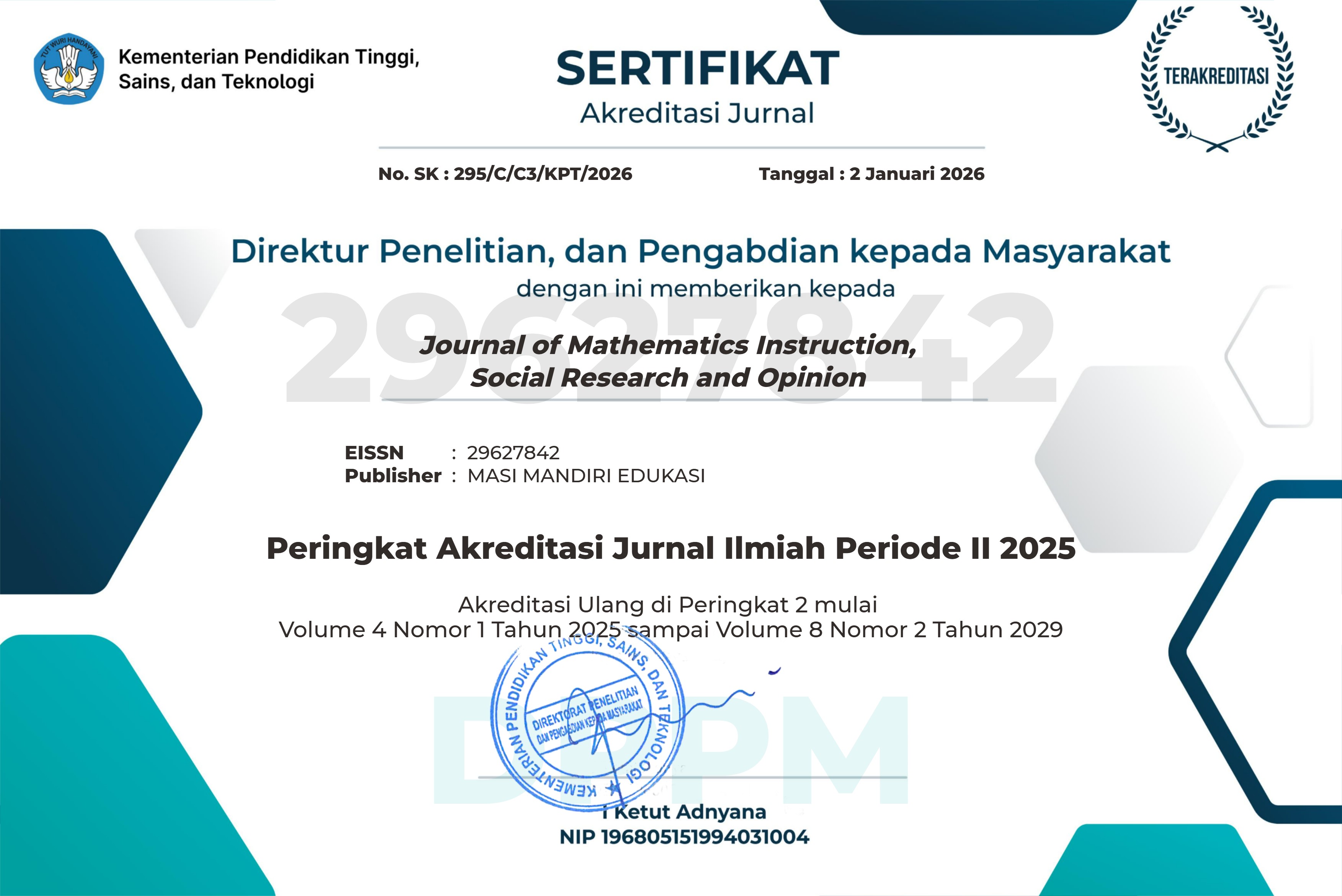
| Accreditation Certificate |
  |
| Indexing |






Contact Us

visitor
| Information |
>> For Authors
>> For Readers
>> For Librarians
| Visitor Statistics |
| Member of |

| Announcement |

| Keywords |
Mathematics Learning Difficulty Dyscalculia Teacher perceptions personality ICT Learning Computer teaching Academic Fisherfolks Economic Behavior Probit Models matrix mathematical model Concepts Guided Note Taking Golden Ratio Philosophy Integrated Learning van Hiele geometry Assessment Learning Outcomes method skills Problem Solving Experiment
| License |

MISRO is licensed under a Creative Commons Attribution-ShareAlike 4.0 International License.
| Publisher |

Address:
Jl. Gagak N0.105, Bandung,
Indonesia 40133
E-mail:
journalmisro@gmail.com
| in collaboration with |

| Recommended Tools |


| ISSN Barcode |

