
Kompas Group’s Dual-Product Strategy in Indonesia’s Digital Media Economy: A Picardian Media Economics Analysis
DOI:
https://doi.org/10.58421/misro.v4i4.900Keywords:
Digital Disruption, Dual-Product Market, Kompas Group, Legacy Media, Media EconomicsAbstract
This study addresses the challenge legacy media face in sustaining economic viability amid digital disruption in Indonesia, focusing on the tension between journalistic idealism and business sustainability. The objective of this research is to examine the economic strategies Kompas Group employs to manage the dual-product media market amid intensified competition and changing audience behavior. This study applies a descriptive qualitative research method, with data collected through in-depth interviews with a media economics expert, internal representatives of Kompas Group, and Generation Z audiences, supported by a literature review and secondary data analysis. The findings indicate that Kompas Group implements a dual economic strategy by separating advertising-driven platforms, such as Kompas.com, from subscription-based digital journalism through Kompas.id. Although this strategy demonstrates adaptive efforts toward digital transformation, its effectiveness remains constrained by structural challenges, including declining advertising revenues, low willingness among younger audiences to pay for news, reduced tolerance for digital advertising, and weakened brand loyalty due to algorithm-driven news consumption on social media. Additionally, both intramedia competition with digital-native media and intermedia competition with global technology platforms further intensify economic pressures on legacy media. This study concludes that the long-term sustainability of Kompas Group depends not only on technological innovation but also on its capacity to adapt to evolving audience behavior, address structural imbalances in the digital media economy, and diversify revenue sources while maintaining core journalistic values.
Downloads
References
R. G. Picard, The Economics and Financing of Media Companies. New York, NY, USA: Fordham University Press, 2002.
A. B. Albarran, Media Economics: Understanding Markets, Industries, and Concepts, 3rd ed. New York, NY, USA: Routledge, 2017.
G. Doyle, Understanding Media Economics, 2nd ed. London, UK: SAGE Publications, 2013.
R. G. Picard, The Economics and Financing of Media Companies, 2nd ed. New York, NY, USA: Fordham University Press, 2011.
P. M. Napoli, Social Media and the Public Interest: Media Regulation in the Disinformation Age. New York, NY, USA: Columbia University Press, 2019.
A. Desyandra, “Personal interview,” Producer, Kompas TV, 2025.
T. Rheabela, “Personal interview,” Producer, Kompas TV, 2025.
Grid Network, “Profil dan Ekosistem Digital Grid Network,” 2024. [Online]. Available: https://www.grid.id
Kompas Gramedia, “Sejarah dan Profil Kompas Gramedia,” 2024. [Online]. Available: https://www.kompasgramedia.com
Kompas.com, “Reposisi Kompas TV sebagai Televisi Berita,” 2016. [Online]. Available: https://www.kompas.com
A. Cook and A. Attari, “Paying for online news: Subscription models and the role of perceived value,” Journalism Practice, vol. 15, no. 8, pp. 1131–1148, 2021.
R. G. Picard, “Twilight or new dawn of journalism? Evidence from the changing news ecosystem,” Journalism Studies, vol. 15, no. 5, pp. 500–510, 2014.
L. Myllylahti, “Paywalls and the changing nature of news,” Digital Journalism, vol. 2, no. 2, pp. 179–194, 2014.
N. Newman, R. Fletcher, A. Kalogeropoulos, and R. Nielsen, “Reuters Institute Digital News Report,” Reuters Institute for the Study of Journalism, Oxford, 2024.
D. McQuail, McQuail’s Mass Communication Theory, 6th ed. London, UK: Sage, 2010.
G. Doyle, “Re-invention and survival: Newspapers in the era of digital multiplatform delivery,” Journal of Media Business Studies, vol. 10, no. 4, pp. 1–20, 2013.
J. van Dijck, T. Poell, and M. de Waal, The Platform Society: Public Values in a Connective World. Oxford, UK: Oxford University Press, 2018.
P. Napoli, “Audience evolution and the future of audience research,” International Journal on Media Management, vol. 14, no. 2, pp. 79–97, 2012.
S. Chyi, “Willingness to pay for online news: An empirical study,” Journal of Media Economics, vol. 18, no. 2, pp. 131–152, 2005.
T. Flew, Understanding Global Media, 3rd ed. London, UK: Palgrave Macmillan, 2018.
J. van Dijck, “Facebook and the engineering of connectivity: A multi-layered approach,” Convergence, vol. 19, no. 2, pp. 141–155, 2013.
V. Pickard, Democracy Without Journalism? Confronting the Misinformation Society. Oxford, UK: Oxford University Press, 2020.
C. Fuchs, Social Media: A Critical Introduction, 2nd ed. London, UK: Sage, 2017.
R. Nielsen and L. Myllylahti, “Rethinking media funding,” Journalism Practice, vol. 12, no. 6, pp. 1–17, 2018.
M. Deuze and T. Witschge, “Beyond journalism: Theorizing the transformation of journalism,” Journalism, vol. 19, no. 2, pp. 165–181, 2018.
Downloads
Additional Files
Published
How to Cite
Issue
Section
License
Copyright (c) 2025 Journal of Mathematics Instruction, Social Research and Opinion

This work is licensed under a Creative Commons Attribution-ShareAlike 4.0 International License.
SideBar
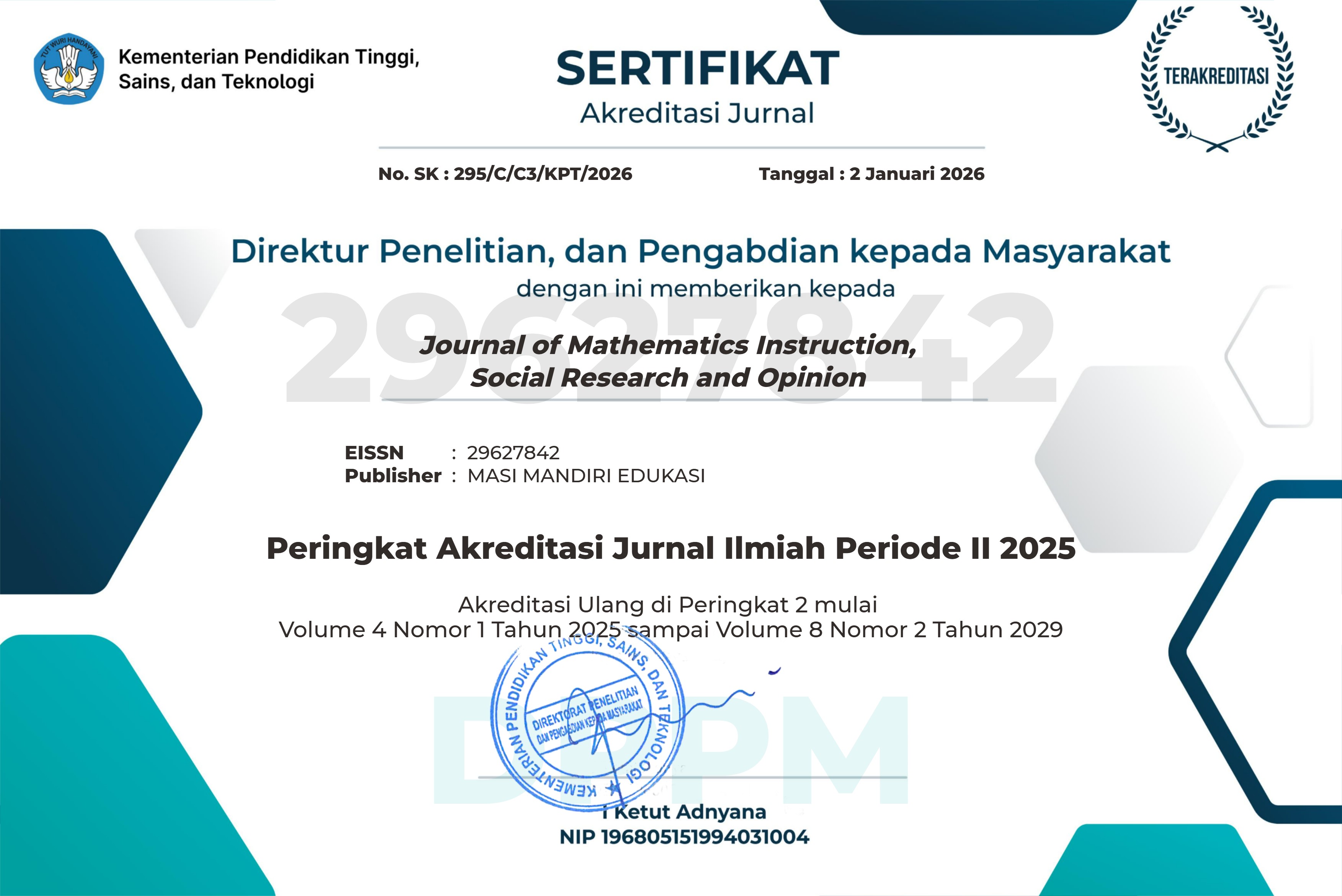
| Accreditation Certificate |
  |
| Indexing |






Contact Us

visitor
| Information |
>> For Authors
>> For Readers
>> For Librarians
| Visitor Statistics |
| Member of |


| Announcement |

| Keywords |
Mathematics Learning Difficulty Dyscalculia Teacher perceptions personality ICT Learning Computer teaching Academic Fisherfolks Economic Behavior Probit Models matrix mathematical model Concepts Guided Note Taking Golden Ratio Philosophy Integrated Learning van Hiele geometry Assessment Learning Outcomes method skills Problem Solving Experiment
| License |

MISRO is licensed under a Creative Commons Attribution-ShareAlike 4.0 International License.
| Publisher |

Address:
Jl. Gagak N0.105, Bandung,
Indonesia 40133
E-mail:
journalmisro@gmail.com
| in collaboration with |

| Recommended Tools |


| ISSN Barcode |

