
Implementing SIMANTAP for Personnel Administration Services in Samboja District: An Edward III Policy Implementation Analysis
DOI:
https://doi.org/10.58421/misro.v4i4.849Keywords:
SIMANTAP, Policy Implementation, Public AdministrationAbstract
Digital transformation in public administration is a strategic effort to achieve governance that is effective, efficient, and accountable. This study examines the implementation of the Rapid Introductory Letter Administration Service System (SIMANTAP) in Samboja District as a digital innovation in personnel services, aiming to identify factors that hinder its optimal operation. A descriptive qualitative approach was employed, with data collected through in-depth interviews, observations, and documentation. Informants included the Head of Samboja District, the Head of the General and Personnel Subdivision, and SIMANTAP operators at district and village levels. Data were analyzed through data reduction, presentation, and conclusion drawing, using Edward III’s policy implementation model, encompassing communication, resources, disposition, and bureaucratic structure. The findings indicate that initial socialization of SIMANTAP reached 85% of target personnel but lacked ongoing communication. While 90% of staff demonstrated readiness and positive commitment, only 60% had stable access to functional computers and reliable internet. No dedicated budget exists in the regional budget (APBD), and structured monitoring mechanisms are absent. The study concludes that SIMANTAP has strong potential as a district-level e-government model, but its adoption is constrained by limited technological infrastructure, inadequate budgetary support, and a lack of systematic evaluation. Strengthening policy guidance, enhancing staff capacity, modernizing ICT infrastructure, and allocating budgets are critical to ensuring sustainable and effective implementation.
Downloads
References
P. Dunleavy, H. Margetts, S. Bastow, and J. Tinkler, Digital Era Governance: IT Corporations, the State, and E-Government. Oxford: Oxford University Press, 2006.
D. M. West, Digital Government: Technology and Public Sector Performance. Princeton: Princeton University Press, 2005.
Republik Indonesia, Peraturan Presiden Nomor 95 Tahun 2018 tentang Sistem Pemerintahan Berbasis Elektronik (SPBE).
Kementerian Komunikasi dan Informatika, Laporan Tahunan Teknologi Informasi dan Komunikasi. Jakarta: Kemkominfo, 2020.
R. Gauld, S. Goldfinch, and S. Horsburgh, “How Responsive is E-Government? Evidence from Australia and New Zealand,” Government Information Quarterly, vol. 27, no. 2, pp. 13–18, 2010.
C. Hood, “A Public Management for All Seasons?”, Public Administration, vol. 69, no. 1, pp. 3–19, 1991.
M. S. Grindle, Politics and Policy Implementation in the Third World. Princeton, NJ: Princeton University Press, 1980.
C. Pollitt and G. Bouckaert, Public Management Reform: A Comparative Analysis. Oxford: Oxford University Press, 2011.
D. Osborne and T. Gaebler, Reinventing Government. Reading, MA: Addison-Wesley, 1992.
M. Jannah, A. Karim, and B. Irawan, “Efektivitas penerapan sistem informasi manajemen kepegawaian berbasis teknologi informasi pada BKP2D Kota Samarinda,” eJournal Administrasi Negara, vol. 6, no. 3, pp. 7911–7922, 2018.
Q. A. Indica, Implementasi Sistem Administrasi Manajemen Kepegawaian Berbasis Elektronik di Kabupaten Mesuji. Skripsi, Fakultas Hukum, Universitas Lampung, 2023.
D. M. West, Digital Government: Technology and Public Sector Performance. Princeton: Princeton University Press, 2005.
H. Fernando and I. Keppitigoda, Barriers to Digital Transformation in a Public Organization: Case of the Ministry of Finance in Sri Lanka. Master’s Thesis, Dept. of Computer and Systems Sciences, 2024.
S. R. Akramian, A. Nikpour, H. R. Mollaei, M. J. Kamali, and H. Talebi, “Providing digital human resource management model,” Management and Educational Perspective, vol. 6, no. 3, pp. 282–297, 2024.
P. Mustabsirah, Implementasi Kebijakan Sistem Informasi Manajemen Kepegawaian (SIMPEG) pada BKPSDM Kota Medan. Tesis Magister, Universitas Medan Area, 2021.
G. C. Edwards III, Implementing Public Policy. Washington DC: Congressional Quarterly Press, 1980.
D. S. Van Meter and C. E. Van Horn, “The policy implementation process: A conceptual framework,” Administration & Society, vol. 6, no. 4, pp. 445–488, 1975.
Sugiyono, Memahami Penelitian Kualitatif. Bandung: Penerbit Alfabeta, 2014.
M. B. Miles, A. M. Huberman, and J. Saldaña, Qualitative Data Analysis: A Sourcebook of New Methods, 2nd ed. Thousand Oaks, CA: Sage Publications, 2014.
S. Imam, Analisis Data Kualitatif: Sebuah Pengantar, ed. 2. Jakarta: Penerbit ABC, 2016.
S. C. Winter, “Implementation,” in The Sage Handbook of Public Administration, 2nd ed., B. G. Peters and J. Pierre, Eds. London: Sage Publications, 2012, pp. 255–266.
M. Siwi et al., Strategi Komunikasi dalam Adopsi Teknologi Digital E-government bagi Keberlanjutan Pembangunan Desa Digital, Policy Brief Pertanian, Kelautan, dan Biosains Tropika, vol. 6, no. 4, 2024.
Strategi Komunikasi Dinas Kominfo Kota Yogyakarta dalam Mensosialisasikan Aplikasi Jogja Smart Service (JSS) untuk Meningkatkan E-Government di Yogyakarta, UPN “Veteran” Yogyakarta, 2024.
R. Adi Nugroho and Y. Purbokusumo, E-Government Readiness: Penilaian Kesiapan Aktor Utama Penerapan E-Government di Indonesia, Jurnal IPTEKKOM, 2025.
M. Howlett and M. Ramesh, Studying Public Policy: Policy Cycles and Policy Subsystems, 3rd ed. Oxford: Oxford University Press, 2013.
Downloads
Additional Files
Published
How to Cite
Issue
Section
License
Copyright (c) 2025 Journal of Mathematics Instruction, Social Research and Opinion

This work is licensed under a Creative Commons Attribution-ShareAlike 4.0 International License.
SideBar
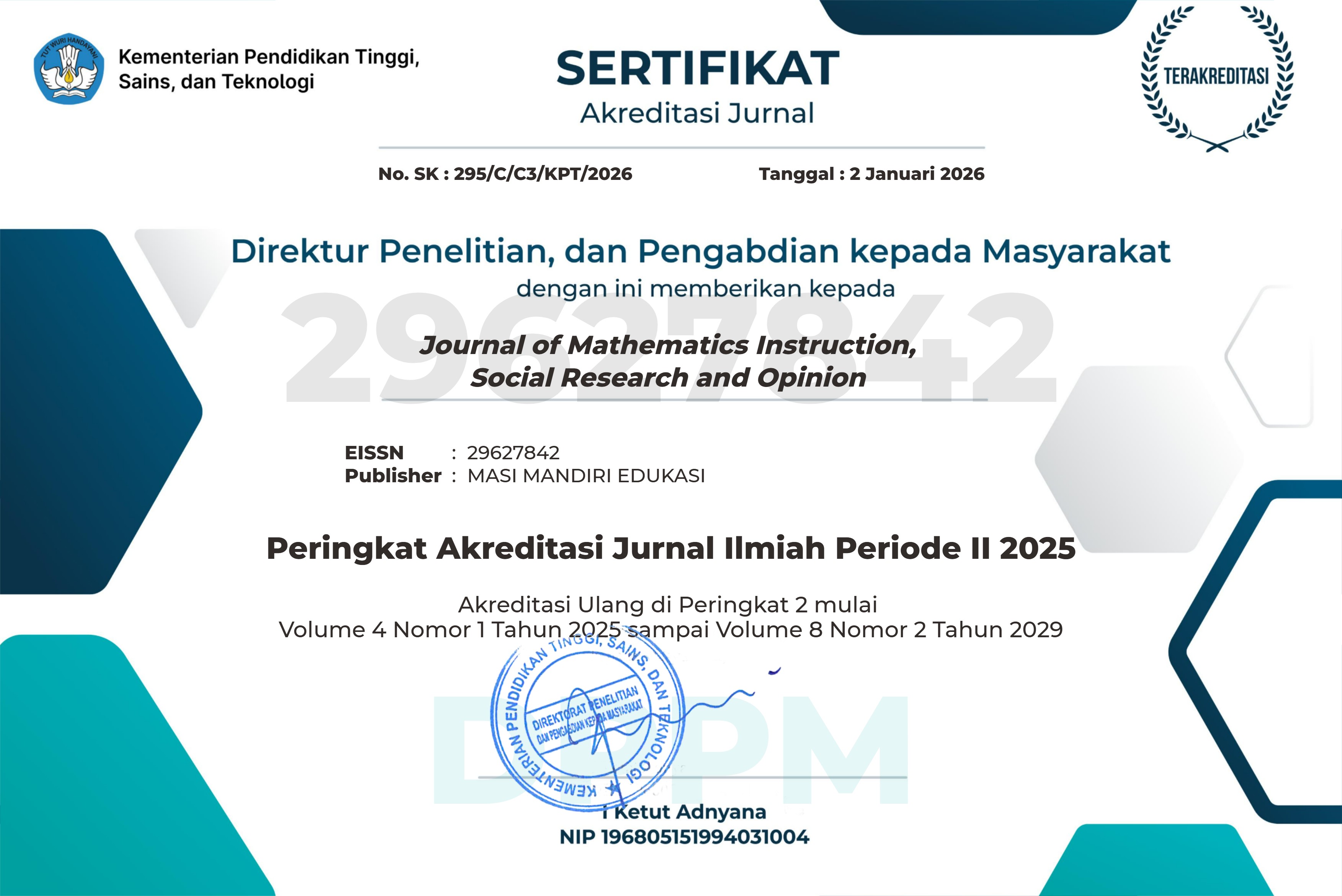
| Accreditation Certificate |
  |
| Indexing |






Contact Us

visitor
| Information |
>> For Authors
>> For Readers
>> For Librarians
| Visitor Statistics |
| Member of |


| Announcement |

| Keywords |
Mathematics Learning Difficulty Dyscalculia Teacher perceptions personality ICT Learning Computer teaching Academic Fisherfolks Economic Behavior Probit Models matrix mathematical model Concepts Guided Note Taking Golden Ratio Philosophy Integrated Learning van Hiele geometry Assessment Learning Outcomes method skills Problem Solving Experiment
| License |

MISRO is licensed under a Creative Commons Attribution-ShareAlike 4.0 International License.
| Publisher |

Address:
Jl. Gagak N0.105, Bandung,
Indonesia 40133
E-mail:
journalmisro@gmail.com
| in collaboration with |

| Recommended Tools |


| ISSN Barcode |

