
The Effect of Project-Based Learning (PjBL) On Critical Thinking Skills as Seen from Cognitive Styles
DOI:
https://doi.org/10.58421/misro.v4i3.711Keywords:
Critical thinking skills, Mathematics Learning, Project-Based Learning Model (PjBL), Students' Cognitive StylesAbstract
This study investigates thei effect of the Project-Based Learning (PjBL) model on eighth-grade students’ mathematical critical thinking skills, considering their cognitive styles. The research employed a quasi-experimental design with a non-equivalent control group, involving eighth-grade students of SMP Negeri 24 Kerinci in the 2023/2024 academic year. The sample comprised two experimental classes taught with the PjBL model and one control class taught conventionally. Data were collected using the1 Group Embedded Figures Test (GEFT) to identify students’ cognitive styles and an essay test to measure critical thinking skills. Data analysis was conducted through a two-way ANOVA to examine the effects of the learning model and cognitive style, followed by a t-test for further comparison. The results showed that the PjBL model and students’ cognitive styles significantly influenced mathematical critical thinking skills. Field Independent (FI) students scored higher than Field Dependent (FD) students. However, no significant interaction was found between the learning model and cognitive style, indicating that PjBL provides relatively balanced opportunities for all learners. These findings suggest that PjBL can be an effective and inclusive instructional approach to foster students’ critical thinking, and mathematics teachers are encouraged to integrate it into classroom practice.
Downloads
References
Afandi, M., Nuraini Khoirul Fatma, & Sari Yustiana. (2024). Model Pembelajaran PjBL terhadap Kemampuan Berpikir Kiritis Siswa Kelas V Sekolah Dasar. Jurnal Ilmiah Pendidikan Profesi Guru, 7(2), 426–437. https://doi.org/10.23887/jippg.v7i2.78951
Bell, S. (2010). Project-Based Learning for the 21st Century: Skills for the Future. The Clearing House: A Journal of Educational Strategies, Issues and Ideas, 83(2), 39–43. https://doi.org/10.1080/00098650903505415
Budiningsih, H., Ubudiyah Siregar, S., & Sitorus, Y. (2024). Effort To Increase Students` Learning Motivation In Mathematics Using Models Project Based learning. Jurnal Pembelajaran Dan Matematika Sigma (JPMS) , 10(1), 102–106. https://doi.org/10.36987/jpms.v9i1.5761
Cresswell. (2018). Research Design Qualitative, Quantitative, and Mixed Methods 2018.
DongJin, S., & Mohamad Ashari, Z. B. (2024). Project-based Learning in Early Science Education A Systematic Review. International Journal of Academic Research in Progressive Education and Development, 13(2). https://doi.org/10.6007/ijarped/v13-i2/21365
Evendi, E., Al Kusaeri, A. K., Pardi, M. H. H., Sucipto, L., Bayani, F., & Prayogi, S. (2022). Assessing students’ critical thinking skills viewed from cognitive style: Study on implementation of problem-based e-learning model in mathematics courses. Eurasia Journal of Mathematics, Science and Technology Education, 18(7). https://doi.org/10.29333/ejmste/12161
Firdaus, A., Nisa, L. C., & Nadhifah, N. (2019). Kemampuan Berpikir Kritis Siswa pada Materi Barisan dan Deret Berdasarkan Gaya Berpikir. Kreano, Jurnal Matematika Kreatif-Inovatif, 10(1), 68–77. https://doi.org/10.15294/kreano.v10i1.17822
Hidayah, S., Yunita, A., & Pramitha Muslim, A. (2022). Analisis Kemampuan Pemecahan Masalah Matematika Ditinjau Dari Gaya Kognitif Reflektif Dan Impulsif SIswa kelas VIIB SMPN 4 Solok Selatan. Audra Pramitha Muslim II / JHP, 2(1), 2022. https://ejournal.upgrisba.ac.id/index.php/horizon
Mardliyah, S., Herman, T., Suhendra, S., & Febrianti, E. D. (2024). Kemampuan Berpikir Kritis Matematis Siswa SMP Kelas VIII. Teorema: Teori Dan Riset Matematika, 9(1), 121. https://doi.org/10.25157/teorema.v9i1.13312
Meinarni, W. (2022). Analisis Pemahaman Konsep Matematika Ditinjau Dari Gaya Kognitif Siswa. JURNAL ILMIAH PENDIDIKAN PROFESI GURU, 11(1), 2745–9241. https://jurnal.fkip.untad.ac.id/index.php/jax
Novita, A. L., Suad, S., & Madjdi, A. H. (2024). The Influence of the PjBL and Savi Model On Students’ Critical Thinking. ASEANA: Science and Education Journal, 4, 12–15. https://doi.org/10.53797/aseana.v4i1.2.2024
Nufus, H., Anggraini, R. D., Subrantas, J. H., Km, P., & Tampan -Pekanbaru, K. (2022). Efektivitas Penggunaan Buku Ajar Program Linier Terintegrasi Keislaman terhadap Kemampuan Komunikasi Matematis ditinjau dari Gaya Kognitif. Urnal Cendekia: Jurnal Pendidikan Matematika, 06(01), 147–163.
Nur azizatun niza. (2023). Pengaruh Model Pembelajaran Project Based Learning Terhadap High Order Thinking Skill (Hots) Peserta Didik Di Kelas 4 SD Negeri Prajekan Kidul 2. Jurnal Bina Ilmu Cendikia, 3, 20–30.
Ospankulova, E., Maxutov, S., Lathrop, R., Anuarova, L., & Balta, N. (2025). Science students’ attitudes, learning, critical thinking and engagement in project-based learning. Cogent Education, 12(1). https://doi.org/10.1080/2331186X.2024.2445358
Rahim, A. (2023). Meningkatkan Keterampilan Berpikir Kritis Melalui Pembelajaran Kritis. JSE: Journal Sains and Education, 1.
Sari, N. I., Luthfiana Rozak, D., Andriani, R., & Dewi, K. (2023). Implementasi Model Pembelajaran Project Based Learning Dengan Media Dakon Untuk Meningkatkan Hasil Belajar Matematika Siswa. Jurnal Ilmiah Pendidikan Dasar, 6(1), 278–287. https://doi.org/10.33603/.v6i1.8193
Selviana, M. T., Yayan, S., & Pramasdyahsari, A. S. (2021). Profil Pemahaman Konsep Matematika Bentuk Aljabar Pada Siswa Dengan Gaya Belajar Kognitif Field Independet. Algoritma: Journal of Mathematics Education, 3(1), 72–82. https://doi.org/10.15408/ajme.v3i1.20033
Sintiya, A., Hasan, B., & Affaf, Moh. (2021). Analisis Kemampuan Berpikir Kritis Siswa SMA Dalam Menyelesaikan Masalah Logaritma Berdasarkan Gaya Kognitif Visualizer-Verbalizer. Jurnal Ilmiah Soulmath : Jurnal Edukasi Pendidikan Matematika, 9(1), 57–74. https://doi.org/10.25139/smj.v9i1.3088
Sugiyono. (2013). Metode Penelitian Kuantitatif, Kualitatif Dan R&D. In Metode Penelitian (pp. 1–346).
Suleiman, A. D., Hou, D., Liu, Y., DeWaters, J., Shepherd, D. C., & de Souza, J. G. (2025). Systematic Literature Review on Project-Based Learning in Computing Education. ACM Transactions on Computing Education. https://doi.org/10.1145/3743684
Teguh Riyanti, M., & Nuriah Erwin, T. (2017). Implementing Project Based Learning Approach to Graphic Design Course. American Journal of Educational Research, 5(5), 559–563. https://doi.org/10.12691/education-5-5-13
Triana Dewi Harizah, D., Bachri, S., Al Khairat Pamekasan, I., Raya Palengaan No, J., Timur, J., Negeri Malang, U., Semarang No, J., Lowokwaru, K., & Malang, K. (2022). Pengaruh Model Pembelajaran Project Based Learning terhadap Hasil Belajar Geografi Siswa SMAN 5 Pamekasan The Effect of Project Based Learning Learning Model on Geography Learning Outcomes of SMAN 5 Pamekasan Students. J-PIPS (JURNAL PENDIDIKAN ILMU PENGETAHUAN SOSIAL) , 8(2), 104–113. https://doi.org/10.18860/jpips.v8i1.13020
Ulfa, T., & Munastiwi, E. (2021). Keterampilan Berpikir Kritis Dalam Pembelajaran Ilmu Pengetahuan Sosial. Journal of Education, Humaniora and Social Sciences (JEHSS), 4(1), 50–54. https://doi.org/10.34007/jehss.v4i1.576
Widyasari Leung, A., Hasratuddin, H., & Syahputra, H. (2018). Development of Learning Devices Based on Discovery Learning Assisted Geogebra Models to Improve Self-regulated Learning of Students at SMP Negeri 1 Stabat. American Journal of Educational Research, 6(12), 1646–1653. https://doi.org/10.12691/education-6-12-9
Witkin, H. A., Moore, C. A., Goodenough, D. R., & Cox, P. W. (1975). Fiel-Dependent And Independentr Cognitive Styles And Their Educational Implications. ETS Research Bulletin Series, 1975(2), 1–64. https://doi.org/10.1002/j.2333-8504.1975.tb01065.x
Yoesepa Dwi Utami, N., & Setiani, Y. (2021). Analisis Kesalahan Siswa Kelas VII dalam Menyelesaikan Soal Himpunan Ditinjau dari Gaya Kognitif. Jurnal Cendekia: Jurnal Pendidikan Matematika, 05(0), 2702–2710.
Yulianto, D., Umami, Moh. R., Anwar, S., Juniawan, E. A., & Junaedi, Y. (2024). The influence of project-based mathematics learning on 21st century skills (4C’s) considering students’ learning styles and teachers’ instructional methods. AXIOM : Jurnal Pendidikan Dan Matematika, 13(2), 153. https://doi.org/10.30821/axiom.v13i2.19787
Yuniar Setiya Ayuningrum, H. J. S. (2024). Penerapan Model Pembelajaran Project Based learning (PJBL) Terhadap Keterampilan Pemecahan Masalah Pada Pembelajaran IPAS. Innovative: Journal Of Social Science Reserch, 4(2).
Downloads
Additional Files
Published
How to Cite
Issue
Section
License
Copyright (c) 2025 Journal of Mathematics Instruction, Social Research and Opinion

This work is licensed under a Creative Commons Attribution-ShareAlike 4.0 International License.
SideBar
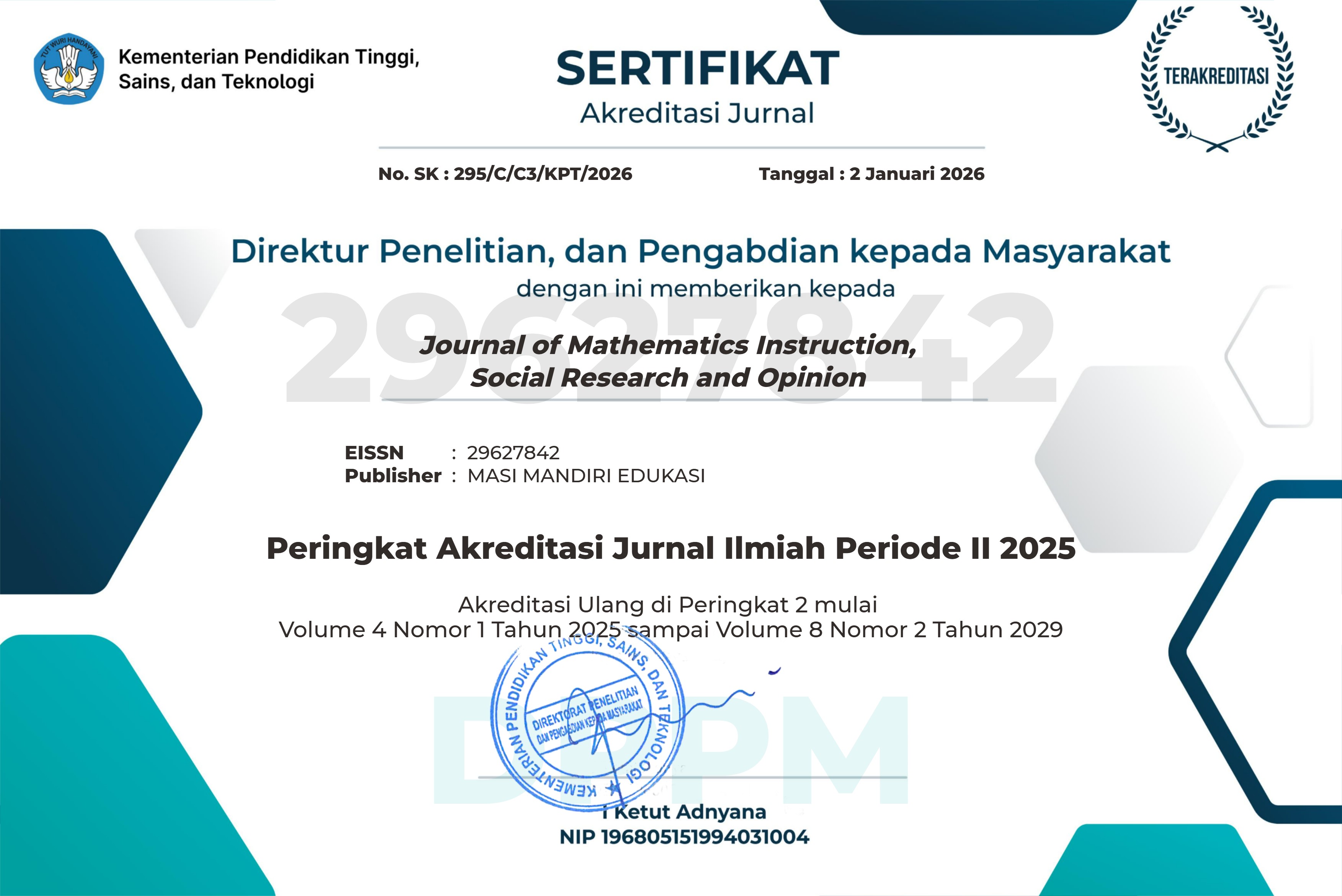
| Accreditation Certificate |
  |
| Indexing |






Contact Us

visitor
| Information |
>> For Authors
>> For Readers
>> For Librarians
| Visitor Statistics |
| Member of |


| Announcement |

| Keywords |
Mathematics Learning Difficulty Dyscalculia Teacher perceptions personality ICT Learning Computer teaching Academic Fisherfolks Economic Behavior Probit Models matrix mathematical model Concepts Guided Note Taking Golden Ratio Philosophy Integrated Learning van Hiele geometry Assessment Learning Outcomes method skills Problem Solving Experiment
| License |

MISRO is licensed under a Creative Commons Attribution-ShareAlike 4.0 International License.
| Publisher |

Address:
Jl. Gagak N0.105, Bandung,
Indonesia 40133
E-mail:
journalmisro@gmail.com
| in collaboration with |

| Recommended Tools |


| ISSN Barcode |

