
Reversible Thinking in Mathematical Problem Solving: An Adversity Quotient-Based Analysis of Grade VIII Students
DOI:
https://doi.org/10.58421/misro.v4i4.706Keywords:
Reversible thinking, Adversity quotient, statistics, Mathematics education, Problem solving , Qualitative researchAbstract
Reversible thinking is the ability to reverse the order of thinking, understand two-way relationships, and logically and reflectively retrace initial information. This study aimed to describe students’ reversible thinking abilities in mathematical problem solving based on adversity (AQ). The research was conducted using a qualitative descriptive design with 21 eighth-grade students of MTs Annajah Sungai Luar. From these, five subjects were selected purposively to represent the AQ types: quitter, camper, and climber. Data were collected through AQ questionnaires, Test of Reversible Thinking (TTR) essay tasks, and interviews. The results indicated that students with the quitter type were unable to fulfill all aspects of reversible thinking. Camper-type students could fulfill two aspects, namely negation and reciprocity, while climber-type students were able to fulfill all three aspects: negation, reciprocity, and returning to the initial condition. The findings suggest that students with higher AQ demonstrate stronger reversible thinking skills in mathematical problem solving. This contributes to mathematics education by emphasizing the importance of fostering reflective thinking and resilience in the learning process.
Downloads
References
L. Rusmin, Y. Misrahayu, F. Pongpalilu, Radiansyah, and Dwiyanto, “Critical Thinking and Problem-Solving Skills in the 21st Century,” Global Society Publishing, vol. 1, no. 5, pp. 144–162, 2024, [Online]. Available: https://ejournal.mellbaou.com/in
K. R. Subedi, “Cognition in the Psychological Perspectives,” 2022, doi: 10.13140/RG.2.2.29414.70720.
NCTM, Principles and standards for school mathematics: Discussion draft. National Council of Teachers of Mathematics, 1998.
F. Romadhona, K. Kamid, and R. Rohati, “Profile of Mathematical Problem-Solving Ability in Students with Attention Deficit Hyperactivity Disorder (ADHD) Based on Their Emotional Intelligence,” Journal of General Education and Humanities, vol. 4, no. 1, pp. 179–196, Feb. 2025, doi: 10.58421/gehu.v4i1.382.
C. Odooh et al., “The Windy City’s Dark Side: A Statistical Exploration of Crime in the City of Chicago,” Journal of Data Analysis and Information Processing, vol. 12, no. 03, pp. 370–387, 2024, doi: 10.4236/jdaip.2024.123020.
L. A. Daulay, H. Hakim, and L. D. Sartikawati, “the Improvement of Student’S Mathematical Communication Ability By Using Cooperative Learning: Course Review Horay,” Jurnal Tarbiyah, vol. 26, no. 1, 2019, doi: 10.30829/tar.v26i1.376.
V. A. Krutetskii, The Psychology of Mathematical Abilities in Schoolchildren. Chicago: The University of Chicago Press, 1976.
G. Polya, “How to Solve It. Princeton,” New Jersey: Princeton University, 1945.
L. Oakley, Cognitive Development. 2004.
J. Piaget and B. Inhelder, “The Structural Integration of Formal Thought,” 1958.
L. Saparwadi, C. Sa, A. Rahman, and T. Daniel, “The Aspects and Stages of Reversible Thinking of Secondary School Students in Resolving the Problems of Fractional Numbers,” vol. 11, no. 6, pp. 1302–1310, 2020.
A. Purwaningrum and S. Sutiarso, “Analysis of the Reversible Thinking Ability of Grade VIII Junior High School Students on the Material of Two-Variable Linear Equation Systems,” vol. 07, no. 1, pp. 39–48, 2023.
S. Maf’Ulah, H. Fitriyani, E. Yudianto, F. R. Fiantika, and R. M. Hariastuti, “Identifying the reversible thinking skill of students in solving function problems,” in Journal of Physics: Conference Series, Institute of Physics Publishing, Apr. 2019. doi: 10.1088/1742-6596/1188/1/012033.
A. Pebrianti and D. Juandi, “Reversible Thinking Ability in Solving Mathematics Problems,” Jurnal Cendekia : Jurnal Pendidikan Matematika, vol. 7, no. 1, pp. 163–173, Dec. 2022, doi: 10.31004/cendekia.v7i1.1905.
Y. D. Kurino, Tatang Herman, Turmudi, Wahyudin, Ani Rosidah, and Dudu Suhandi Saputra, “Problem-Solving Skills in Solving Cube Volume Problems,” Jurnal Elementaria Edukasia, vol. 6, no. 4, pp. 2051–2057, Dec. 2023, doi: 10.31949/jee.v6i4.7825.
S. J. Lamon, “Rational numbers and proportional reasoning: Toward a theoretical framework for research,” Second handbook of research on mathematics teaching and learning, vol. 1, no. 1, pp. 629–668, 2007.
H. R. Fauzan, E. Hidayanto, and T. D. Chandra, “Reversible Thinking in Solving Mathematics Problems in Terms of Cognitive Style,” Al-Jabar: Journal of Mathematics Education, vol. 15, no. 2, p. 559, Dec. 2024, doi: 10.24042/ajpm.v15i2.24527.
S. Hadi, H. Retnawati, S. Munadi, E. Apino, and N. F. Wulandari, “THE DIFFICULTIES OF HIGH SCHOOL STUDENTS IN SOLVING HIGHER-ORDER THINKING SKILLS PROBLEMS,” vol. 76, no. 4, 2018.
A. Banawi, M. I. Rumasoreng, N. Hasanah, D. A. Rahawarin, and I. Basta, “The Relationship between Problem-Solving Skills and Student Academic Achievement: A Meta-Analysis in Education,” Journal of Ecohumanism, vol. 3, no. 3, pp. 1287–1299, Apr. 2024, doi: 10.62754/joe.v3i3.3413.
N. A. Dina, S. M. Amin, and Masriyah, “Flexibility in Mathematics Problem Solving Based on Adversity Quotient,” in Journal of Physics: Conference Series, Institute of Physics Publishing, Jan. 2018. doi: 10.1088/1742-6596/947/1/012025.
R. Mustika, Yurniwati, and E. L. Hakim, “The Relationship between Self Confidence and Adversity Quotient on Students’ Mathematical Problem Solving Ability,” Journal of Educational Research, 2018, doi: https://doi.org/10.17509/jpp.v18i2.12964.
P. G. Stoltz, Adversity Quotient: Turning Obstacles into Opportunities. Jakarta: PT Gramedia, 2005.
F. A. Fahrudin, C. Sa’dijah, E. Hidayanto, and H. Susanto, “Student’s Reversible Thinking Processes: An Analysis Based on Adversity Quotient Type Climbers,” Qualitative Research in Education, vol. 13, no. 1, pp. 19–42, Feb. 2024, doi: 10.17583/qre.11964.
R. A. Putra, Nurjanah, D. Juandi, and L. H. Jufri, “Adversity Quotient in Mathematics Learning,” Plusminus: Journal of Mathematics Education, vol. 3, no. 3, pp. 385–398, Nov. 2023, doi: 10.31980/plusminus.v3i3.1503.
D. Kurniawati and S. Sutiarso, “Analysis of High School Students’ Mathematical Reversible Thinking Ability in Calculus Concepts,” vol. 06, no. 03, pp. 2908–2922, 2022.
I. K. G. Sukarsa and I. P. E. N. Kencana, Basic Statistics. Bali: FMIPA Universitas Udayana, 2015.
A. Syamili, N. Falasifah, L. Radjawane, and A. A. Putraa, Quantitative, Qualitative, and Combined Research Methodology. Bandung: Media Sains Indonesia, 2023.
L. J. Moleong, “Qualitative research methodology, Bandung,” Rural Tourism as an Alternative for Sustainable Development (Competitive Grant Research Report for Higher Education Institutions) Yogyakarta, 2012.
S. Maf’ulah, D. Juniati, and T. Siswono, “The aspects of reversible thinking in solving algebraic problems by an elementary student winning National Olympiad medals in science,” World Transactions on Engineering and Technology Education, 2017.
S. Sutiarso, “Analysis of Student Reversible Thinking Skills on Graph Concept,” Indonesian Journal of Science and Mathematics Education, vol. 3, no. 2, pp. 185–195, Jul. 2020, doi: 10.24042/ijsme.v3i2.6768.
P. G. Stoltz, The Most Important Factor in Achieving Success: Adversity Quotient: Turning Obstacles into Opportunities. John Wiley & Sons, Inc, 1997.
H. R. Juwita, Roemintoyo, and B. Usodo, “The Role of Adversity Quotient in the Field of Education: A Review of the Literature on Educational Development,” Int J Educ Method, vol. 6, no. 3, pp. 507–515, 2020, doi: 10.12973/ijem.6.3.507.
P. G. Stoltz, Adversity quotient: Turning obstacles into opportunities. John Wiley & Sons, 1999.
A. Pebrianti, S. Prabawanto, and E. Nurlaelah, “How do students solve reversible thinking problems in mathematics?” Jurnal elemen, vol. 9, no. June, pp. 630–643, 2023.
Downloads
Additional Files
Published
How to Cite
Issue
Section
License
Copyright (c) 2025 Journal of Mathematics Instruction, Social Research and Opinion

This work is licensed under a Creative Commons Attribution-ShareAlike 4.0 International License.
SideBar
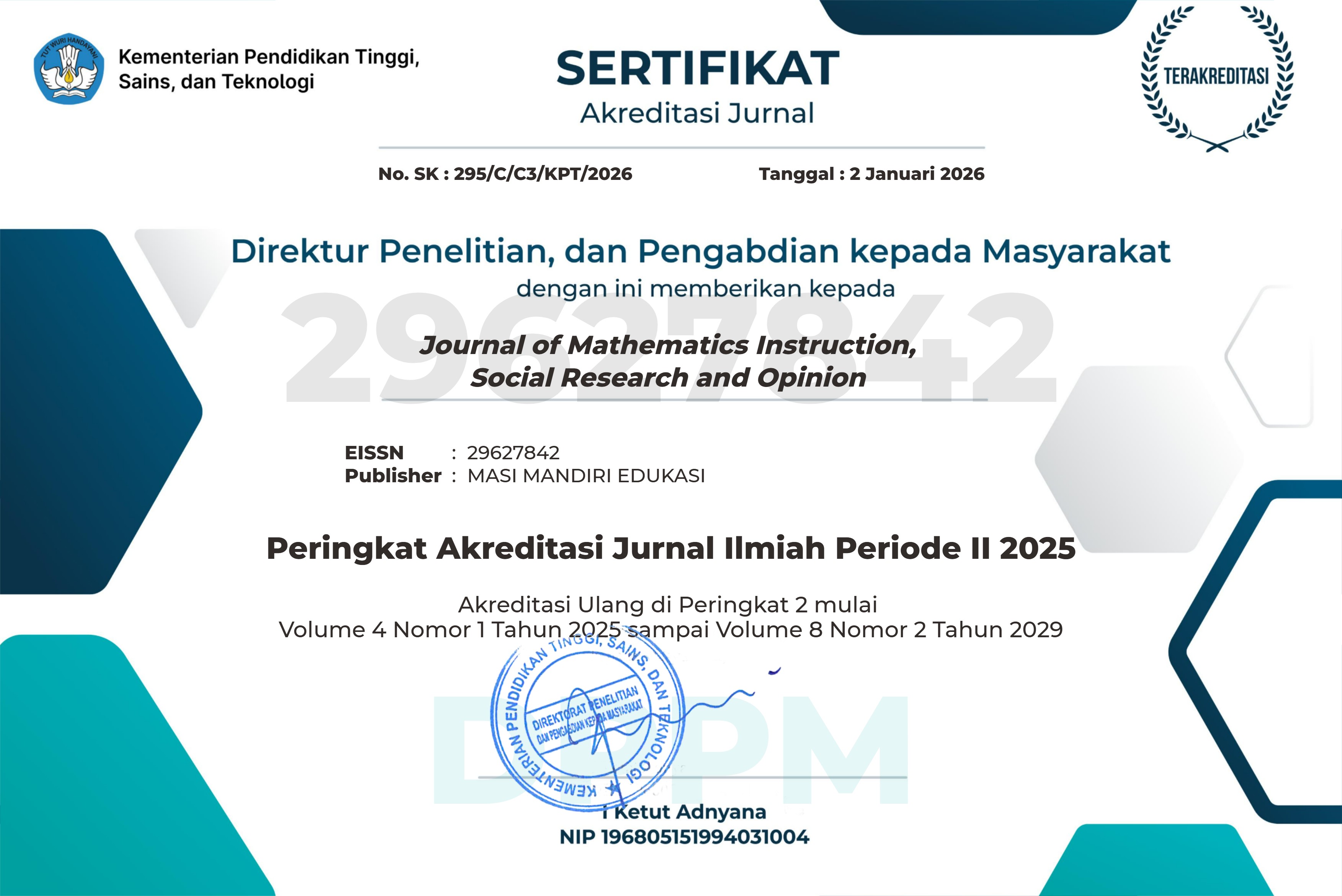
| Accreditation Certificate |
  |
| Indexing |






Contact Us

visitor
| Information |
>> For Authors
>> For Readers
>> For Librarians
| Visitor Statistics |
| Member of |


| Announcement |

| Keywords |
Mathematics Learning Difficulty Dyscalculia Teacher perceptions personality ICT Learning Computer teaching Academic Fisherfolks Economic Behavior Probit Models matrix mathematical model Concepts Guided Note Taking Golden Ratio Philosophy Integrated Learning van Hiele geometry Assessment Learning Outcomes method skills Problem Solving Experiment
| License |

MISRO is licensed under a Creative Commons Attribution-ShareAlike 4.0 International License.
| Publisher |

Address:
Jl. Gagak N0.105, Bandung,
Indonesia 40133
E-mail:
journalmisro@gmail.com
| in collaboration with |

| Recommended Tools |


| ISSN Barcode |

