
Model Deployment Realistic Mathematics Education to Improve Student Learning Outcomes Grade 5
DOI:
https://doi.org/10.58421/misro.v2i1.67Keywords:
Realistic Mathematic Education , Mathematics, Learning Outcomes , Fractions , Classroom Action ResearchAbstract
This study aims to improve learning outcomes by applying learning models to Realistic Mathematic Education on material for arithmetic operations on fractions in class V SDN 1 Karangkendal, Kapetakan District, Cirebon Regency. This research is a Classroom Action Research conducted in 3 cycles. The subjects of this study were 29 grade 5 students at SDN 1 Karangkendal, Kapetakan District, Cirebon Regency. Research data was collected through tests. This data analysis uses a qualitative descriptive analysis technique. The results showed increased learning outcomes in fifth-grade students at SDN 1 Karangkendal, Kapetakan District, Cirebon Regency, through a learning model, Realistic Mathematic Education. The increase in student learning outcomes is shown by the increasing number of students who meet the Minimum Mastery Criteria scores. In cycle one there were 62.1% of students achieved the Minimum Mastery Criteria scores. Then, in cycle two there were 75.9% of students had achieved the Minimum Completeness Criteria score; in cycle three, 86.2% of students had achieved the Minimum Mastery Criteria score. Based on these results, there is an increase in student learning outcomes with the application of learning models Realistic Mathematic Education on material for arithmetic operations on fractions at SDN 1 Karangkendal, Kapetakan District, Cirebon Regency.
Downloads
References
S. Afsari, I. Safitri, S. K. Harahap, and L. S. Munthe, “Systematic Literature Review: Efektivitas Pendekatan Pendidikan Matematika Realistik Pada Pembelajaran Matematika,” Indones. J. Intellect. Publ., vol. 1, no. 3, pp. 189–197, Jul. 2021, doi: 10.51577/ijipublication.v1i3.117.
Y. Suzana and I. Jayanto, Teori Belajar dan Pembelajaran. Malang: Literasi Nusantara, 2021.
O. Hamalik, Kurikulum dan Pembelajaran. Bandung: Bumi Aksara, 2017.
A. Setiawan, Belajar dan pembelajaran. Ponorogo: Uwais Inspirasi Indonesia, 2017.
A. Pane and M. D. Dasopang, “Belajar dan Pembelajaran,” FITRAH J. Kaji. Ilmu-Ilmu Keislam., vol. 3, no. 2, 2017.
F. Fakhrurrazi, “Hakikat Pembelajaran yang Efektif,” At-Tafkir, vol. 11, no. 1, pp. 85–99, Oct. 2018, doi: 10.32505/at.v11i1.529.
Danang Dwi Prasetyo, “Paradigma Baru Pendidikan Islam 4.0: Telaah Taksonomi Bloom dalam Perspektif Iman,” SALIHA J. Pendidik. Agama Islam, vol. 2, no. 1, pp. 185–197, Jan. 2019, doi: 10.54396/saliha.v2i1.110.
D. Indriyani, D. Desyandri, Y. Fitria, and I. Irdamurni, “Perbedaan Model Children’s Learning in Science (CliS) dan Model Scientific Terhadap Hasil Belajar Siswa Pada Pembelajaran Tematik Terpadu di Sekolah Dasar,” J. Basicedu, vol. 2, no. 1, pp. 627–633, Jul. 2019, doi: 10.31004/basicedu.v3i2.216.
E. Ediyanto, N. Gistituati, Y. Fitria, and A. Zikri, “Pengaruh Pendekatan Realistic Mathematics Education Terhadap Motivasi dan Hasil Belajar Materi Matematika di Sekolah Dasar,” J. Basicedu, vol. 4, no. 1, pp. 203–209, Jan. 2020, doi: 10.31004/basicedu.v4i1.325.
A. Suprijono, Cooperative learning : Teori dan aplikasi paikem. Yogyakarta: Pustaka Pelajar, 2012.
A. Jihad and A. Haris, Evaluasi Pembelajaran. Yggyakarta: Multi Pressindo., 2012.
M. R. Tikollah, M. Azis, and F. Azis, “The Influence of Corporate Social Responsibility, Revenue Growth, and Ownership Structure on Tax Avoidance,” Proc. Int. Conf. Soc. Econ. Business, Educ. (ICSEBE 2021), vol. 205, no. Icsebe 2021, pp. 224–229, 2022, doi: 10.2991/aebmr.k.220107.042.
Z. Aqib, Penelitian tindakan kelas : untuk guru. Bandung: Yrama Widya, 2006.
S. Arikunto, Prosedur Penelitian Suatu Pendekatan Praktik. Jakarta: Rineka Cipta, 2013.
M. Abdurrahman, Pendidikan bagi anak berkesulitan belajar. Jakarta: Rineka Cipta, 1999.
R. Jalaludin, Persepsi Dalam Proses Belajar Mengajar. Jakarta: Rajawali Pers, 2007.
S. Azwar, Metode Penelitian, Pustaka Pe. Yogyakatra, 2003.
Isrok’atun and A. Rosmala, Model-model pembelajaran matematika. Jakarta: Bumi Aksara, 2018.
Trianto, Model Pembelajaran Terpadu, Konsep, Strategi dan Implementasinya dalam KTSP. Jakarta: Bumi Aksara, 2010.
S. Aris, 68 model pembelajaran inovatif dalam kurikulum 2013. Yogyakarta: Ar-Ruzz Media, 2014.
F. Elwijaya, M. Harun, and Y. Helsa, “Implementassi Pendekatan Realistic Mathematics Education (RME) di Sekolah Dasar,” J. Basicedu, vol. 5, no. 2, pp. 741–748, Feb. 2021, doi: 10.31004/basicedu.v5i2.796.
A. Jupri, D. Usdiyana, and R. Sispiyati, “Realistic Mathematics Education Principles for Designing a Learning Sequence on Number Patterns,” J. Kiprah, vol. 8, no. 2, pp. 105–112, Nov. 2020, doi: 10.31629/kiprah.v8i2.2358.
E. I. F. Hidayat, I. A. Vivi Yandhari, and T. P. Alamsyah, “Efektivitas Pendekatan Realistic Mathematics Education (RME) Untuk Meningkatkan Kemampuan Pemahaman Konsep Matematika Siswa Kelas V,” J. Ilm. Sekol. Dasar, vol. 4, no. 1, p. 106, Apr. 2020, doi: 10.23887/jisd.v4i1.21103.
M. Mufridah, H. Hendriana, and T. Alawiyah, “Gambaran Sikap Belajar Positif Siswa Kelas VIII di SMPN 3 Batujajar,” FOKUS (Kajian Bimbing. Konseling dalam Pendidikan), vol. 4, no. 2, p. 99, Mar. 2021, doi: 10.22460/fokus.v4i2.6323.
P. G. Schrader and K. A. Lawless, “The knowledge, attitudes, & behaviors approach how to evaluate performance and learning in complex environments,” Perform. Improv., vol. 43, no. 9, pp. 8–15, Sep. 2004, doi: 10.1002/pfi.4140430905.
Downloads
Published
How to Cite
Issue
Section
License
Copyright (c) 2023 Journal of Mathematics Instruction, Social Research and Opinion

This work is licensed under a Creative Commons Attribution-ShareAlike 4.0 International License.
SideBar
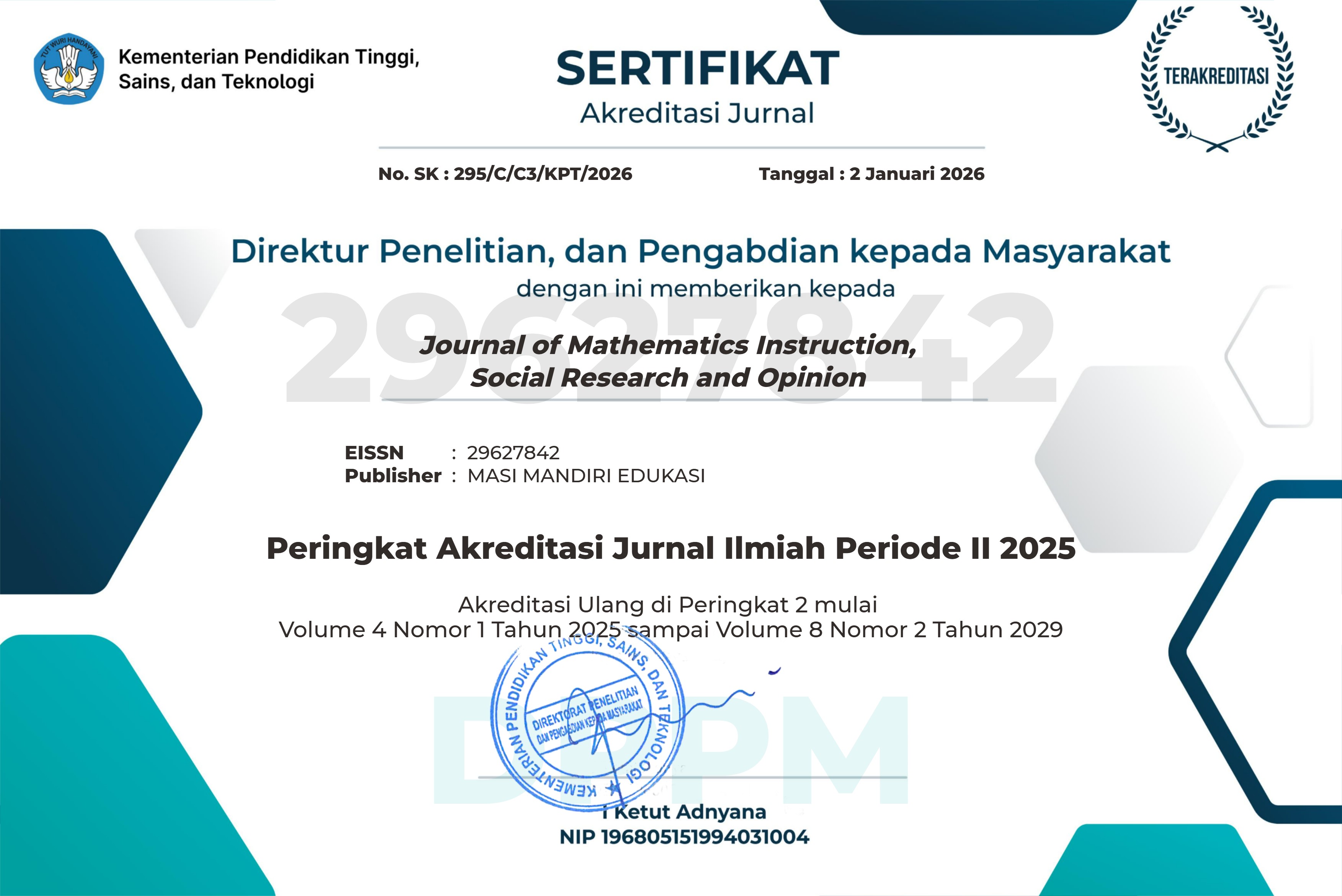
| Accreditation Certificate |
  |
| Indexing |






Contact Us

visitor
| Information |
>> For Authors
>> For Readers
>> For Librarians
| Visitor Statistics |
| Member of |

| Announcement |

| Keywords |
Mathematics Learning Difficulty Dyscalculia Teacher perceptions personality ICT Learning Computer teaching Academic Fisherfolks Economic Behavior Probit Models matrix mathematical model Concepts Guided Note Taking Golden Ratio Philosophy Integrated Learning van Hiele geometry Assessment Learning Outcomes method skills Problem Solving Experiment
| License |

MISRO is licensed under a Creative Commons Attribution-ShareAlike 4.0 International License.
| Publisher |

Address:
Jl. Gagak N0.105, Bandung,
Indonesia 40133
E-mail:
journalmisro@gmail.com
| in collaboration with |
| Recommended Tools |


| ISSN Barcode |

