
Formative Assessment as an Evaluation Tool for Elementary Students’ Speaking Skills in Indonesian Language Learning: A Descriptive Qualitative Study
DOI:
https://doi.org/10.58421/misro.v4i3.610Keywords:
Formative Assessment, Speaking skills, Indonesian lesson, Elementary schoolAbstract
Assessment of speaking skills must be conducted objectively, systematically, and thoroughly to provide students with appropriate feedback that can improve their performance. One recommended form of authentic assessment is formative assessment. This study aims to analyse the implementation of formative assessment in evaluating the speaking skills of fourth-grade elementary school students in Indonesian language learning, using a qualitative descriptive approach with data collected through observation, interviews, documentation, and rubric-based assessment. The participants comprised one teacher and thirty students, with four selected for in-depth interviews. The findings revealed that formative assessment was implemented systematically through criteria-based rubrics, oral and written feedback, observation notes, and student reflection. Most students achieved speaking scores in the good to very good category, particularly in content and fluency. Formative assessment helped students gradually identify their weaknesses, improve their speaking performance, and develop reflective learning awareness. The results of this study support the use of formative assessment as a constructive evaluation approach in elementary-level language learning.
Downloads
References
G. Hansen and R. Ringdal, “Formative assessment as a future step in maintaining the mastery-approach and performance-avoidance goal stability,” Stud. Educ. Eval., vol. 56, no. November 2017, pp. 59–70, 2018, doi: 10.1016/j.stueduc.2017.11.005.
S. Bez, F. Burkart, M. J. Tomasik, and S. Merk, “How do teachers process technology-based formative assessment results in their daily practice? Results from process mining of think-aloud data,” Learn. Instr., vol. 97, 2025, doi: https://doi.org/10.1016/j.learninstruc.2025.102100.
I. A. Simanjuntak, S. Akbar, and A. Mudiono, “Asesmen Formatif Perkembangan Bahasa Anak,” J. Pendidik. Teor. Penelitian, dan Pengemb., vol. 4, no. 8, p. 1097, 2019, doi: 10.17977/jptpp.v4i8.12686.
H. Zhang, S. Ge, and M. R. Bin Mohd Saad, “Formative assessment in K-12 English as a foreign language education: A systematic review,” Heliyon, vol. 10, no. 10, p. e31367, 2024, doi: 10.1016/j.heliyon.2024.e31367.
L. Goertzen, S. Heeneman, and T. Schils, “The impact of formative assessment on pupil academic achievement: An empirical study of the effects of a formative assessment practices program that was co-designed in a teacher community,” Learn. Instr., vol. 99, no. June 2024, p. 102153, 2025, doi: 10.1016/j.learninstruc.2025.102153.
J. Fraile, M. Monguillot, C. González-Arévalo, P. Lehane, and E. Panadero, “Investigating anonymity in formative and summative peer assessment: Effects on university students’ social-affective factors, perceptions and preference,” Stud. Educ. Eval., vol. 83, no. September, 2024, doi: 10.1016/j.stueduc.2024.101410.
J. van der Steen, T. van Schilt-Mol, and C. van der Vleuten, “Supporting Teachers in Improving Formative Decision-Making: Design Principles for Formative Assessment Plans,” Front. Educ., vol. 7, no. June, pp. 1–9, 2022, doi: 10.3389/feduc.2022.925352.
T. Sunaryati, A. Wiharja, D. P. Sekarwangi, and V. Khoerunnissa, “Efektivitas Metode Penilaian Formatif dalam Meningkatkan Hasil Belajar Siswa di Sekolah Dasar : Tinjauan Literatur,” J. Pendidik. Tambusai, vol. 8, no. 2, pp. 32306–32309, 2024, [Online]. Available: https://jptam.org/index.php/jptam/article/view/18344
S. Earle, “Formative Decision-Making in Response to Primary Science Classroom Assessment: What to do Next?,” Front. Educ., vol. 5, no. January, pp. 1–7, 2021, doi: 10.3389/feduc.2020.584200.
P. Y. Gu, “An Argument-Based Framework for Validating Formative Assessment in the Classroom,” Front. Educ., vol. 6, no. March, pp. 1–10, 2021, doi: 10.3389/feduc.2021.605999.
M. J. Veugen, J. T. M. Gulikers, and P. den Brok, “We agree on what we see: Teacher and student perceptions of formative assessment practice,” Stud. Educ. Eval., vol. 70, no. October 2020, p. 101027, 2021, doi: 10.1016/j.stueduc.2021.101027.
K. Kristiyuana, F. Wuriningsih, I. Idammatussilmi, and A. Agung, “Reforming Pedagogy in Indonesian Primary Schools : A Five-Year Systematic Review of Differentiated Instruction , Project-Based Learning , and Formative,” J. Ilm. Profesi Pendidik., vol. 10, no. 2, pp. 1694–1705, 2025, doi: 10.29303/jipp.v10i2.3413.
K. Børte, S. Lillejord, J. Chan, B. Wasson, and S. Greiff, “Prerequisites for teachers’ technology use in formative assessment practices: A systematic review,” Educ. Res. Rev., vol. 41, no. October 2022, 2023, doi: 10.1016/j.edurev.2023.100568.
N. English, P. Robertson, S. Gillis, and L. Graham, “Rubrics and formative assessment in K-12 education: A scoping review of literature,” Int. J. Educ. Res., vol. 113, no. November 2021, p. 101964, 2022, doi: 10.1016/j.ijer.2022.101964.
E. Ediyanto, “Pengembangan Model Penilaian Formatif Berbasis Web untuk Meningkatkan Pemahaman Konsep Fisika Siswa,” J. Pendidik. Sains, vol. 2, no. 2, pp. 63–75, 2014, doi: http://dx.doi.org/10.17977/jps.v2i2.4499.
I. Machali, “Bagaimana Melakukan Penelitian Tindakan Kelas Bagi Guru?,” Indones. J. Action Res., vol. 1, no. 2, pp. 315–327, 2022, doi: 10.14421/ijar.2022.12-21.
I. Firdaus, R. Hidayati, R. S. Hamidah, R. Rianti, R. Cahyuni, and K. Khotimah, “Model-Model Pengumpulan Data dalam Penelitian Tindakan Kelas,” J. Kreat. Mhs., vol. 1, no. 2, pp. 105–113, 2023.
G. N. Reniasih, “Penerapan Bimbingan Berkelanjutan untuk Meningkatkan Kemampuan Melaksanakan Asesmen Autentik pada Guru di SD,” J. Ilm. Sekol. Dasar, vol. 4, no. 1, p. 41, 2020, doi: 10.23887/jisd.v4i1.24278.
N. N. Srinadi, .A. Gede Agung, and I. M. Yudana, “Pengaruh Bimbingan Berkelanjutan Terhadap Kemampuan Melaksanakan Asesmen Autentik pada Guru,” J. Pedagog. dan Pembelajaran, vol. 3, no. 1, p. 84, 2020, doi: 10.23887/jp2.v3i1.24365.
Downloads
Additional Files
Published
How to Cite
Issue
Section
License
Copyright (c) 2025 Journal of Mathematics Instruction, Social Research and Opinion

This work is licensed under a Creative Commons Attribution-ShareAlike 4.0 International License.
SideBar
| Accreditation Certificate |
 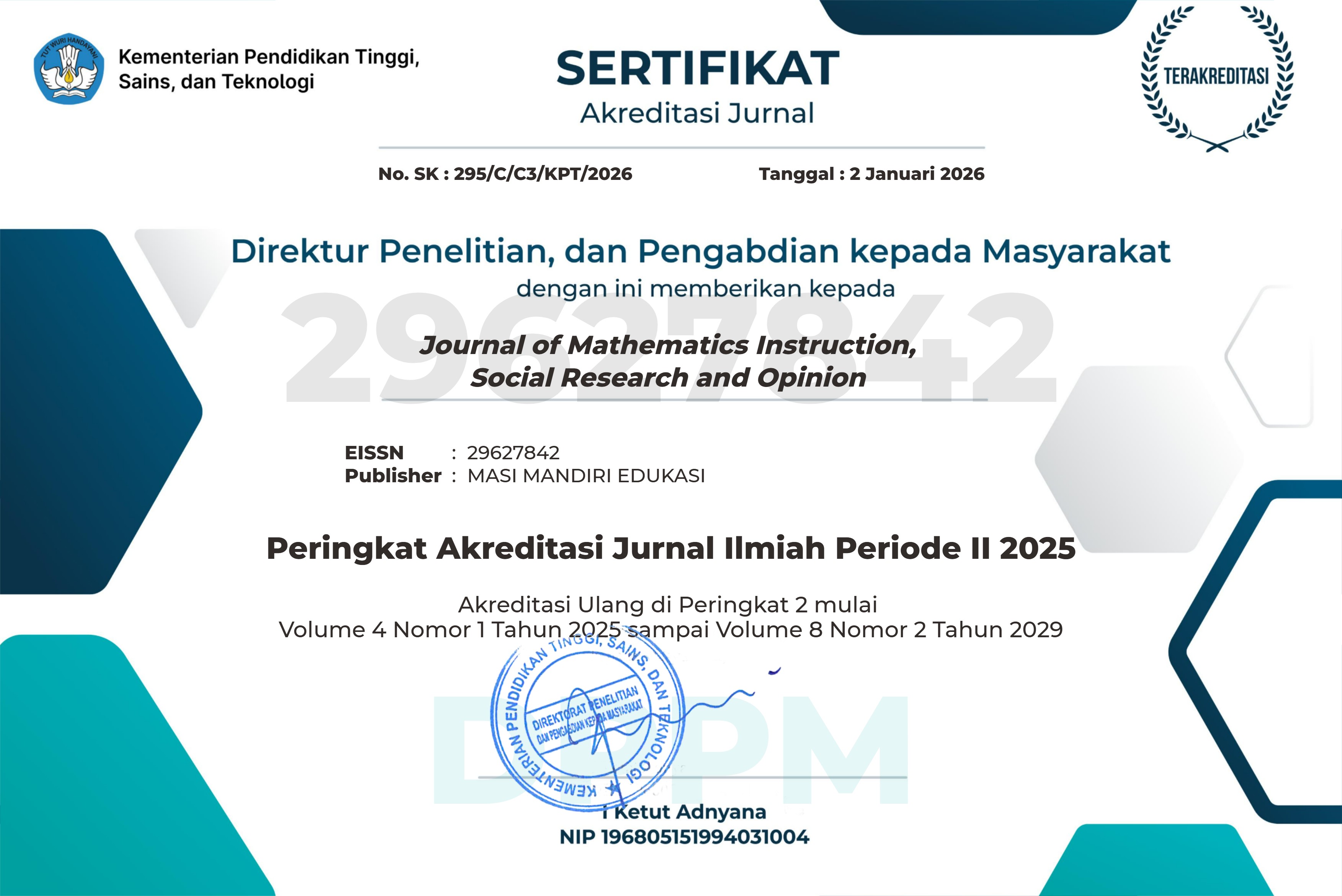 |
| Indexing |






Contact Us

visitor
| Information |
>> For Authors
>> For Readers
>> For Librarians
| Visitor Statistics |
| Member of |

| Announcement |

| Keywords |
Mathematics Learning Difficulty Dyscalculia Teacher perceptions personality ICT Learning Computer teaching Academic Fisherfolks Economic Behavior Probit Models matrix mathematical model Concepts Guided Note Taking Golden Ratio Philosophy Integrated Learning van Hiele geometry Assessment Learning Outcomes method skills Problem Solving Experiment
| License |

MISRO is licensed under a Creative Commons Attribution-ShareAlike 4.0 International License.
| Publisher |

Address:
Jl. Gagak N0.105, Bandung,
Indonesia 40133
E-mail:
journalmisro@gmail.com
| in collaboration with |
| Recommended Tools |


| ISSN Barcode |

