
Changing Mangalehen Tuor Tradition in Mandailing Weddings: A Case Study from Damuli Pekan Village for Sociology Learning
DOI:
https://doi.org/10.58421/misro.v4i3.604Keywords:
Marriage, Sociology, Manglehen TuorAbstract
This study investigates the evolving practice of the Mangalehen Tuor tradition in Mandailing wedding ceremonies, particularly in Damuli Pekan Village, and its potential as a source of contextual sociology learning. Employing a qualitative case study approach, data were collected through interviews, observations, and document analysis involving traditional leaders and indigenous Mandailing community members. Data were analyzed through reduction stages, presentation, verification, and conclusion. The findings reveal significant transformations in the tradition, particularly in the quantity and types of tuor offered, and in the dynamics of the negotiation process. Historically grounded in customary values and kinship relations, the Mangalehen Tuor tradition has shifted toward more pragmatic considerations influenced by economic factors and modern lifestyles. These shifts reflect broader processes of social change, modernization, and the influence of globalization on local cultural practices. This transformation offers valuable insights for sociological inquiry, particularly regarding adapting traditions in response to contemporary societal pressures. As such, the case of Mangalehen Tuor provides a relevant and culturally rich resource for sociology education, enabling students to examine the interplay between tradition and modernity critically. This case study contributes to a deeper understanding of socio-cultural transformation and its pedagogical implications for contextualizing sociology education. It also underscores the importance of preserving local wisdom amid global influences, offering a pathway for younger generations to engage with and learn from their cultural heritage.
Downloads
References
Asrul Hamid, A. M. Nst, R. Ritonga, Z. Hsb, and I. R. Siregar, “Pergeseran Makna Mahar dalam Tradisi Perkawinan Adat Mandailing: Perspektif Hukum Islam dan Nilai Sosial,” Familia: Jurnal Hukum Keluarga, vol. 6, no. 1, pp. 22–41, Jun. 2025, doi: 10.24239/familia.v6i1.298.
Wasiyem, U. Kalsum, P. Syahri, W. T. Abdi, Darussalim, and T. Iskandar, Isu - Isu Kontemporer. Jambi: PT. Sonpedia Publishing Indonesia, 2023.
L. Anggina and Irwan, “Tradisi Mangompa Manuk dalam Pesta Adat Pernikahan Masyarakat Mandailing Natal Perspektif Urf,” UNES Law Review, vol. 6, no. 1, pp. 3133–3146, 2023.
M. O. Hsb, “Sanksi Adat Pertunangan di Desa Huta Pasir Kecamatan Simangambat Kabupaten Padang Lawas Utara,” AL WASATH Jurnal Ilmu Hukum, vol. 4, no. 2, pp. 115–130, Nov. 2023, doi: 10.47776/alwasath.v4i2.334.
M. O. Hasibuan, “Sanksi Adat Pertunangan di Desa Huta Pasir Kecamatan Simangambat Kabupaten Padang Lawas Utara,” Journal of Islamic Law El Madani, vol. 1, no. 2, pp. 69–81, Jul. 2022, doi: 10.55438/jile.v1i2.23.
P. H. Siregar, H. Fitri, and P. Sumantri, “Transformasi Tradisi Mangalehen Tuor dalam Upacara Perkawinan Mandailing Pasca Migrasi ke Kota Medan,” Polyscopia, vol. 1, no. 3, pp. 168–172, Jul. 2024, doi: 10.57251/polyscopia.v1i3.1377.
M. Sari and T. R. Marnelly, “Tradisi Jujuran Pada Perkawinan Masyarakat Mandailing Desa Bangun Purba Kecamatan Rokan Hulu,” Innovative: Journal Of Social Science Research, vol. 3, no. 6, pp. 5316–5330, Dec. 2023, [Online]. Available: https://j-innovative.org/index.php/Innovative/article/view/7132
L. J. Moleong, Metode Penelitian Kualitatif. Bandung: PT Remaja Rosdakarya, 2017.
Sugiyono, Metode Penelitian Kuantitatif, Kualitatif, dan R&D. Bandung: Alfabeta, 2017.
J. Creswell and T. Guetterman, Educational Research: Planning, Conducting, and Evaluating Quantitative and Qualitative Research, 6th Edition. 2018.
M. B. Miles, A. M. Huberman, and J. Saldana, Qualitative Data Analysis: A Methods Sourcebook, 3rd ed. Washington DC: SAGE Publications, Inc, 2014.
S. Soekanto, Sosiologi: Suatu Pengantar. Jakarta: Rajawali Pers, 2014.
N. Harahap, “Pergeseran Nilai dalam Pemberian Mahar Adat Mandailing,” Jurnal Adat dan Budaya Nusantara, vol. 12, no. 2, 2020.
R. Simanjuntak, “Simplifikasi Tradisi Adat dalam Konteks Ekonomi: Studi Kasus di Mandailing Nata,” Jurnal Kebudayaan Indonesia, vol. 18, no. 2, pp. 23–34, 2021.
C. Geertz, The Interpretation of Cultures. New York: Basic Books, Inc., Publishers, 1973.
“Adaptasi Tradisi Pernikahan Mandailing di Era Modern: Studi Sosiologis,” Nasution, A. , vol. 15, no. 3, pp. 102–118, 2019.
M. Hutagalung, “Peran Pendidikan Budaya dalam Revitalisasi Adat Mandailing,” Jurnal Pendidikan dan Kebudayaan, vol. 27, no. 1, pp. 78–89, 2011.
Koentjaraningrat, Manusia dan Kebudayaan di Indonesia. Jakarta: Rineka Cipta, 2004.
L. Siregar, “Kompromi Adat dan Ekonomi dalam Perkawinan Adat Mandailing,” Jurnal Sosial Humaniora, vol. 9, no. 3, pp. 303–318, 2021.
M. Hadi, “Modernisasi dan Identitas Budaya Lokal,” Jurnal Sosiologi Reflektif, vol. 17, no. 2, pp. 213–229, 2022.
R. Sibarani, “Revitalisasi Budaya Lokal dalam Era Digital,” Jurnal Ilmu Budaya, vol. 25, no. 1, pp. 44–58, 2023.
R. Harahap and H. Rambe, “Tradisi Mangalehen Tuor sebagai Representasi Sistem Sosial Mandailing,” Jurnal Antropologi Budaya, vol. 13, no. 2, pp. 134–145, 2021.
J. T. Situmorang, “Perubahan Sosial dalam Komunitas Adat akibat Migrasi Internal,” Jurnal Sosiologi Reflektif, vol. 13, pp. 45–58, 2019.
R. Ritonga and F. Pulungan, “Transformasi Budaya Adat Mandailing dalam Konteks Urbanisasi dan Ekonomi Pasar,” Jurnal Ilmu Sosial dan Budaya, vol. 7, no. 4, pp. 311–324, 2021.
Downloads
Published
How to Cite
Issue
Section
License
Copyright (c) 2025 Journal of Mathematics Instruction, Social Research and Opinion

This work is licensed under a Creative Commons Attribution-ShareAlike 4.0 International License.
SideBar
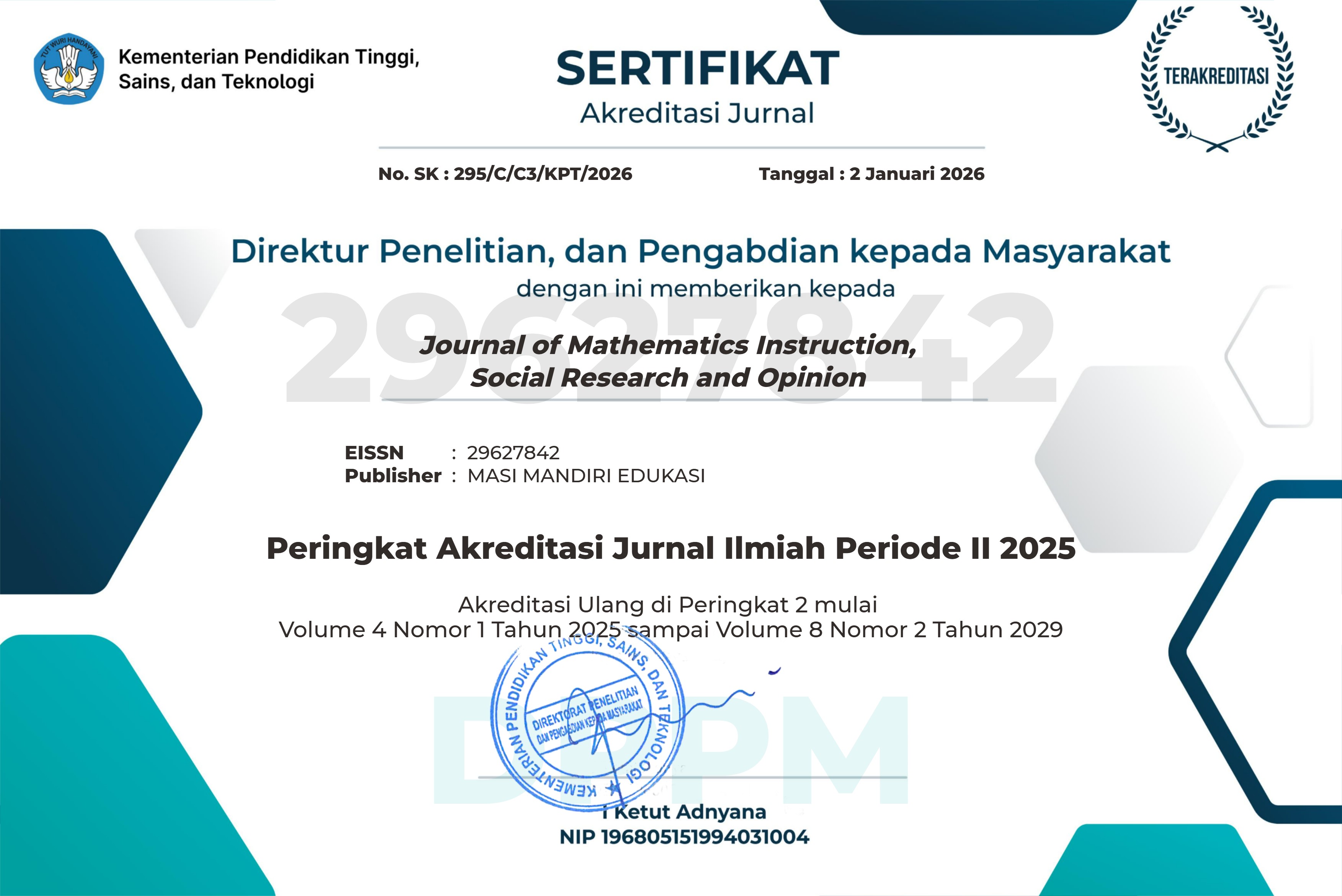
| Accreditation Certificate |
  |
| Indexing |






Contact Us

visitor
| Information |
>> For Authors
>> For Readers
>> For Librarians
| Visitor Statistics |
| Member of |


| Announcement |

| Keywords |
Mathematics Learning Difficulty Dyscalculia Teacher perceptions personality ICT Learning Computer teaching Academic Fisherfolks Economic Behavior Probit Models matrix mathematical model Concepts Guided Note Taking Golden Ratio Philosophy Integrated Learning van Hiele geometry Assessment Learning Outcomes method skills Problem Solving Experiment
| License |

MISRO is licensed under a Creative Commons Attribution-ShareAlike 4.0 International License.
| Publisher |

Address:
Jl. Gagak N0.105, Bandung,
Indonesia 40133
E-mail:
journalmisro@gmail.com
| in collaboration with |

| Recommended Tools |


| ISSN Barcode |

