
Ethnomathematical Exploration of Kasepuhan Palace Architecture: Geometry, Symmetry, and Cultural Values in Mathematics Learning
DOI:
https://doi.org/10.58421/misro.v4i4.587Keywords:
Cultural Heritage, Ethnomathematics, Geometry, Keraton Kasepuhan, Mathematical ConceptsAbstract
The Kasepuhan Cirebon Palace is one of the historical sites that still stand in Cirebon City and reflect the local community's cultural heritage, including ethnomathematical practices embedded in daily life. This study aims to analyse the ethnomathematical aspects of the Kasepuhan Palace as a source of contextual mathematics learning. This qualitative research employed an ethnographic approach and was conducted in the Pekalipan area of Cirebon City. The data were collected from a building complex (Keraton Kasepuhan), and one informant was selected based on their role as cultural custodians (Abdi Dalem). Data collection techniques included observation, interviews, and documentation. The findings suggest that the architectural structure, floor patterns, and carved ornaments of the Kasepuhan Palace incorporate various mathematical concepts, including geometry, angles, symmetry, and measurement. These concepts appear in the spatial layout, pillar arrangement, and shapes such as rectangles, triangles, cuboids, limas, and tubes. The study suggests that incorporating the ethnomathematical elements of the Kasepuhan Palace into mathematics learning can enhance students’ understanding of geometric concepts while fostering their appreciation for local cultural wisdom. However, this study is limited to one palace complex and a small number of informants; future research could expand to other historical sites or compare multiple palaces to enrich the ethnomathematical analysis.
Downloads
References
P. Delgadoa, C. Vargasb, R. Ackermanc, and L. Salmerón, “Don’t throw away your printed books: A meta-analysis on the effects of reading media on reading comprehension,” Educ Res Rev, vol. 25, pp. 23–38, 2018, doi: 10.1016/j.edurev.2018.09.003.
N. P. D. A. Wijaya, K. S. Adnyana, and I. N. L. Jayanta, “Ethnomathematics-Based Animated Video on Geometry Material to Improve Mathematical Literacy and Learning Resilience of Second Grade Students,” 2025, Universitas Pendidikan Ganesha. doi: 10.23887/jmt.v5i3.100453.
I. Nurbaiti and K. Kusno, “Ethnomathematics in Traditional Farming Systems in Pegalongan Village, Patikraja,” 2025, Universitas Teknokrat Indonesia. doi: 10.33365/jm.v7i1.4882.
M. Marsigit, M. Irfan, and H. Sukoco, “Evaluation of Pedagogical Quality in Ethnomathematics Learning Practices,” 2025, Springer Science and Business Media LLC. doi: 10.21203/rs.3.rs-6447442/v1.
Y. H. Pongoliu, “The Effectiveness of Gorontalo Local Wisdom-Based Ethnomathematics in Enhancing Mathematics Understanding,” 2025, Newinera Publisher. doi: 10.37899/journallaedusci.v6i1.2161.
E. K. Sandi, “Exploring Ethnomathematics in Local Culture: A Bridge Between Tradition and Classroom Mathematics,” 2025, PT. Anagata Sembagi Education. doi: 10.62872/rbrtaa18.
K. Kodirun and M. Munaji, “Learning Design with A Scientific Approach Based on Ethnomathematics on the Perimeter and Area of Rectangles,” 2025, STKIP PGRI Banjarmasin. doi: 10.33654/math.v11i2.77.
M. S. K. Batiibwe, “Ethnomathematics as a pedagogical tool for mathematics education: opportunities and challenges,” 2025, Springer Science and Business Media LLC. doi: 10.1007/s43545-025-01260-0.
L. H. Rubel and A. V. McCloskey, “Contextualization of mathematics: which and whose world?,” Educational Studies in Mathematics, vol. 107, no. 2, pp. 383–404, Jun. 2021, doi: 10.1007/s10649-021-10041-4.
OECD, Mathematics Teaching and Learning Strategies in PISA. Paris: OECD Publishing, 2021.
V. Rawat and Nagaraju, “Factors Influencing Students’ Attitude towards Ethno mathematics in Mathematics Curriculum: A Structural Equation Modelling Approach,” Jun. 2025.
A. Irawan, M. Lestari, and W. Rahayu, “Konsep Etnomatematika Batik Tradisional Jawa Sebagai Pengembangan Media Pembelajaran Matematika,” Scholaria: Jurnal Pendidikan dan Kebudayaan, vol. 12, no. 1, pp. 39–45, Jan. 2022, doi: 10.24246/j.js.2022.v12.i1.p39-45.
A. Fauzan, F. Tasman, and R. Fitriza, “Exploration of Ethnomathematics at Rumah Gadang Minangkabau to Design Mathematics Learning Based on RME in Junior High Schools,” in International Conference Innovation in Education, 2020, pp. 279–283. doi: 10.2991/assehr.k.201209.234.
P. Delgado, C. Vargas, R. Ackerman, and L. Salmerón, “Don’t throw away your printed books: A meta-analysis on the effects of reading media on reading comprehension,” Educ Res Rev, vol. 25, pp. 23–38, Nov. 2018, doi: 10.1016/j.edurev.2018.09.003.
N. Linuhung, S. W. Sudarman, and R. Agustina, “Development of Ethnomathematics-Based Numeracy Literacy Questions in Peci Tapis Lampung,” JTAM (Jurnal Teori dan Aplikasi Matematika), vol. 9, no. 2, p. 629, Apr. 2025, doi: 10.31764/jtam.v9i2.30095.
J. P. Spradley, The Ethnographic Interview. Illinois: Waveland Press, INc, 2016.
Y. Royandi, E. A. Halim, and L. L. Jonatan, “Perubahan Fungsi Ruang Dalam Pada Keraton Kacirebonan,” Jurnal Dimensi Seni Rupa dan Desain, vol. 18, no. 1, pp. 13–24, Oct. 2021, doi: 10.25105/dim.v18i1.8814.
L. Irfan and I. Purnama, “Tata Letak Siti Inggil di Keraton Kasepuhan Dan Keraton Kanoman,” Jurnal Arsitektur, vol. 12, no. 1, pp. 18–22, Apr. 2020, doi: 10.59970/jas.v12i1.71.
T. Rahmawati, The Meaning of Traditional Javanese Gate Architecture. Yogyakarta: UGM, 2021.
Sudianto and E. Santoso, “Eksplorasi Etnomatematika pada Area Siti Inggil Keraton Kasepuhan Cirebon,” Didactical Mathematics, vol. 4, no. 1, pp. 273–282, Apr. 2022, doi: 10.31949/dm.v4i1.2501.
I. Tohar and S. Istijanto, “Akulturasi Budaya Dalam Rancangan Arsitektur Studi Kasus: Keraton Yogyakarta,” Jurnal Ilmiah Arsitektur, vol. 11, no. 2, pp. 40–47, Dec. 2021, doi: 10.32699/jiars.v11i2.2201.
R. Setianingrum, R. Jumri, and M. Masri, “Eksplorasi Etnomatematika Pada Bangunan Pura Di Desa Rama Agung Kabupaten Bengkulu Utara,” JP2M (Jurnal Pendidikan dan Pembelajaran Matematika), vol. 11, no. 1, pp. 605–615, Mar. 2025, doi: 10.29100/jp2m.v11i1.7430.
A. R. Siregar et al., “Etnomatematika Sebagai Sarana Penguatan Budaya Lokal Melalui Kurikulum Merdeka Belajar,” Prosiding MAHASENDIKA III, pp. 44–57, 2024.
A. I. Nurhayati and B. E. Susilo, “Systematic Literature Review: Implementasi Pembelajaran Etnomatematika terhadap Kemampuan Pemecahan Masalah Matematis dan Karakter Cinta Budaya Lokal,” Didactical Mathematics, vol. 4, no. 2, pp. 368–379, Oct. 2022, doi: 10.31949/dm.v4i2.3359.
H. Sape and A. Syamsuddin, “Studi Etnomatematika Pada Tradisi Lokal Sebagai Konteks Pembelajaran Matematika,” Jurnal Penalaran dan Riset Matematika, vol. 4, no. 1, pp. 35–41, Apr. 2025, doi: 10.62388/prisma.v4i1.540.
Downloads
Additional Files
Published
How to Cite
Issue
Section
License
Copyright (c) 2025 Journal of Mathematics Instruction, Social Research and Opinion

This work is licensed under a Creative Commons Attribution-ShareAlike 4.0 International License.
SideBar
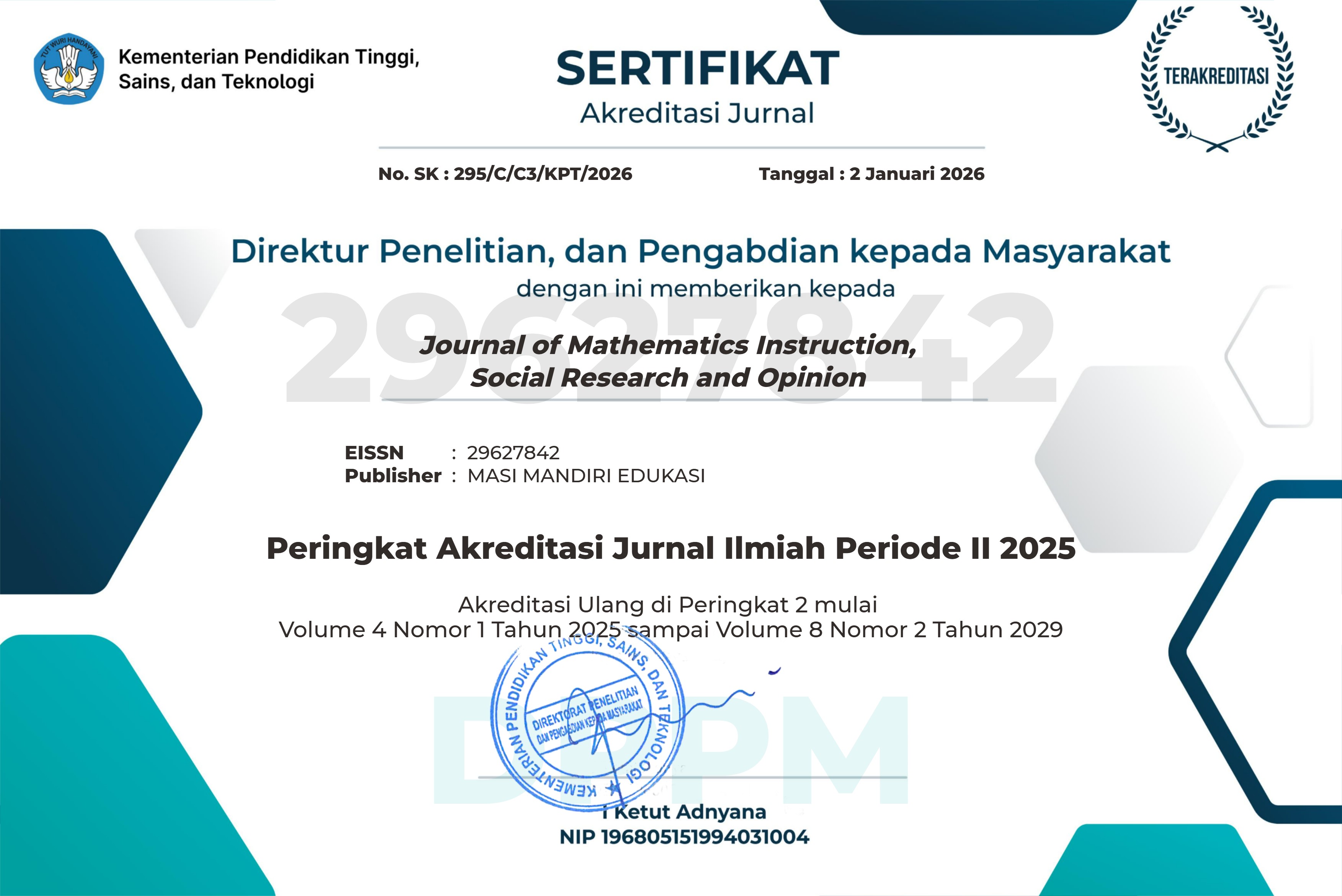
| Accreditation Certificate |
  |
| Indexing |






Contact Us

visitor
| Information |
>> For Authors
>> For Readers
>> For Librarians
| Visitor Statistics |
| Member of |


| Announcement |

| Keywords |
Mathematics Learning Difficulty Dyscalculia Teacher perceptions personality ICT Learning Computer teaching Academic Fisherfolks Economic Behavior Probit Models matrix mathematical model Concepts Guided Note Taking Golden Ratio Philosophy Integrated Learning van Hiele geometry Assessment Learning Outcomes method skills Problem Solving Experiment
| License |

MISRO is licensed under a Creative Commons Attribution-ShareAlike 4.0 International License.
| Publisher |

Address:
Jl. Gagak N0.105, Bandung,
Indonesia 40133
E-mail:
journalmisro@gmail.com
| in collaboration with |

| Recommended Tools |


| ISSN Barcode |

