
Mastery of Trigonometry Material and Its Effect on Students' Ability to Solving Three Dimensional Problems
DOI:
https://doi.org/10.58421/misro.v1i2.23Keywords:
Material mastery, Problem Solving Ability, Trigonometry, three-dimensionalAbstract
This study aims to describe whether or not mastery of trigonometry affects students' ability to solve geometric problems in class X at SMAN Kadugede. The form of research used in this study is a quantitative research method. The research design used in this study is a one-shot case study, meaning that the treatment is applied to one experimental group, and then the dependent variable is measured. This design aims to determine a variable's effect on other variables effectively. The data collection instrument used was a test of mastery of trigonometric material and students' abilities in solving three-dimensional space problems. The population in this study was 253 students of class X; in this study, the authors took samples using the cluster random sampling technique with the object sampled in this study, namely class X 4, as many as 34 students at SMA Negeri 1 Kadugede. Analysis of the research data using linear regression test. Mastery of trigonometry material significantly influences mastery of three-dimensional space material. This is indicated by a significant value of 0.000 < 0.05 and the regression equation obtained is Y = 11.435 + 0.758 . The equation means that the ability to solve geometrical problems increases or increases by 0.758 times the mastery of trigonometry material, while the constant value of 11.435 states that if students do not have mastery of trigonometry material, then the ability to solve three-dimensional space problems is shallow. The results of the statistical test showed that there was an effect of mastery of trigonometry material on students' ability to solve three-dimensional problems.
Downloads
References
E. Graf, In Higher Education Resources in Higher Education Institutions, vol. 107, no. 442. 2015.
M. Meiers, Handbook of Teacher Education, no. January 2007. 2007.
C. Rapanta, L. Botturi, P. Goodyear, L. Guàrdia, and M. Koole, “Online University Teaching During and After the Covid-19 Crisis: Refocusing Teacher Presence and Learning Activity,” Postdigital Sci. Educ., vol. 2, no. 3, pp. 923–945, 2020, doi: 10.1007/s42438-020-00155-y.
J. M. Lodge, G. Kennedy, L. Lockyer, A. Arguel, and M. Pachman, “Understanding Difficulties and Resulting Confusion in Learning: An Integrative Review,” Front. Educ., vol. 3, no. June, pp. 1–10, 2018, doi: 10.3389/feduc.2018.00049.
L. Darling-Hammond, L. Flook, C. Cook-Harvey, B. Barron, and D. Osher, “Implications for educational practice of the science of learning and development,” Appl. Dev. Sci., vol. 24, no. 2, pp. 97–140, 2020, doi: 10.1080/10888691.2018.1537791.
Depdiknas, “Peraturan Menteri Pendidikan Nasional Nomor 22 Tahun 2006 Tentang Standar Isi.” Depdiknas, Jakarta, p. 346, 2006.
K. Sadiyah, A. Muchyidin, and N. Izzati, “Application of Collaborative Teamwork Learning Model and Guided Note Taking Model and Their Influence on Students ’ Ability to Understand Mathematical Concepts,” J. Math. Instr. Soc. Res. Opin. (MISRO, vol. 1, no. 1, pp. 14–26, 2022.
I. H. Bisri and A. Muchyidin, “Mathematics on Cirebon Woven Fabric with Lanang Motifs,” J. Math. Instr. Soc. Res. Opin. (MISRO, vol. 1, no. 1, pp. 1–13, 2022.
Kosim, “Application Ability of Students in Integrated Computer-Aided Numerical Analysis Learning,” J. Math. Instr. Soc. Res. Opin. (MISRO, vol. 1, no. 1, pp. 54–62, 2022.
I. Perasutiyo, A. Muchyidin, and I. Nursuprianah, “Golden Ratio and the Meaning of the Wayang Kulit Gunungan Philosophy,” J. Math. Instr. Soc. Res. Opin. (MISRO, vol. 1, no. 1, pp. 41–53, 2022.
T. P. Wahyusukma, A. Muchyidin, and I. Nursuprianah, “Macan Ali In The Cirebon Glass Painting : The Study Of Ethnomathematics,” J. Math. Instr. Soc. Res. Opin. (MISRO, vol. 1, no. 1, pp. 27–40, 2022.
E. Utomo, Pokok-Pokok Penegertian dan Pelaksanaan Kurikulum Muatan Lokal. Jakarta: Departemen Pendidikan dan Kebudayaan, 1997.
W. S. R. Y. Sultra, “Self-Concept of Junior High School Student in Learning Mathematics,” Int. Conf. Math. Anal. Its Appl. Learn., no. 36, pp. 44–49, 2018.
R. S. R. Sinaga, “Analysis of Student’S Mathematical Problem Solving Ability in Learning Mathematics During the Covid-19 Pandemic,” Educ. + Train., vol. 12, no. January, pp. 0–10, 2021, [Online]. Available: https://www.researchgate.net/publication/348277627.
Kusmaryono, “The Importance Of Mathematical Power In Mathematics Learning,” Int. Conf. Math. Sci. Educ., vol. ICMSE, no. 2014, pp. 35–40, 2014.
Hasratuddin, “Improving Student’s Emotional Intelligence by Mathematics Learning,” Int. Semin. Fourth Natl. Conf. Math. Educ. 2011, pp. 539–546, 2011.
H. R. Maharani, “Creative Thinking In Mathematics : Are We Able To Solve Mathematical Problems In A Variety Of Way ?,” Int. Conf. Math. Sci. Educ. 2014, vol. 2014, no. Icmse, 2014.
J. Mumu and B. Tanujaya, “Measure reasoning skill of mathematics students,” Int. J. High. Educ., vol. 8, no. 6, pp. 85–91, 2019, doi: 10.5430/ijhe.v8n6p85.
Sukardi, Evaluasi Pendidikan : Prinsidp dan Operasionalnya. Jakarta: Bumi Aksara, 2009.
M. Natsir, Metode Penelitian. Jakarta: Ghalia Indonesia, 1999.
S. Arikunto, Dasar-Dasar Evaluasi Pendidikan. Jakarta: Bumi Aksara, 2013.
Sugiyono, Metode Penelitian Pendidikan: Pendekatan Kuantitatif, Kualitatif, dan R & D. Bandung: Alfabeta, 2015.
R. W. Dahar, Teori-Teori Belajar. Jakarta: Erlangga, 2006.
B. Marhijanto, Kamus Lengkap Bahasa Indonesia Populer. Surabaya: Bintang Timur Surabaya, 1995.
M. Ariyanti, “Pengaruh Kompetensi Pedagogik Guru terhadap Prestasi Belajar Matematika Siswa Kelas XI SMA di Kabupaten Cirebon,” IAIN Syekh Nurjati Cirebon, 2012.
Downloads
Published
How to Cite
Issue
Section
License
Copyright (c) 2022 Journal of Mathematics Instruction, Social Research and Opinion

This work is licensed under a Creative Commons Attribution-ShareAlike 4.0 International License.
SideBar
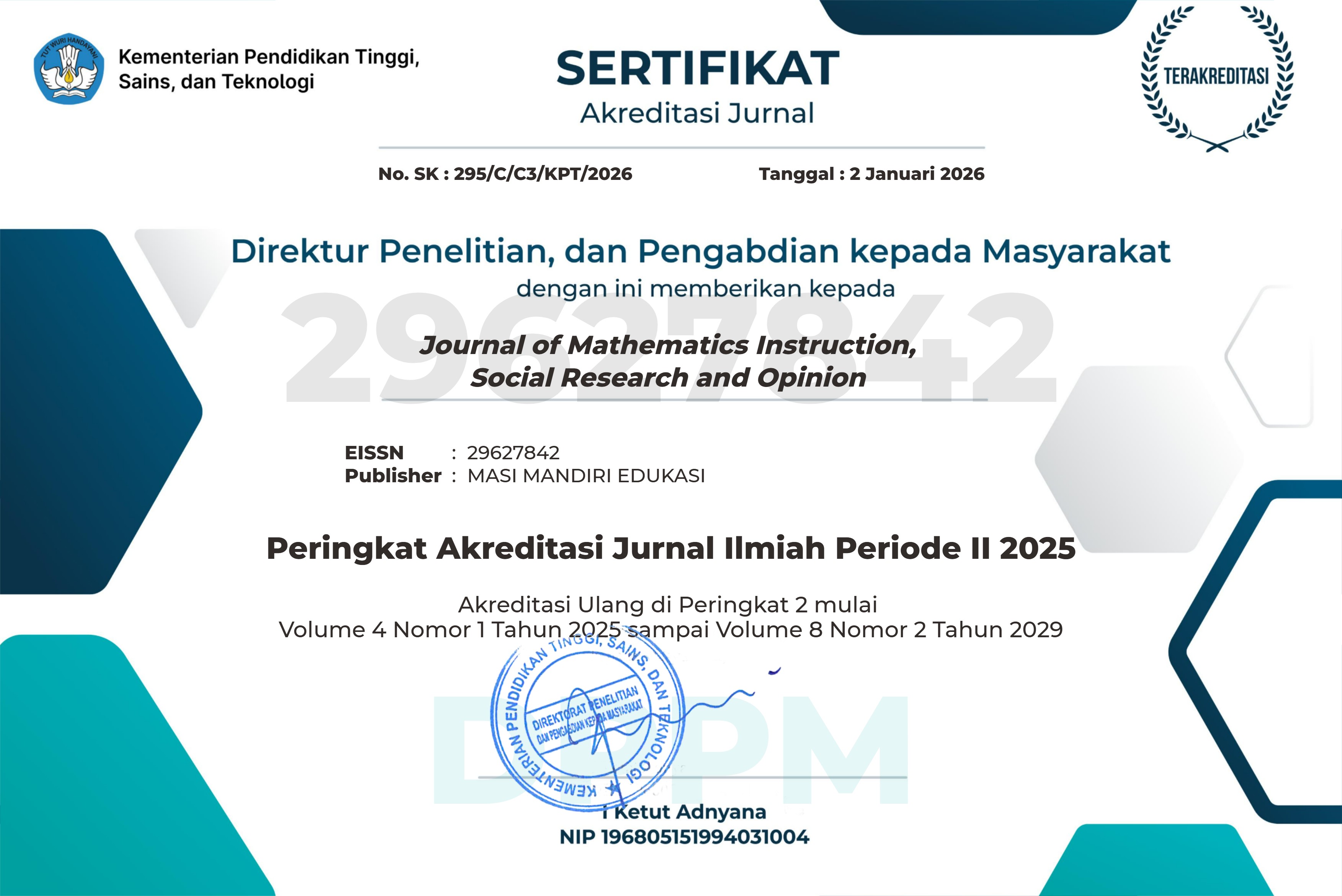
| Accreditation Certificate |
  |
| Indexing |






Contact Us

visitor
| Information |
>> For Authors
>> For Readers
>> For Librarians
| Visitor Statistics |
| Member of |

| Announcement |

| Keywords |
Mathematics Learning Difficulty Dyscalculia Teacher perceptions personality ICT Learning Computer teaching Academic Fisherfolks Economic Behavior Probit Models matrix mathematical model Concepts Guided Note Taking Golden Ratio Philosophy Integrated Learning van Hiele geometry Assessment Learning Outcomes method skills Problem Solving Experiment
| License |

MISRO is licensed under a Creative Commons Attribution-ShareAlike 4.0 International License.
| Publisher |

Address:
Jl. Gagak N0.105, Bandung,
Indonesia 40133
E-mail:
journalmisro@gmail.com
| in collaboration with |
| Recommended Tools |


| ISSN Barcode |

