
Development of Peer-Based Interaction Skills Assessment Instruments in Mathematics Learning Process in Class
DOI:
https://doi.org/10.58421/misro.v1i2.22Keywords:
Interaction skills, Development method, Learning mathematicsAbstract
Interaction skills between students are needed during the learning process. If a student does not interact with the teacher or between students during the learning process in the classroom, they will have difficulty achieving maximum learning success. The purpose of this research and development is to develop an instrument for assessing interaction skills among students in the mathematics learning process in the classroom. This development method was adapted from the steps developed by Saefuddin Azwar, which started with the identification of measurement objectives, operationalization of aspects, item writing, language testing, field tests, item selection, and final compilation. The subject of the experiment was carried out on class VIII-C students of SMPN 3 Luragung. Based on the results of research and development at SMPN 3 Luragung to produce a peer-based interaction skill assessment product during the mathematics learning process in class, the researcher can conclude that the assessment of interaction skills between students can objectively assess interaction skills between students when learning mathematics so that the results of the assessment are more accurate. In addition, the validity and reliability of the test results of the instrument for assessing interaction skills between students in the learning process of mathematics in the classroom that has been developed indicate that this instrument is suitable for use in learning mathematics. With minimum validity of 1 of three authors, the reliability of the instrument is said to be very high, with a result of 0.91, and the item discrimination power is greater than the item-total correlation coefficient of 0.2
Downloads
References
K. Sukiyasa and S. Sukoco, “Pengaruh media animasi terhadap hasil belajar dan motivasi belajar siswa materi sistem kelistrikan otomotif,” J. Pendidik. Vokasi, vol. 3, no. 1, pp. 126–137, 2013, doi: 10.21831/jpv.v3i1.1588.
S. Wardhani, Penilaian Pembelajaran Matematika Berbasis Kompetensi. Yogyakarta: PPPPTK Matematika, 2004.
L. Octaviani, “Pengembangan Instrumen Penilaian Sikap Peserta Didik SMA/MA Pada Pembelajaran Kimia Materi Pokok Asam Basa dan Koloid,” UIN Sunan Kalijaga, 2012.
A. Budiman and Jailani, “Pengembangan Instrumen Asesmen Higher Order Thinking[1] A. Budiman and Jailani, ‘Pengembangan Instrumen Asesmen Higher Order Thinking Skill (Hots) Pada Mata Pelajaran Matematika SMP Kelas VIII Semester 1,’ J. Ris. Pendidik. Mat., vol. 1, no. 2, p. 139, 20,” J. Ris. Pendidik. Mat., vol. 1, no. 2, p. 139, 2014.
Sunarti and S. Rahmawati, Penilaian Dalam Kurikulum 2013. Yogyakarta: Andi Offset, 2014.
F. F. Zulhisra and S. Khabibah, “Penerapan Pembelajaran Matematika dengan Model Pembelajaran Aptitude Treatment Interaction pada Materi Luas Permukaan Limas dan Tabung Kelas X,” MATHEdunesa, vol. 3, no. 3, pp. 63–68, 2014.
M. Yamin, Kiat Membelajarkan Siswa. Jakarta: Gaung Persada Press, 2007.
A. Fauzi, Manajemen Pembelajaran. Yogyakarta: Deepublish, 2014.
B. Pangestu and A. Kosasih, “Application of Additive Ratio Assessment ( ARAS ) Method for the Selection of Youth Red Cross Chairperson at SMA Negeri 1 Lebakwangi Kuningan,” vol. 1, no. 2, pp. 35–46, 2022.
R. Kristianti, A. Muchyidin, and B. Manfaat, “Exploration of Vocational School Students ’ Misconceptions of Circle Material,” vol. 1, no. 2, pp. 47–57, 2022.
D. Apriliani, B. Manfaat, and A. Muchyidin, “Evaluation of Bilingual Mathematics Learning Program at Al-Azhar Islamic Middle School , South Tangerang,” vol. 1, no. 2, pp. 23–34, 2022.
I. Hikmatusholikhah and A. Muchyidin, “Student Problems In The Implementation Of The 2013 Curriculum With A Scientific Approach To Mathematics At MTs N 4 Cirebon,” vol. 1, no. 2, pp. 14–22, 2022.
F. G. Mulyani and A. Muchyidin, “Misconception Analysis of Student Teacher Candidates Using Certainty of Response Index ( CRI ) and Interviews on the Subject of Calculus 1 : Mapping by Gender,” vol. 1, no. 2, pp. 1–13, 2022.
M. M. Fernanda, A. Sano, and . Nurfarhanah, “Hubungan antara Kemampuan Berinteraksi Sosial dengan Hasil Belajar,” Konselor, vol. 1, no. 2, pp. 1–8, 2012, doi: 10.24036/0201212698-0-00.
K. Sadiyah, A. Muchyidin, and N. Izzati, “Application of Collaborative Teamwork Learning Model and Guided Note Taking Model and Their Influence on Students ’ Ability to Understand Mathematical Concepts,” J. Math. Instr. Soc. Res. Opin. (MISRO, vol. 1, no. 1, pp. 14–26, 2022.
I. H. Bisri and A. Muchyidin, “Mathematics on Cirebon Woven Fabric with Lanang Motifs,” J. Math. Instr. Soc. Res. Opin. (MISRO, vol. 1, no. 1, pp. 1–13, 2022.
T. P. Wahyusukma, A. Muchyidin, and I. Nursuprianah, “Macan Ali In The Cirebon Glass Painting : The Study Of Ethnomathematics,” J. Math. Instr. Soc. Res. Opin. (MISRO, vol. 1, no. 1, pp. 27–40, 2022.
Kosim, “Application Ability of Students in Integrated Computer-Aided Numerical Analysis Learning,” J. Math. Instr. Soc. Res. Opin. (MISRO, vol. 1, no. 1, pp. 54–62, 2022.
I. Perasutiyo, A. Muchyidin, and I. Nursuprianah, “Golden Ratio and the Meaning of the Wayang Kulit Gunungan Philosophy,” J. Math. Instr. Soc. Res. Opin. (MISRO, vol. 1, no. 1, pp. 41–53, 2022.
Sugiyono, Metode Penelitian Kuantitatif, Kualitatif, dan R&D. Bandung: Alfabeta, 2017.
S. Azwar, Sikap Manusia: Teori dan Pengukurannya. Yogyakarta: Pustaka Pelajar, 2007.
M. Masaviru, “Self-disclosure: theories and model riview,” J. Curlture, Soc. Dev., vol. 18, no. May, pp. 43–47, 2016, [Online]. Available: https://www.researchgate.net/publication/301789757.
S. Steinberg, An Introduction to Communication Studies. Capetown: Juta & Co, Ltd, 2007.
V. J. Derlega, B. A. Winstead, and K. Greene, “Self-disclosure and starting a close relationship,” Self-disclosure and starting a close relationship, 2001. http://eclipse.rutgers.edu/wp-content/uploads/sites/108/2014/pdf/Derlega et al. Self-disclosure and starting a close relationship.PDF (accessed Aug. 28, 2022).
N. Tang, L. Bensman, and E. Hatfield, “Culture and Sexual Self-Disclosure in Intimate Relationships,” Interpersona An Int. J. Pers. Relationships, vol. 7, no. 2, pp. 227–245, 2013, doi: 10.5964/ijpr.v7i2.141.
D. W. Johnson and R. T. Johnson, “Restorative justice in the classroom: Necessary roles of cooperative context, constructive conflict, and civic values,” Negot. Confl. Manag. Res., vol. 5, no. 1, pp. 4–28, 2012, doi: 10.1111/j.1750-4716.2011.00088.x.
M. N. Purwanto, Psikologi Pendidikan. Bandung: Remaja Rosdakarya, 2007.
M. Ali and M. Asrori, Psikologi Remaja Perkembangan Peserta Didik. Jakarta: Bumi Aksara, 2004.
Downloads
Published
How to Cite
Issue
Section
License
Copyright (c) 2022 Journal of Mathematics Instruction, Social Research and Opinion

This work is licensed under a Creative Commons Attribution-ShareAlike 4.0 International License.
SideBar
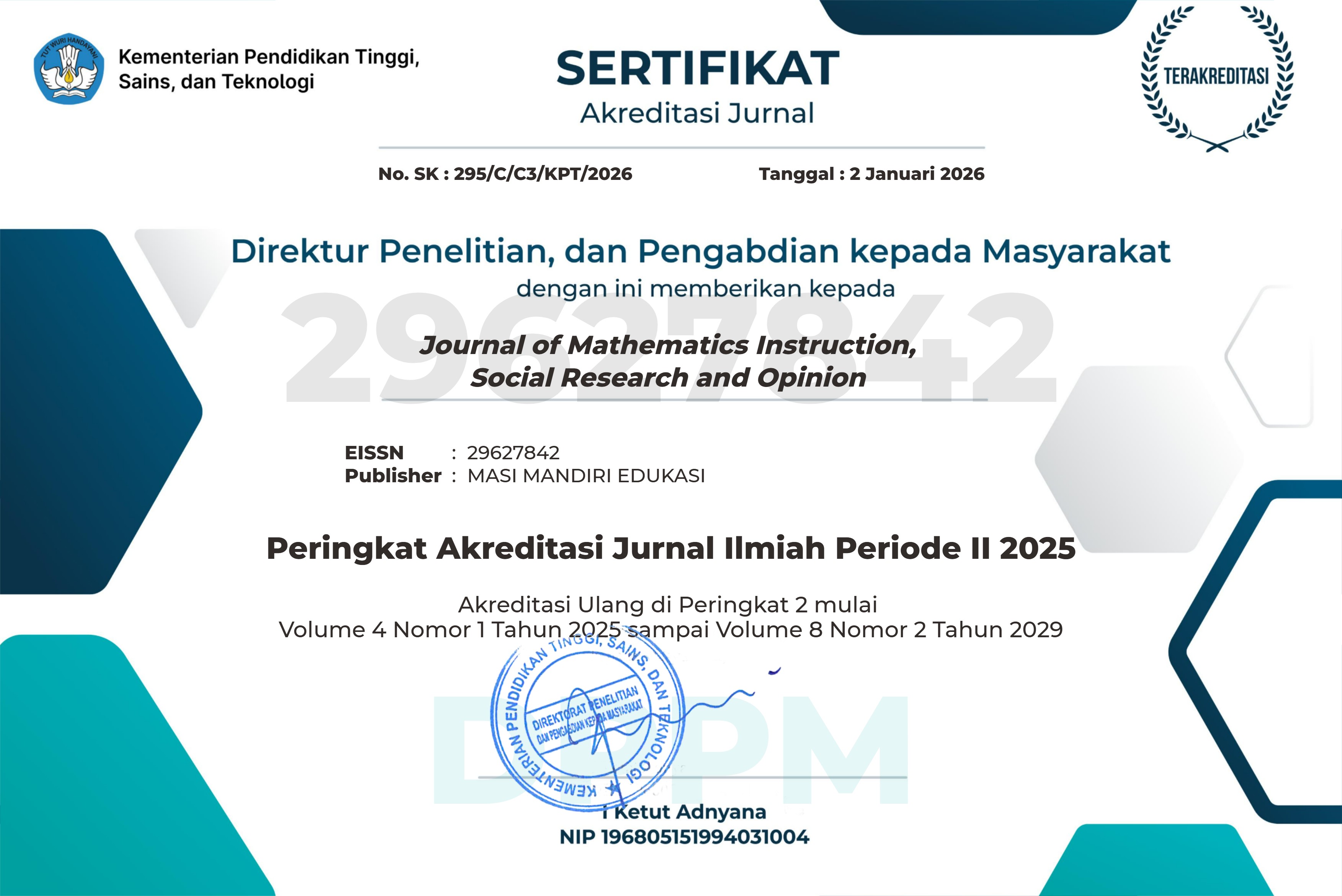
| Accreditation Certificate |
  |
| Indexing |






Contact Us

visitor
| Information |
>> For Authors
>> For Readers
>> For Librarians
| Visitor Statistics |
| Member of |

| Announcement |

| Keywords |
Mathematics Learning Difficulty Dyscalculia Teacher perceptions personality ICT Learning Computer teaching Academic Fisherfolks Economic Behavior Probit Models matrix mathematical model Concepts Guided Note Taking Golden Ratio Philosophy Integrated Learning van Hiele geometry Assessment Learning Outcomes method skills Problem Solving Experiment
| License |

MISRO is licensed under a Creative Commons Attribution-ShareAlike 4.0 International License.
| Publisher |

Address:
Jl. Gagak N0.105, Bandung,
Indonesia 40133
E-mail:
journalmisro@gmail.com
| in collaboration with |
| Recommended Tools |


| ISSN Barcode |

