
Exploring Computational Thinking in Geometric Proof Construction Across Gender Groups
DOI:
https://doi.org/10.58421/misro.v5i3.2137Keywords:
Mathematics education, Geometry transformation, Algorithmic thinking, Abstraction and generalization, Proof strategiesAbstract
Mathematical proof requires students to coordinate concepts, procedures, reasoning, and justification, while computational thinking (CT) provides a lens for organizing such processes. How CT processes are manifested during geometric transformation proof construction, particularly in relation to variation in proof representation, remains insufficiently explored. This study examined CT processes in students’ mathematical proof construction and described gender-related variation without assuming differences in mathematical ability. A qualitative descriptive design was conducted with 20 Grade XI students (10 male, 10 female) at a single senior high school. Data were collected through four open-ended geometric transformation tasks, reflection sheets, semi-structured interviews with six selected cases, and documentation. Data were analyzed through framework-based coding of decomposition, pattern recognition, algorithmic thinking, evaluation, and abstraction and generalization, alongside levels of proof construction. CT processes appeared unevenly across students. Evaluation and abstraction and generalization were the most challenging processes. Only 4 of 20 students reached the holistic-structural proof level. In the analyzed cases, some male cases showed more algebraic-structural representations, whereas some female cases showed more deductive-narrative representations. Conclusion: Procedural accuracy alone was insufficient for complete proof construction. The study contributes an analytical perspective linking CT processes with proof construction and highlights pedagogical attention to evaluation and generalization.
Downloads
References
G. J. Stylianides, A. J. Stylianides, and A. Moutsios-Rentzos, “Proof and proving in school and university mathematics education research: a systematic review,” ZDM – Math. Educ., vol. 56, no. 1, pp. 47–59, 2024, doi: 10.1007/s11858-023-01518-y.
M. Miyazaki, T. Fujita, and K. Jones, “Students’ understanding of the structure of deductive proof,” Educ. Stud. Math., vol. 94, no. 2, pp. 223–239, 2017, doi: 10.1007/s10649-016-9720-9.
M. Miyazaki, T. Fujita, K. Iwata, and K. Jones, “Level-spanning proof-production strategies to enhance students’ understanding of the proof structure in school mathematics,” Int. J. Math. Educ. Sci. Technol., vol. 55, no. 7, pp. 1597–1618, 2024, doi: 10.1080/0020739X.2022.2075288.
K. Kirsten and G. Greefrath, “Proof construction and in-process validation – Validation activities of undergraduates in constructing mathematical proofs,” J. Math. Behav., vol. 70, p. 101064, 2023, doi: 10.1016/j.jmathb.2023.101064.
L. Anwar, M. J. Goedhart, and A. Mali, “Learning trajectory of geometry proof construction: Studying the emerging understanding of the structure of Euclidean proof,” EURASIA J. Math. Sci. Technol. Educ., vol. 19, no. 5, p. em2266, 2023, doi: 10.29333/ejmste/13160.
S. S. Siagian, A. Mujib, and C. L. Zahari, “Analisis Tingkat Kecemasan Matematika dalam Pembentukan Konsep Image Siswa,” Parad. J. Pendidik. Mat., vol. 15, no. 1, pp. 8–13, 2022.
A. F. Mujib, “Improvement habits of minds in constructing mathematical proof using DNR-model,” in Aip Conference Proceedings, 2022. doi: https://doi.org/10.1063/5.0096095.
L. Anwar, S. H. Nasution, Sudirman, and Susiswo, “Proses berpikir mahasiswa dalam membuktikan proposisi: Konseptualisasi-gambar,” J. Kaji. Pembelajaran Mat., vol. 2, no. 2, pp. 46–56, 2018.
I. Kontorovich and S. Greenwood, “From Collaborative Construction, Through Whole-Class Presentation, to a Posteriori Reflection: Proof Progression in a Topology Classroom,” Int. J. Res. Undergrad. Math. Educ., vol. 10, no. 2, pp. 516–546, 2024, doi: 10.1007/s40753-023-00217-z.
F. Berisha, E. Vula, R. Gisewhite, and H. McDuffie, “The effectiveness and challenges implementing a formative assessment professional development program,” Teacher Development, vol. 28, no. 1. Informa UK Limited, pp. 19–43, 2023. doi: 10.1080/13664530.2023.2210533.
S. K. Nordby, A. H. Bjerke, and L. Mifsud, “Computational Thinking in the Primary Mathematics Classroom: a Systematic Review,” Digit. Exp. Math. Educ., vol. 8, pp. 27–49, 2022, doi: 10.1007/s40751-022-00102-5.
H. Ye, B. Liang, O.-L. Ng, and C. S. Chai, “Integration of computational thinking in K-12 mathematics education: a systematic review on CT-based mathematics instruction and student learning,” Int. J. STEM Educ., vol. 10, no. 1, p. 3, 2023, doi: 10.1186/s40594-023-00396-w.
S. J. Lee, G. M. Francom, and J. Nuatomue, “Computer science education and K-12 students’ computational thinking: A systematic review,” Int. J. Educ. Res., vol. 114, p. 102008, 2022, doi: 10.1016/j.ijer.2022.102008.
N. A. K. A. F. Khoo, N. A. H. N. Ishak, S. Osman, N. Ismail, and D. Kurniati, “Computational thinking in mathematics education: A systematic review,” in AIP Conference Proceedings, AIP Publishing, 2022, p. 30043. doi: 10.1063/5.0102618.
H. R. Mubarokah, D. S. Pambudi, N. D. S. Lestari, D. Kurniati, and D. D. H. Jatmiko, “Kemampuan berpikir komputasi siswa dalam menyelesaikan soal numerasi tipe AKM materi pola bilangan,” JNPM (Jurnal Nas. Pendidik. Mat., vol. 7, no. 2, pp. 343–355, 2023, doi: 10.33603/jnpm.v7i2.8013.
S. Al Aziz, A. Fauzan, and Helma, “Computational Thinking Analysis of 21st Century Professional Teacher Candidates in Solving Math Problems Viewed from the Four Foundations of CT,” J. Eksakta Pendidik., vol. 7, no. 2, pp. 211–224, 2023, doi: 10.24036/jep/vol7-iss2/779.
I. G. N. Y. Hartawan, L. H. A. Putri, and G. A. Mahayukti, “Junior High School Student’s Computational Thinking Ability in Solving Mathematical Problems,” J. Pedagog. dan Pembelajaran, vol. 7, no. 1, pp. 124–133, 2024, doi: 10.23887/jp2.v7i1.78001.
S. R. Candraningtyas and H. Khusna, “Computational thinking ability becomes a predictor of mathematical critical thinking ability,” Alifmatika J. Pendidik. dan Pembelajaran Mat., vol. 5, no. 2, pp. 247–263, 2023, doi: 10.35316/alifmatika.2023.v5i2.247-263.
R. N. Afifah and F. Apriyono, “Analysis of Students’ Computational Thinking Skills on Social Arithmetic Material in Terms of Adversity Quotient,” Kreano, J. Mat. Kreat., vol. 14, no. 2, pp. 243–253, 2023, doi: 10.15294/kreano.v14i2.45273.
T. Harmini, P. Annurwanda, and S. Suprihatiningsih, “Computational Thinking Ability Students Based on Gender in Calculus Learning,” AKSIOMA J. Progr. Stud. Pendidik. Mat., vol. 9, no. 4, pp. 977–986, 2020, doi: 10.24127/ajpm.v9i4.3160.
N. K. Erawati and N. K. R. Purwati, “Kemampuan pembuktian matematika berdasarkan gender dan gaya belajar,” Prima J. Pendidik. Mat., vol. 4, no. 2, pp. 109–120, 2020, doi: 10.31000/prima.v4i2.2617.
B. Nurwahyu, T. Y. E. Siswono, and S. Suwarsono, “Bayangan konsep (concept image) mahasiswa pada konsep kombinasi ditinjau dari perbedaan gender dan kemampuan matematika,” Kreano, J. Mat. Kreat., vol. 7, no. 2, pp. 153–162, 2016, doi: 10.15294/kreano.v7i2.5901.
J. W. Creswell, Educational Research: Planning, Conducting, and Evaluating Quantitative and Qualitative Research, 5th ed. Boston, MA: Pearson, 2015.
L. J. Moleong, Metodologi Penelitian Kualitatif. Bandung: PT Remaja Rosdakarya, 2017.
G. Wahyuni, A. Mujib, and C. L. Zahari, “Analisis Kemampuan Berpikir Visual Siswa Ditinjau Dari Adversity Quotient,” JUPE J. Pendidik. Mandala, vol. 7, no. 2, pp. 289–295, 2022, doi: 10.58258/jupe.v7i2.3335.
M. B. Miles and A. M. Huberman, Qualitative Data Analysis: An Expanded Sourcebook, 2nd ed. Thousand Oaks, CA: Sage Publications, 1994.
S. S. Siagian, A. Mujib, and Firmansyah, “The role of concept image in constructing mathematical proof,” in AIP Conference Proceedings, AIP Publishing, 2024, p. 20041. doi: 10.1063/5.0195137.
& M. Mujib, A., Firmansyah, Siagian, S. S., “The I-CON Model in Constructing Mathematical Proof,” J. Eduscience, vol. 12, no. 3, pp. 844–858, 2025.
G. Hanna, B. Larvor, and X. Yan, “Using the proof assistant Lean in undergraduate mathematics classrooms,” ZDM – Math. Educ., vol. 56, no. 7, pp. 1517–1529, 2024, doi: 10.1007/s11858-024-01577-9.
Downloads
Additional Files
Published
How to Cite
Issue
Section
License
Copyright (c) 2026 Journal of Mathematics Instruction, Social Research and Opinion

This work is licensed under a Creative Commons Attribution-ShareAlike 4.0 International License.
SideBar
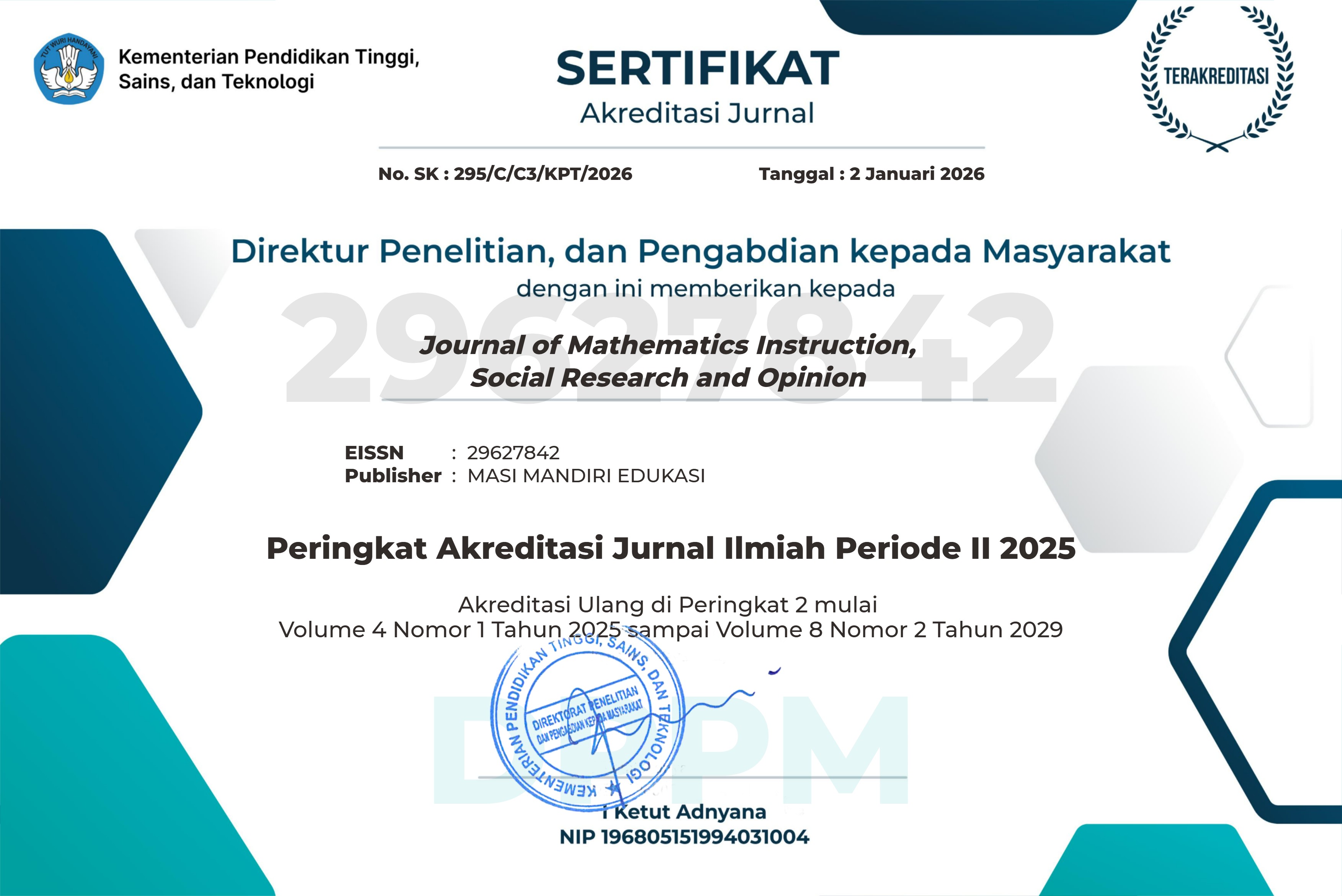
| Accreditation Certificate |
  |
| Indexing |






Contact Us

visitor
| Information |
>> For Authors
>> For Readers
>> For Librarians
| Visitor Statistics |
| Member of |

| Announcement |

| Keywords |
Mathematics Learning Difficulty Dyscalculia Teacher perceptions personality ICT Learning Computer teaching Academic Fisherfolks Economic Behavior Probit Models matrix mathematical model Concepts Guided Note Taking Golden Ratio Philosophy Integrated Learning van Hiele geometry Assessment Learning Outcomes method skills Problem Solving Experiment
| License |

MISRO is licensed under a Creative Commons Attribution-ShareAlike 4.0 International License.
| Publisher |

Address:
Jl. Gagak N0.105, Bandung,
Indonesia 40133
E-mail:
journalmisro@gmail.com
| in collaboration with |

| Recommended Tools |


| ISSN Barcode |

