
Transformational Leadership of School Principals in Optimizing the Management of Teacher E-Performance Through Ruang GTK: A Multi-Site Study at SMP Negeri 2 Plaosan and SMP Negeri 1 Takeran
DOI:
https://doi.org/10.58421/misro.v5i3.2127Keywords:
Multi-site study, Ruang GTK, School principal, Teacher e-performance, Transformational leadershipAbstract
School principals hold a strategic role in directing teachers to use the Ruang GTK platform for managing teacher e-performance (e-Kinerja), as mandated by Regulation of the Director General of Teachers and Education Personnel No. 7327/B.B1/HK.03.01/2023 on the School Principal Competency Model. However, the success of this digitalization depends less on system availability than on the quality of principal leadership in managing change. This study describes in depth how principals enact transformational leadership, namely idealized influence, inspirational motivation, intellectual stimulation, and individualized consideration in Bass and Riggio's framework [2], to optimize teacher e-performance management through Ruang GTK. A descriptive qualitative approach with a multi-site design was used at SMP Negeri 2 Plaosan and SMP Negeri 1 Takeran, Magetan Regency. Data were gathered through observation, in-depth interviews, and documentation with principals, vice principals, and teachers as key informants, then analyzed using Miles and Huberman's interactive model together with cross-site analysis. Trustworthiness was established through credibility, transferability, dependability, and confirmability. Findings show that principals at both sites consistently enacted all four dimensions: exemplary conduct built teachers' trust in digital change; inspirational motivation reframed e-Kinerja from an administrative burden into a professional responsibility; intellectual stimulation drove collaborative problem solving; and individualized consideration provided mentoring matched to each teacher's digital competence. These results affirm transformational leadership as the primary driver of school digital transformation, offering a reference for developing principal competencies in the era of digital performance management.
Downloads
References
K. Banoğlu, R. Vanderlinde, M. Çetin, and K. Aesaert, “Role of school principals' technology leadership in building digital school culture,” Journal of Research in Primary Education, vol. 5, no. 1, 2023.
B. M. Bass and R. E. Riggio, Transformational Leadership, 2nd ed. Mahwah, NJ, USA: Lawrence Erlbaum Associates, 2006.
I. Berkovich and A. Hassan, “Digital transformational leadership in schools,” Journal of Educational Administration, vol. 61, no. 2, pp. 145–162, 2023, doi: 10.1108/JEA-2022.
C. Dasruth, S. R. Naicker, and T. Smith, “School digital transformation and principal leadership practices,” 2024.
Directorate General of Teachers and Education Personnel, Decree of the Director General of Teachers and Education Personnel No. 7607/B.B1/HK.03/2023 on Technical Guidelines for Managing Teacher and Principal Performance. Jakarta, Indonesia: Ministry of Education, Culture, Research, and Technology, 2023.
Directorate General of Teachers and Education Personnel, Decree of the Director General of Teachers and Education Personnel No. 4242/B.B1/HK.03.01/2024 on Teacher Performance Assessment. Jakarta, Indonesia: Ministry of Primary and Secondary Education, 2024.
Ministry of Primary and Secondary Education, Guidelines for Managing Teacher and Principal Performance through Ruang GTK. Jakarta, Indonesia: Directorate General of Teachers and Education Personnel, 2024.
K. Leithwood, A. Harris, and D. Hopkins, “Seven strong claims about successful school leadership,” School Leadership & Management, vol. 28, no. 1, pp. 27–42, 2008, doi: 10.1080/13632430701800060.
K. Leithwood and D. Jantzi, “Transformational school leadership for large-scale reform: Effects on students, teachers, and their classroom practices,” School Effectiveness and School Improvement, vol. 17, no. 2, pp. 201–227, 2006.
P. G. Northouse, Leadership: Theory and Practice, 8th ed. Thousand Oaks, CA, USA: SAGE Publications, 2019.
Republic of Indonesia, Regulation of the Minister of Administrative and Bureaucratic Reform No. 6 of 2022 on the Performance Management of State Civil Apparatus Employees, 2022.
T. J. Sergiovanni, Rethinking Leadership: A Collection of Articles, 2nd ed. Thousand Oaks, CA, USA: Corwin Press, 2007.
N. Termizi, R. Hamid, and A. Razak, “Transformational leadership and teacher digital competence,” 2025.
Y. Tobondo, “Transformational leadership and teacher adaptability in digitalized educational environments,” 2025.
G. Yukl, Leadership in Organizations, 7th ed. Upper Saddle River, NJ, USA: Pearson Prentice Hall, 2010.
X. Zhou and L. Niu, “Principal transformational leadership and teachers' technology use intention: The role of psychological mechanisms and innovation climate,” 2025.
M.-L. Schmitz, C. Antonietti, T. Consoli, A. Cattaneo, P. Gonon, and D. Petko, “Transformational leadership for technology integration in schools: Empowering teachers to use technology in a more demanding way,” Computers & Education, vol. 204, Art. no. 104880, 2023, doi: 10.1016/j.compedu.2023.104880.
Rasdiana, B. B. Wiyono, A. Imron, L. Rahma, N. Arifah, R. Azhari, Elfira, I. Sibula, and M. A. Maharmawan, “Elevating teachers’ professional digital competence: Synergies of principals’ instructional e-supervision, technology leadership and digital culture for educational excellence in digital-savvy era,” Education Sciences, vol. 14, no. 3, Art. no. 266, 2024, doi: 10.3390/educsci14030266.
M.-L. Schmitz, C. Antonietti, T. Consoli, P. Gonon, A. Cattaneo, and D. Petko, “Enhancing teacher collaboration for technology integration: The impact of transformational leadership,” Computers & Education, vol. 234, Art. no. 105331, 2025, doi: 10.1016/j.compedu.2025.105331.
K. Leithwood, A. Harris, and D. Hopkins, “Seven strong claims about successful school leadership revisited,” School Leadership & Management, vol. 40, no. 1, pp. 5–22, 2020, doi: 10.1080/13632434.2019.1596077.
E. C. Sheninger, Digital Leadership: Changing Paradigms for Changing Times. Thousand Oaks, CA, USA: Corwin, 2014.
I. Berkovich and T. Hassan, “Principals’ digital transformational leadership, teachers’ commitment, and school effectiveness,” Education Inquiry, vol. 16, no. 2, pp. 177–194, 2025, doi: 10.1080/20004508.2023.2173705.
W. Handayani, S. Hidayat, and Elan, “Transformational leadership of school principals as a catalyst for digital learning implementation in primary schools,” Journal of Innovation and Research in Primary Education, vol. 4, no. 3, 2025, doi: 10.56916/jirpe.v4i3.1826.
M. L. Haryanti and R. Purbojo, “Peran kepemimpinan transformasional dan literasi digital terhadap kompetensi pedagogis guru dalam pengintegrasian teknologi,” Edumatic: Jurnal Pendidikan Informatika, vol. 8, no. 1, pp. 103–112, 2024, doi: 10.29408/edumatic.v8i1.25444.
M. Amrah, A. P. Kartiwi, B. Tamam, and A. Aminudin, “From foundation to continuity: Reframing principal transformational leadership in school digital transformation,” Idaarah: Jurnal Manajemen Pendidikan, vol. 10, no. 1, 2026, doi: 10.24252/idaarah.v10i1.67629.
Downloads
Additional Files
Published
How to Cite
Issue
Section
License
Copyright (c) 2026 Journal of Mathematics Instruction, Social Research and Opinion

This work is licensed under a Creative Commons Attribution-ShareAlike 4.0 International License.
SideBar
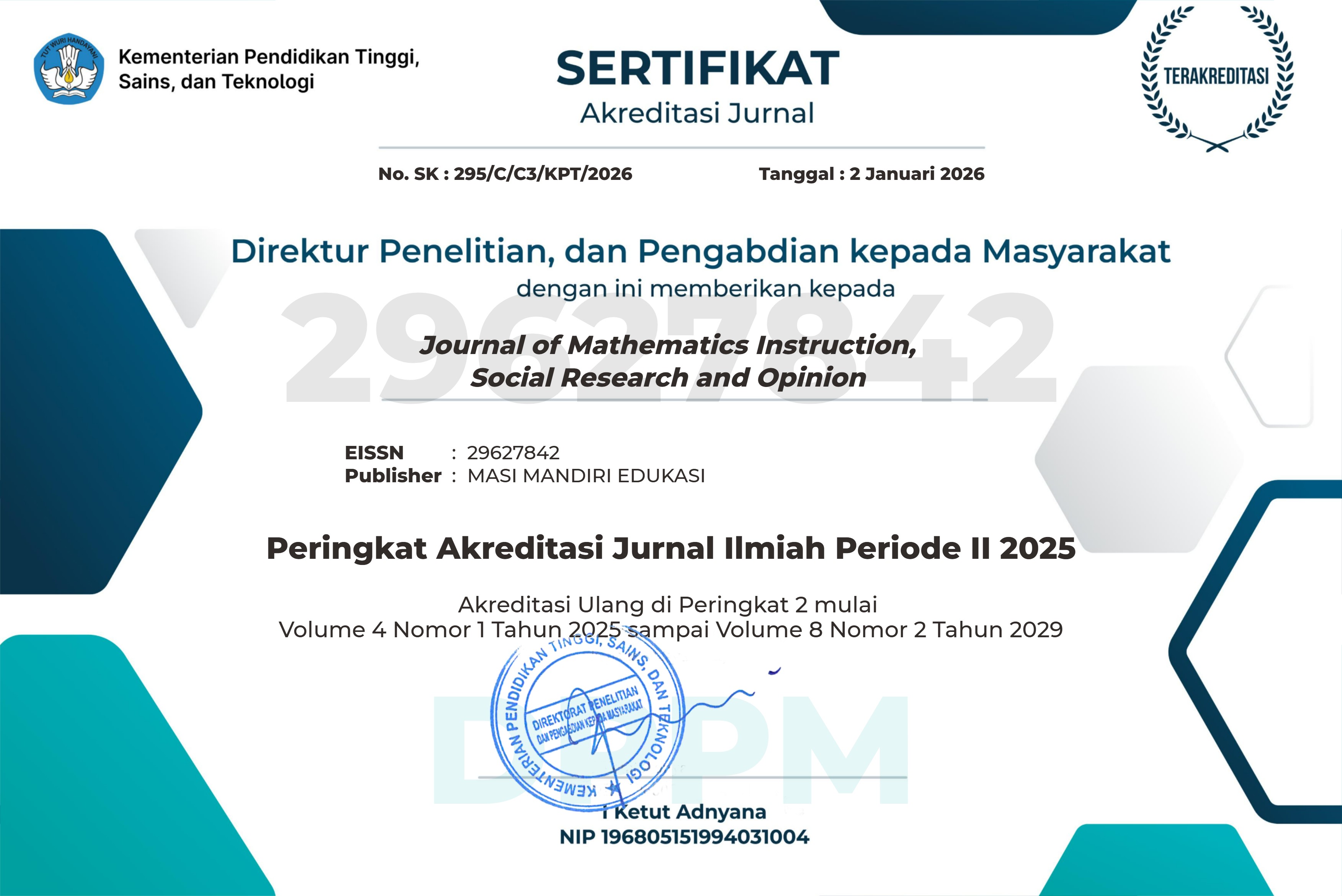
| Accreditation Certificate |
  |
| Indexing |






Contact Us

visitor
| Information |
>> For Authors
>> For Readers
>> For Librarians
| Visitor Statistics |
| Member of |


| Announcement |

| Keywords |
Mathematics Learning Difficulty Dyscalculia Teacher perceptions personality ICT Learning Computer teaching Academic Fisherfolks Economic Behavior Probit Models matrix mathematical model Concepts Guided Note Taking Golden Ratio Philosophy Integrated Learning van Hiele geometry Assessment Learning Outcomes method skills Problem Solving Experiment
| License |

MISRO is licensed under a Creative Commons Attribution-ShareAlike 4.0 International License.
| Publisher |

Address:
Jl. Gagak N0.105, Bandung,
Indonesia 40133
E-mail:
journalmisro@gmail.com
| in collaboration with |

| Recommended Tools |


| ISSN Barcode |

