
Spatial-Algebraic Cognitive Barriers in Solving Ellipse and Hyperbola Problems: An Analysis Using Polya’s Heuristics and Cognitive Load Theory
DOI:
https://doi.org/10.58421/misro.v5i3.2027Keywords:
Cognitive barriers, Polya’s heuristics, Cognitive load theory, Problem-solving, Spatial algebraic representationAbstract
Ellipse and hyperbola problems require students to coordinate geometric, spatial, and algebraic representations, which may generate cognitive barriers. This qualitative preliminary study aims to characterise students’ cognitive barriers when solving conic section tasks by integrating Polya’s heuristics with Cognitive Load Theory (CLT) as an analytical lens, without directly measuring empirical cognitive load states. Participants included 25 undergraduate students across two groups (4A and 4B). Data were collected from students’ written metacognitive reflections following a final examination alongside their problem-solving artefacts. Data were analysed using integrative coding across Polya’s four stages and qualitatively interpreted through intrinsic, extraneous, and germane cognitive load dimensions. Among the recurring patterns identified in hyperbola tasks, students frequently struggled to coordinate the centre, vertex, and focus to determine curve orientation and key parameters and . In ellipse tasks, barriers were commonly observed during general-to-standard equation transformations, specifically in grouping terms and completing the square. Procedural complexity, time constraints, and schema retrieval difficulties further interrupted problem-solving trajectories. These findings suggest that conic-section problem-solving difficulties reflect complex interactions between spatial-algebraic coordination and cognitive demands. Consequently, this study conceptualises the spatial-algebraic cognitive barrier as a preliminary analytical concept rather than an established psychological construct, offering pedagogical insights for analytic geometry instruction.
Downloads
References
E. Sudihartinih and T. Purniati, “Students’ mistakes and misconceptions on the subject of conics,” International Journal of Education, vol. 12, no. 2, pp. 92–100, 2020, doi: 10.17509/ije.v12i2.19130.
M. Dintarini, M. T. Budiarto, and Y. Fuad, “Spatial thinking in conic sections: A study of undergraduate mathematics students by sex and spatial category,” Jurnal Pendidikan Matematika, vol. 19, no. 2, pp. 275–298, 2025.
A. I. Sugandi, D. Sofyan, L. Linda, and D. R. Sari, “Identifikasi kesalahan mahasiswa dalam menyelesaikan soal-soal pada mata kuliah geometri analitik,” JPMI (Jurnal Pembelajaran Matematika Inovatif), vol. 5, no. 4, 2022, doi: 10.22460/jpmi.v5i4.11151.
S. Ainsworth, “DeFT: A conceptual framework for considering learning with multiple representations,” Learning and Instruction, vol. 16, no. 3, pp. 183–198, 2006, doi: 10.1016/j.learninstruc.2006.03.001.
R. Duval, “A cognitive analysis of problems of comprehension in the learning of mathematics,” Educational Studies in Mathematics, vol. 61, pp. 103–131, 2006, doi: 10.1007/s10649-006-0400-z.
A. Arcavi, “The role of visual representations in the learning of mathematics,” Educational Studies in Mathematics, vol. 52, no. 3, pp. 215–241, 2003, doi: 10.1023/A:1024312321077.
M. Hegarty and M. Kozhevnikov, “Types of visual-spatial representations and mathematical problem solving,” Journal of Educational Psychology, vol. 91, no. 4, pp. 684–689, 1999, doi: 10.1037/0022-0663.91.4.684.
M. T. Battista, “The development of geometric and spatial thinking,” in F. K. Lester Jr., Ed., Second Handbook of Research on Mathematics Teaching and Learning. Charlotte, NC: Information Age Publishing, 2007, pp. 843–908.
D. H. Clements and M. T. Battista, “Geometry and spatial reasoning,” in D. A. Grouws, Ed., Handbook of Research on Mathematics Teaching and Learning. New York, NY: Macmillan, 1992, pp. 420–464.
A. J. Bishop, “Review of research on visualisation in mathematics education,” Focus on Learning Problems in Mathematics, vol. 11, no. 1–2, pp. 7–16, 1989.
G. A. Goldin, “Representation in mathematical learning and problem solving,” in L. D. English, Ed., Handbook of International Research in Mathematics Education. Mahwah, NJ: Lawrence Erlbaum Associates, 2002, pp. 197–218.
C. Janvier, Ed., Problems of Representation in the Teaching and Learning of Mathematics. Hillsdale, NJ: Lawrence Erlbaum Associates, 1987.
J. J. Kaput, “Representation systems and mathematics,” in C. Janvier, Ed., Problems of Representation in the Teaching and Learning of Mathematics. Hillsdale, NJ: Lawrence Erlbaum Associates, 1987, pp. 19–26.
R. Duval, Sémiosis et pensée humaine: Registres sémiotiques et apprentissages intellectuels. Bern, Switzerland: Peter Lang, 1995.
G. Pólya, How to Solve It: A New Aspect of Mathematical Method, 2nd ed. Princeton, NJ: Princeton University Press, 1957.
A. A. Wahab, Y. S. Kusuma, D. Juandi, T. Turmudi, B. Buhaerah, and S. Syaiful, “Understanding students’ struggles in solving mathematical problems: A systematic literature review using Polya’s framework,” Jurnal Pendidikan Progresif, vol. 14, no. 3, 2024, doi: 10.23960/jpp.v14.i3.2024118.
A. H. Schoenfeld, Mathematical Problem Solving. Orlando, FL: Academic Press, 1985.
A. H. Schoenfeld, “What’s all the fuss about metacognition?” in Cognitive Science and Mathematics Education, A. H. Schoenfeld, Ed. Hillsdale, NJ: Lawrence Erlbaum Associates, 1987, pp. 189–215.
A. H. Schoenfeld, “Learning to think mathematically: Problem solving, metacognition, and sense-making in mathematics,” in D. A. Grouws, Ed., Handbook of Research on Mathematics Teaching and Learning. New York, NY: Macmillan, 1992, pp. 334–370.
J. Mason, L. Burton, and K. Stacey, Thinking Mathematically, 2nd ed. Harlow, UK: Pearson, 2010.
National Research Council, Adding It Up: Helping Children Learn Mathematics. Washington, DC: National Academy Press, 2001, doi: 10.17226/9822.
L. R. Izzati and A. Mahmudi, “The influence of metacognition in mathematical problem solving,” Journal of Physics: Conference Series, vol. 1097, no. 1, Art. no. 012107, 2018, doi: 10.1088/1742-6596/1097/1/012107.
J. Sweller, “Cognitive load theory, learning difficulty, and instructional design,” Learning and Instruction, vol. 4, no. 4, pp. 295–312, 1994, doi: 10.1016/0959-4752(94)90003-5.
J. Sweller, J. J. G. van Merriënboer, and F. G. W. C. Paas, “Cognitive architecture and instructional design,” Educational Psychology Review, vol. 10, no. 3, pp. 251–296, 1998, doi: 10.1023/A:1022193728205.
J. Sweller, J. J. G. van Merriënboer, and F. Paas, “Cognitive architecture and instructional design: 20 years later,” Educational Psychology Review, vol. 31, pp. 261–292, 2019, doi: 10.1007/s10648-019-09465-5.
J. Sweller, “Element interactivity and intrinsic, extraneous, and germane cognitive load,” Educational Psychology Review, vol. 22, pp. 123–138, 2010, doi: 10.1007/s10648-010-9128-5.
S. Kalyuga, “Cognitive load theory: How many types of load does it really need?” Educational Psychology Review, vol. 23, no. 1, pp. 1–19, 2011, doi: 10.1007/s10648-010-9150-7.
F. Paas, J. E. Tuovinen, H. Tabbers, and P. W. M. van Gerven, “Cognitive load measurement as a means to advance cognitive load theory,” Educational Psychologist, vol. 38, no. 1, pp. 63–71, 2003, doi: 10.1207/S15326985EP3801_8.
P. Chandler and J. Sweller, “Cognitive load theory and the format of instruction,” Cognition and Instruction, vol. 8, no. 4, pp. 293–332, 1991, doi: 10.1207/S1532690XCI0804_2.
J. Sweller and P. Chandler, “Evidence for cognitive load theory,” Cognition and Instruction, vol. 8, no. 4, pp. 351–362, 1991, doi: 10.1207/S1532690XCI0804_5.
F. Paas, A. Renkl, and J. Sweller, “Cognitive load theory and instructional design: Recent developments,” Educational Psychologist, vol. 38, no. 1, pp. 1–4, 2003, doi: 10.1207/S15326985EP3801_1.
S. Kalyuga, P. Ayres, P. Chandler, and J. Sweller, “The expertise reversal effect,” Educational Psychologist, vol. 38, no. 1, pp. 23–31, 2003, doi: 10.1207/S15326985EP3801_4.
S. Kalyuga, P. Chandler, J. Tuovinen, and J. Sweller, “When problem solving is superior to studying worked examples,” Journal of Educational Psychology, vol. 93, no. 3, pp. 579–588, 2001, doi: 10.1037/0022-0663.93.3.579.
J. Sweller and G. A. Cooper, “The use of worked examples as a substitute for problem solving in learning algebra,” Cognition and Instruction, vol. 2, no. 1, pp. 59–89, 1985, doi: 10.1207/S1532690XCI0201_3.
J. Hiebert and P. Lefevre, “Conceptual and procedural knowledge in mathematics: An introductory analysis,” in J. Hiebert, Ed., Conceptual and Procedural Knowledge: The Case of Mathematics. Hillsdale, NJ: Lawrence Erlbaum Associates, 1986, pp. 1–27.
T. R. Azzahra and S. Mariani, “Mathematical problem solving skills reviewed from students’ metacognition performance in online-based PME learning model,” Unnes Journal of Mathematics Education, vol. 11, no. 1, pp. 48–57, 2022, doi: 10.15294/ujme.v11i1.54664.
J. R. Star, “Reconceptualising procedural knowledge,” Journal for Research in Mathematics Education, vol. 36, no. 5, pp. 404–411, 2005, doi: 10.2307/30034943.
J. Sweller, R. Low, and J. Sweller, “Some cognitive factors relevant to mathematics instruction,” Mathematics Education Research Journal, vol. 4, pp. 83–94, 1992, doi: 10.1007/BF03217233.
D. A. Sholihah, “Strategi pembelajaran matematika berdasarkan Cognitive Load Theory untuk meminimalkan extraneous cognitive load,” EQUALS: Jurnal Ilmiah Pendidikan Matematika, vol. 5, no. 1, pp. 13–23, 2022, doi: 10.46918/equals.v5i1.1197.
Downloads
Additional Files
Published
How to Cite
Issue
Section
License
Copyright (c) 2026 Journal of Mathematics Instruction, Social Research and Opinion

This work is licensed under a Creative Commons Attribution-ShareAlike 4.0 International License.
SideBar
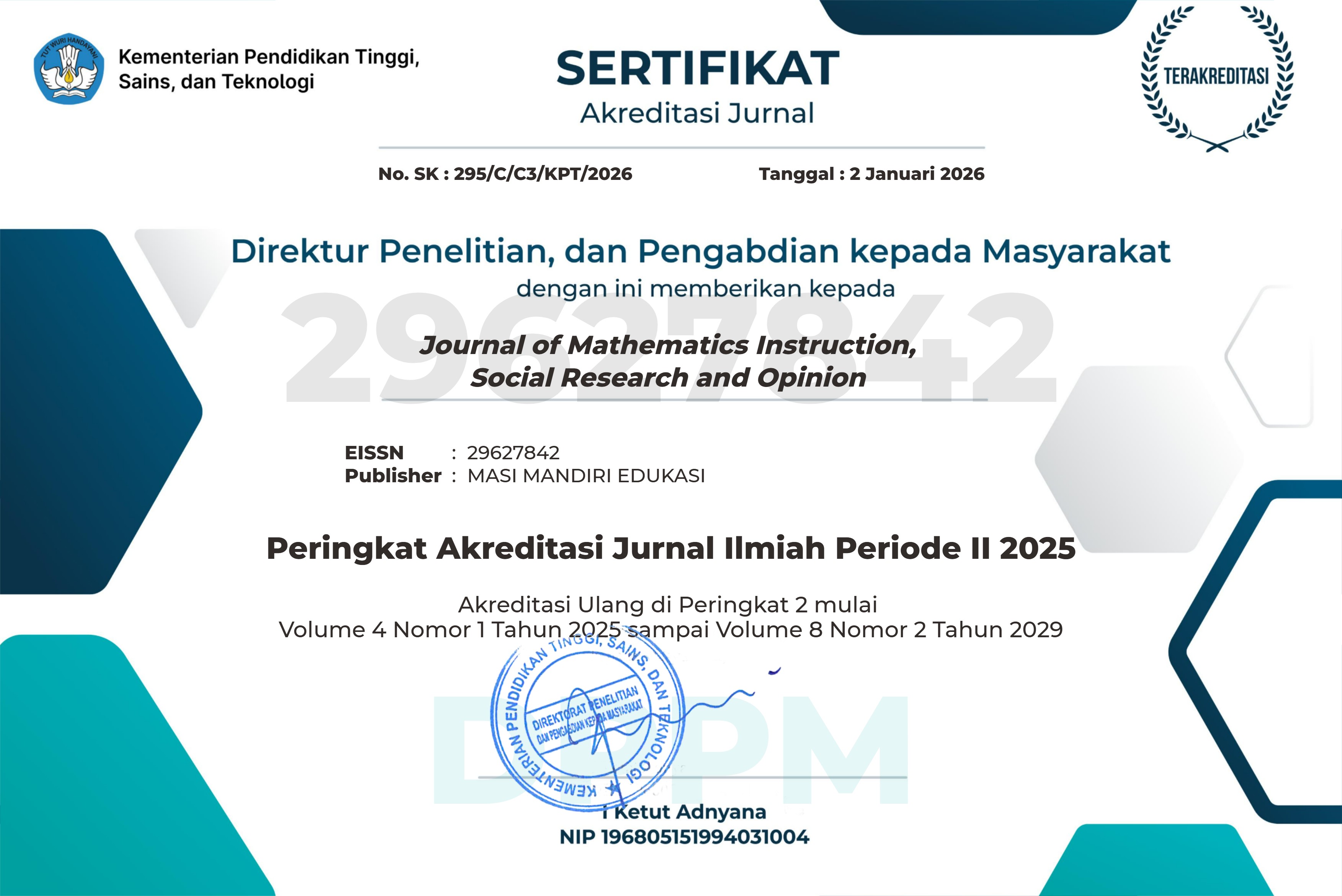
| Accreditation Certificate |
  |
| Indexing |






Contact Us

visitor
| Information |
>> For Authors
>> For Readers
>> For Librarians
| Visitor Statistics |
| Member of |


| Announcement |

| Keywords |
Mathematics Learning Difficulty Dyscalculia Teacher perceptions personality ICT Learning Computer teaching Academic Fisherfolks Economic Behavior Probit Models matrix mathematical model Concepts Guided Note Taking Golden Ratio Philosophy Integrated Learning van Hiele geometry Assessment Learning Outcomes method skills Problem Solving Experiment
| License |

MISRO is licensed under a Creative Commons Attribution-ShareAlike 4.0 International License.
| Publisher |

Address:
Jl. Gagak N0.105, Bandung,
Indonesia 40133
E-mail:
journalmisro@gmail.com
| in collaboration with |

| Recommended Tools |


| ISSN Barcode |

