
The Comparison of Students Mathematics Learning Outcomes Between Using Performance Assessment and Self-assessment
DOI:
https://doi.org/10.58421/misro.v1i2.20Keywords:
Performance Assessment, Self-assessment, Students Learning OutcomesAbstract
A good assessment covers three aspects: cognitive, affective, and psychomotor. Many teachers tend to assess only the cognitive aspect. This problem requires treatment in the form of appropriate assessment so that the development of student learning outcomes not only covers the knowledge aspect only. This research aims to find out the result of students learning outcomes in a group of mathematic learners after being given treatment in the form of performance assessment and self-assessment and find out which treatment gives better results amongst students who are treated in the form of performance assessment and self-assessment. This research is an experimental study. The population taken is all students in grade X of MA Ash-Siddiqiyyah. The sample was taken based on purpose, namely purposive sampling. The class used as the experimental class I is class X IPA 1, which amounted to 30 students, and class X IPS 2, which amounted to 30 students, is experimental class II. Based on the results obtained, the average student learning outcomes in experimental class I is in the high category with an average number gain value of 0.71. The average student learning outcomes in experimental class II are in the medium category and are shown by the average number of gain values of 0.64. Based on the hypothesis test results, the decision is to reject Ho and accept Ha. Then it can be concluded that the results of student learning in the learning group treated by performance assessment are better than student learning outcomes in the learning group treated with self-assessment.
Downloads
References
Kosim, “Application Ability of Students in Integrated Computer-Aided Numerical Analysis Learning,” J. Math. Instr. Soc. Res. Opin. (MISRO, vol. 1, no. 1, pp. 54–62, 2022.
T. P. Wahyusukma, A. Muchyidin, and I. Nursuprianah, “Macan Ali In The Cirebon Glass Painting : The Study Of Ethnomathematics,” J. Math. Instr. Soc. Res. Opin. (MISRO, vol. 1, no. 1, pp. 27–40, 2022.
I. Perasutiyo, A. Muchyidin, and I. Nursuprianah, “Golden Ratio and the Meaning of the Wayang Kulit Gunungan Philosophy,” J. Math. Instr. Soc. Res. Opin. (MISRO, vol. 1, no. 1, pp. 41–53, 2022.
K. Sadiyah, A. Muchyidin, and N. Izzati, “Application of Collaborative Teamwork Learning Model and Guided Note Taking Model and Their Influence on Students ’ Ability to Understand Mathematical Concepts,” J. Math. Instr. Soc. Res. Opin. (MISRO, vol. 1, no. 1, pp. 14–26, 2022.
I. H. Bisri and A. Muchyidin, “Mathematics on Cirebon Woven Fabric with Lanang Motifs,” J. Math. Instr. Soc. Res. Opin. (MISRO, vol. 1, no. 1, pp. 1–13, 2022.
I. Kurniati, H. Helmawati, and M. Syah, “Problem Solving Method Management to Improve the Quality of PAI Learning,” Int. J. Nusant. Islam, vol. 9, no. 1, pp. 80–92, 2021, doi: 10.15575/ijni.v9i1.11921.
T. Muttaqin, “Determinants of Unequal Access to and Quality of Education in Indonesia,” J. Perenc. Pembang. Indones. J. Dev. Plan., vol. 2, no. 1, pp. 1–23, 2018, doi: 10.36574/jpp.v2i1.27.
D. Erlina, D. Devitasari, and L. Marzulina, “Students ’ Demotivating Factors in English Language Learning : A Case Study,” Indones. Res. J. Educ., vol. 4, no. 1, pp. 120–136, 2020.
H. Wijanarko, “Phenomenology studies in junior high school students’ enthusiasm in social studies learning in Universitas Malang Laboratorium, Indonesia,” Harmon. Sos. J. Pendidik. IPS, vol. 7, no. 2, pp. 141–149, 2020, doi: 10.21831/hsjpi.v7i2.31686.
O. C. Barbu and C. R. Beal, “Effects of Linguistic Complexity and Math Difficulty on Word Problem Solving by English Learners,” Int. J. Educ., vol. 2, no. 2, 2010, doi: 10.5296/ije.v2i2.508.
M. R. Novriani and E. Surya, “International Journal of Sciences : Analysis of Student Difficulties in Mathematics Problem Solving Ability at MTs SWASTA IRA Medan,” Int. J. Sci. Basic Appl. Res., vol. 33, no. 3, pp. 63–75, 2017.
H. D. Putra, W. Setiawan, and M. Afrilianto, “Indonesian high scholar difficulties in learning mathematics,” Int. J. Sci. Technol. Res., vol. 9, no. 1, pp. 3466–3471, 2020.
M. Doorman, P. Drijvers, T. Dekker, M. van den Heuvel-Panhuizen, J. de Lange, and M. Wijers, “Problem solving as a challenge for mathematics education in The Netherlands,” ZDM - Int. J. Math. Educ., vol. 39, no. 5–6, pp. 405–418, 2007, doi: 10.1007/s11858-007-0043-2.
C. Bryson, “Engagement through partnership: students as partners in learning and teaching in higher education,” Int. J. Acad. Dev., vol. 21, no. 1, pp. 84–86, 2016, doi: 10.1080/1360144x.2016.1124966.
Wahidmurni, Evaluasi Pembelajaran (Kompetensi dan Praktik). Yogyakarta: Nuha Litera, 2014.
S. Arikunto, Dasar-Dasar Evaluasi Pendidikan. Jakarta: Bumi Aksara, 2013.
Sukardi, Evaluasi Pendidikan : Prinsidp dan Operasionalnya. Jakarta: Bumi Aksara, 2009.
D. Adom, J. A. Mensah, and D. A. Dake, “Test, measurement, and evaluation: Understanding and use of the concepts in education,” Int. J. Eval. Res. Educ., vol. 9, no. 1, pp. 109–119, 2020, doi: 10.11591/ijere.v9i1.20457.
U. Hayati, M. Ediyani, M. Maimun, K. Anwar, M. B. Fauzi, and S. Suryati, “Test Technique as a Tool for Evaluation of Learning Outcomes,” Budapest Int. Res. Critics Inst. Humanit. Soc. Sci., vol. 3, no. 2, pp. 1198–1205, 2020, doi: 10.33258/birci.v3i2.961.
D. Rukmini and L. A. D. E. Saputri, “The authentic assessment to measure students’ English productive skills based on 2013 Curriculum,” Indones. J. Appl. Linguist., vol. 7, no. 2, pp. 263–273, 2017, doi: 10.17509/ijal.v7i2.8128.
J. W. Creswell, Research design: qualitative, quantitative, and mixed methods approaches, 4th ed., no. c. Los Angeles: SAGE, 2014.
Downloads
Published
How to Cite
Issue
Section
License
Copyright (c) 2022 Journal of Mathematics Instruction, Social Research and Opinion

This work is licensed under a Creative Commons Attribution-ShareAlike 4.0 International License.
SideBar
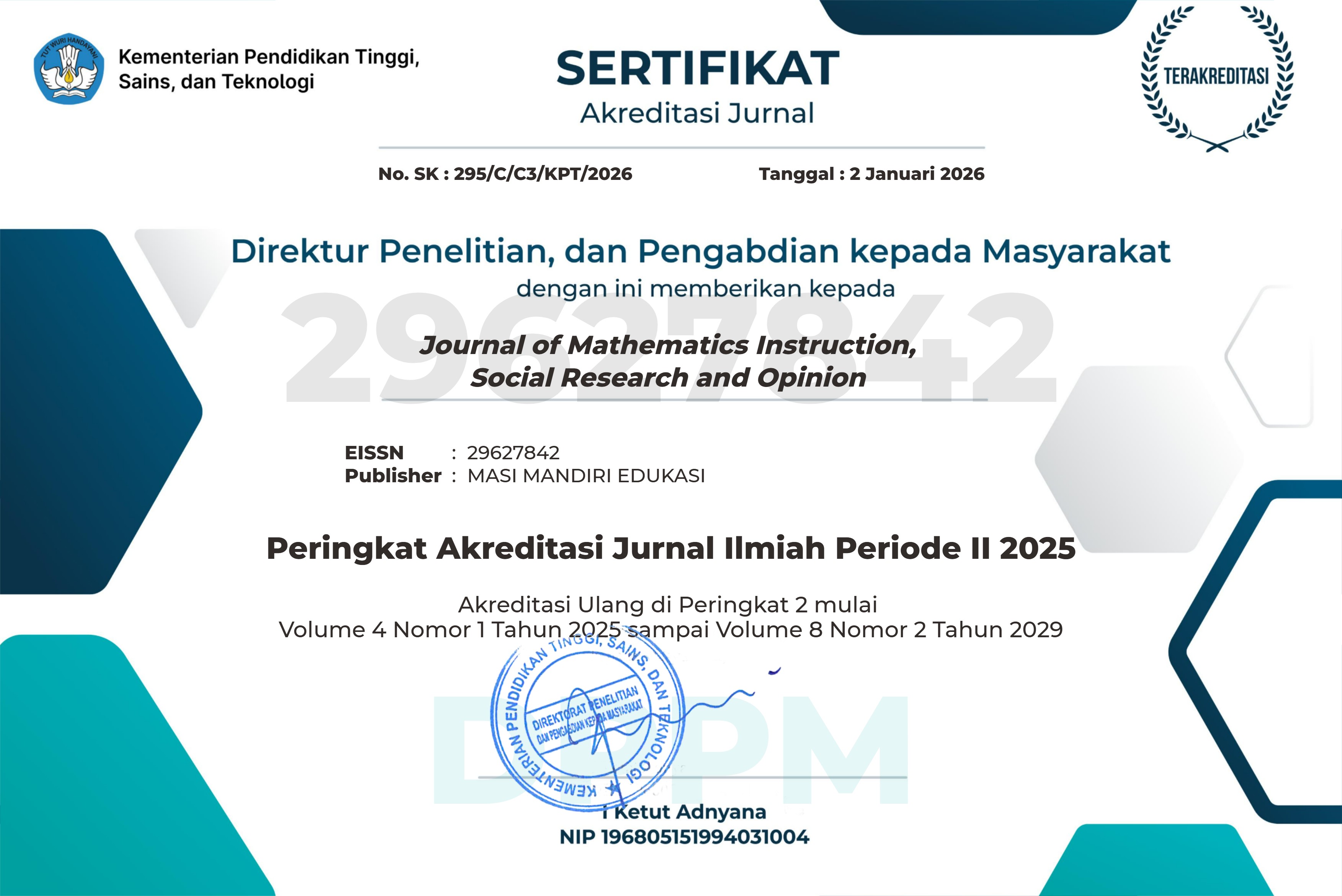
| Accreditation Certificate |
  |
| Indexing |






Contact Us

visitor
| Information |
>> For Authors
>> For Readers
>> For Librarians
| Visitor Statistics |
| Member of |

| Announcement |

| Keywords |
Mathematics Learning Difficulty Dyscalculia Teacher perceptions personality ICT Learning Computer teaching Academic Fisherfolks Economic Behavior Probit Models matrix mathematical model Concepts Guided Note Taking Golden Ratio Philosophy Integrated Learning van Hiele geometry Assessment Learning Outcomes method skills Problem Solving Experiment
| License |

MISRO is licensed under a Creative Commons Attribution-ShareAlike 4.0 International License.
| Publisher |

Address:
Jl. Gagak N0.105, Bandung,
Indonesia 40133
E-mail:
journalmisro@gmail.com
| in collaboration with |
| Recommended Tools |


| ISSN Barcode |

