
Unpacking the Determinants of Coastal Village Development: A Systematic Review of Financial Inclusion and Sustainability
DOI:
https://doi.org/10.58421/misro.v5i3.1959Keywords:
Coastal Village, Rural Development, Financial Inclusion, Sustainable Development, Public PolicyAbstract
Coastal villages possess immense geo-economic potential due to abundant marine resources, yet they persistently face chronic socio-economic disparities and intensifying ecological vulnerabilities. While macro-level sustainable development frameworks exist, their successful realization heavily hinges on localized, micro-level strategies. However, prior scientific inquiries often evaluate developmental determinants in isolation, leaving a critical empirical gap in understanding the synergistic effects between demographic shifts, financial architectures, physical connectivity, ecological preservation, fiscal governance, and social networks. To address this, this study aims to comprehensively evaluate the multi-dimensional determinants of coastal village development, emphasizing the role of financial inclusion. The research utilizes a Systematic Literature Review (SLR) and bibliometric analysis guided by the PRISMA framework, analyzing 258 eligible peer-reviewed articles published between 2021 and 2026 retrieved from the Scopus database. Employing bibliometric mapping and keyword network clustering, the results reveal a significant paradigm shift in rural development discourse, transitioning from fundamental localized capacity building toward digitally integrated and sustainable regional planning. Key determinants driving coastal resilience include human capital (education), digital acceleration, and institutional frameworks, with empirical synthesis indicating a massive valuation gap between global ecological assets and local economic capacities. In conclusion, financial inclusion acts as a vital strategic catalyst for rural stability, and robust village-level institutions are necessary to internalize ecological values. Ultimately, this study contributes to policy development by demonstrating that securing long-term economic stability and climate resilience in vulnerable coastal frontiers requires targeted, place-based government interventions that synchronize financial accessibility, digital empowerment, and educational enhancement.
Downloads
References
C. Béné, “When fishery rhymes with poverty: A first step beyond the old paradigm on poverty in small-scale fisheries,” World Dev., vol. 31, no. 6, pp. 949–975, 2003.
M. R. Carter and C. B. Barrett, “The economics of poverty traps and persistent poverty: An asset-based approach,” J. Dev. Stud., vol. 42, no. 2, pp. 178–199, 2006.
E. H. Allison and F. Ellis, “The livelihoods approach and management of small-scale fisheries,” Mar. Policy, vol. 25, no. 5, pp. 377–388, 2001.
S. Wahyuni, E. Sri Redjeki, R. A. Listyaningrum, and D. Avrilianda, “Contribution Of Parenting Patterns And Social Environment Through The Phenomenon Of Gadget Addiction To Juvenile Delinquency In The Rural-Urban Area Of Malang City, Indonesia,” Kolok. J. Pendidik. Luar Sekol., vol. 11, no. 2, pp. 215–226, 2023.
I. Scoones, “Sustainable rural livelihoods: a framework for analysis,” 1998.
S. Kumar and A. D. Kumar, “E-training impact on trainee experience and self-assessment,” J. Work. Learn., vol. 35, no. 7, pp. 599–612, 2023.
F. Ellis, Rural livelihoods and diversity in developing countries. Oxford University Press, 2000.
E. Ostrom, Governing the commons: The evolution of institutions for collective action. Cambridge University Press, 1990.
A. Kuncoro, V. Adrison, and I. Isfandiarni, Varieties of governance of public goods delivery in Indonesia: the case of roads after decentralization and local democratization. Institute of Economic and Social Research, Faculty of Economics, University …, 2013.
I. T. Partnership, Tourism and Local Economic Development. London: International Tourism Partnership, 2004.
J. E. Stiglitz and B. Greenwald, “Creating a learning society,” in Creating a Learning Society, Columbia University Press, 2014.
A. Demirguc-Kunt, L. Klapper, D. Singer, and S. Ansar, “The Global Findex Database 2017: Measuring financial inclusion and the fintech revolution,” World Bank Group, 2018.
P. K. Ozili, “Impact of digital finance on financial inclusion and stability,” Borsa Istanbul Rev., vol. 18, no. 4, pp. 329–340, 2018.
F. Lwiza and U. M. Nwankwo, “Financial inclusion and rural development in developing countries: A systematic review,” J. Rural Stud., vol. 95, pp. 120–135, 2022.
R. S. Pomeroy and M. J. Williams, “Fisheries co-management and small-scale fisheries: a policy brief,” International Center for Living Aquatic Resources Management, 1994.
H. Pamuk, E. Bulte, and A. A. Adekunle, “Do decentralized innovation systems promote agricultural technology adoption? Experimental evidence from Africa,” Food Policy, vol. 44, pp. 227–236, 2014.
F. Zheng, Y. Li, Z. Jian, and R. Lu, “Industrial productivity dilemma in management and economics: Retrospect and prospect,” Int. J. …, 2023, doi: 10.1111/ijmr.12327.
M. J. Page et al., “The PRISMA 2020 statement: an updated guideline for reporting systematic reviews,” BMJ, vol. 372, p. n71, 2021.
D. Moher, A. Liberati, J. Tetzlaff, D. G. Altman, and T. P. Group, “Preferred reporting items for systematic reviews and meta-analyses: The PRISMA statement,” BMJ, vol. 339, p. b2535, 2009.
M. W. Lipsey and D. B. Wilson, Practical Meta-Analysis. Thousand Oaks: Sage Publications, Inc., 2001.
A. Malik et al., “Economic valuation of mangrove blue carbon in South Sulawesi: bridging conservation and sustainable development,” GeoJournal, vol. 91, no. 2, p. 46, 2026.
J. Liu, G. Zhang, J. Zhang, and C. Li, “Human capital, social capital, and farmers’ credit availability in China: based on the analysis of the ordered probit and PSM models,” sustainability, vol. 12, no. 4, p. 1583, 2020.
R. Saville, E. Nafysa, K. Hatanaka, N. N. Shimoguchi, and C. P. Pratiwi, “Determinants of Income and Profitability in Smallholder Seaweed Farming and Their Implications for Rural Livelihoods in Indonesia,” Agrar. J. Agribus. Rural Dev. Res., vol. 11, no. 2, pp. 343–363, 2025.
T. V Truong, P. T. Huynh, T. H. H. Tong, and D. Q. Truong, “Changing livelihoods under stress: Household transitions and resilience in coastal Central Vietnam,” J. Int. Dev., vol. 38, no. 4, pp. 605–617, 2026.
G. Anggadwita, B. S. Luturlean, V. Ramadani, and V. Ratten, “Socio-cultural environments and emerging economy entrepreneurship: Women entrepreneurs in Indonesia,” J. Entrep. Emerg. Econ., 2017.
S. L. Andrew and J. A. Orodho, “Socio-Economic Factors Influencing Pupil’s Access to Education in Informal Settlements: A Case of Kibera, Nairobi County, Kenya,” Int. J. Educ. Res., vol. 2, no. 3, pp. 1–16, 2014.
I. M. Jimu, “Community development: A cross-examination of theory and practice using experiences in rural Malawi,” Africa Dev., vol. 33, no. 2, pp. 23–35, 2008, doi: 10.4314/ad.v33i2.57277.
L. Purwito, Z. Zulkarnain, K. M. Raharjo, and D. Avrilianda, “Companion Skills for Local Food Tourism Village Facilitators to Improve the Family Economy of Ngemplak Dusun, Sumber Suko Village, Wagir District, Malang,” Kolok. J. Pendidik. Luar Sekol., vol. 11, no. 2, pp. 370–375, 2023.
M. S. Ahmad and N. B. Abu Talib, “Analysis of Community Empowerment on Projects Sustainability: Moderating Role of Sense of Community,” Soc. Indic. Res., vol. 129, no. 3, pp. 1039–1056, 2016, doi: 10.1007/s11205-014-0781-9.
J. Hafidz, “Corruption Eradication in the Government’s Goods and/or Service Procurement,” in International Conference on Business Law and Local Wisdom in Tourism (ICBLT 2018), 2018, pp. 104–109.
R. Hanifa, “Digital transformation of government administration: Analysis of efficiency, transparency, and challenges in Indonesia,” J. Public Adm. Gov., 2024.
Y. Song, O. Escobar, U. Arzubiaga, and A. De Massis, “The digital transformation of a traditional market into an entrepreneurial ecosystem,” Rev. Manag. Sci., vol. 16, no. 1, pp. 65–88, 2022.
N. Kabeer, “Resources, agency, achievements: Reflections on the measurement of women’s empowerment,” Dev. Change, vol. 30, no. 3, pp. 435–464, 1999.
Downloads
Additional Files
Published
How to Cite
Issue
Section
License
Copyright (c) 2026 Journal of Mathematics Instruction, Social Research and Opinion

This work is licensed under a Creative Commons Attribution-ShareAlike 4.0 International License.
SideBar
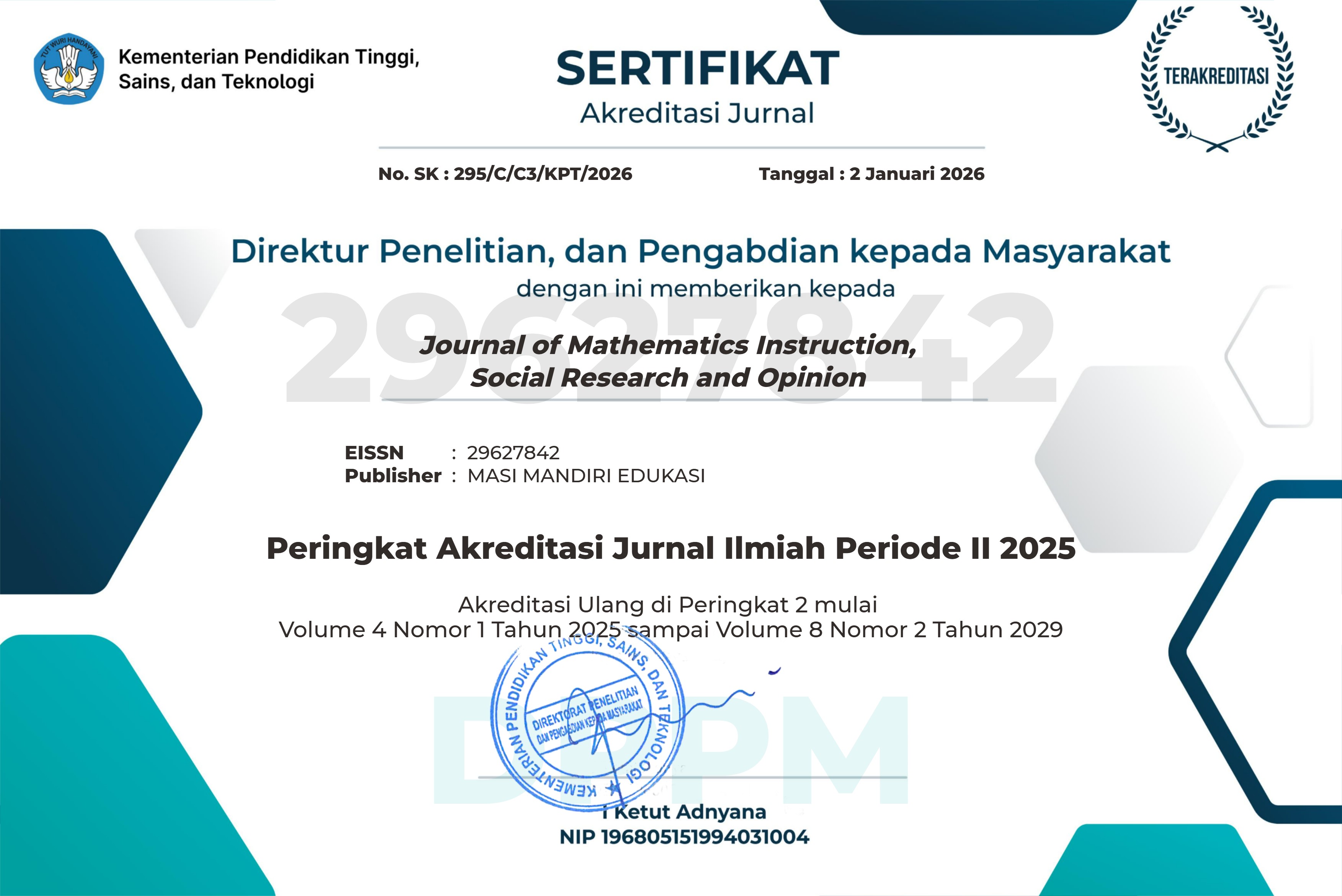
| Accreditation Certificate |
  |
| Indexing |






Contact Us

visitor
| Information |
>> For Authors
>> For Readers
>> For Librarians
| Visitor Statistics |
| Member of |


| Announcement |

| Keywords |
Mathematics Learning Difficulty Dyscalculia Teacher perceptions personality ICT Learning Computer teaching Academic Fisherfolks Economic Behavior Probit Models matrix mathematical model Concepts Guided Note Taking Golden Ratio Philosophy Integrated Learning van Hiele geometry Assessment Learning Outcomes method skills Problem Solving Experiment
| License |

MISRO is licensed under a Creative Commons Attribution-ShareAlike 4.0 International License.
| Publisher |

Address:
Jl. Gagak N0.105, Bandung,
Indonesia 40133
E-mail:
journalmisro@gmail.com
| in collaboration with |

| Recommended Tools |


| ISSN Barcode |

