
Analysis of Flood Management Effectiveness Through the Implementation of Drainage Revitalization Policies: A Systematic Literature Review
DOI:
https://doi.org/10.58421/misro.v5i3.1826Keywords:
Policy Implementation, Drainage Revitalization, Flood Management Effectiveness, Systematic Literature Review, PRISMA, Edwards III ModelAbstract
Urban flooding has become increasingly frequent due to rapid urbanization, climate change, and the limited capacity of drainage infrastructure, prompting growing scholarly attention to the effectiveness of drainage revitalization policies across countries. However, the literature examining the relationship between policy implementation and flood management effectiveness remains fragmented across different disciplines and methodological approaches, and has not yet been systematically synthesized. This study aims to identify, evaluate, and synthesize scientific literature on the effectiveness of flood management through the implementation of drainage revitalization policies, using a Systematic Literature Review (SLR) approach based on the PRISMA 2020 framework. Literature searches were conducted in Google Scholar, ScienceDirect, MDPI, and Scopus databases using the keywords policy implementation, drainage revitalization, flood management effectiveness, and flood management policy implementation, resulting in 41 relevant articles selected from an initial pool of 312 studies after undergoing the stages of identification, screening, eligibility assessment, and inclusion. The synthesis identified four major themes influencing flood management effectiveness through drainage revitalization: governance and institutional coordination; technical and infrastructural capacity; community participation and social adaptation; and approaches based on natural processes and geomorphology. The findings indicate that the success of drainage policies is consistently determined by the quality of implementation, particularly communication, resources, implementers' disposition, and bureaucratic structure, as proposed by Edwards III (1980), rather than solely by the scale of investment in physical infrastructure. This study concludes that flood management effectiveness results from a multidimensional interaction among policy quality, infrastructure performance, and institutional capacity. Therefore, future evaluations of drainage policies should integrate these three dimensions simultaneously to achieve more effective and sustainable urban flood management.
Downloads
References
Intergovernmental Panel on Climate Change (IPCC). (2023). Climate Change 2023: Synthesis Report. Geneva, Switzerland: IPCC.
Luo, P., et al. (2021). Urban flood management under climate change. Sustainable Cities and Society.
Huang, J., et al. (2022). Urbanization impacts on flood risks. Science of the Total Environment.
Wang, Y., et al. (2024). Climate adaptation for urban drainage systems. Journal of Hydrology.
Drainage System Optimization as an Effective Flood Management Strategy in Urban Regions: A Systematic Review Utilizing PRISMA. (2025). Sustainability (STPP) Theory, Practice and Policy, 5(2), 95–104. https://doi.org/10.30631/sdgs.52.3771
Edwards III, G. C. (1980). Implementing Public Policy. Washington, DC: Congressional Quarterly Press.
Faktor Penyebab Banjir dan Kebijakan Tata Ruang Kota Makassar. (2021). Jurnal Pendidikan Kewarganegaraan. Yogyakarta: Universitas PGRI Yogyakarta.
Masrura, D., Rahmawati, Hasdanita, F., & Fahmi, N. Y. (2025). Revitalisasi sistem drainase perkotaan dalam upaya keberlanjutan sosial ekonomi daerah pesisir melalui implementasi eco-drainase. VOCATECH: Vocational Education and Technology Journal, 7(2), 34–48.
Page, M. J., McKenzie, J. E., Bossuyt, P. M., Boutron, I., Hoffmann, T. C., Mulrow, C. D., et al. (2021). The PRISMA 2020 statement: An updated guideline for reporting systematic reviews. BMJ, 372, n71. https://doi.org/10.1136/bmj.n71
Pemberdayaan Masyarakat dalam Pengelolaan Drainase sebagai Strategi Mitigasi Banjir. (2023). Jurnal Abdimas Humanis dan Edukasi (JAHE).
Pengendalian Banjir di Kawasan Sempadan Sungai Kali Lamong Kabupaten Gresik Melalui Pembangunan Tanggul. (2024). JPAP: Jurnal Penelitian Administrasi Publik. Surabaya: Universitas 17 Agustus 1945 Surabaya.
Pressman, J. L., & Wildavsky, A. (1973). Implementation. Berkeley, CA: University of California Press.
Revolutionizing Urban Water Resilience: Innovative Strategies and Advancements in Sustainable Urban Drainage Systems (SuDS). (2025). ScienceDirect.
Thomas, J., & Harden, A. (2008). Methods for the thematic synthesis of qualitative research in systematic reviews. BMC Medical Research Methodology, 8(1), 45. https://doi.org/10.1186/1471-2288-8-45
A Review Study on Community-Based Flood Adaptation in Informal Settlements in the Global South. (2025). Discover Sustainability. Springer Nature.
Abebe, Y., et al. (2021). Urban flood vulnerability assessment. Natural Hazards.
Ahmad, M., et al. (2023). Governance challenges in urban flood management. Environmental Science and Policy.
Kementerian Pekerjaan Umum dan Perumahan Rakyat. (2023). Strategi Ketahanan Banjir Perkotaan Indonesia. Jakarta: Kementerian PUPR.
Rahman, A., et al. (2022). Drainage revitalization and flood resilience. International Journal of Disaster Risk Reduction.
Zhang, X., et al. (2024). Urban drainage infrastructure performance. Water Resources Management.
Wicaksono, D., et al. (2022). Tata kelola pengendalian banjir perkotaan di Indonesia. Jurnal Wilayah dan Lingkungan.
Nugroho, S., & Hadi, S. (2024). Implementasi kebijakan drainase berkelanjutan. Jurnal Administrasi Publik.
Prasetyo, A., et al. (2023). Implementasi kebijakan pengendalian banjir di Kali Lamong. Jurnal Kebijakan Publik.
Setiawan, R., et al. (2022). Koordinasi kelembagaan dalam pengelolaan banjir perkotaan. Jurnal Perencanaan Wilayah.
Nguyen, T., et al. (2023). Smart drainage systems for resilient cities. Urban Water Journal.
Li, H., et al. (2024). Nature-based solutions for urban flood mitigation. Environmental Research.
Downloads
Additional Files
Published
How to Cite
Issue
Section
License
Copyright (c) 2026 Journal of Mathematics Instruction, Social Research and Opinion

This work is licensed under a Creative Commons Attribution-ShareAlike 4.0 International License.
SideBar
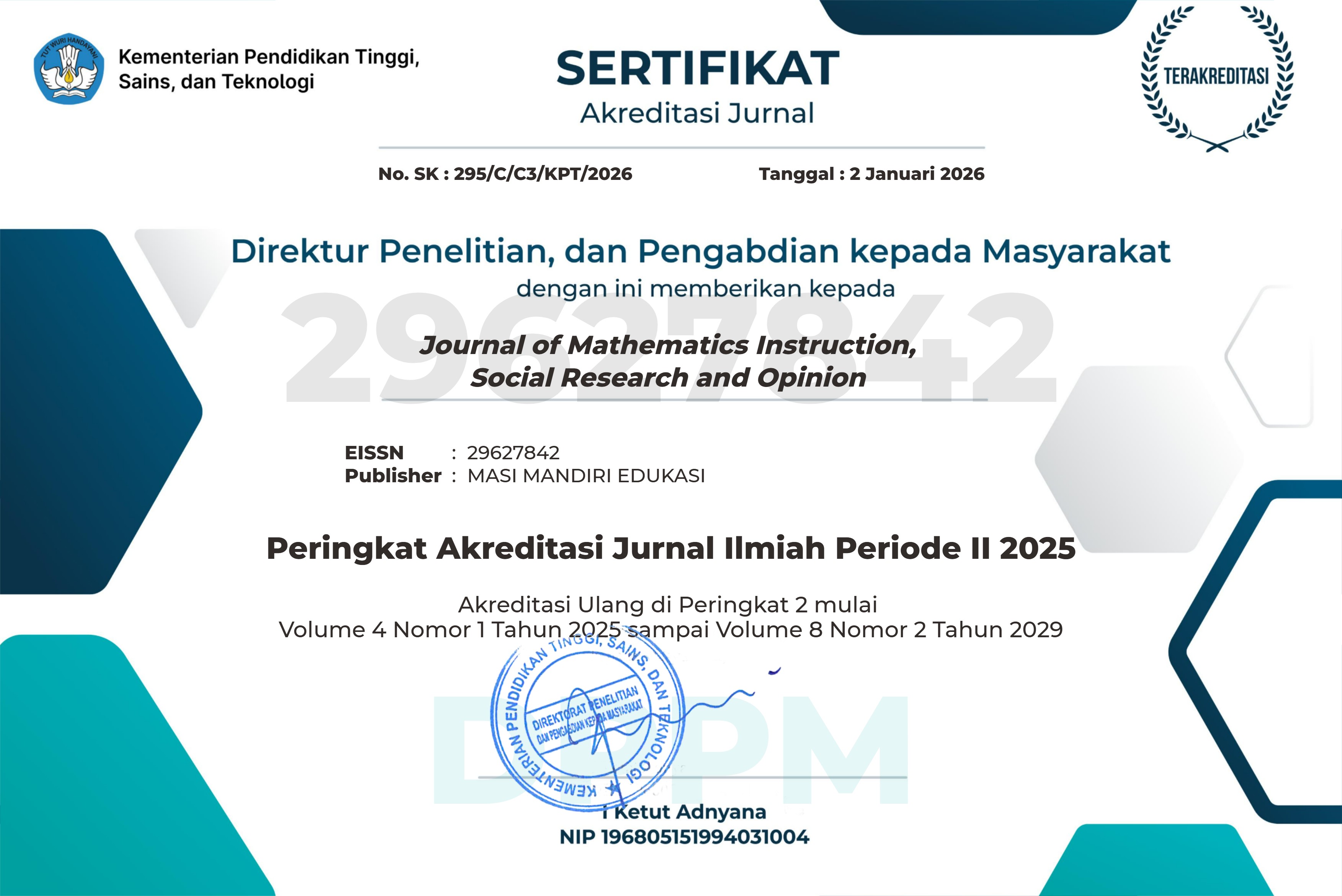
| Accreditation Certificate |
  |
| Indexing |






Contact Us

visitor
| Information |
>> For Authors
>> For Readers
>> For Librarians
| Visitor Statistics |
| Member of |


| Announcement |

| Keywords |
Mathematics Learning Difficulty Dyscalculia Teacher perceptions personality ICT Learning Computer teaching Academic Fisherfolks Economic Behavior Probit Models matrix mathematical model Concepts Guided Note Taking Golden Ratio Philosophy Integrated Learning van Hiele geometry Assessment Learning Outcomes method skills Problem Solving Experiment
| License |

MISRO is licensed under a Creative Commons Attribution-ShareAlike 4.0 International License.
| Publisher |

Address:
Jl. Gagak N0.105, Bandung,
Indonesia 40133
E-mail:
journalmisro@gmail.com
| in collaboration with |

| Recommended Tools |


| ISSN Barcode |

