
The Influence of Organizational Work-Life Support and Work Environment on Turnover Intention with Work-Life Conflict as an Intervening Variable (A Study on Generation Z Employees at the Sisumut Plantation of PT Perkebunan Nusantara IV Regional 1 North Sumatra)
DOI:
https://doi.org/10.58421/misro.v5i3.1776Keywords:
Organizational Work–Life Support, Turnover Intention., Work – Life Conflict, Work EnvironmentAbstract
Background: Generation Z comprises individuals born between 1995 and 2012. This generation possesses distinctive characteristics that set them apart from previous generations in the workforce. These differing characteristics make Gen Z employees more likely to leave their workplace if it does not meet their expectations. This study aims to analyze the role of Organizational Work–Life Support and Work Environment on Turnover Intention through Work–Life Conflict. Methods: The data analysis method used is SEM-PLS with a Second-Order Construct. Data were collected through questionnaires distributed to 128 Gen Z employees at Kebun Sisumut PT Perkebunan Nusantara IV Regional 1 Sumatera Utara. Results: Organizational Work–Life Support and Work Environment significantly affect Turnover Intention. Furthermore, Work –Life Conflict also influences Turnover Intention, and both Organizational Work–Life Support and Work Environment affect Turnover Intention through Work–Life Conflict. The findings of this study provide insights for companies on the importance of supporting the balance between work and personal life, as well as creating a work environment that aligns with the characteristics of Gen Z employees. Conclusion: These findings are expected to help organizations minimize role conflict and reduce turnover intention among Gen Z employees.
Downloads
References
N. A. A. Abdelwahed, M. A. Al Doghan, U. N. Saraih, and B. A. Soomro, “Forecasting turnover intention: An analysis of psychological factors and perceived organizational support among healthcare professionals,” International Journal of Human Rights in Healthcare, vol. 17, no. 5, pp. 645–661, 2024, doi: 10.1108/IJHRH-06-2023-0043.
A. H. Abdou, A. A. F. Khalil, H. M. E. Mahmoud, M. A. Elsaied, and A. A. Elsaed, “The impact of hospitality work environment on employees’ turnover intentions during COVID-19 pandemic: The mediating role of work-family conflict,” Frontiers in Psychology, vol. 13, p. 890418, 2022, doi: 10.3389/fpsyg.2022.890418.
M. Z. Amarta, “Pengaruh gaya kepemimpinan, stres kerja, lingkungan kerja, kepuasan kerja, dan work-life balance terhadap turnover intention di Rumah Sakit Ananda Purwokerto,” vol. 9, no. 10, 2024.
I. Asriani and S. Riyanto, “The impact of working environment, compensation, and job satisfaction on turnover intention in public service agency,” 2020.
H. Aulia, P. Pristiyono, R. Syahputra, Z. Zuriani, and D. Hasibuan, “Analisis lingkungan kerja dan job insecurity terhadap turnover intention dengan work life balance sebagai variabel moderating pada PT. Kereta Api Indonesia Stasiun Besar Rantauprapat,” Jurnal Valuasi: Jurnal Ilmiah Ilmu Manajemen dan Kewirausahaan, vol. 1, no. 2, pp. 323–339, 2021, doi: 10.46306/vls.v1i2.23.
P. Bhende, N. Mekoth, V. Ingalhalli, and Y. V. Reddy, “Quality of work life and work–life balance,” Journal of Human Values, vol. 26, no. 3, pp. 256–265, 2020, doi: 10.1177/0971685820939380.
E. Botezat, S. Fotea, and I. Fotea, “Investigating the relationship between workplace expectations and turnover intention mindset among Romanian students as representatives of Generation Z,” Journal of East European Management Studies, vol. 28, no. 4, pp. 630–663, 2023, doi: 10.5771/0949-6181-2023-4-630.
L. N. De Silva and K. A. S. Dhammika, “The impact of expectations on turnover intention among Generation Z employees in the financial sector in Sri Lanka,” Journal of Management, Social Sciences and Humanities, vol. 3, no. 1, pp. 55–82, 2022, doi: 10.4038/jmsh.v3i1.3.
P. Gupta and S. Srivastava, “Work–life conflict and burnout among working women: A mediated moderated model of support and resilience,” International Journal of Organizational Analysis, vol. 29, no. 3, pp. 629–655, 2021, doi: 10.1108/IJOA-12-2019-1993.
J. F. Hair, G. T. M. Hult, C. M. Ringle, M. Sarstedt, N. P. Danks, and S. Ray, Partial Least Squares Structural Equation Modeling (PLS-SEM) Using R: A Workbook. Cham, Switzerland: Springer International Publishing, 2021, doi: 10.1007/978-3-030-80519-7.
J. F. Hair, G. T. Hult, C. M. Ringle, and M. Sarstedt, A Primer on Partial Least Squares Structural Equation Modeling (PLS-SEM), 3rd ed. Thousand Oaks, CA, USA: SAGE Publications, 2022.
M. Irfan, R. A. Khalid, S. S. U. H. Kaka Khel, A. Maqsoom, and I. K. Sherani, “Impact of work–life balance with the role of organizational support and job burnout on project performance,” Engineering, Construction and Architectural Management, vol. 30, no. 1, pp. 154–171, 2023, doi: 10.1108/ECAM-04-2021-0316.
S. Jiang and J. Li, “Impact of person-environment fit on construction project managers’ turnover intention: A moderated mediation model,” Engineering, Construction and Architectural Management, 2023, doi: 10.1108/ECAM-04-2023-0384.
E. Julianti, S. Wahyulina, D. Suprayetno, and A. S. Fauzi, “Pengaruh job insecurity dan work-life balance terhadap turnover intention pada karyawan ritel modern Generasi Z di Kabupaten Lombok Tengah,” Indonesian Research Journal on Education, vol. 4, no. 4, pp. 167–174, 2024, doi: 10.31004/irje.v4i4.1002.
A. Kalev and F. Dobbin, “The surprising benefits of work/life support,” Harvard Business Review, 2022.
Y. Kim and S. Cho, “Socioeconomic status, work-life conflict, and mental health,” American Journal of Industrial Medicine, 2020, doi: 10.1002/ajim.23118.
K. M. Lawson, S. Lee, C. Smith, and K. C. Thiem, “Retaining U.S. STEM women faculty during the COVID-19 pandemic: The important role of family-supportive supervisor behaviors to lower work-to-life conflict,” Gender in Management: An International Journal, vol. 39, no. 1, pp. 52–70, 2024, doi: 10.1108/GM-10-2022-0326.
H. Ludiya, “Pengaruh work life policies, work life conflict, job stress, dan loneliness terhadap turnover intentions pada sebuah universitas swasta di Kota Batam,” Jurnal Manajemen dan Pemasaran Jasa, vol. 9, no. 2, pp. 299–322, 2018, doi: 10.25105/jmpj.v9i2.2233.
N. A. Marzuqi, “Pengaruh job insecurity, job satisfaction dan lingkungan kerja terhadap turnover intention karyawan,” Jurnal Ilmu Manajemen, vol. 9, no. 4, pp. 1393–1405, 2021, doi: 10.26740/jim.v9n4.p1393-1405.
W. H. Mobley, “Intermediate linkages in the relationship between job satisfaction and employee turnover,” Journal of Applied Psychology, vol. 62, no. 2, 1997, doi: 10.1037/0021-9010.62.2.237.
M. Pittman, S. (Sean) Jung, and S. E. Gordon, “Which came first, work-personal conflict or work environment? Extending the generational debate on cohort differences in turnover intention,” International Journal of Contemporary Hospitality Management, vol. 36, no. 10, pp. 3283–3299, 2024, doi: 10.1108/IJCHM-06-2023-0827.
H. R. D. Putranti, Turnover Intention. CV Eureka Media Aksara, 2022.
E. Rahmansyah and D. Indiyati, “The influence of workload and work environment on the turnover intention of employees in PT. XYZ,” 2024.
A. Shakoor, S. Haider, M. H. Akhtar, and M. A. Asadullah, “Moderated mediation between work–life conflict and employee turnover intentions: The role of job dissatisfaction and workplace social support,” International Journal of Organizational Analysis, vol. 31, no. 4, pp. 1037–1060, 2023, doi: 10.1108/IJOA-06-2021-2807.
K. O. Siddiqi, M. H. Rahman, and M. A. Esquivas, “The effect of perceived organizational and supervisor support on nurses’ turnover intention in Bangladesh: Does work-family conflict play a role?” Social Sciences & Humanities Open, vol. 10, 2024.
H. Sihotang and P. Sitompul, “Pengaruh employer branding dan work life balance terhadap turnover intention pada Generasi Z di Kota Medan: Job satisfaction sebagai variabel intervening,” vol. 24, 2024.
A. K. M. M. H. Talukder, “Supervisor support and organizational commitment: The role of work–family conflict, job satisfaction, and work–life balance,” Journal of Employment Counseling, vol. 56, no. 3, pp. 98–116, 2019, doi: 10.1002/joec.12125.
M. Valcour, A. Ollier-Malaterre, C. Matz-Costa, M. Pitt-Catsouphes, and M. Brown, “Influences on employee perceptions of organizational work–life support: Signals and resources,” Journal of Vocational Behavior, vol. 79, no. 2, pp. 588–595, 2011, doi: 10.1016/j.jvb.2011.02.002.
Y. Zhang, W. Xu, S. Yoon, W. Chen, and S. Parmenter, “Workplace support, job autonomy, and turnover intention among child welfare workers in China: The mediating role of job satisfaction,” Child Protection and Practice, vol. 2, p. 100027, 2024, doi: 10.1016/j.chipro.2024.100027.
Downloads
Additional Files
Published
How to Cite
Issue
Section
License
Copyright (c) 2026 Journal of Mathematics Instruction, Social Research and Opinion

This work is licensed under a Creative Commons Attribution-ShareAlike 4.0 International License.
SideBar
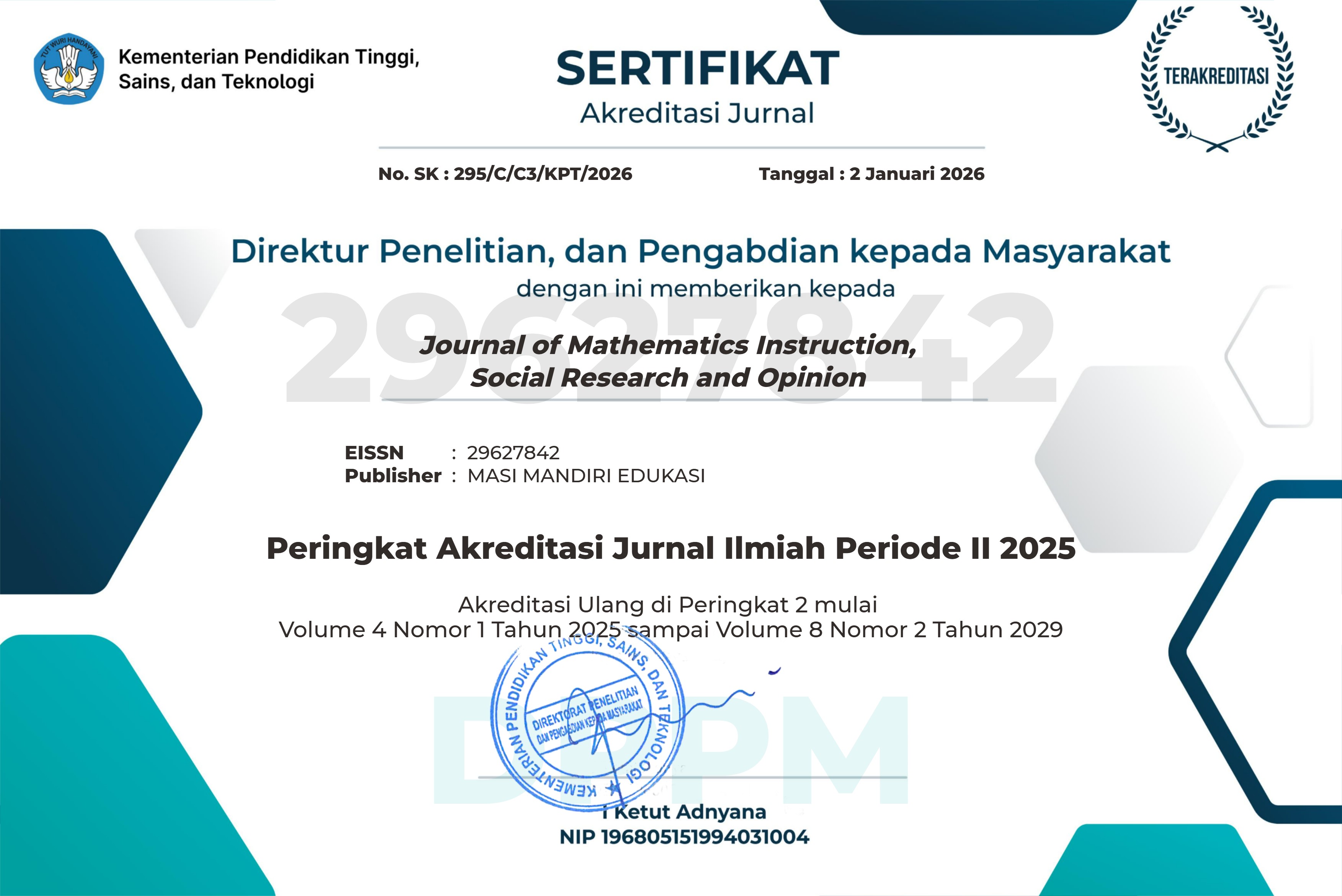
| Accreditation Certificate |
  |
| Indexing |






Contact Us

visitor
| Information |
>> For Authors
>> For Readers
>> For Librarians
| Visitor Statistics |
| Member of |


| Announcement |

| Keywords |
Mathematics Learning Difficulty Dyscalculia Teacher perceptions personality ICT Learning Computer teaching Academic Fisherfolks Economic Behavior Probit Models matrix mathematical model Concepts Guided Note Taking Golden Ratio Philosophy Integrated Learning van Hiele geometry Assessment Learning Outcomes method skills Problem Solving Experiment
| License |

MISRO is licensed under a Creative Commons Attribution-ShareAlike 4.0 International License.
| Publisher |

Address:
Jl. Gagak N0.105, Bandung,
Indonesia 40133
E-mail:
journalmisro@gmail.com
| in collaboration with |

| Recommended Tools |


| ISSN Barcode |

