
Assessing Mathematics Pre-Service Teachers’ Content Knowledge and Pedagogical Content Knowledge through a Diagnostic Computer-Based Test
DOI:
https://doi.org/10.58421/misro.v5i3.1770Keywords:
Professional Knowledge, Content Knowledge, Pedagogical Content Knowledge, Computer-Based Test, Diagnostic assessment, Mathematics Pre-Service TeachersAbstract
Content Knowledge (CK) and Pedagogical Content Knowledge (PCK) are core components of mathematics teachers’ competence, yet they are rarely measured simultaneously through technology-based diagnostic assessment. This study measures and profiles the CK and PCK of mathematics pre-service teachers using a diagnostic Computer-Based Test (CBT). A quantitative descriptive-correlational design was applied to 30 purposively selected pre-service teachers. Each construct was measured with 25 multiple-choice items whose content validity was established by expert judgment and whose reliability was confirmed before use (KR-20 = 0.81 for CK; 0.79 for PCK). Data were analyzed with descriptive statistics, Pearson correlation, and simple linear regression after assumption checks. Mean CK (50.00%) and PCK (52.67%) were both below the 75% mastery threshold, with 60% of students in the low category; specialized content knowledge and knowledge of content and curriculum were the weakest dimensions. CK and PCK correlated strongly and positively (r = 0.72; p < 0.001), with CK accounting for about 52% of the variance in PCK as a predictive, non-causal association. The CBT generated actionable diagnostic profiles at the dimension and indicator levels. These findings support using diagnostic CBT to guide data-driven curriculum reform integrating content mastery and pedagogical capacity.
Downloads
References
X. Yang and G. Kaiser, “The impact of mathematics teachers’ professional competence on instructional quality and students’ mathematics learning outcomes,” Curr. Opin. Behav. Sci., vol. 48, p. 101225, Dec. 2022, doi: 10.1016/j.cobeha.2022.101225.
S. Krauss et al., “Pedagogical content knowledge and content knowledge of secondary mathematics teachers,” J. Educ. Psychol., vol. 100, no. 3, pp. 716–725, Aug. 2008, doi: 10.1037/0022-0663.100.3.716.
OECD, PISA 2022 Results (Volume I): The State of Learning and Equity in Education. In PISA. OECD Publishing, 2023. doi: 10.1787/53f23881-en.
International Association for the Evaluation of Educational Achievement, Policy, practice, and readiness to teach primary and secondary mathematics in 17 countries: findings from the IEA Teacher Education and Development Study in Mathematics (TEDS-M). Amsterdam: IEA, 2012.
H. Qian and P. Youngs, “The effect of teacher education programs on future elementary mathematics teachers’ knowledge: a five-country analysis using TEDS-M data,” J. Math. Teach. Educ., vol. 19, no. 4, pp. 371–396, Aug. 2016, doi: 10.1007/s10857-014-9297-0.
D. Loewenberg Ball, M. H. Thames, and G. Phelps, “Content Knowledge for Teaching: What Makes It Special?,” J. Teach. Educ., vol. 59, no. 5, pp. 389–407, Nov. 2008, doi: 10.1177/0022487108324554.
L. S. Shulman, “Those Who Understand: Knowledge Growth in Teaching,” Educ. Res., vol. 15, no. 2, pp. 4–14, Feb. 1986, doi: 10.3102/0013189X015002004.
M. Grigaliūnienė, E. Lehtinen, L. Verschaffel, and F. Depaepe, “Systematic Review of Research on Pedagogical Content Knowledge in Mathematics: Insights from a Topic-Specific Approach,” ZDM – Math. Educ., vol. 57, no. 4, pp. 777–794, Aug. 2025, doi: 10.1007/s11858-025-01684-1.
F. Depaepe, L. Verschaffel, and G. Kelchtermans, “Pedagogical content knowledge: A systematic review of the way in which the concept has pervaded mathematics educational research,” Teach. Teach. Educ., vol. 34, pp. 12–25, Aug. 2013, doi: 10.1016/j.tate.2013.03.001.
S. Y. Ningsih, Turmudi, and D. Juandi, “Pedagogical content knowledge (PCK) profile of prospective teachers in mathematics learning,” J. Phys. Conf. Ser., vol. 1521, no. 3, p. 032057, Apr. 2020, doi: 10.1088/1742-6596/1521/3/032057.
S. Fiangga, S. Khabibah, S. M. Amin, and R. Ekawati, “A Learning Design Analysis of the Pre-service Teachers’ Mathematics Pedagogical Content Knowledge,” J. Phys. Conf. Ser., vol. 1899, no. 1, p. 012153, May 2021, doi: 10.1088/1742-6596/1899/1/012153.
X. Yang, B. Schwarz, and I. K. C. Leung, “Pre-service mathematics teachers’ professional modeling competencies: a comparative study between Germany, Mainland China, and Hong Kong,” Educ. Stud. Math., vol. 109, no. 2, pp. 409–429, Feb. 2022, doi: 10.1007/s10649-021-10064-x.
J. Njiku, “Pre-service teachers manifested mathematics pedagogical content knowledge: The role of the teaching practicum,” Pedagog. Res., vol. 10, no. 1, p. em0229, Jan. 2025, doi: 10.29333/pr/15647.
A. J. Boevé, R. R. Meijer, C. J. Albers, Y. Beetsma, and R. J. Bosker, “Introducing Computer-Based Testing in High-Stakes Exams in Higher Education: Results of a Field Experiment,” PLOS ONE, vol. 10, no. 12, p. e0143616, Dec. 2015, doi: 10.1371/journal.pone.0143616.
C. Y. Piaw, “Replacing Paper-based Testing with Computer-based Testing in Assessment: Are we Doing Wrong?,” Procedia - Soc. Behav. Sci., vol. 64, pp. 655–664, Nov. 2012, doi: 10.1016/j.sbspro.2012.11.077.
A. Berry, P. Friedrichsen, and J. Loughran, Eds., Re-examining pedagogical content knowledge in science education. In teaching and learning in science series. London, New York: Routledge, 2015. doi: 10.4324/9781315735665.
M. Schmid, E. Brianza, and D. Petko, “Self-reported technological pedagogical content knowledge (TPACK) of pre-service teachers in relation to digital technology use in lesson plans,” Comput. Hum. Behav., vol. 115, p. 106586, Feb. 2021, doi: 10.1016/j.chb.2020.106586.
L. Maas, M. J. S. Brinkhuis, L. Kester, and L. Wijngaards-de Meij, “Cognitive Diagnostic Assessment in University Statistics Education: Valid and Reliable Skill Measurement for Actionable Feedback Using Learning Dashboards,” Appl. Sci., vol. 12, no. 10, p. 4809, May 2022, doi: 10.3390/app12104809.
A. Barana, M. Marchisio, and M. Sacchet, “Interactive Feedback for Learning Mathematics in a Digital Learning Environment,” Educ. Sci., vol. 11, no. 6, p. 279, Jun. 2021, doi: 10.3390/educsci11060279.
S. Rezat, “How automated feedback from a digital mathematics textbook affects primary students’ conceptual development: two case studies,” ZDM – Math. Educ., vol. 53, no. 6, pp. 1433–1445, Nov. 2021, doi: 10.1007/s11858-021-01263-0.
L. N. Yaqin, L. D. Prasojo, N. A. Haji-Othman, N. Yusof, and A. Habibi, “Addressing the Digital Divide in Indonesian Higher Education: Insights, Implications, and Potential Solutions,” in From Digital Divide to Digital Inclusion, Ł. Tomczyk, F. D. Guillén-Gámez, J. Ruiz-Palmero, and A. Habibi, Eds., in Lecture Notes in Educational Technology. Singapore: Springer Nature Singapore, 2023, pp. 291–307. doi: 10.1007/978-981-99-7645-4_13.
Naila Rajiha and S. Rini, “Computer-Based Standardized Testing (CBT) Summative Assessment: One Institution Experience,” JISAE J. Indones. Stud. Assess. Eval., vol. 9, no. 1, pp. 1–7, Jan. 2023, doi: 10.21009/jisae.v9i1.33233.
G. Kaiser and J. König, “Competence Measurement in (Mathematics) Teacher Education and Beyond: Implications for Policy,” High. Educ. Policy, vol. 32, no. 4, pp. 597–615, Dec. 2019, doi: 10.1057/s41307-019-00139-z.
T. Kleickmann et al., “Teachers’ Content Knowledge and Pedagogical Content Knowledge: The Role of Structural Differences in Teacher Education,” J. Teach. Educ., vol. 64, no. 1, pp. 90–106, Jan. 2013, doi: 10.1177/0022487112460398.
J. Baumert and M. Kunter, “The COACTIV Model of Teachers’ Professional Competence,” in Cognitive Activation in the Mathematics Classroom and Professional Competence of Teachers, M. Kunter, J. Baumert, W. Blum, U. Klusmann, S. Krauss, and M. Neubrand, Eds., Boston, MA: Springer US, 2013, pp. 25–48. doi: 10.1007/978-1-4614-5149-5_2.
B. Rowan, R. Correnti, and R. J. Miller, “What Large-Scale, Survey Research Tells Us about Teacher Effects on Student Achievement: Insights from the Prospects Study of Elementary Schools,” Teach. Coll. Rec. Voice Scholarsh. Educ., vol. 104, no. 8, pp. 1525–1567, Aug. 2002, doi: 10.1111/1467-9620.00212.
S. Blömeke, J.-E. Gustafsson, and R. J. Shavelson, “Beyond Dichotomies: Competence Viewed as a Continuum,” Z. Für Psychol., vol. 223, no. 1, pp. 3–13, Jan. 2015, doi: 10.1027/2151-2604/a000194.
E. Mohammadpour and Y. Maroofi, “A performance-based test to measure teachers’ mathematics and science content and pedagogical knowledge,” Heliyon, vol. 9, no. 3, p. e13932, Mar. 2023, doi: 10.1016/j.heliyon.2023.e13932.
T. Clark and H. Endres, “Computer-based diagnostic assessment of high school students’ grammar skills with automated feedback – an international trial,” Assess. Educ. Princ. Policy Pract., vol. 28, no. 5–6, pp. 602–632, Nov. 2021, doi: 10.1080/0969594X.2021.1970513.
G. A. Nortvedt and N. Buchholtz, “Assessment in mathematics education: responding to issues regarding methodology, policy, and equity,” ZDM, vol. 50, no. 4, pp. 555–570, Aug. 2018, doi: 10.1007/s11858-018-0963-z.
Downloads
Additional Files
Published
How to Cite
Issue
Section
License
Copyright (c) 2026 Journal of Mathematics Instruction, Social Research and Opinion

This work is licensed under a Creative Commons Attribution-ShareAlike 4.0 International License.
SideBar
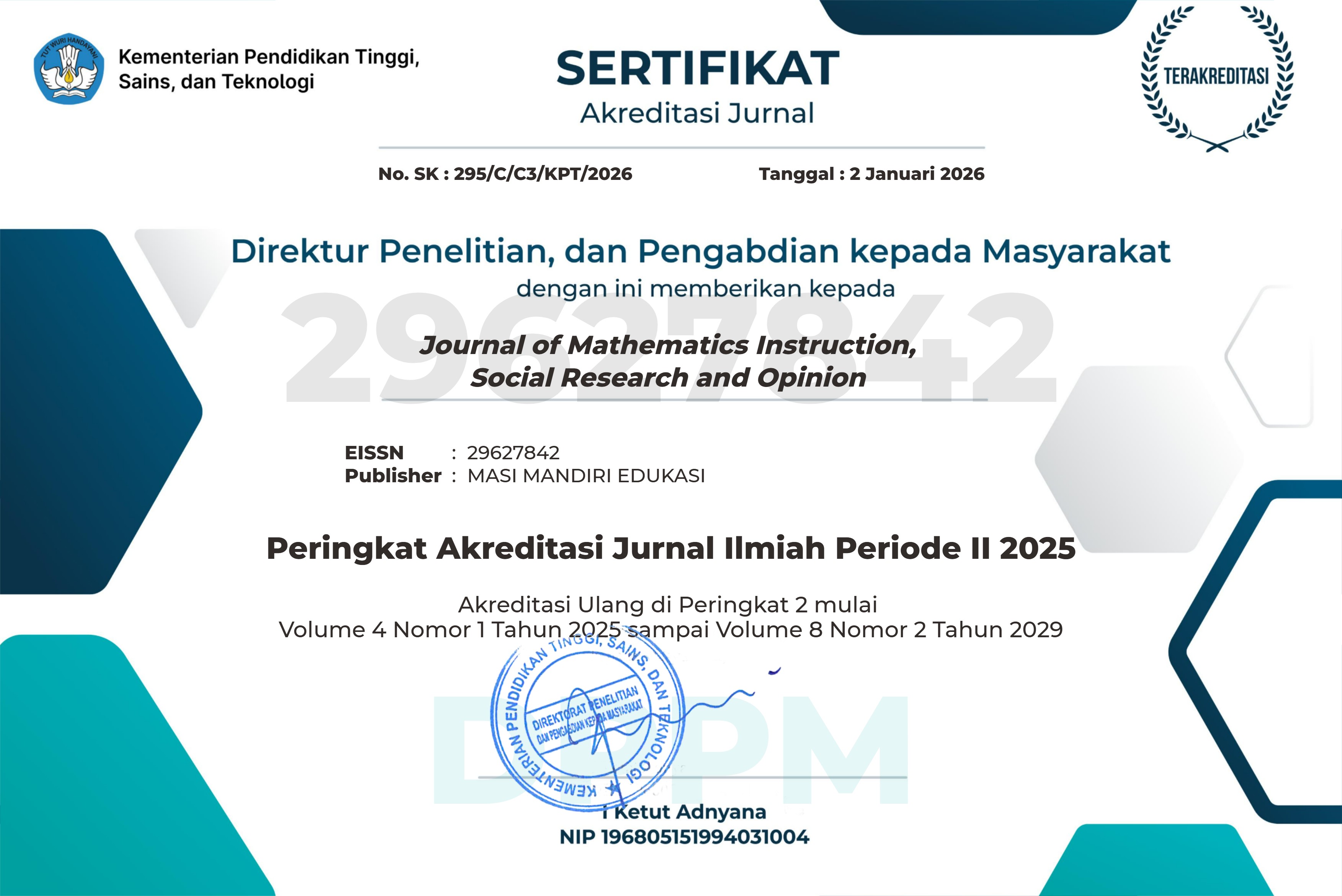
| Accreditation Certificate |
  |
| Indexing |






Contact Us

visitor
| Information |
>> For Authors
>> For Readers
>> For Librarians
| Visitor Statistics |
| Member of |

| Announcement |

| Keywords |
Mathematics Learning Difficulty Dyscalculia Teacher perceptions personality ICT Learning Computer teaching Academic Fisherfolks Economic Behavior Probit Models matrix mathematical model Concepts Guided Note Taking Golden Ratio Philosophy Integrated Learning van Hiele geometry Assessment Learning Outcomes method skills Problem Solving Experiment
| License |

MISRO is licensed under a Creative Commons Attribution-ShareAlike 4.0 International License.
| Publisher |

Address:
Jl. Gagak N0.105, Bandung,
Indonesia 40133
E-mail:
journalmisro@gmail.com
| in collaboration with |

| Recommended Tools |


| ISSN Barcode |

