
The Roles of Regulatory Pressure, Organisational Support, and Data Quality in AI Capability Development for Fraud Reduction in Financial Institutions
DOI:
https://doi.org/10.58421/misro.v5i3.1693Keywords:
AI Capability, Artificial Intelligence, Fraud Reduction, Regulatory Pressure, TOE FrameworkAbstract
The rapid expansion of digital financial services in Indonesia has increased fraud risks and intensified demands for technological transformation. Although artificial intelligence (AI) is increasingly applied in fraud detection, the process through which governance conditions contribute to fraud reduction remains insufficiently understood. This study examines the development of AI capabilities within Indonesian financial institutions by integrating the Technology–Organization–Environment (TOE) framework and the Information Systems Success Model. AI capability development is conceptualized through three stages: AI Integration, AI Assimilation, and AI Effectiveness. Survey data were analyzed using Partial Least Squares Structural Equation Modeling (PLS-SEM). The findings show that regulatory pressure does not directly improve fraud reduction outcomes. Instead, regulatory and organizational conditions support Data Quality, facilitating AI Integration and strengthening subsequent AI capability development. Fraud reduction is achieved only when AI systems reach operational effectiveness. The results suggest that fraud reduction represents an outcome of organizational capability development rather than a direct consequence of regulatory pressure or technological implementation alone.
Downloads
References
F. Xu, Y. Kasperskaya, and M. Sagarra, “The impact of FinTech on bank performance: A systematic literature review,” Digital Business, vol. 5, no. 2, p. 100131, Dec. 2025, doi: 10.1016/j.digbus.2025.100131.
M. Barroso and J. Laborda, “Digital transformation and the emergence of the Fintech sector: Systematic literature review,” Digital Business, vol. 2, no. 2, p. 100028, 2022, doi: 10.1016/j.digbus.2022.100028.
M. Xu, J. M. David, and S. H. Kim, “The Fourth Industrial Revolution: Opportunities and Challenges,” International Journal of Financial Research, vol. 9, no. 2, p. 90, Feb. 2018, doi: 10.5430/ijfr.v9n2p90.
. Mani, A. S., D. V., and D. R., “Financial Fraud Detection in Transactions Using AI,” in Proceedings of the 1st International Conference on Research and Development in Information, Communication, and Computing Technologies, SCITEPRESS - Science and Technology Publications, 2025, pp. 515–521. doi: 10.5220/0013868500004919.
C. Aldemir and T. Uçma Uysal, “Artificial Intelligence for Financial Accountability and Governance in the Public Sector: Strategic Opportunities and Challenges,” Adm. Sci., vol. 15, no. 2, p. 58, Feb. 2025, doi: 10.3390/admsci15020058.
P. Mikalef and M. Gupta, “Artificial intelligence capability: Conceptualization, measurement calibration, and empirical study on its impact on organizational creativity and firm performance,” Information & Management, vol. 58, no. 3, p. 103434, Apr. 2021, doi: 10.1016/j.im.2021.103434.
A. Rai, S. S. Lang, and R. B. Welker, “Assessing the Validity of IS Success Models: An Empirical Test and Theoretical Analysis,” Information Systems Research, vol. 13, no. 1, pp. 50–69, Mar. 2002, doi: 10.1287/isre.13.1.50.96.
K. Zhu, K. L. Kraemer, and S. Xu, “The Process of Innovation Assimilation by Firms in Different Countries: A Technology Diffusion Perspective on E-Business,” Manage. Sci., vol. 52, no. 10, pp. 1557–1576, Oct. 2006, doi: 10.1287/mnsc.1050.0487.
S. Maycotte, A. Alvarez-Risco, E. Garcia-Valenzuela, and M. Kuljis, “Digital capabilities in emerging market firms: Construct development, scale validation, and implications for SMEs,” Journal of Open Innovation: Technology, Market, and Complexity, vol. 11, no. 2, p. 100513, Jun. 2025, doi: 10.1016/j.joitmc.2025.100513.
U. S. D. of C. The International Trade Administration, “Indonesia Digital Economy,” Nov. 2025.
K. Naseer and H. N. Ahmed, “Effectiveness and Reliability of Artificial Intelligence in Fraud Detection: A Mixed-Method Study on Financial Audit,” Journal of Management and Informatics, vol. 4, no. 1, pp. 706–722, Apr. 2025, doi: 10.51903/jmi.v4i1.168.
A. Batool, D. Zowghi, and M. Bano, “AI governance: a systematic literature review,” AI and Ethics, vol. 5, no. 3, pp. 3265–3279, Jun. 2025, doi: 10.1007/s43681-024-00653-w.
C. Cancela-Outeda, “The EU’s AI act: A framework for collaborative governance,” Internet of Things, vol. 27, p. 101291, Oct. 2024, doi: 10.1016/j.iot.2024.101291.
Association of Southeast Asian Nations (ASEAN), “ASEAN Guide on AI Governance and Ethics,” 2024.
Nydia REMOLINA LEON, “AI governance and algorithmic auditing in financial institutions: Lessons from Singapore ,” Yong Pung How School of Law, 2025.
E. W. T. Ngai, Y. Hu, Y. H. Wong, Y. Chen, and X. Sun, “The application of data mining techniques in financial fraud detection: A classification framework and an academic review of literature,” Decis. Support Syst., vol. 50, no. 3, pp. 559–569, Feb. 2011, doi: 10.1016/j.dss.2010.08.006.
A. Abdallah, M. A. Maarof, and A. Zainal, “Fraud detection system: A survey,” Journal of Network and Computer Applications, vol. 68, pp. 90–113, Jun. 2016, doi: 10.1016/j.jnca.2016.04.007.
Yufeng Kou, Chang-Tien Lu, S. Sirwongwattana, and Yo-Ping Huang, “Survey of fraud detection techniques,” in IEEE International Conference on Networking, Sensing and Control, 2004, IEEE, pp. 749–754. doi: 10.1109/ICNSC.2004.1297040.
W. Hilal, S. A. Gadsden, and J. Yawney, “Financial Fraud: A Review of Anomaly Detection Techniques and Recent Advances,” Expert Syst. Appl., vol. 193, p. 116429, May 2022, doi: 10.1016/j.eswa.2021.116429.
N. Jahan Sarna et al., “AI Driven Fraud Detection Models in Financial Networks: A Comprehensive Systematic Review,” IEEE Access, vol. 13, pp. 141204–141233, 2025, doi: 10.1109/ACCESS.2025.3596060.
R. C. Ångström, M. Björn, L. Dahlander, M. Mähring, and M. W. Wallin, “Getting AI Implementation Right: I nsights from a G lobal S urvey,” Calif. Manage. Rev., vol. 66, no. 1, pp. 5–22, Nov. 2023, doi: 10.1177/00081256231190430.
N.-A. Perifanis and F. Kitsios, “Investigating the Influence of Artificial Intelligence on Business Value in the Digital Era of Strategy: A Literature Review,” Information, vol. 14, no. 2, p. 85, Feb. 2023, doi: 10.3390/info14020085.
A. mayow Abdi, X. Deng, and A. J. Mohamud, “AI-Driven Organizational Adaptation in Non-Renewable Energy Sector A Systematic Review and Theoretical Framework Development,” 2026, doi: 10.2139/ssrn.6459839.
P. J. DiMaggio and W. W. Powell, “The Iron Cage Revisited: Institutional Isomorphism and Collective Rationality in Organizational Fields,” Am. Sociol. Rev., vol. 48, no. 2, p. 147, Apr. 1983, doi: 10.2307/2095101.
N. Bagherifam, S. Naghdi, V. Ahmadian, A. Fazlzadeh, and M. Baghalzadeh Shishehgarkhaneh, “Digital Regulatory Governance: The Role of RegTech and SupTech in Transforming Financial Oversight and Administrative Capacity,” International Journal of Financial Studies, vol. 13, no. 4, p. 217, Nov. 2025, doi: 10.3390/ijfs13040217.
S. Anomah, “Assessing the institutional readiness and capacity for AI adoption in public audit institutions in developing countries: evidence from Ghana,” Telematics and Informatics Reports, vol. 20, p. 100260, Dec. 2025, doi: 10.1016/j.teler.2025.100260.
T. H. Nguyen, X. C. Le, and T. H. L. Vu, “An Extended Technology-Organization-Environment (TOE) Framework for Online Retailing Utilization in Digital Transformation: Empirical Evidence from Vietnam,” Journal of Open Innovation: Technology, Market, and Complexity, vol. 8, no. 4, p. 200, Dec. 2022, doi: 10.3390/joitmc8040200.
Y. Zhan, Y. Xiong, R. Han, H. K. S. Lam, and C. Blome, “The impact of artificial intelligence adoption for business-to-business marketing on shareholder reaction: A social actor perspective,” Int. J. Inf. Manage., vol. 76, p. 102768, Jun. 2024, doi: 10.1016/j.ijinfomgt.2024.102768.
“The DeLone and McLean Model of Information Systems Success: A Ten-Year Update,” Journal of Management Information Systems, vol. 19, no. 4, pp. 9–30, Apr. 2003, doi: 10.1080/07421222.2003.11045748.
The European Union, “REGULATION (EU) 2024/1689 OF THE EUROPEAN PARLIAMENT AND OF THE COUNCIL,” 2024.
R. Drazin, “The processes of technological innovation,” J. Technol. Transf., vol. 16, no. 1, pp. 45–46, Mar. 1991, doi: 10.1007/BF02371446.
K. Jamil, W. Zhang, A. Anwar, and S. Mustafa, “Exploring the Influence of AI Adoption and Technological Readiness on Sustainable Performance in Pakistani Export Sector Manufacturing Small and Medium-Sized Enterprises,” Sustainability, vol. 17, no. 8, p. 3599, Apr. 2025, doi: 10.3390/su17083599.
M. Guillen-Aguinaga, E. Aguinaga-Ontoso, L. Guillen-Aguinaga, F. Guillen-Grima, and I. Aguinaga-Ontoso, “Data Quality in the Age of AI: A Review of Governance, Ethics, and the FAIR Principles,” Data (Basel)., vol. 10, no. 12, p. 201, Dec. 2025, doi: 10.3390/data10120201.
L. Rodríguez Valencia et al., “A Systematic Review of Artificial Intelligence Applied to Compliance: Fraud Detection in Cryptocurrency Transactions,” Journal of Risk and Financial Management, vol. 18, no. 11, p. 612, Oct. 2025, doi: 10.3390/jrfm18110612.
Mahmoud Khaled Al-Kofah, Haslinda Hassan, and Rosli Mohamad, “Information Systems Success Model: A Review of Literature,” International Journal of Innovation, Creativity and Change, vol. 12, no. 8, 2020.
J. F. Hair et al., Partial Least Squares Structural Equation Modeling (PLS-SEM) Using R. Springer International Publishing, 2022. doi: 10.1007/978-3-030-80519-7.
J. F. . Hair, G. T. M. . Hult, C. M. . Ringle, and Marko. Sarstedt, A primer on partial least squares structural equation modeling (PLS-SEM). SAGE Publications, Inc., 2022.
Downloads
Additional Files
Published
How to Cite
Issue
Section
License
Copyright (c) 2026 Journal of Mathematics Instruction, Social Research and Opinion

This work is licensed under a Creative Commons Attribution-ShareAlike 4.0 International License.
SideBar
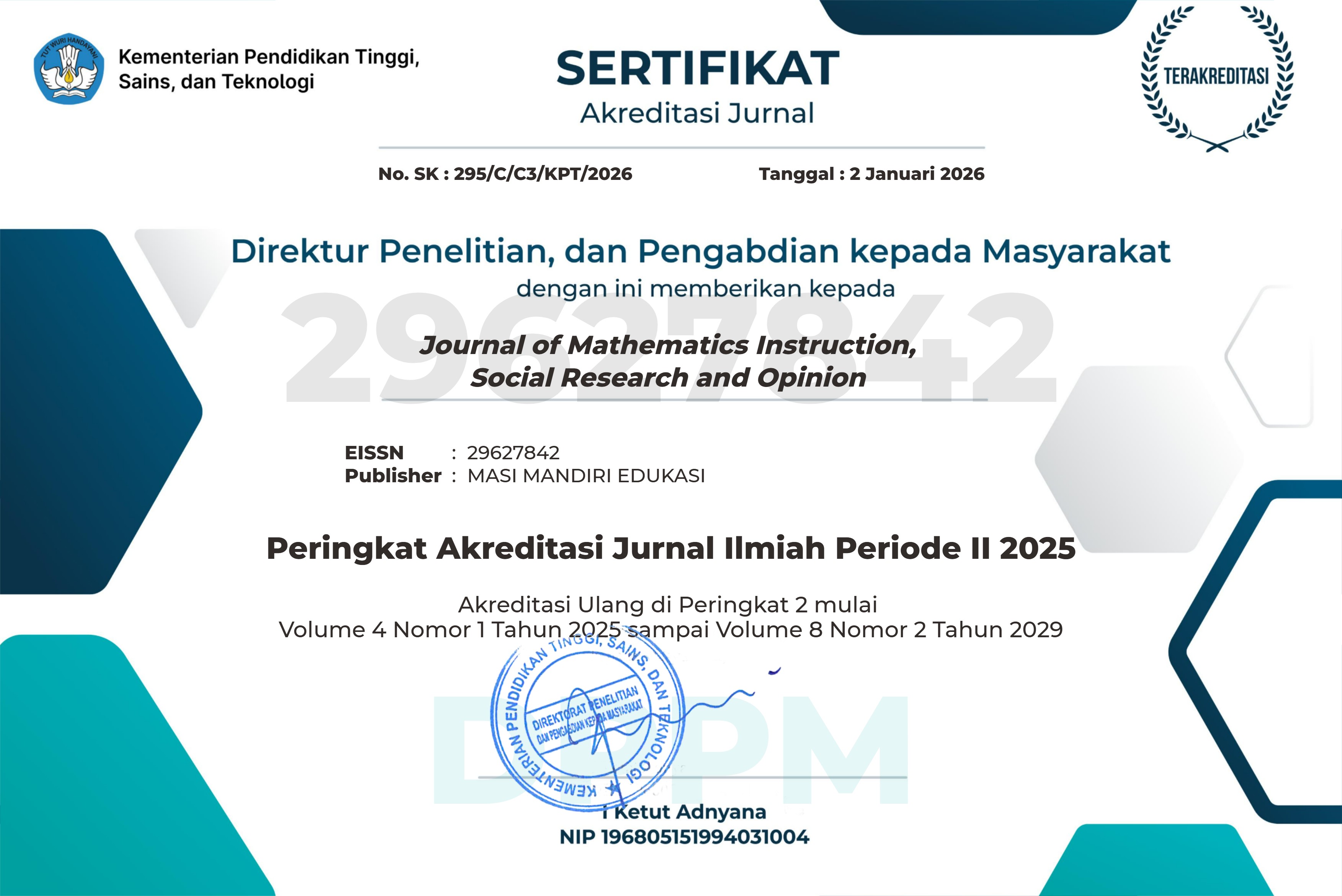
| Accreditation Certificate |
  |
| Indexing |






Contact Us

visitor
| Information |
>> For Authors
>> For Readers
>> For Librarians
| Visitor Statistics |
| Member of |


| Announcement |

| Keywords |
Mathematics Learning Difficulty Dyscalculia Teacher perceptions personality ICT Learning Computer teaching Academic Fisherfolks Economic Behavior Probit Models matrix mathematical model Concepts Guided Note Taking Golden Ratio Philosophy Integrated Learning van Hiele geometry Assessment Learning Outcomes method skills Problem Solving Experiment
| License |

MISRO is licensed under a Creative Commons Attribution-ShareAlike 4.0 International License.
| Publisher |

Address:
Jl. Gagak N0.105, Bandung,
Indonesia 40133
E-mail:
journalmisro@gmail.com
| in collaboration with |

| Recommended Tools |


| ISSN Barcode |

