
Reconstructing Inclusive Political Communication Styles: The Function of Personal Figurations of Female Figures in Regional Leadership Through Systematic Literature Review
DOI:
https://doi.org/10.58421/misro.v5i3.1576Keywords:
Digital Representation, Inclusive Communication, Local Leadership, Personal Figuration, Women’s Political , CommunicationAbstract
This study aimed to examine the political communication styles of female leaders in local governance by applying the concepts of personal figuration and inclusive communication based on mutual relations. Using a systematic literature review (SLR), the research analyzed 15 Scopus-indexed articles published between 2015 and 2025 that addressed themes of female leadership, political communication, and digital representation. The thematic analysis focused on three core issues: how leaders' lived experiences shaped their communication styles; which elements of inclusive, mutual communication were employed to build socio-political relations; and how digital strategies contributed to political legitimacy. The findings revealed that narratives of personal experience and community values strongly influenced the communication styles of local female leaders. They adopted empathetic and dialogical approaches to strengthen relationships with constituents and strategically used digital media as a space for affective, personalized political representation. The study concluded that women's political communication styles represented symbolic constructions rooted in social, gendered, and cultural contexts. These insights contributed to the development of gender-sensitive political communication theory and highlighted practical implications for female leadership strategies in the digital era.
Downloads
References
J. Blumenau, "The effects of female leadership on women's voice in political debate," British Journal of Political Science, vol. 51, no. 2, pp. 750–771, 2021, doi: 10.1017/S0007123419000334.
D. Casey, "CanberraInbox: Political communication, the personal vote and representation styles—Studying legislators' e-newsletters in Australia," Legislative Studies Quarterly, Feb. 2025, doi: 10.1111/lsq.70004.
R. P. Chaudhury, "The political asceticism of Mamata Banerjee: Female populist leadership in contemporary India," Politics & Gender, vol. 18, no. 4, pp. 942–977, 2022, doi: 10.1017/S1743923X21000209.
T. R. Keller and K. Kleinen-von Königslöw, "Pseudo-discursive, mobilizing, emotional, and entertaining: Identifying four successful communication styles of political actors on social media during the 2015 Swiss national elections," Journal of Information Technology & Politics, vol. 15, no. 4, pp. 358–377, 2018, doi: 10.1080/19331681.2018.1510355.
L. C. Puertas, "Female political leadership: A comparison between media treatment of Ana Botella and Manuela Carmena during their first week in charge," Política y Sociedad, vol. 57, no. 1, pp. 99–119, 2020, doi: 10.5209/POSO.64329.
M. Reveilhac, "The influences of political strategies and communication styles on political candidates' online and offline visibility," Journal of Political Marketing, pp. 1–18, 2023, doi: 10.1080/15377857.2023.2254709.
U. M. Rodrigues and M. Niemann, "Political communication Modi style: A case study of the demonetization campaign on Twitter," International Journal of Media and Cultural Politics, vol. 15, no. 3, pp. 361–379, 2019, doi: 10.1386/macp_00006_1.
K. Sengul, "Populism, democracy, political style and post-truth: Issues for communication research," Communication Research and Practice, vol. 5, no. 1, pp. 88–101, 2019, doi: 10.1080/22041451.2019.1561399.
S. Simon and C. L. Hoyt, "Exploring the effect of media images on women's leadership self-perceptions and aspirations," Group Processes and Intergroup Relations, vol. 16, no. 2, pp. 232–245, 2013, doi: 10.1177/1368430212451176.
E. W. Stuhlhofer, "Black, Female, and Divorced: A discourse analysis of Wangarĩ Maathai's leadership with reflections from Naleli Morojele's study of Rwandan and South African female political leaders," Societies, vol. 12, no. 1, 2022, doi: 10.3390/soc12010023.
H. Wu and J. Mackenzie, "Dual-gendered leadership: Gender-inclusive scientific-political public health communication supporting government COVID-19 responses in Atlantic Canada," Healthcare, vol. 9, no. 10, 2021, doi: 10.3390/healthcare9101345.
P. Norris and R. Inglehart, Cultural Backlash: Trump, Brexit, and Authoritarian Populism. Cambridge, U.K.: Cambridge University Press, 2019.
P. Norris, A Virtuous Circle: Political Communications in Postindustrial Societies. Cambridge, U.K.: Cambridge University Press, 2000.
S. Coleman and J. G. Blumler, The Internet and Democratic Citizenship: Theory, Practice and Policy. Cambridge, U.K.: Cambridge University Press, 2009.
B. G. Southwell, E. A. Thorson, and L. Sheble, Misinformation and Mass Audiences. Austin, TX, USA: University of Texas Press, 2018.
K. Ross, Gender, Politics, News: A Game of Three Sides. Chichester, U.K.: Wiley-Blackwell, 2017.
K. Ross, Women, Politics, Media: Uneasy Relations in Comparative Perspective. Cresskill, NJ, USA: Hampton Press, 2002.
P. Norris, Women, Media, and Politics. New York, NY, USA: Oxford University Press, 1997.
D. V. Shah, M. D. McLeod, and J. M. Yoon, "Communication, context, and community: An exploration of print, broadcast, and internet influences," Communication Research, vol. 28, no. 4, pp. 464–506, 2001.
L. Bennett and A. Segerberg, The Logic of Connective Action. Cambridge, U.K.: Cambridge University Press, 2013.
M. Castells, Communication Power. Oxford, UK: Oxford University Press, 2009.
W. L. Bennett and A. Segerberg, "The logic of connective action: Digital media and the personalization of contentious politics," Information, Communication & Society, vol. 15, no. 5, pp. 739–768, 2012.
Z. Papacharissi, Affective Publics: Sentiment, Technology, and Politics. New York, NY, USA: Oxford University Press, 2015.
B. Pfetsch, "Political communication cultures in Western Europe," European Journal of Communication, vol. 29, no. 4, pp. 344–356, 2014.
P. Van Aelst et al., "Political communication in a high-choice media environment: A challenge for democracy?," Annals of the International Communication Association, vol. 41, no. 1, pp. 3–27, 2017, doi: 10.1080/23808985.2017.1288551.
J. G. Blumler, "The fourth age of political communication," Politiques de Communication, no. 6, pp. 19–30, 2016.
Downloads
Additional Files
Published
How to Cite
Issue
Section
License
Copyright (c) 2026 Journal of Mathematics Instruction, Social Research and Opinion

This work is licensed under a Creative Commons Attribution-ShareAlike 4.0 International License.
SideBar
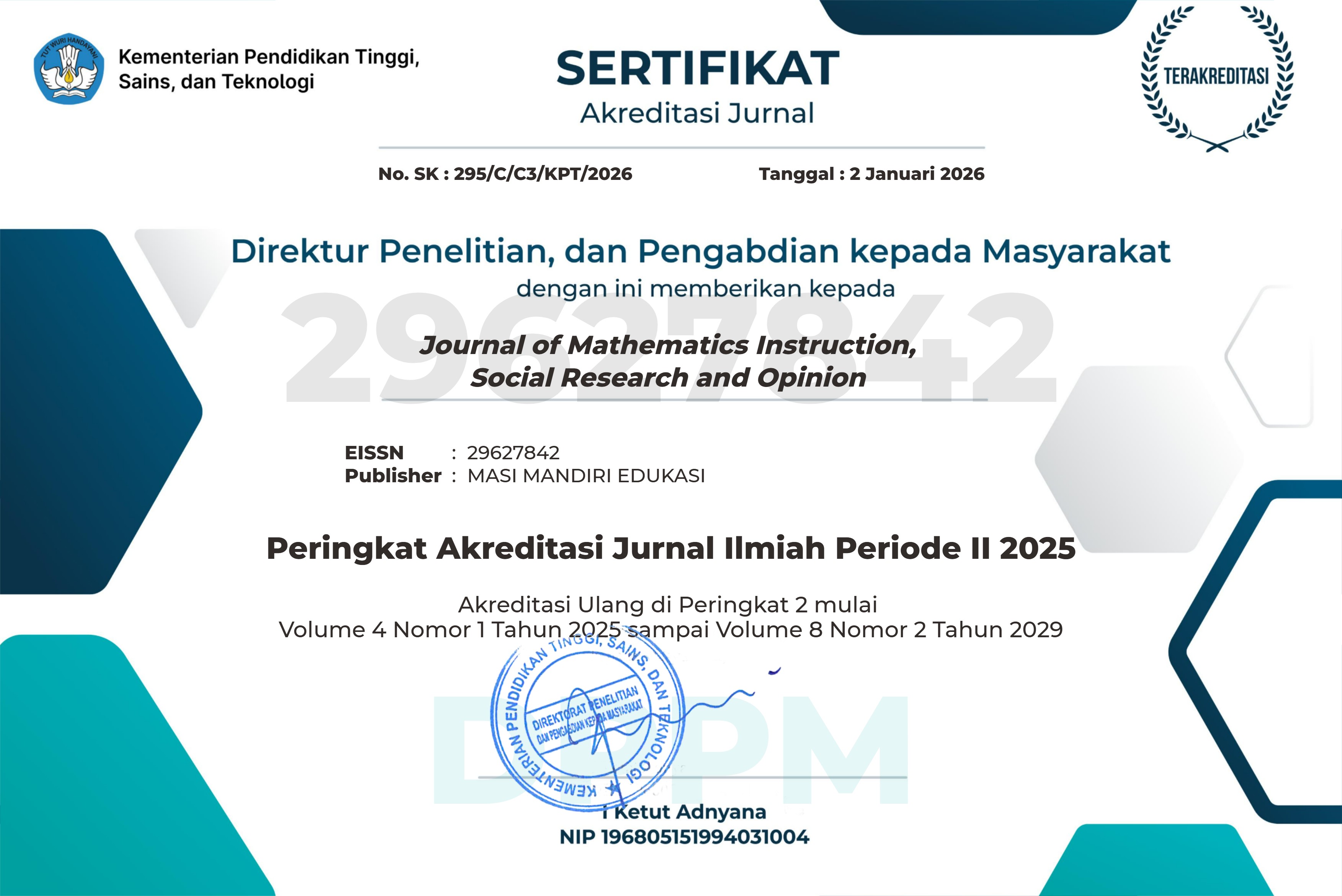
| Accreditation Certificate |
  |
| Indexing |






Contact Us

visitor
| Information |
>> For Authors
>> For Readers
>> For Librarians
| Visitor Statistics |
| Member of |


| Announcement |

| Keywords |
Mathematics Learning Difficulty Dyscalculia Teacher perceptions personality ICT Learning Computer teaching Academic Fisherfolks Economic Behavior Probit Models matrix mathematical model Concepts Guided Note Taking Golden Ratio Philosophy Integrated Learning van Hiele geometry Assessment Learning Outcomes method skills Problem Solving Experiment
| License |

MISRO is licensed under a Creative Commons Attribution-ShareAlike 4.0 International License.
| Publisher |

Address:
Jl. Gagak N0.105, Bandung,
Indonesia 40133
E-mail:
journalmisro@gmail.com
| in collaboration with |

| Recommended Tools |


| ISSN Barcode |

