
Legal Protection for Doctors Performing Pregnancy Termination in Anencephaly Cases under Law Number 17 of 2023 on Health
DOI:
https://doi.org/10.58421/misro.v5i3.1507Keywords:
Anencephaly, Criminal Code, Healthcare Professionals, Legal Protection, Pregnancy TerminationAbstract
Legal protection for healthcare professionals remains a significant issue in Indonesia, particularly regarding pregnancy termination in cases of anencephalic fetuses. Although Indonesian law permits abortion on limited grounds, including medical emergencies and pregnancies resulting from rape or other sexual violence, legal uncertainty persists when anencephaly is diagnosed after 14 weeks of gestation. This study analyzes the legal regulation of pregnancy termination in such cases and examines the legal protection available to doctors performing these procedures. Using juridical-normative and empirical-juridical approaches with a descriptive-analytical method, the study combines legal analysis with empirical data collected from 34 informants and respondents, including obstetricians, police officers, healthcare professionals, academics, religious leaders, hospital management, and legal practitioners. The findings indicate that the absence of clear operational regulations for late-detected anencephaly creates uncertainty and increases the risk of criminalization, even when procedures are performed in accordance with medical indications, informed consent, professional standards, and accredited healthcare facilities. Respondents emphasized the need for clearer procedural guidelines, stronger legal guarantees, professional protocols, and coordinated medicolegal mechanisms. The study concludes that pregnancy termination in cases of late-detected anencephaly should not automatically be treated as a criminal act when conducted by competent medical personnel in accordance with medical, ethical, and legal standards. It proposes a lex specialis-based legal protection model to strengthen legal certainty and support future health law reform in Indonesia.
Downloads
References
Law Number 1 of 2023 on the Criminal Code, Article 463.
Law Number 17 of 2023 on Health, Article 60.
Law Number 17 of 2023 on Health, Article 429.
Law Number 1 of 2023 on the Criminal Code, Article 463 paragraph (2).
Government Regulation Number 28 of 2024 on Implementing Regulation of Law Number 17 of 2023 on Health, Articles 116–123.
Vera Uliana Simanjuntak, Daniel Saranga, and Muh Ardi Munir, “Prinsip Diagnosis Anensefali: Laporan Kasus,” Jurnal Medical Profession (MedPro) 3, no. 3 (2021): 248. https://jurnal.fk.untad.ac.id/index.php/medpro/article/view/706
Vera Uliana Simanjuntak, Daniel Saranga, and Muh Ardi Munir, “Prinsip Diagnosis Anensefali: Laporan Kasus,” Jurnal Medical Profession (MedPro) 3, no. 3 (2021): 248. https://jurnal.fk.untad.ac.id/index.php/medpro/article/view/706
D. C. R. Kusuma et al., Asuhan Neonatus dan Bayi Baru Lahir dengan Kelainan Bawaan (Padang: PT Global Eksekutif Teknologi, 2022).
M. Jusuf Hanafiah and Amri Amir, Etika Kedokteran dan Hukum Kesehatan (Jakarta: EGC, 2017).
Lidya Nurmalita Sari, Sulistyaningsih, and M. H. Kes, Pelaksanaan Terminasi Kehamilan di RS PKU Muhammadiyah Yogyakarta (Yogyakarta: Universitas Aisyiyah Yogyakarta, 2011).
Putri Widya Herman and Annisa Wahyuni, “Masalah Etika Dan Hukum Kesehatan Pada Layanan Kesehatan Publik Atau Rumah Sakit ‘Aborsi’,” Iris Journal of Health Information Management (IJHIMa) 3, no. 2 (2023),1-8 https://garuda.kemdiktisaintek.go.id/documents/detail/3911887
Christina Zampas and Jaime M. Gher, “Abortion as a Human Right International and Regional Standards,” Human Rights Law Review 8, no. 2 (2008): 249–294. https://doi.org/10.1093/hrlr/ngn008
Maidina Rahmawati and A. Budiman, Kerangka Hukum tentang Terminasi Kehamilan di Indonesia (Jakarta: Institute for Criminal Justice Reform, 2023).
Tunggul Ansari Setia Negara, “Normative Legal Research in Indonesia: Its Originis and Approaches,” Audito Comparative Law Journal 4, no. 1 (2023): 1–9, https://doi.org/10.22219/aclj.v4i1.24855.
Terry Hutchinson and Nigel Duncan, “Defining and Describing What We Do: Doctrinal Legal Research,” Deakin Law Review 17, no. 1 (2012): 83–119, https://doi.org/10.21153/dlr2012vol17no1art70.
Ujang Charda S., “Typology of Legal Research Methods in Normative and Sociological Thinking,” Fox Justi: Jurnal Ilmu Hukum 12, no. 1 (2021): 113–120, https://doi.org/10.58471/justi.v12i1.769.
Law Number 1 of 2023 on the Criminal Code, https://peraturan.bpk.go.id/details/234935/uu-no-1-tahun-2023.
Law Number 17 of 2023 on Health, https://peraturan.bpk.go.id/details/258028/uu-no-17-tahun-2023.
Government Regulation Number 28 of 2024 on Implementing Regulation of Law Number 17 of 2023 on Health, https://peraturan.bpk.go.id/details/294077/pp-no-28-tahun-2024.
Minister of Health Regulation Number 2 of 2025 on the Implementation of Reproductive Health Efforts, https://peraturan.bpk.go.id/Details/314518/permenkes-no-2-tahun-2025.
Imami Nur Rachmawati, “Pengumpulan Data dalam Penelitian Kualitatif: Wawancara,” Jurnal Keperawatan Indonesia 11, no. 1 (2007): 35–40, https://doi.org/10.7454/jki.v11i1.184.
Tunggul Ansari Setia Negara, “Normative Legal Research in Indonesia: Its Originis and Approaches,” Audito Comparative Law Journal 4, no. 1 (2023): 1–9, https://doi.org/10.22219/aclj.v4i1.24855.
Virginia Braun and Victoria Clarke, “Using Thematic Analysis in Psychology,” Qualitative Research in Psychology 3, no. 2 (2006): 77–101, https://doi.org/10.1191/1478088706qp063oa.
Lorelli S. Nowell, Jill M. Norris, Deborah E. White, and Nancy J. Moules, “Thematic Analysis: Striving to Meet the Trustworthiness Criteria,” International Journal of Qualitative Methods 16, no. 1 (2017): 1–13, https://doi.org/10.1177/1609406917733847.
Law Number 1 of 2023 on the Criminal Code, Article 463, https://peraturan.bpk.go.id/details/234935/uu-no-1-tahun-2023.
Law Number 17 of 2023 on Health, Articles 60, 273, 274, and 429, https://peraturan.bpk.go.id/details/258028/uu-no-17-tahun-2023.
Government Regulation Number 28 of 2024 on Implementing Regulation of Law Number 17 of 2023 on Health, Articles 116–123, https://peraturan.bpk.go.id/details/294077/pp-no-28-tahun-2024.
Minister of Health Regulation Number 2 of 2025 on the Implementation of Reproductive Health Efforts, https://peraturan.bpk.go.id/Details/314518/permenkes-no-2-tahun-2025.
Emre Ekmekci and Servet Gencdal, “What’s Happening When the Pregnancies Are Not Terminated in Case of Anencephalic Fetuses?” Journal of Clinical Medicine Research 11, no. 5 (2019): 332–336, https://doi.org/10.14740/jocmr3777.
Imelda Yunitra et al., “Dilemma of Labor Management in Lethal Anencephalic Fetus,” Jurnal Biomedika dan Kesehatan 8, no. 2 (2025): 202–207, https://doi.org/10.18051/JBiomedKes.2024.v8.202-207.
Sawsan Al-Obaidly et al., “Anencephaly and Obstetric Outcome Beyond the Age of Viability,” Journal of Perinatal Medicine 46, no. 8 (2018): 885–888, https://doi.org/10.1515/jpm-2017-0363.
Law Number 17 of 2023 on Health, Articles 60 and 429, https://peraturan.bpk.go.id/details/258028/uu-no-17-tahun-2023; Government Regulation Number 28 of 2024, Articles 116–123, https://peraturan.bpk.go.id/details/294077/pp-no-28-tahun-2024.
Law Number 1 of 2023 on the Criminal Code, Article 463 paragraph (2), https://peraturan.bpk.go.id/details/234935/uu-no-1-tahun-2023.
Imelda Yunitra et al., “Dilemma of Labor Management in Lethal Anencephalic Fetus,” Jurnal Biomedika dan Kesehatan 8, no. 2 (2025): 202–207, https://doi.org/10.18051/JBiomedKes.2024.v8.202-207.
The 1945 Constitution of the Republic of Indonesia, Articles 28H and 28I, https://www.mpr.go.id/img/sosialisasi/file/1610334013_file_mpr.pdf
Downloads
Additional Files
Published
How to Cite
Issue
Section
License
Copyright (c) 2026 Journal of Mathematics Instruction, Social Research and Opinion

This work is licensed under a Creative Commons Attribution-ShareAlike 4.0 International License.
SideBar
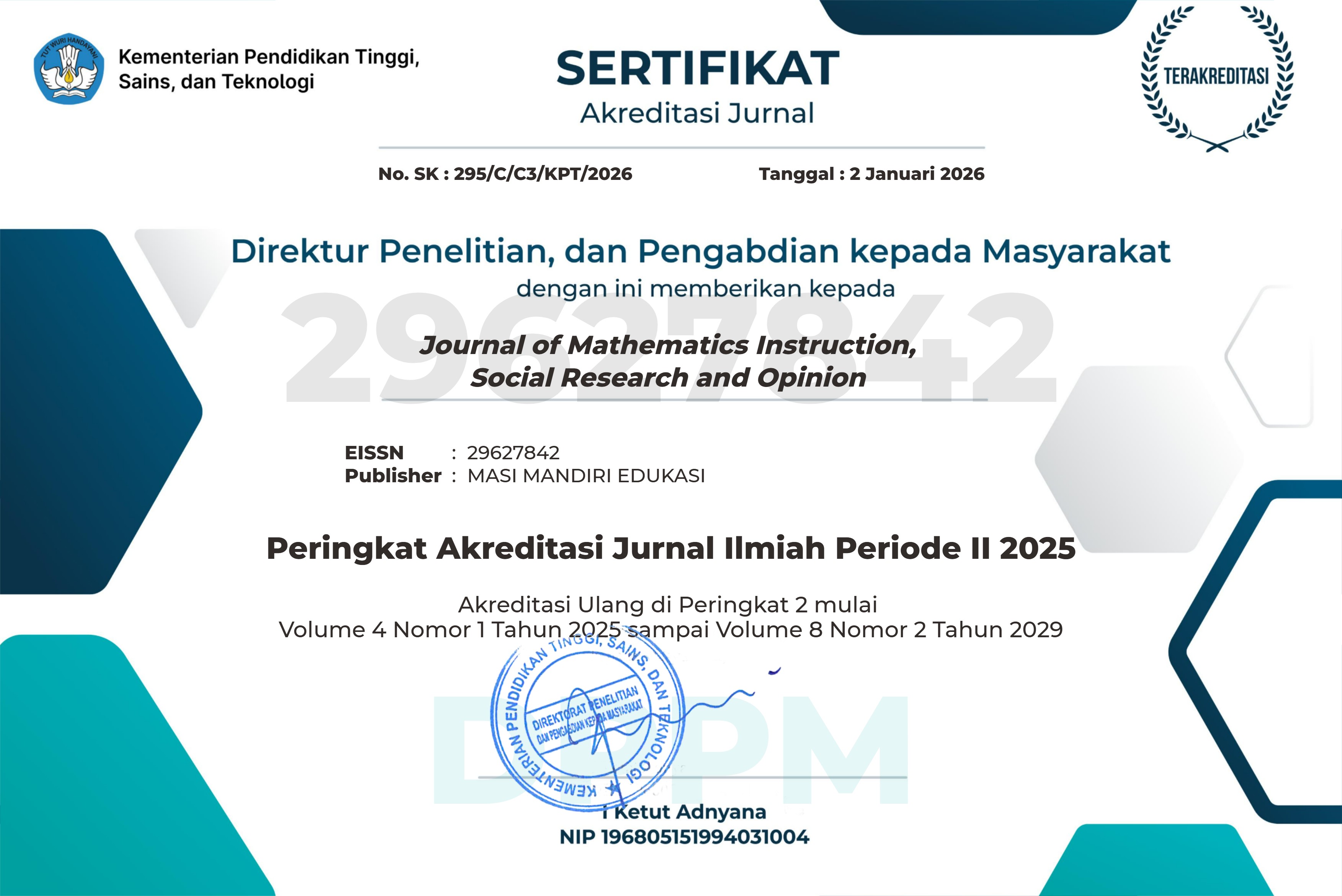
| Accreditation Certificate |
  |
| Indexing |






Contact Us

visitor
| Information |
>> For Authors
>> For Readers
>> For Librarians
| Visitor Statistics |
| Member of |


| Announcement |

| Keywords |
Mathematics Learning Difficulty Dyscalculia Teacher perceptions personality ICT Learning Computer teaching Academic Fisherfolks Economic Behavior Probit Models matrix mathematical model Concepts Guided Note Taking Golden Ratio Philosophy Integrated Learning van Hiele geometry Assessment Learning Outcomes method skills Problem Solving Experiment
| License |

MISRO is licensed under a Creative Commons Attribution-ShareAlike 4.0 International License.
| Publisher |

Address:
Jl. Gagak N0.105, Bandung,
Indonesia 40133
E-mail:
journalmisro@gmail.com
| in collaboration with |

| Recommended Tools |


| ISSN Barcode |

