
Islamic boarding school governance and Islamic boarding school education from the perspective of Qur'anic ethics with a case study of Al-Khoziny
DOI:
https://doi.org/10.58421/misro.v5i3.1444Keywords:
Al-‘adl, Al-amanah, Al-Khoziny, Islamic Boarding School Education, Pesantren Governance, Qur’anic EthicsAbstract
Islamic boarding schools (pesantren) serve as important institutions for religious education, character formation, and community development in Indonesia. Alongside their educational mission, pesantren are increasingly required to strengthen governance practices to ensure institutional sustainability, educational quality, and public trust. The collapse of a building within the Al-Khoziny Islamic Boarding School complex attracted public attention and raised broader questions regarding institutional governance, risk management, and educational responsibility in pesantren environments. However, previous studies have primarily examined pesantren from leadership, curriculum, and management perspectives, while limited research has explored governance and educational responsibility through a Qur’anic ethical framework. This study aims to analyze Islamic boarding school governance and Islamic boarding school education from the perspective of Qur’anic ethics using the Al-Khoziny case as an institutional reflection. The research employs a qualitative library-based approach combined with a case-based institutional analysis. Data were collected from Qur’anic verses, hadith literature, classical and contemporary tafsir, scholarly publications on Islamic education, and documented information related to the Al-Khoziny case. Data analysis was conducted through a dialectical hermeneutic process consisting of textual interpretation, ethical abstraction, and institutional contextualization. The findings indicate that the Qur’anic principles of al-‘adl (justice), al-amanah (trustworthiness), and al-ihsan (excellence) provide an integrated ethical foundation for strengthening governance and educational practices in pesantren. The Al-Khoziny case highlights the importance of accountability, transparency, institutional supervision, and continuous improvement as essential dimensions of pesantren management. The analysis further demonstrates that Qur’anic ethical values can guide institutional decision-making while supporting the educational mission of fostering responsibility, integrity, and social awareness among students and stakeholders. This study concludes that effective pesantren governance cannot be separated from ethical values embedded in Islamic teachings. The integration of justice, trustworthiness, and excellence contributes to the development of governance systems that support both educational objectives and institutional resilience. The proposed Qur’anic institutional ethics model offers practical guidance for pesantren leaders in strengthening governance, educational quality, stakeholder participation, and long-term institutional sustainability.
Downloads
References
A. N. Andri Nirwana et al., “SWOT Analysis of AI Integration in Islamic Education: Cognitive, Affective, and Psychomotor Impacts,” Qubahan Academic Journal, vol. 5, no. 1, 2025, doi: 10.48161/qaj.v5n1a1498.
Umar, A. Ghufron, and W. Wuryandani, “Integrating Maja Labo Dahu culture in Islamic education: a module for character development in elementary students,” Journal of Education and Learning, vol. 19, no. 2, 2025, doi: 10.11591/edulearn.v19i2.21801.
A. S. Aceh, N. Asnawi, and M. F. Tharaba, “Exploring the Impact of Islamic Leadership, Work Ethic, and Discipline on Job Satisfaction and Teacher Performance in Madrasah,” Al-Tanzim: Jurnal Manajemen Pendidikan Islam, vol. 8, no. 4, 2024, doi: 10.33650/al-tanzim.v8i4.8911.
Y. Akhyar, “Public Accountability in Financial Management Practice at Islamic Education Institutions: A Survey Research,” AL-ISHLAH: Jurnal Pendidikan, vol. 16, no. 3, 2024, doi: 10.35445/alishlah.v16i3.4372.
M. Zalil, A. Aspandi, A. M. El Banna, and A. Syarifudin, “Reassessing Student Representation: Legal and Managerial Implications of the Absence of a Student Executive Board under Law No. 12 of 2012,” Journal of General Education and Humanities, vol. 5, no. 1, 2025, doi: 10.58421/gehu.v5i1.715.
A. Masuwai, H. Zulkifli, and M. I. Hamzah, “Self-assessment for continuous professional development: The perspective of Islamic Education,” Heliyon, vol. 10, no. 19, 2024, doi: 10.1016/j.heliyon.2024.e38268.
N. A. Memon, M. Abdalla, and D. Chown, “Laying Foundations for Islamic Teacher Education,” Educ. Sci. (Basel)., vol. 14, no. 10, 2024, doi: 10.3390/educsci14101046.
B. Davies and J. Savulescu, “Institutional Responsibility is Prior to Personal Responsibility in a Pandemic,” Journal of Value Inquiry, vol. 58, no. 2, 2024, doi: 10.1007/s10790-021-09876-0.
D. Mariyono, “Multicultural values: meeting point of two forces in developing Islamic education,” Quality Education for All, vol. 1, no. 1, 2024, doi: 10.1108/QEA-02-2024-0018.
Y. Ichsan, S. Syamsudin, Z. Nuryana, and Sukiman, “Realizing Islamic Education Based on Religious Moderation with the Wasathiyah Islamic Paradigm from the Perspective of the Qur’an,” Jurnal Pendidikan Agama Islam, vol. 21, no. 1, 2024, doi: 10.14421/jpai.v21i1.9944.
M. Astuti, F. Ismail, S. Fatimah, W. Puspita, and Herlina, “The Relevance Of The Merdeka Curriculum In Improving The Quality Of Islamic Education In Indonesia,” International Journal of Learning, Teaching and Educational Research, vol. 23, no. 6, 2024, doi: 10.26803/ijlter.23.6.3.
H. S. Siregar, Nurhamzah, M. Munir, and M. Fikri, “Enhancing Islamic Education Through Technology Integration: A Study Of Teaching Practices In Indonesia,” Jurnal Ilmiah Peuradeun, vol. 13, no. 2, 2025, doi: 10.26811/peuradeun.v13i2.1875.
A. A. N. Nirwana, Mahmudulhassan, Muthoifin, and Waston, “Bibliometric Analysis of Islamic Education and Character Development in Religious Education Practices in Indonesia,” Pak. J. Life Soc. Sci., vol. 22, no. 2, 2024, doi: 10.57239/PJLSS-2024-22.2.0086.
A. M. Iqbal, N. Ahmad, and A. Suhartini, “Implications of the Tijaniyah Order for Islamic Education at Zawiyah Islamic Boarding School,” Nazhruna: Jurnal Pendidikan Islam, vol. 6, no. 1, 2023, doi: 10.31538/nzh.v6i1.2467.
M. Fahmi et al., “Multicultural Islamic Education as Strategy for Strengthening Social Cohesion in Islamic School,” Nazhruna: Jurnal Pendidikan Islam, vol. 8, no. 1, 2025, doi: 10.31538/nzh.v8i1.67.
Zakariyah, “Improving Madrasah Competitiveness Through Excellent Islamic Education Development Strategies,” Nazhruna: Jurnal Pendidikan Islam, vol. 7, no. 1, 2024, doi: 10.31538/nzh.v7i1.4541.
M. I. Sholeh, H. Rohman, E. A. Suwandi, Akhyak, N. Efendi, and A. Muhajir, “Transformation of Islamic Education: A Study of Changes in The Transformation of The Education Curriculum,” Jurnal Pendidikan Agama Islam, vol. 20, no. 1, 2023, doi: 10.14421/jpai.v20i1.6770.
M. Kosim, F. Muqoddam, F. Mubarok, and N. Q. Laila, “The dynamics of Islamic education policies in Indonesia,” Cogent Education, vol. 10, no. 1, 2023, doi: 10.1080/2331186X.2023.2172930.
A. Rohman et al., “Challenges in Islamic Education Curriculum Development: A Comparative Study of Indonesia, Pakistan, and India,” International Journal of Learning, Teaching and Educational Research, vol. 23, no. 6, 2024, doi: 10.26803/ijlter.23.6.23.
Achruh, M. Rapi, M. Rusdi, and R. Idris, “Challenges and Opportunities of Artificial Intelligence Adoption in Islamic Education in Indonesian Higher Education Institutions,” International Journal of Learning, Teaching and Educational Research, vol. 23, no. 11, 2024, doi: 10.26803/ijlter.23.11.22.
Suyadi, Z. Nuryana, Sutrisno, and Baidi, “Academic reform and sustainability of Islamic higher education in Indonesia,” Int. J. Educ. Dev., vol. 89, 2022, doi: 10.1016/j.ijedudev.2021.102534.
A. Aspandi, U. Nuansah, N. L. F. Mima, M. A. Zalil, and A. Saepudin, “Dialogic Leadership in Managing Islamic Boarding Schools for the Digital Generation,” Al-Tanzim: Jurnal Manajemen Pendidikan Islam, vol. 9, no. 4, 2025, doi: 10.33650/al-tanzim.v9i4.10754.
R. R. Lubis, M. A. Hanafiah, R. A. Dalimunthe, and Z. N. Rashed, “Modernization Of Islamic Education Lectures At Islamic Higher Education Institutions In Contemporary Indonesia,” Miqot: Jurnal Ilmu-ilmu Keislaman, vol. 48, no. 2, 2024, doi: 10.30821/miqot.v48i2.1189.
A. Yusril Musyafa’, A. Akhyak, and Abd. Aziz, “Management of Pesantren Governance in Improving the Quality of Islamic Education (Multi-site Study at Pondok Pesantren Wali Songo Ngabar Ponorogo and Pesantren Putri Al-Mawaddah Coper Ponorogo),” International Journal of Science, Technology & Management, vol. 6, no. 1, 2025, doi: 10.46729/ijstm.v6i1.1268.
Kasman Kasman, “Islamic Boarding School Management in the Modern Era: Literature Review of Local Wisdom-Based Management Models,” Bulletin of Indonesian Islamic Studies, vol. 4, no. 1, 2025, doi: 10.51214/biis.v4i1.1539.
M. A. Auf, S. A. Widodo, R. Pradipa, S. Huda, and R. K. Nazikhah, “Value-Based Monitoring and Evaluation in Islamic Education Governance,” Indonesian Journal of Innovation Studies, vol. 26, no. 4, 2025.
W. Miftahussurur and Z. Widad, “Page| 58 Good Governance Framework In Islamic Educational Institutions: Literature-Based Insights On Amanah, Maslahah, And Accountability,” 2025.
K. In, Q. A. Y. Dasuki, and A. Nurwahid, “Adaptive Leadership and Institutional Development in Islamic Education: A Case Study of Madrasah Diniyah At-Ta’abud Wonokromo,” Journal of Islamic Education …, vol. 2, no. 2, 2024.
M. H. Mu’afi and S. Sugiri, “Fixed Asset Management of Pondok Pesantren: Practices, Practitioners, and Praxis,” MANAGERIA: Jurnal Manajemen Pendidikan Islam, vol. 10, no. 1, 2025.
Hamdanah, Mardia, and M. Rusydi, “Visionary Leadership in Islamic Boarding Schools: Implications for Institutional Management within the Barakka Framework,” International Journal of Learning, Teaching and Educational Research, vol. 24, no. 8, 2025, doi: 10.26803/ijlter.24.8.46.
A. Nurkhin, A. Rohman, and T. J. W. Prabowo, “Accountability of pondok pesantren; a systematic literature review,” 2024. doi: 10.1080/23311975.2024.2332503.
Downloads
Additional Files
Published
How to Cite
Issue
Section
License
Copyright (c) 2026 Journal of Mathematics Instruction, Social Research and Opinion

This work is licensed under a Creative Commons Attribution-ShareAlike 4.0 International License.
SideBar
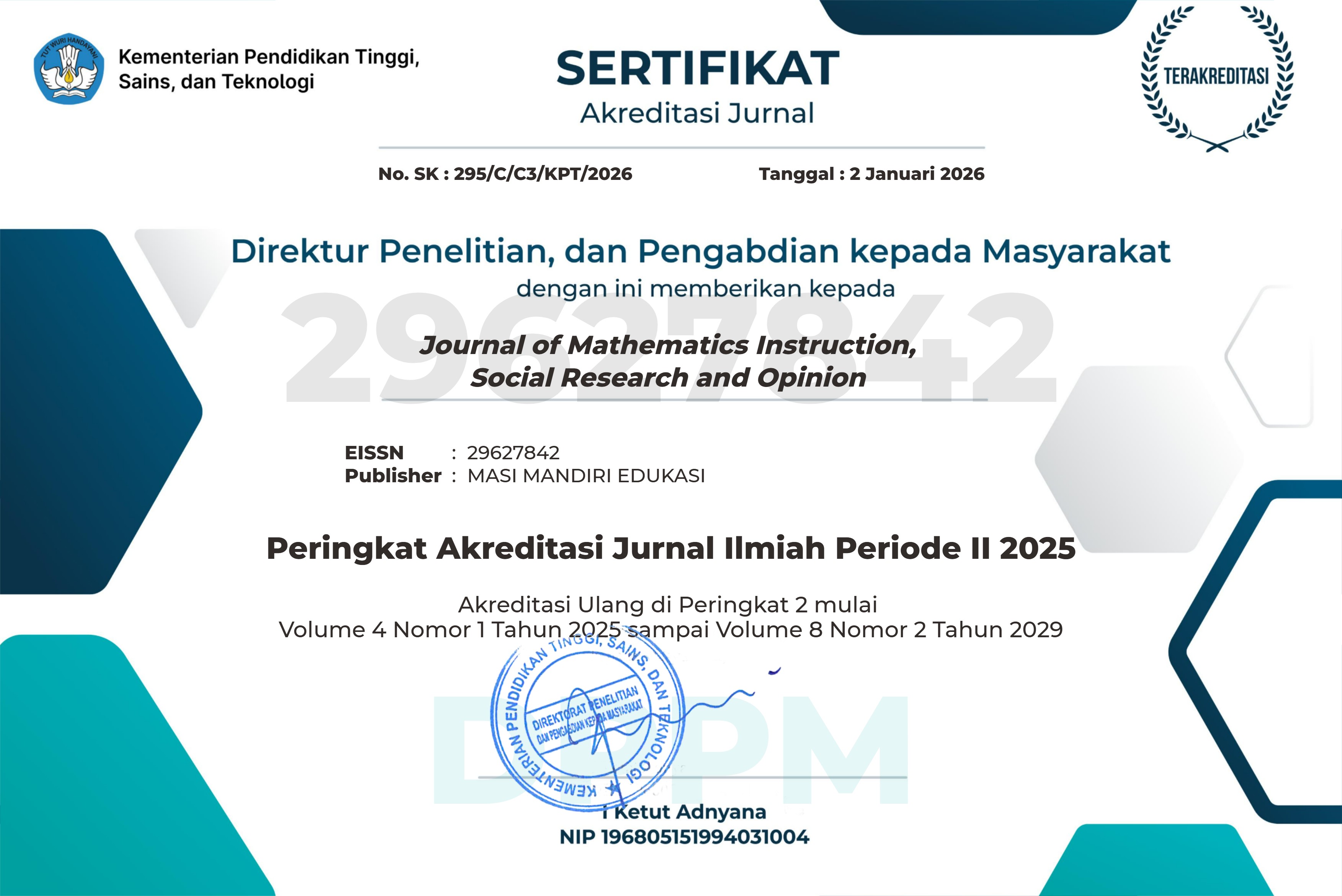
| Accreditation Certificate |
  |
| Indexing |






Contact Us

visitor
| Information |
>> For Authors
>> For Readers
>> For Librarians
| Visitor Statistics |
| Member of |


| Announcement |

| Keywords |
Mathematics Learning Difficulty Dyscalculia Teacher perceptions personality ICT Learning Computer teaching Academic Fisherfolks Economic Behavior Probit Models matrix mathematical model Concepts Guided Note Taking Golden Ratio Philosophy Integrated Learning van Hiele geometry Assessment Learning Outcomes method skills Problem Solving Experiment
| License |

MISRO is licensed under a Creative Commons Attribution-ShareAlike 4.0 International License.
| Publisher |

Address:
Jl. Gagak N0.105, Bandung,
Indonesia 40133
E-mail:
journalmisro@gmail.com
| in collaboration with |

| Recommended Tools |


| ISSN Barcode |

