
A Concise Study on Teachers’ Perceptions of Their Continuing Professional Development in Cambodian High Schools
DOI:
https://doi.org/10.58421/misro.v2i2.144Keywords:
Perceptions, CPD, Cambodian High SchoolsAbstract
This concise study was mainly about the perceptions of teachers toward continuing professional development (CPD). A qualitative method was employed to gather participants' information and ideas. Two-main questions and several sub-questions were designed to interview the respondents to address the research issue. Findings suggested that continuing professional development (CPD) is essential for teachers and school leaders to develop their mindsets and growth; moreover, most respondents agreed that CPD is crucial for self-development. However, one respondent felt that the school lacked teacher training. This can be notified that school leaders shall create more CPD activities for improving their colleagues. Moreover, without continuing professional development (CPD), teachers and staff will not become well-educated and knowledgeable human resources. Hence, lifelong Learning is a must for oneself to be promoted or to a successful life journey. Last but not least, this study implied that school leaders' and teachers’ perceptions were slightly different regarding CPD. Further study shall focus on teachers’ satisfaction regarding continuing professional development (CPD).
Downloads
References
A. W. Khan, “Continuing Professional Development (CPD); What should we do?,” Bangladesh J. Med. Educ., vol. 1, no. 1, pp. 37–44, 2012, doi: 10.3329/bjme.v1i1.12857.
C. Day and J. Sachs, International Handbook on the Continuing Professional Development of Teachers. Maidenhead: Open University Press, 2004.
L. Gallagher, “Continuing education in nursing: A concept analysis,” Nurse Educ. Today, vol. 27, no. 5, pp. 466–473, Jul. 2007, doi: 10.1016/j.nedt.2006.08.007.
E. Powell, S. Furey, A. Scott-Evans, and I. Terrell, “Teachers’ perceptions of the impact of CPD: an institutional case study ed,” J. In-Service Educ., vol. 29, no. 3, pp. 389–404, Sep. 2003, doi: 10.1080/13674580300200225.
K. Manley, A. Martin, C. Jackson, and T. Wright, “A realist synthesis of effective continuing professional development (CPD): A case study of healthcare practitioners’ CPD,” Nurse Educ. Today, vol. 69, pp. 134–141, Oct. 2018, doi: 10.1016/j.nedt.2018.07.010.
A. R. Al Asmar, “Continuous Professional Development of English Language Teachers: Perception and Practices,” Adv. Lang. Lit. Stud., vol. 7, no. 3, Apr. 2016, doi: 10.7575/aiac.alls.v.7n.3p.117.
A. Arıkan and E. I. Turhan, “English Language Teacher Development With and Without a Teacher,” e-Journal New World Sci. Acad., vol. 4, no. 2, pp. 410–421, 2009.
N. S. Mahmood and H. H. Ali, “An Evaluation of the EFL Iraqi Secondary School Teachers Linguistic Competence Needs,” Nasaq J., vol. 36, no. 1, 2022.
J. C. Richards and T. S. C. Farrell, Professional Development for Language Teachers. Cambridge University Press, 2005.
G. Yurtsever, “English Language Instructors’ Beliefs on Professional Development Models and Preferences to Improve Their Teaching Skills,” Procedia - Soc. Behav. Sci., vol. 70, pp. 666–674, Jan. 2013, doi: 10.1016/j.sbspro.2013.01.107.
A. Atikler, “The Role of Action Research in the Self-Development of an ELT Teacher: A Descriptive Case Study,” Bilkent Universitesi, 1997.
R. Judith, “Building Learning into the Teaching Job,” Educ. Leadersh., vol. 55, no. 5, pp. 70–74, 1998.
G. Özdemir, S. Şahin, and N. Öztürk, “Teachers’ Self-Efficacy Perceptions in Terms of School Principal’s Instructional Leadership Behaviours,” Int. J. Progress. Educ., vol. 16, no. 1, pp. 25–40, Feb. 2020, doi: 10.29329/ijpe.2020.228.3.
A. Badia, E. Liesa, L. Becerril, and P. Mayoral, “A dialogical self approach to the conceptualisation of teacher-inquirer identity,” Eur. J. Psychol. Educ., vol. 35, no. 4, pp. 865–879, Dec. 2020, doi: 10.1007/s10212-019-00459-z.
B. Vadivel, E. Namaziandost, and A. Saeedian, “Progress in English Language Teaching Through Continuous Professional Development—Teachers’ Self-Awareness, Perception, and Feedback,” Front. Educ., vol. 6, Nov. 2021, doi: 10.3389/feduc.2021.757285.
K. E. Johnson and P. R. Golombek, A Sociocultural Theoretical Perspective on Teacher Professional Developmen. Routledge, 2010.
K. A. Dilsad, “Teachers’ perceptions of self-initiated professional development: a case study on Başkent University English languge teachers,” METU, 2003.
K. Sey, “Educational and Organizational Handling during COVID-19 Pandemic: Challenges and Changes,” J. Gen. Educ. Humanit., vol. 2, no. 3, pp. 187–198, Jun. 2023, doi: 10.58421/gehu.v2i3.96.
K. Sey and S. Em, “Attitudes and Perceptions of Using Zoom: A Survey of Cambodian University Students,” J. As-Salam, vol. 7, no. 1, pp. 1–15, Apr. 2023, doi: 10.37249/assalam.v7i1.511.
K. Sey, “E-readiness of Cambodian Undergraduate Students in Using Google Classroom,” Cambodian J. Educ. Res, vol. 1, no. 2, pp. 87–95, 2021.
I. Lee, “Teachers as presenters at continuing professional development seminars in the English-as-a-foreign-language context: ‘I find it more convincing,’” Aust. J. Teach. Educ., vol. 36, no. 2, Mar. 2011, doi: 10.14221/ajte.2011v36n2.3.
A. H. Littlejohn, “Improving continuing professional development in the use of ICT,” J. Comput. Assist. Learn., vol. 18, no. 2, pp. 166–174, Jun. 2002, doi: 10.1046/j.0266-4909.2001.00224.x.
A. Murray, “Empowering Teachers through Professional Development,” English Teach. Forum, vol. 48, no. 1, pp. 2–11, 2010.
J. C. Richards and T. S. Farrell, Professional development for language teachers: Strategies for teacher learning. Cambridge University Press, 2005.
D. Morris, “Are teachers technophobes? Investigating professional competency in the use of ICT to support teaching and learning,” Procedia - Soc. Behav. Sci., vol. 2, no. 2, pp. 4010–4015, 2010, doi: 10.1016/j.sbspro.2010.03.632.
S. Shawer, “Classroom‐level teacher professional development and satisfaction: teachers learn in the context of classroom‐level curriculum development,” Prof. Dev. Educ., vol. 36, no. 4, pp. 597–620, Dec. 2010, doi: 10.1080/19415257.2010.489802.
M. D. C. Tongco, “Purposive Sampling as a Tool for Informant Selection,” Ethnobot. Res. Appl., vol. 5, pp. 147–158, 2007, [Online]. Available: https://ethnobotanyjournal.org/index.php/era/article/view/126.
S. R. Fussell and R. M. Krauss, “Coordination of knowledge in communication: Effects of speakers’ assumptions about what others know.,” J. Pers. Soc. Psychol., vol. 62, no. 3, pp. 378–391, 1992, doi: 10.1037/0022-3514.62.3.378.
C. Day, Developing teachers: The challenges of lifelong Learning. Routledge, 2002.
I. R. Cornford, “Learning-to-learn strategies as a basis for effective lifelong learning,” Int. J. Lifelong Educ., vol. 21, no. 4, pp. 357–368, Aug. 2002, doi: 10.1080/02601370210141020.
D. David, “Developing Teachers: the challenges of lifelong learning,” Educ. Rev., vol. 52, no. 1, 2000.
W. Bank, Lifelong Learning in the Global Knowledge Economy. The World Bank, 2003.
Downloads
Published
How to Cite
Issue
Section
License
Copyright (c) 2023 Journal of Mathematics Instruction, Social Research and Opinion

This work is licensed under a Creative Commons Attribution-ShareAlike 4.0 International License.
SideBar
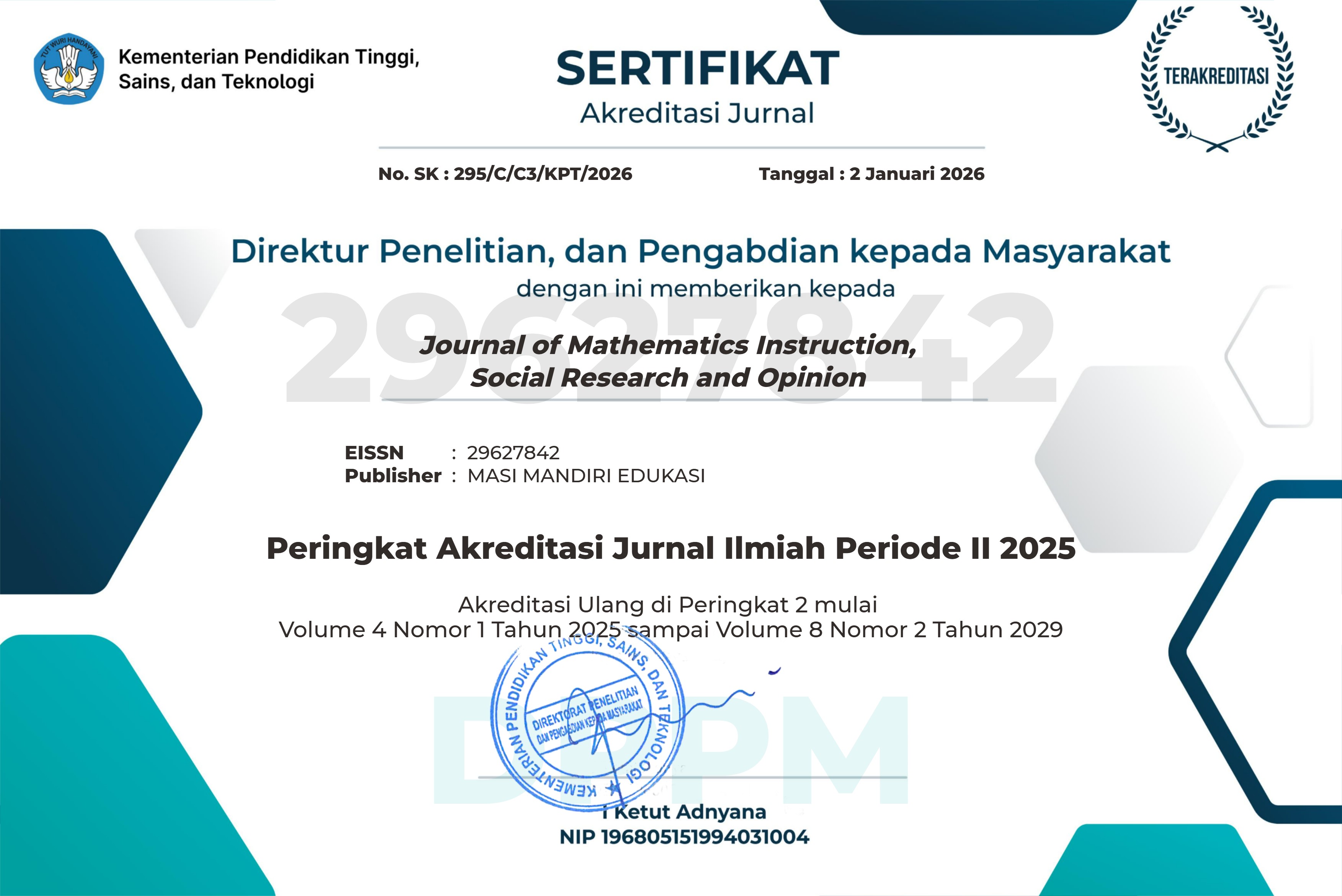
| Accreditation Certificate |
  |
| Indexing |






Contact Us

visitor
| Information |
>> For Authors
>> For Readers
>> For Librarians
| Visitor Statistics |
| Member of |


| Announcement |

| Keywords |
Mathematics Learning Difficulty Dyscalculia Teacher perceptions personality ICT Learning Computer teaching Academic Fisherfolks Economic Behavior Probit Models matrix mathematical model Concepts Guided Note Taking Golden Ratio Philosophy Integrated Learning van Hiele geometry Assessment Learning Outcomes method skills Problem Solving Experiment
| License |

MISRO is licensed under a Creative Commons Attribution-ShareAlike 4.0 International License.
| Publisher |

Address:
Jl. Gagak N0.105, Bandung,
Indonesia 40133
E-mail:
journalmisro@gmail.com
| in collaboration with |

| Recommended Tools |


| ISSN Barcode |

