
Analyzing the Determinants of Intention to Use Property Technology Applications in Indonesia
DOI:
https://doi.org/10.58421/misro.v5i3.1332Keywords:
Intent to Use, Perceived Uses, Property Technology, Social Influence, TrustAbstract
Property technology (PropTech) applications are growing rapidly in Indonesia, especially in the Greater Jakarta area, reflecting the increasing demand for efficient digital property transactions. This study seeks to assess the factors that influence users' intention to engage with PropTech applications using a model that combines variables such as Perceived Usability, Perceived Ease of Use, Trustworthiness, Accuracy of Perceived Information, and Quality of Perceived Information. The data were analyzed using a research model developed from previous literature, adopting a modified Technology Acceptance Model (TAM) that incorporates several relevant factors influencing the adoption of Property Technology (PropTech) applications. Perceived Compatibility, Perceived Risk, and Social Influence. The data were collected through a survey involving 400 Indonesian respondents living in Greater Jakarta. The findings show that factors such as perceived usability, trust, and social Influence significantly influence users' intent to use PropTech applications. This research offers valuable insights for improving marketing strategies and improving service quality among PropTech application providers. These results underscore that utility, information quality, and social Influence are the main drivers for adopting PropTech solutions, while trust and risk serve as mediators that increase perceived usability.
Downloads
References
Ajzen, I., & Fishbein, M. (1980). Understanding Attitudes and Predicting Social Behavior. Englewood Cliffs, NJ: Prentice Hall.
APJII. (2024). Indonesian Internet Penetration Survey Report 2024. Indonesian Internet Service Providers Association.
BPS. (2024). Projected Population of Greater Jakarta 2024. Central Statistics Agency.
Data Reports. (2024). Digital 2024: Indonesia. We are social & water melt.
Davis, F.D., Bagozzi, R.P., & Warshaw, P.R. (1989). Consumer Acceptance of Computer Technology: A Comparison of Two Theoretical Models. Management Science, 35(8), 982-1003.
Davis, FD, 1989. Perceived usability, perceived ease of use, and user acceptance of information technology. MIS Quarterly, 13(3), pp.319-340.
DeLone, W.H., & McLean, ER (2003). DeLone and McLean information systems success model: A ten-year update. Journal of Management Information Systems, 19(4), 9–30.
Featherman, M.S., & Pavlou, P.A. (2003). Predicting the adoption of electronic services: Perspective on perceived risk aspects. International Journal of Human-Computer Studies, 59(4), 451–474.
Gefen, D., Karahanna, E., & Straub, D.W. (2003). Trust and TAM in online shopping: An integrated model. MIS Quarterly, 27(1), 51–90.
Huang, Z., & Benyoucef, M. (2022). A systematic literature review on mobile app usability: addressing a design perspective. Universal Access in the Information Society, 22, pp. 715-735.
Laudon, K.C., & Laudon, J.P. (2016). Management Information Systems: Managing Digital Companies. 14th Edition of Harlow: Pearson's Education.
Moore, G.C., & Benbasat, I. (1991). The development of instruments to measure perception adopts information technology innovations. Information Systems Research, 2(3), 192–222.
Naeem, N., Rana, IA and Nasir, A.R., 2023. Digital real estate: an overview of technologies and tools that are transforming industries and society. Smart Construction and Sustainable Cities, 1(15), p.9336.
Orientani, M. and Kurniawati, F., 2021. Factors Influencing Intention to Use SPayLater in Indonesia. Journal of Business and Management, 23(2), pp.45-56.
Rahayu, S., 2022. Factors influencing behavioral intentions to use electronic payments in Indonesia. Journal of Information Systems, 28(1), pp.67-82.
Siahaan, A., 2024. Real estate in Indonesia - statistics & facts. Statista. Available on: https://www.statista.com/topics/8596/real-estate-in-indonesia/
Similar websites. (2025). Website Traffic Data for Rumah123.com, Rumah.com, 99.co, Lamudi.co.id, OLX.co.id (July 2025). https://similarweb.com
Venkatesh, V., Morris, M.G., Davis, B.G., & Davis, F.D. (2003). User acceptance of information technology: Towards a unified view. MIS Quarterly, 27(3), 425-478.
Wixom, B.H., & Todd, P.A. (2005). Theoretical integration of user satisfaction and technology acceptance. Information Systems Research, 16(1), 85–102.
Rogers, E.M. (2003). Diffusion of innovation (5th edition). Free Press.
Downloads
Additional Files
Published
How to Cite
Issue
Section
License
Copyright (c) 2026 Journal of Mathematics Instruction, Social Research and Opinion

This work is licensed under a Creative Commons Attribution-ShareAlike 4.0 International License.
SideBar
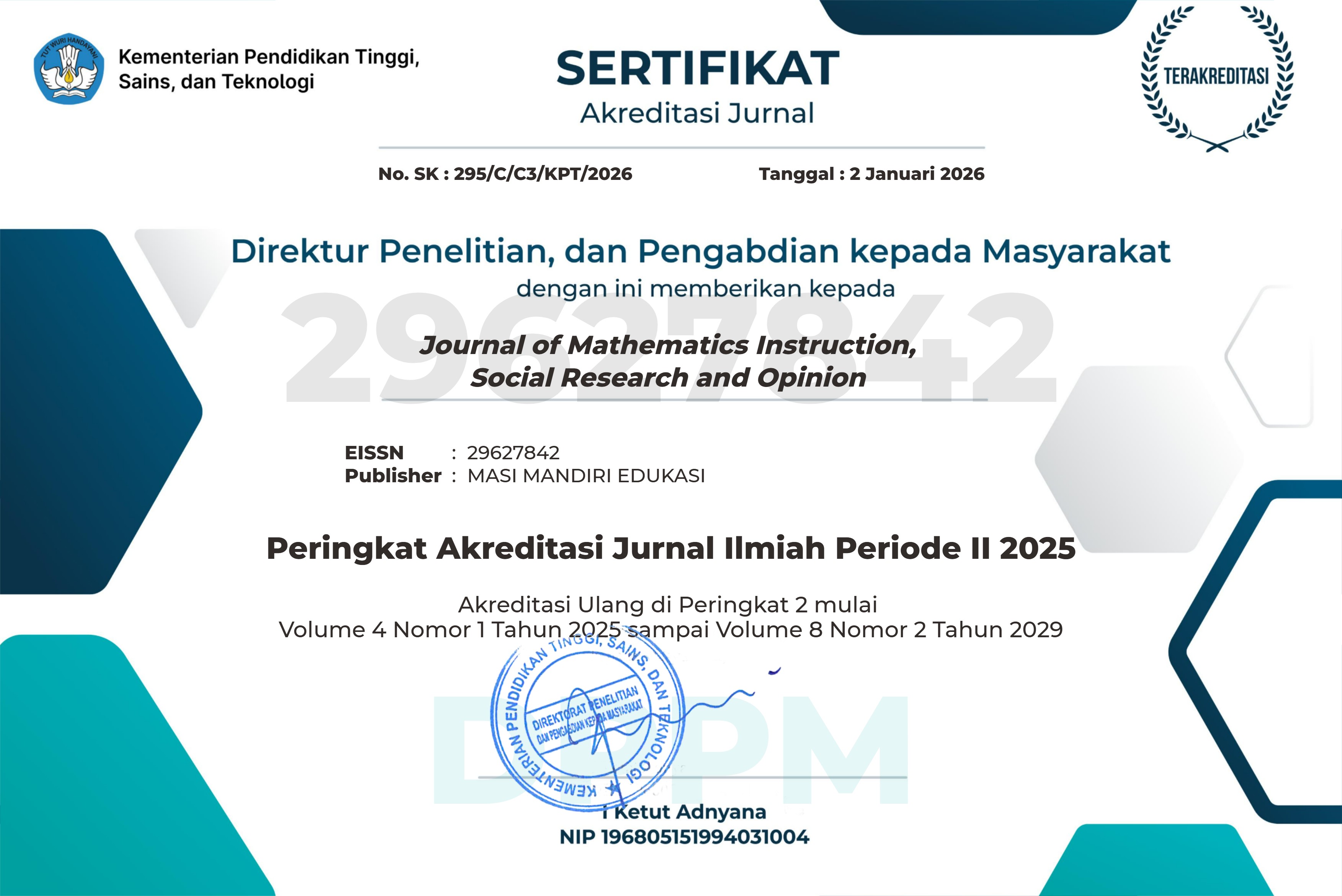
| Accreditation Certificate |
  |
| Indexing |






Contact Us

visitor
| Information |
>> For Authors
>> For Readers
>> For Librarians
| Visitor Statistics |
| Member of |


| Announcement |

| Keywords |
Mathematics Learning Difficulty Dyscalculia Teacher perceptions personality ICT Learning Computer teaching Academic Fisherfolks Economic Behavior Probit Models matrix mathematical model Concepts Guided Note Taking Golden Ratio Philosophy Integrated Learning van Hiele geometry Assessment Learning Outcomes method skills Problem Solving Experiment
| License |

MISRO is licensed under a Creative Commons Attribution-ShareAlike 4.0 International License.
| Publisher |

Address:
Jl. Gagak N0.105, Bandung,
Indonesia 40133
E-mail:
journalmisro@gmail.com
| in collaboration with |

| Recommended Tools |


| ISSN Barcode |

